



|
|
College of Engineering | |
|
COLLEGE OF ENGINEERING
<http://www.csupomona.edu/~engineering>
Edward C. Hohmann, Dean
Uei-Jiun Fan, Associate Dean
Rajan Chandra, Director, Graduate Studies and Research
Engineering is a dynamic profession that provides the expertise to meet the technical challenges facing the nation. Cal Poly Pomona's College of Engineering has a well-earned reputation of helping to meet these challenges by preparing engineers and engineering technologists who, upon graduation, are prepared to contribute to industry and are also ready for graduate studies. The emphasis on a strong theoretical background coordinated with early and significant laboratory experiences continues to make the college a leader in engineering education. In consultation with its many constituencies, the College of Engineering has adopted the following as its principal educational objectives:
* Preparation of graduates for immediate entry into the engineering profession, technically well-prepared in analysis and design, and understanding their professional responsibilities for contemporary and future human welfare
* Preparation of graduates as practicing engineers who communicate effectively, work collaboratively, learn independently and act ethically
* Adoption by graduates of life long learning, including formal advanced studies, as necessary for continued effectiveness in the profession
The College of Engineering provides study opportunities to undergraduate and graduate students in eleven disciplines, offering programs leading to Bachelor of Science degrees in:
Aerospace Engineering
Chemical Engineering
Civil Engineering
Computer Engineering
Electrical Engineering
Industrial Engineering
Manufacturing Engineering
Materials Engineering
Mechanical Engineering
Engineering Technology
Construction Engineering Technology
Electronics and Computer Engineering Technology
The programs each require 202 units for the Bachelor of Science degree.
In addition, the college offers individualized programs leading to the Master of Science degree in Electrical Engineering, Mechanical Engineering, Structural Engineering, and Engineering, with specializations in each of the engineering disciplines. A proposal to institute a new master's degree in Engineering Management is currently under review. Please check with the Graduate Studies Office in the College of Engineering for the planned date of implementation of the new program.
All undergraduate engineering programs, except the recently established ones in Materials Engineering and Computer Engineering, are accredited by the Engineering Accreditation Commission of the Accreditation Board for Engineering and Technology (ABET). The programs in Engineering Technology are accredited by the Technology Accreditation Commission of ABET. The address and phone number of ABET are:
The Accreditation Board for Engineering and Technology
111 Market Place, Suite 1050
Baltimore, MD 21202
(410) 347-7700
Each engineering curriculum is designed to give the student both an understanding of the fundamental principles of engineering as an applied science and the practical expertise to apply these principles to actual situations. In keeping with professional expectations, each engineering program incorporates these curricular areas into the educational experience: mathematics and basic sciences; engineering sciences and engineering design; and humanities and social sciences. Per ABET, accreditable engineering programs must demonstrate that their graduates have:
* an ability to apply knowledge of mathematics, science, and engineering,
* an ability to design and conduct experiments, as well as to analyze and interpret data,
* an ability to design a system, component, or process to meet desired needs,
* an ability to function on multi-disciplinary teams,
* an ability to identify, formulate, and solve engineering problems,
* an understanding of professional and ethical responsibility,
* an ability to communicate effectively,
* the broad education necessary to understand the impact of engineering solutions in a global and societal context,
* a recognition of the need for, and an ability to engage in life-long learning,
* a knowledge of contemporary issues, and
* an ability to use the techniques, skills, and modern engineering tools necessary for engineering practice.
It is important to distinguish between Engineering and Engineering Technology. Engineering Technology is that part of the technological field that requires the application of scientific and engineering knowledge and methods combined with technical skills in support of engineering activities; it lies in the occupational spectrum between the craftsman and the engineer. The engineering technologist is more specialized than the engineer, focusing on a technical specialty within an engineering discipline. Compared to the engineering curricula, there is less emphasis on basic science and mathematics and engineering science and more emphasis on skills and knowledge of existing technology related to design support; production; and equipment selection, modification, and service. Studies for a bachelor's degree in Engineering Technology include coursework in mathematics and basic sciences; technical sciences, specialties, and electives; and social sciences/humanities and communication.
As a result of Cal Poly Pomona's "learn by doing" environment, graduates of the college continue to be in great demand by industry in southern California, helping Cal Poly Pomona fulfill its mission of service to the people of California. Cal Poly Pomona's engineering curricula demand that students take computer programming and engineering orientation courses in the freshman year, and that mathematics, basic science, and general education courses begin concurrently. Throughout their educational programs students become adept at using both the university's computing facilities and the College's computer-aided engineering laboratory facilities as part of their regular coursework. Specific features of the curricula reflect the input of the college's Industry Action Councils, composed of over 200 leaders in local industry. Many of the engineering science and engineering design courses have laboratory components. Study of the ethical issues that confront those in the practice of engineering and the need for professional registration are an important part of the curriculum. In addition, many students pass the Fundamentals of Engineering Examination (FE) before they graduate.
Departments host chapters of national professional societies and/or honor societies appropriate to their disciplines. Honor societies include Tau Beta Pi (engineering), Tau Alpha Pi (technology), Sigma Gamma Tau (aerospace), Omega Chi Epsilon (chemical), Chi Epsilon (civil), Eta Kappa Nu (electrical), Alpha Pi Mu (industrial), and Pi Tau Sigma (mechanical). In addition, chapters of the following cross-disciplinary organizations are active: the Institute of Robotics Engineers; Society of Women Engineers; National Society of Black Engineers; Society of Hispanics in Science and Engineering; and the American Indian Science and Engineering Society.
A Partnership in Engineering Education
Recognizing that the professional education of students is a partnership of faculty, staff, administrators and students, the college has identified the responsibilities and obligations needed for this partnership to succeed. All students of the college obtain a copy of the college's policies and procedures from the website. The site is not meant as a substitute for the personal advising of students by faculty, but helps promote an understanding of the fundamental operating tenets on which engineering education at Cal Poly Pomona is based.
All students, faculty, and staff of the College of Engineering should know and understand both the academic policies of the college and the academic policies of the University as explained in the University Catalog. In many cases, the policies of the College of Engineering are rather strict interpretations of University policy, in keeping with the high standards that the faculty, students and the engineering profession as a whole expect of themselves.
Students in the college are expected to bring to this partnership:
* a willingness to learn and demonstrate their mastery of the subject material,
* an appropriate attitude regarding the seriousness of their studies, and
* an appreciation of the value of their education.
Throughout their academic careers in the college, they should acquire not only the expertise that can be learned in a classroom, but also an esteem for the profession, a maturity of manner, a respect for colleagues, and a credo to guide both personal and professional behavior. These qualities are what make a graduates of the Cal Poly Pomona's College of Engineering desirable.
Faculty bring to the partnership the experiences of having been students themselves and then having practiced in the profession, acquiring the expertise that only practice can perfect, and an eagerness to enthusiastically share this expertise with students. The faculty is committed to seeing students succeed. Excellence in the teaching/ learning enterprise is the primary goal of the faculty. It is the faculty of the College of Engineering that is primarily responsible for developing and maintaining an environment supportive of learning for each student and for encouraging each student to reach for and achieve the highest goals possible. Faculty members provide valuable academic advising, maintain the announced office hours, teach the stated content of each course, share their personal professional experiences and evaluate student performance fairly and consistently.
Additionally, the College of Engineering expects its students to display the intent and motivation to graduate and to achieve their stated degree objectives as optimally as possible. Operationally, the college has the same goals and offers the most intensive undergraduate curricula in the university as optimally as possible. It is only with the students, faculty and staff working hard together in the partnership, and with mutual respect, that the common goal of excellence in preparation for the engineering profession can be achieved.
Preparation For The Engineering Culture
Professional engineering practice has evolved through a millennia-long technological tradition and, as is true of other professions, now consists of a set of standardized characteristics and modes of behavior; it is a culture in an anthropological sense. This "Engineering Culture" has as its particular responsibility not only the maintenance and development of technical knowledge for the larger society, but also the codes of conduct and practice for the application of that knowledge within the larger society. It has its own language, its own operating principles, its own beliefs and its own credos, all of which are extensions of those of the larger society. The members of this culture assume the responsibility for the welfare of the larger society in technological matters, and are characterized by their advanced and unique analytical and constructive abilities.
The College of Engineering at California State Polytechnic University, Pomona has as its primary mission the preparation of students for entry into the engineering culture. The College recognizes the credo of the professional engineer and, as part thereof, that society's safety and well-being demand that engineering professionals practice their craft with diligence. As educators, the faculty knows that professional diligence mirrors personal diligence. Accordingly, the faculty of the College of Engineering, while subscribing to the academic policies of the university, also feels dutybound to expect their students and themselves to answer to the set of high academic standards corresponding to those of the engineering culture.
Hence, for students within the College of Engineering to successfully complete the curriculum efficiently, with pride and with maturity, they must not only have mastered technical knowledge and skills, but must also have been diligent in attending to the details of their individual progress through the program. Students must satisfy the bureaucratic details of their own program in a timely, well-planned manner. Students have the responsibility for their own progress and are expected to serve as their own primary advocates. Furthermore, engineering students are expected to be mature enough to accept and to deal with the consequences of their own actions and inactions.
Student Advocacy
The Dean's Office in the College of Engineering provides student advocacy services to students who are experiencing extraordinary personal challenges, have unusual situations requiring administrative intervention, or are facing serious dilemmas in their academic careers. Students should seek the help of this office only after discussing the situation with their faculty advisors. Student advocates are available to listen and talk with students, to provide feedback of value, to guide the student to other on-campus services available to them, and, in rare cases, to advocate on behalf of the student with faculty and administrators if appropriate. Student advocacy services are provided
* to assist students in honestly evaluating and facing their situations;
* to help students establish a realistic plan to achieve graduation, or consider new career directions; and
* to help students mature in accepting personal responsibility for their actions and inactions. Faculty advisors retain principal responsibility for academic advising; the college's student advocacy services supplement the faculty advising system.
MEP Maximizing Engineering Potential
Established in 1983, the Maximizing Engineering Potential program (MEP) at Cal Poly Pomona is a retention and academic enhancement program for students in Engineering and Computer Science. Its purpose is to increase the number and diversity of students graduating in technical disciplines. The Cal Poly Pomona MEP program is the largest program in the state of California. It has a long and successful record of graduating students and placing them in industry. The program has twelve specific service components designed to support student achievement, as well as assist in their personal and professional development. These service components include: pre-enrollment services, a summer transition program, orientation courses, academic excellence workshops, academic advisement, student professional development activities, study centers, student organizations, tutoring, summer and part-time job information, scholarships and incentive grants, and direct linkages to industry and company representatives.
Academic Excellence Workshops
Academic Excellence Workshops, administered through MEP, supplement certain foundation courses in chemistry, mathematics, physics, and engineering and are open by invitation only. Participants in MEP and SEES in the College of Science receive priority consideration. The Workshop program promotes technical excellence in the subject area while also developing communications skills and building an academic community under the guidance of a trained facilitator. An invitation to participate should be regarded as an honor and a unique opportunity.
Engineering Transfer Credit Policy
The Evaluations Office will not automatically give students credit for courses taken at other institutions in which they have received a "C" or less even if those courses articulate with core or support courses for the major. Students must request credit for those courses through the General Academic Petition process. Specific details about this policy are available from academic advisors and from engineering department offices.
General Education Requirements in the College of Engineering
Because of the high-unit nature of all curricula in the College of Engineering, the pattern of General Education course requirements is somewhat different than the "standard" pattern discussed earlier. The following table summarizes the GE requirements for each curriculum in the College of Engineering. Specific details are available from academic advisors and from department offices.
COLLEGE OF ENGINEERING MINORS
Students in consultation with the coordinator of the minor are to develop a program of study to meet undergraduate minor requirements. A "Request for Award of Minor" form will be completed towards the completion of the minor course work and indicated on a student's permanent record (transcript) upon achieving at least a 2.0 for all minor work completed. This form is available in departments which offer minors. The form must be turned in to the Registrar's Office for proper processing. Minors cannot be awarded subsequent to the granting of a bachelor's degree. All minors, consist of 24 or more quarter units, 12 of which must be upper division units. All 24 units must be taken outside of the major core requirements
ENERGY ENGINEERING MINOR
John R. Biddle, Coordinator of the Minor, Mechanical Engineering
William E. Mortensen, Aerospace Engineering
A. George Stoll, Chemical and Materials Engineering
Donald G. Wells, Civil Engineering
Alexander E. Koutras, Electrical and Computer Engineering
Farouk Darweesh, Industrial and Manufacturing Engineering
The purpose of this minor is to provide students in the programs of the College of Engineering and the Physics department of the College of Science a flexible, interdisciplinary program of study in the emerging and important field of energy engineering. The minor is designed to encourage engineering study and applied research directed toward society's energy needs. The multidisciplinary scope of the minor includes study of all energy sources (fossil, solar, geothermal, nuclear and others), energy conversion and transfer systems, efficient energy utilization (including conservation strategies) and environmental implications.
There is an increasing need for technically qualified and informed graduates in the utilization and development of new sources of energy for society. Currently there are many courses in the various engineering disciplines related to this field. By having these courses offered together in a minor program, the graduate will be able to emphasize this important technical area and be better able to accept meaningful technical positions in energy industries.
Completion of the following courses is required:
Thermodynamics ME 301 (4)
or Chemical and Materials Engineering
| Thermodynamics I | CHE | 302 | (4) |
| or Thermal Physics | PHY | 333 | (4) |
| Energy Management | ME | 306 | (4) |
| Alternative Energy Systems | ME | 307 | (4) |
The remainder of the 24 units required for the minor will be selected from:
| Air Pollution Control | ARO | 418 | (4) |
| Solid Waste Management | CE | 457 | (3) |
| Chemical Engineering Thermodynamics II | CHE | 303 | (4) |
| Pollution Abatement and Hazardous Matls. Mgmt | CHE | 432/433L | (4) |
| Ocean Engineering | EGR | 430 | (4) |
| Capital Allocation Theory | EGR | 403 | (4) |
| Control Systems Engineering | ECE | 309 | (4) |
| Thermodynamics | ME | 302 | (4) |
| Solar Thermal Engineering | ME | 407 | (4) |
| Nuclear Engineering | ME | 408 | (4) |
| Kinetic Theory/Statistical Thermodynamics | ME | 409 | (4) |
| Energy and the Environment | PHY | 340 | (4) |
| Advanced Nuclear Physics | PHY | 404 | (4) |
| Production Engineering I | MFE | 324L | (3) |
| Production Engineering II | MFE | 325L | (3) |
| Industrial Engineering Design | IE | 429L | (4) |
| Industrial Engineering Systems | IE | 437 | (3) |
ILLUMINATION ENGINEERING MINOR
David L. Clark, Coordinator of the Minor, Electrical and Computer Engineering
Kamran Abedini, Industrial and Manufacturing Engineering
Michael T. Shelton, Mechanical Engineering
The purpose of the minor in Illumination Engineering is to help meet the need for advanced lighting expertise in the state of California, both for professionals in the field and engineers who want to provide advanced expertise so sorely needed. Lighting is a significant part of the energy being used in the state. Training engineers with expertise in lighting will provide a healthy basis for the myriad of lighting applications where energy efficient designs and technologies are important. The minor is designed to be appropriate for students in the physical sciences and engineering and engineering technology. The required course in area V is an approved elective in all engineering disciplines.
Completion of one course from each of Areas I through IV and two courses from Area V is required with a minimum unit requirement of 24 units.
AREA I (Human Factors)
Fundamentals of Human Factors
Engineering/Laboratory IE 225/L (3/1)
AREA II (Optics/Light)
| General Physics/Laboratory | PHY | 234/234L | (3/1) |
| Applied Optics | PHY | 344 | (4) |
AREA III (Energy Conservation)
| Energy Management | ME | 306 | (4) |
| Applied Heating and Air Conditioning | ETM | 334 | (4) |
AREA IV (Lighting Design)
| Interior Design II | HE | 320/320A | (3/3) |
| Stage Lighting | TH | 332/L | (2/1) |
AREA V (Lighting Technology)
| Illumination Engineering (required) | ECE | 490/L | (4/1) |
| Lamp Design and Manufacture | MTE | 490 | (4) |
| Lighting Controls/Design | ECE | 492/L | (5) |
| Luminaries Design/Manufacture | IE | 490/L | (3/1) |
MATERIALS SCIENCE AND ENGINEERING MINOR
J. Winthrop Aldrich, Coordinator of the Minor, Chemical and Materials Engineering
William E. Mortensen, Aerospace Engineering
Phyllis Nelson, Electrical and Computer Engineering
Farouk Darweesh, Industrial and Manufacturing Engineering
Hassan M. Rejali, Mechanical Engineering
Materials Science and Engineering studies the relationships among the properties and performance of materials to their structures. The minor in Materials Science and Engineering is available to students who satisfactorily complete the 24-unit requirement. The minor is appropriate for all engineering and science majors.
The goal of the materials scientist is to understand and improve the properties of materials while that of the materials engineer is to apply this knowledge in the production, selection and utilization of materials. Since engineers or scientists are called upon to work with new ideas and materials, the broadly trained graduate has an ability to respond to such a challenge.
Students pursuing this minor are particularly encouraged to become active in the student chapters of ASM International and SAMPE.
Completion of the following courses is required:
| Materials Science and Engineering | MTE | 207 | (3) |
| or Engineering Materials. | ME | 315 | (4) |
| Materials Science and Engineering Lab | MTE | 317L | (1) |
| or Materials Science and Selection Lab | ME | 350L | (1) |
| Strength of Materials | ME | 218 | (3) |
| or Introduction to Structural Mechanics | ARO | 326 | (4) |
| Strength of Materials Lab | ME | 220L | (1) |
| or Aerospace Structures Lab | ARO | 357L | (1) |
Chemical and Materials Engineering
| Thermodynamics I | CHE | 302 | (4) |
| or Thermodynamics | ME | 301 | (4) |
| MTE electives | MTE | XXX | (11-12) |
OCEAN ENGINEERING MINOR
Uei-Jiun Fan, Coordinator of the Minor, Mechanical Engineering
Christopher L. Caenepeel, Chemical and Materials Engineering
Donald G. Wells, Civil Engineering
Dennis Fitzgerald, Electrical and Computer Engineering
Ocean Engineering is a cross-disciplinary field dealing with all aspects of the marine environment. Subjects emphasized include marine structures, marine vehicles, marine chemistry, marine ecology, coastal and marine engineering. The Ocean Engineering minor has access to the research facilities of the CSU Ocean Studies Institute (OSI) and the 80-foot Research Vessel YELLOWFIN. Cal Poly Pomona facilities include a fleet of general purpose and instrumented craft, and the Fluids Laboratory.
The minor in Ocean Engineering is available to any engineering student. The attainment of a minor in Ocean Engineering is accomplished by appropriate selection, timely scheduling, and satisfactory completion of certain required and elective-type courses, totaling a minimum of 24 units, as outlined below:
Completion of the following courses is required:
| Introduction to Ocean Engineering | EGR | 230 | (2) |
| Ocean Electronics | ECE | 434 | (4) |
| Ocean Engineering | EGR | 430 | (4) |
| Oceanography | GSC | 335 | (4) |
| Introduction to Marine Biology | BIO | 220 | (4) |
| or Marine Ecology | BIO | 442 | (5) |
The remainder of the 24 units required for the minor will be selected from:
| Underwater Sound | EGR | 437 | (4) |
| Special Study for UD Students | EGR | 400 | (1-2) |
| Special Topics | EGR | 499 | (1-4) |
| Corrosion Chemistry | CHM | 446 | (4) |
| or Corrosion and Material Degradation | MTE | 401 | (3) |
| Coastal Processes | GSC | 338 | (4) |
| Welding Fabrication and Design | MTE | 337 | (3) |
| Skin and Scuba Diving | PE | 231 | (3) |
DEPARTMENTS, MAJORS, MINORS, AND DEGREES
GRADUATE STUDIES
Rajan Chandra, Director
Master of Science in Engineering
Master of Science in Electrical Engineering
Master of Science in Mechanical Engineering
Master of Science in Structural Engineering
AEROSPACE ENGINEERING
William E. Mortensen, Chair
Bachelor of Science in Aerospace Engineering
CHEMICAL AND MATERIALS ENGINEERING
J. Winthrop Aldrich, Acting Chair
Bachelor of Science in Chemical Engineering
Bachelor of Science in Materials Engineering
CIVIL ENGINEERING
Donald P. Coduto, Chair
Bachelor of Science in Civil Engineering, options in General Civil Engineering, Environmental Engineering, and in Surveying Engineering
ELECTRICAL AND COMPUTER ENGINEERING
Kathleen Hayden, Chair
Bachelor of Science in Electrical Engineering
ENGINEERING TECHNOLOGY
Gerald K. Herder, Interim Chair
Bachelor of Science in Engineering Technology
Bachelor of Science in Construction Engineering Technology
Bachelor of Science in Electronics and Computer Engineering Technology
INDUSTRIAL AND MANUFACTURING ENGINEERING
Abdul B. Sadat, Chair
Bachelor of Science in Industrial Engineering
Bachelor of Science in Manufacturing Engineering
MECHANICAL ENGINEERING
Michael Shelton, Chair
Bachelor of Science in Mechanical Engineering
ENERGY ENGINEERING MINOR
John R. Biddle, Coordinator, Energy Engineering Committee
ILLUMINATION ENGINEERING MINOR
David L. Clark, Coordinator, Illumination Engineering Committee
MATERIALS SCIENCE AND ENGINEERING MINOR
J. Winthrop Aldrich, Coordinator, Materials Science and Engineering Committee
OCEAN ENGINEERING MINOR
Uei-Jiun Fan, Coordinator, Ocean Engineering Committee
COLLEGE OF ENGINEERING COURSES
All students in engineering and engineering technology curricula must satisfy ENG 104 prior to enrolling in any 300-level or higher course in the College of Engineering.
All EGR 500- and 600-level courses are listed in the graduate section of this catalog.
EGR 101L Laboratory Safety Orientation (1) (CR/NC)
Individualized introduction to the laboratories and shops of the College of Engineering and to the use and care of the equipment. Discussions and demonstrations of responsible and safe conduct. Discussion of fasteners, pipe and tube fittings, and electrical wiring. Safety test must be passed prior to credit being awarded. Credit is not applicable to a degree in the College of Engineering. 3 hours laboratory.
EGR 102L Laboratory Practices and Procedures (2) (CR/NC)
Instruction tailored to the needs of the individual student and includes safe practices and procedures. Intended for students requiring mechanical skills not acquired through the standard curricula. Projects require the use of laboratory and/or shop facilities. Credit is not applicable to a degree in the College of Engineering. 3 hours laboratory. Prerequisite: EGR 101/L or consent of the instructor.
EGR 110 Engineering Orientation (3)
Introduction to the resources of the College of Engineering; the expectations of the departments and the college; elementary problem-solving, including dimensional analysis; time management and study techniques required by technical majors. The first of a three-course sequence. Priority to students in the MEP program. 3 lectures/ problem-solving.
EGR 111/111A Engineering Career Exploration (1/1)
Introduction to the fields and career opportunities in engineering and computer science; expectations of first professional position; resume writing and interviewing techniques. Development of different engineering projects; building, testing, evaluating, and making presentations on results. The second of a three-course sequence. Priority given to students in the MEP program. 1 hour lecture, 1 two-hour activity.
EGR 112L Engineering Career Exploration II (1)
Introduction to the work environment in engineering and computer science via site visits. The third of a three-course sequence. Priority given to students in the MEP program. 1 three-hour lab.
EGR 120 Introduction to Engineering (4)
Role of engineers in society; career opportunities in engineering; use of mathematics and the physical sciences to solve engineering problems; the design process; use of computers in engineering applications. 4 lecture discussions. Prerequisite: high school course in College Algebra.
EGR 200 Special Study for Lower Division Students (1-2)
Individual or group investigation, research, studies or surveys of selected problems. Total credit limited to 4 units, with a maximum of 2 units per quarter.
EGR 210 Engineering Orientation for Transfer Students (2)
Introduction to the resources of the College of Engineering and the campus, as well as the expectations of the faculty in the majors/departments. Professional development, presentations, time management as required by technical majors in a quarter system school. Priority to students in the Maximizing Engineering Potential (MEP) program. 2 lectures/problem-solving. Prerequisite: MAT 116 or MAT 132 or equivalents.
EGR/ENV/CLS 215 Introduction to Interdisciplinary GIS Studies (2)
Interdisciplinary overview of applications in geographic information system (GIS) applications. Diagnostic assessment of student skills and development of study plans. Linkage of GIS to various disciplines. 2 hours lecture/discussion.
EGR 230 Introduction to Ocean Engineering (2)
Instruction in boat safety, nautical Rules of the Road, coastal navigation, and boat handling; operation in coastal ocean waters using Cal Poly Pomona's trailerable boats with 3D sonar systems and other equipment. 2 lectures/problem-solving. Prerequisite: consent of instructor.
EGR 302/302A Visual Basic for Geographic Information Systems (3/1)
Logical methods and techniques in algorithm development. The Visual Basic environment and Visual Basic programming. Structure of object oriented programs. Concept of class organization and manipulation. Programming Geographical Information Systems (GIS) related algorithms using Visual Basic and their integration in the GIS environment. 3 hours lecture/2 hour activities. Pre-requisite: MAT106 or STA120.
EGR 299/299A/299L Special Topics for Lower Division Students (1-4)
Group study of a selected topic, the title to be specified in advance. Total credit limited to 8 units, with a maximum of 4 units per quarter. Instruction is by lecture, laboratory, or a combination. Prerequisite: consent of instructor.
EGR 301 The Search for Solutions (4)
A study of the development of society using technology as the prime indicator of the maturing of civilizations. Expansion of the theme that technology has been and continues to be central to society's advances, satisfying life-support demands, and allowing the arts to develop. Discussion of the growth of technology and factors guiding its future growth. 4 lecture discussions. Prerequisites: ENG 104 or equivalent, completion of General Education Areas B1, B2, and B3 requirements.
EGR 400 Special Study for Upper Division Students (1-2)
Individual or group investigation, research, studies or surveys of selected problems. Total credit limited to 4 units, with a maximum of 2 units per quarter. Prerequisite: ENG 104 or equivalent.
EGR 402 Ethical Considerations in Technology and Applied Science (4)
This course is team taught by an engineering instructor and a philosophy instructor. Explores the ethics of engineers: values, ethical theory and practice, moral reasoning morality in law and codes, professional standards and societies. Case studies. Prerequisites: One GE course from each of the following Sub-areas: A1, A2, A3 and B2, B3 and C2. Interdisciplinary GE Synthesis
EGR 403 Asset Allocation in Technical Decision Making (4)
Economic theory of capital allocation decisions. Current and relevant views of managerial economics used to present a unified theory of capital allocation appropriate to private, public and governmental entities. Integrated application of economic and operations analysis to managerial problem-solving and decision making processes. Study of inflation and tax consequences on economic decisions. Open to all majors. Four 1-hour lecture discussions. Prerequisites: Completion of GE Area A and sub-areas B1, B2, B3, and D1, D2, D3. Fulfills GE Interdisciplinary Synthesis sub-area B4 or D4.
EGR 430 Ocean Engineering (4)
The engineering major is acquainted with the wide variety of physical and other factors involved when carrying out engineering tasks associated with the marine environment. Working cruises are made in the 80- foot R/V YELLOWFIN. Topics covered include: ocean and harbor wave actions; ocean basins, currents, and tides; ocean chemistry and physical characteristics; marine biology and fouling; wave and wind loads; ocean energy sources; deep ocean mining and drilling; navy ship systems, surface craft, remotely operated vehicles; marine corrosion, preservation; icing, thermal factors; shock, vibration; human factors; engineering requirements and documentation. 4 lectures/problem-solving. Prerequisites: ENG 104 or equivalent, upper division standing in the College of Engineering or consent of the instructor.
EGR 437 Underwater Sound (4)
Principles of underwater sound propagation and reception. The sonar equation. Transducer design and calibration. 4 lectures/problem-solving. Prerequisite: ENG 104 or equivalent, upper division standing and permission of instructor.
EGR/SCI 460 Problems in Oceanographic Studies (3-5)
Course offered in conjunction with the CSU Ocean Studies Institute (OSI). Topics vary each term. May be repeated as needed. Prerequisites: ENG 104 or equivalent, upper division standing and permission of instructor.
EGR 461, 462, 463 Engineering Interdisciplinary Clinic I, II, III (3), (3), (3)
Collaborative efforts among the College of Engineering and external clients. Interdisciplinary teams of students, faculty, consultants, and client liaisons develop a project plan that must be implemented. Project results are reported to clients in formal and written reports. Credit for the entire sequence EGR 461, 462, and 463 substitutes for senior project and seminar. Prerequisites: ENG 104 or equivalent, consent of instructor and the student's department chair.
EGR 470, 471, 472, 473 Cooperative Education (2-4 each)
Four quarters of full-time industry work experience of a nature that relates academic engineering theory to practice. Prerequisites: ENG 104 or equivalent, junior standing and approval of department co-op coordinator.
EGR/EIS/SCI 475 Beyond Curie: Women in Math, Science, and Engineering (4)
Social implications and history of the contribution of women in math, science, and engineering. Examination of how socially defined identities affected the careers of female scientists. Combined with examination of current and specific topics in mathematics, science, and engineering. 4 hours seminar. Prerequisites: One course from each of the following Sub-areas: A1, A2, A3 and B1, B2, B3 and D1, or D2, and D3. Interdisciplinary GE Synthesis Course for Sub-area B4 or D4.
AG/BUS/EGR/SCI 481, 482 Project Design Principles and Applications (2) (2)
Selection and completion of scientific/technological synthesis application project under faculty supervision. Multidisciplinary team project. Projects which graduates solve in discipline of practice. Both formal written and oral reports. Minimum time commitment: 120 hours. Prerequisites: One GE course from each of the following Sub-areas: A1, A2, A3 and B1, B2, B3 and upper division standing and consent of instructor. GE Synthesis course for Sub-area B4.
AG/EGR/SCI 484 Science and Technology Seminar (4)
Issues to be explored will include, but not be limited to: the impact of science and technology on civilization and human values; ecological issues; history of science and technology; scientific method and reasoning; heath and diseases; medical technology and its ethical implications; general systems theory and its application. Prerequisites: One GE course from each of the following Sub-areas: A1, A2, A3 and B1, B2, B3. GE Synthesis course for Sub-area B4.
EGR/ENV/CLS 494/A Interdisciplinary Project in Geographic Information Systems I (1/1)
Problem-solving skills using GIS technology in a Fall/Winter/Spring sequence. Students design, manage and develop GIS projects in an interdisciplinary setting. Issue related to ethics, decision making, interdisciplinary applications and the visual display of information are addressed. 1 lecture discussion, 2 hours activity.
EGR/ENV/CLS 495/A Interdisciplinary Project in Geographic Information Systems II (1/1)
Problem-solving skills using GIS technology in a Fall/Winter/Spring sequence. Students design, manage and develop GIS projects in an interdisciplinary setting. Issue related to ethics, decision making, interdisciplinary applications and the visual display of information are addressed. 1 lecture discussion, 2 hours activity. Pre-requisite: EGR/ENV/CLS 494/A.
EGR/ENV/CLS 496/A Interdisciplinary Project in Geographic Information Systems III (1/1)
Problem-solving skills using GIS technology in a Fall/Winter/Spring sequence. Students design, manage and develop GIS projects in an interdisciplinary setting. Issue related to ethics, decision making, interdisciplinary applications and the visual display of information are addressed. 1 lecture discussion, 2 hours activity. Pre-requisite: EGR/ENV/CLS 495/A.
EGR 499/499A/499L Special Topics for Upper Division Students (1-4)
Group study of a selected topic, the title to be specified in advance. Total credit limited to 8 units, with a maximum of 4 units per quarter. Instruction is by lecture, laboratory or a combination. Prerequisites: ENG 104 or equivalent, permission of instructor.
AEROSPACE ENGINEERING
<http://www.aro.csupomona.edu/>
William E. Mortensen, Chair
Ali R. Ahmadi
Donald L. Edberg
Gabriel G. Georgiades
The goals of the Aerospace Engineering program are:
* to educate those who will succeed at entry level positions in the Aerospace industry and succeed in national graduate programs;
* to exemplify the linking of theoretical and practical knowledge; and
* to provide service to the profession.
Traditionally the aerospace engineer has been involved with the design and development of high speed vehicles such as aircraft, missiles and spacecraft. In recent years this list has evolved to include ocean vessels and high speed land vehicles as well. The extreme environments in which these vehicles operate have dictated the construction of the most complex engineering systems devised by humans and require integration and application of such disparate fields as fluid mechanics and thermodynamics, structural mechanics, control system theory and vehicle dynamics. Often the aerospace engineer is confronted with problems that cannot be fully defined but, in spite of this, require imaginative and sophisticated solutions.
This accredited program aims to:
* provide students with a comprehensive education that includes in-depth instruction in aerodynamics, aircraft and spacecraft structures, flight mechanics, orbital mechanics, flight propulsion, and design of aerospace systems;
* provide adequate laboratory experience and independent study opportunities; and
* prepare students for careers in aerospace engineering by emphasizing analysis and problem-solving, exposure to open-ended problems and design issues while fostering teamwork, communication skills, and individual professionalism.
Students desiring to major in Aerospace Engineering should have a particularly high aptitude for science and mathematics, and incoming freshmen should have taken substantial college preparatory courses in these disciplines in high school. Incoming transfer students should have completed at least one year of college calculus and one year of college physics (with laboratory) prior to beginning the program at Cal Poly Pomona. The community college student planning to transfer into this department should consult a school counselor or department to determine which courses meet the program requirements.
Graduates of the program will have:
* an understanding of physics, chemistry and mathematics sufficient to address real world engineering problems;
* an understanding of engineering science fundamentals that enables them to examine real world engineering problems for the underlying physical principles and decide on appropriate methods of solution;
* the ability to analyze and design aerospace structural elements;
* the ability to perform aerodynamic analysis;
* the ability to analyze air-breathing propulsion systems;
* the ability to analyze the flight dynamics of aircraft and spacecraft and design flight control systems;
* the ability to analyze spacecraft trajectories;
* the ability to work in teams and design complex systems such as aircraft and spacecraft from a conceptual design perspective;
* good oral, written and graphic communications skills; and
* an understanding of the role of the engineer in society and an awareness of ethical, environmental and quality concerns of the engineering profession.
Aerospace engineering students are encouraged to become active in the student branch of the American Institute of Aeronautics and Astronautics, a national society organized for the advancement of aerospace knowledge. Qualified students are invited to join the student chapter of Sigma Gamma Tau, the aerospace engineering honor society.
CORE COURSES FOR MAJOR
Required of all students. A 2.0 cumulative GPA is required in core courses for the major in order to receive a degree in the major.
| Introduction to Aerospace Engineering I | ARO | 101A | (1) |
| Introduction to Aerospace Engineering II | ARO | 102A | (1) |
| Introduction to Aerospace Engineering III | ARO | 103A | (1) |
| Aerospace Engineering Computer Graphics/Lab | ARO | 127L | (2) |
| Fundamentals of Systems Engineering | ARO | 201L | (1) |
| Fundamentals of Aeronautics | ARO | 202L | (1) |
| Fundamentals of Astronautics | ARO | 203L | (1) |
| Fluid Mechanics | ARO | 301 | (4) |
| Subsonic Aerodynamics | ARO | 305 | (4) |
| Astronautics | ARO | 309 | (3) |
| Gas Dynamics | ARO | 311 | (3) |
| Aerospace Propulsion Systems | ARO | 312 | (4) |
| Aerospace Feedback Control Systems | ARO | 322/L | (4) |
| Introduction to Structural Mechanics | ARO | 326 | (4) |
| Aerospace Structural Mechanics | ARO | 327 | (3) |
| Aerospace Structural Analysis and Design | ARO | 329 | (3) |
| Fluid Mechanics/Heat Transfer Lab | ARO | 351L | (1) |
| Aerodynamics and Propulsion Lab | ARO | 352L | (1) |
| Aerospace Structures Laboratory | ARO | 357L | (1) |
| Heat, Mass and Moment Transfer | ARO | 401 | (4) |
| High-Speed Aerodynamics | ARO | 404 | (3) |
| Aerovehicle Stability and Control | ARO | 405 | (4) |
| Dynamics of Aerospace Systems | ARO | 406 | (4) |
| Senior Project | ARO | 461 | (2) |
| Senior Project | ARO | 462 | (2) |
| Aerospace Concepts Integration | ARO | 490L | (1) |
| Introduction to Vehicle Design | ARO | 491L | (2) |
| Vehicle Design Lab I | ARO | 492L | (2) |
| Vehicle Design Lab II | ARO | 493L | (2) |
Advisor Approved Electives (12)
SUPPORT AND ELECTIVE COURSES
(Required of all students)
| Analytic Geometry and Calculus II | MAT | 115 | (4) |
| Analytic Geometry and Calculus III | MAT | 116 | (4) |
| Calculus of Several Variables | MAT | 214 | (3) |
| Calculus of Several Variables | MAT | 215 | (3) |
| Differential Equations | MAT | 216 | (4) |
| Laplace Transform and Fourier Series | MAT | 317 | (3) |
| Mathematical Analysis of Engineering Problems | MAT | 318 | (3) |
| Materials Science | MTE | 207 | (3) |
| General Physics | PHY | 131 | (3) |
| General Physics | PHY | 132/L | (4) |
| General Physics | PHY | 133/L | (4) |
| Elements of Electrical Engineering/Lab | ECE 231/251L | (4) | |
| Vector Statics | ME | 214 | (3) |
| Vector Dynamics | ME | 215 | (4) |
| CME Thermodynamics I | CHE | 302 | (4) |
GENERAL EDUCATION COURSES
An alternate pattern from that listed here for partial fulfillment of Areas A, C, and D available for students in this major is the Interdisciplinary General Education (IGE) Program. Please see the description of IGE elsewhere in this catalog.
Area A (12 units)
| 1. Freshman English I | ENG | 104 | (4) |
| 2. Advocacy and Argument | COM | 204 | (4) |
| 3. Freshman English II | ENG | 105 | (4) |
Area B (16 units)
| 1. Analytic Geometry and Calculus I | MAT | 114 | (4) | |
| 2. General Chemistry/Lab | CHM | 121/121L | (4) | |
| and General Physics Lab | PHY | 131L | (1) | |
3. Biological Sciences (3)
4. Science and Technology Synthesis (4)
Area C (16 units)
1. Fine and Performing Arts (4)
2. Introduction to Philosophy PHL 201 (4)
3. Literature and Foreign Languages (4)
4. Humanities Synthesis (4)
Area D (20 units)
| 1. | Introduction to American Government | PLS | 201 | (4) | |
| and United States History | HST | 202 | (4) | ||
| 2. | Principles of Economics | EC | 202 | (4) | |
| 3. | Political Sociology | SOC/PLS | 390 | (4) | |
| 4. | Social Science Synthesis | (4) | |||
Area E (4 units)
General Psychology PSY 201 (4)
All underlined courses satisfy both major and GE requirements.
COURSE DESCRIPTIONS
All students in engineering and engineering technology curricula must satisfy ENG 104 prior to enrolling in any 300-level or higher course in the College of Engineering.
ARO 101A Introduction to Aerospace Engineering I (1)
Aircraft theme. History of aircraft development; characteristics of current aircraft. Contributions of aerospace engineering to society. Generation of lift. Stress in aircraft structures. Preliminary aircraft sizing. 1 two-hour activity. Corequisite: MAT 114 or mathematics course preliminary to MAT 114.
ARO 102A Introduction to Aerospace Engineering II (1)
Spacecraft theme. History of spacecraft development; characteristics of current spacecraft. The role of the aerospace engineer in industry, government and the university. Trajectories and orbits. Spacecraft structures and materials. Satellite configuration. 1 two-hour activity. Corequisite: MAT 114 or mathematics course preliminary to MAT 114.
ARO 103A Introduction to Aerospace Engineering III (1)
Propulsion theme. History of aircraft engine and rocket development; characteristics of current aircraft and rocket engines. Ethical factors, standards and expectations in aerospace engineering. Generation of thrust. Structure of propulsion systems. Materials for propulsion systems. Propulsion system performance. 1 two-hour activity. Corequisites: MAT 114 or mathematics course preliminary to MAT 114.
ARO 127L Aerospace Engineering Computer Graphics/Laboratory (2)
Computer-aided graphics and engineering design fundamentals. Sketching, line drawing, dimensioning, simple wire frame, solid modeling and projection theory. Airplane general arrangement, layout, and inboard profile drawings. Use of AUTOCAD. 2 three-hour laboratories.
ARO 201L Fundamentals of Systems Engineering (1)
History and purpose of systems engineering. Needs analysis; consideration of social, economic and environmental factors. System-design process. Role of the engineer in system design. Program planning and control. Engineering documentation. System-design exercise. 1 three-hour laboratory. Prerequisites: ENG 104 or equivalent. Corequisite: ARO 101A.
ARO 202L Fundamentals of Aeronautics (1)
Aircraft manufacturing methods. Aerodynamic drag. Aircraft controls and piloting techniques. Aircraft performance. Aeroelasticity concepts. Preliminary aircraft structural design. 1 three-hour laboratory. Prerequisite: C or better in ARO 101A. Corequisite: MAT 115.
ARO 203L Fundamentals of Astronautics (1)
Spacecraft manufacturing methods. Spacecraft mission analysis. Spacecraft guidance and control techniques. Booster design. Boost and reentry trajectory simulation. Problems of hypersonic flight. 1 three-hour laboratory. Prerequisite: C or better in 102A. Corequisite: MAT 116.
ARO 299/299A/299L Special Topics for Lower Division Students (1-4)
Group study of a selected topic, the title to be specified in advance. Total credit limited to 8 units, with a maximum of 4 units per quarter. Instruction is by lectures/problem-solving, laboratory, or a combination. Prerequisite: permission of instructor.
ARO 301 Fluid Mechanics (4)
Properties of the continuum. Control volume and control surface concepts. Inertial and non-inertial systems. Potential flow theory. Development and application of the Navier-Stokes equations. Boundary layer theory. 4 lectures/problem-solving. Prerequisites: ENG 104 or equivalent, C or better in MAT 216 and ME 215. Corequisite: MAT 318.
ARO 305 Subsonic Aerodynamics (4)
Chordwise and spanwise wing-loading. Pressure, induced, and skin friction drag. Drag polars. Blade element theory. Helicopter rotor aerodynamics. Fuselage aerodynamics. Performance (energy methods); steady flight, accelerated flight, take-off and landing. 4 lectures/ problem-solving. Prerequisite: ENG 104 or equivalent, C or better in ARO 301.
ARO 309 Astronautics (3)
Space Environment. Mission design environment. Propulsion. Spacecraft attitude control. Thermal control. Configuration and structural design of space vehicles. 3 lectures/problem-solving. Prerequisites: ENG 104 or equivalent, C or better in ME 215.
ARO 311 Gas Dynamics (3)
Thermodynamic processes. One-dimensional flow, area change, friction heat addition. Normal and oblique shock waves. Nozzle and diffuser theory. Boltzmann distribution; microscopic description of gases; microstates; partition function; properties of high temperature gases. 3 lectures/problem-solving. Prerequisites: ENG 104 or equivalent, C or better in ARO 301.
ARO 312 Aerospace Propulsion Systems (4)
Systems analysis of the fuel burning performance of aircraft powerplants. Aerothermodynamics of inlets, combustors and nozzles. Cycle analysis. Turbomachines. Emphasis on turboprop, turbojet, turbofan, and ramjet. 4 lectures/problem-solving. Prerequisites: ENG 104 or equivalent, C or better in ARO 311.
ARO 322/L Aerospace Feedback Control Systems/Laboratory (3/1)
Mathematical models of systems. Feedback control systems: characteristics, performance, stability. Root locus method. Frequency response methods. Stability in the frequency domain. Time domain analysis. Design and compensation of aerospace feedback control systems. 3 lectures/problem-solving; 1 three-hour laboratory. Prerequisites: ENG 104 or equivalent, C or better in MAT 317.
ARO 326 Introduction to Structural Mechanics (4)
Concepts of stress and strain. Transformation equations and Mohr's Circle. Mechanical properties of aerospace materials. Elastic stress-strain relations. Analysis of stress and deformation in members subject to axial, torsional, bending, shearing and combined loading. Statically indeterminate analysis. 4 lectures/problem-solving. Prerequisites: ENG 104 or equivalent, C or better in ME 214.
ARO 327 Aerospace Structural Mechanics (3)
General loads on aircraft, inertia forces and load factors, V-n diagrams. Membrane stresses in pressure vessels. Shear flow in open and closed thin-walled sections. Bending and shear stresses in beams with unsymmetrical cross-sections. Principles and analysis of stressed skin construction. 3 lectures/problem-solving. Prerequisites: ENG 104 or equivalent, C or better in ARO 326.
ARO 328 Aerospace Structures (4)
Aerospace structural analysis in the design process. Semi-monocoque structures. Energy methods in structural analysis. 4 lectures/problem-solving. Prerequisites: ENG 104 or equivalent, C or better in ARO 327.
ARO 329 Aerospace Structural Analysis and Design (3)
Work and energy methods. Numerical analysis and introduction to the finite element method. Thin plate theory and structural stability. Elastic and aeroelastic instabilities. Design of Aerospace structures. 3 lectures/problem-solving. Prerequisites: ENG 104 or equivalent, C or better in ARO 327.
ARO 351L Fluid Mechanics and Heat Transfer Laboratory (1)
Selected experiments concerning the fundamentals of incompressible fluid mechanics and conduction, convection, and radiation heat transfer. 1 three-hour laboratory. Prerequisites: ENG 104 or equivalent, C or better in ARO 301, 305. Corequisite: ARO 401.
ARO 352L Aerodynamics and Propulsion Laboratory (1)
Selected experiments in low-speed aerodynamics, gas dynamics, high-speed aerodynamics and propulsion using subsonic and supersonic wind tunnels. 1 three-hour laboratory. Prerequisites: ENG 104 or equivalent, C or better in ARO 305, ARO 311. Corequisite: ARO 312, ARO 404.
ARO 357L Aerospace Structures Laboratory (1)
Experimental stress analysis of structures subject to axial, torsional, bending, shearing and combined loading. Statically indeterminate structures. Application of the electrical resistance strain gage and photoelastic methods. Technical communication and engineering report writing. 1 three-hour laboratory. Prerequisites: ENG 104 or equivalent, C or better in ARO 327.
ARO 400 Special Study for Upper Division Students (1-2)
Individual or group investigation, research, studies or surveys of selected problems. Total credit limited to 4 units, with a maximum of 2 units per quarter.
ARO 401 Heat, Mass and Momentum Transfer (4)
Transport properties. Transfer of momentum and energy in laminar and turbulent boundary layers. Energy transfer by conduction, convection and radiation. Heat exchangers. Solar radiation. Mass transfer, molecular diffusion. 4 lectures/problem-solving. Prerequisites: ENG 104 or equivalent, C or better in ARO 301.
ARO 402 Numerical Methods (4)
Numerical methods in engineering. Algorithms. Interpolating polynomials, difference formulas, numerical differentiation and integration. Matrix methods. Non-linear systems. Solution of differential equations. Applications to engineering problems. 4 lectures/problem-solving. Prerequisites: ENG 104 or equivalent, C or better in MAT 216, working knowledge of high-level computer language.
ARO 404 High-Speed Aerodynamics (3)
Effects of compressibility; two-dimensional and conical supersonic flow fields; similarity concepts; solution of wave equations; shock expansion theory. 3 lectures/problem-solving. Prerequisites: ENG 104 or equivalent, C or better in ARO 311.
ARO 405 Aerospace Vehicle Stability and Control (4)
Airplane equations of motion. Stability derivatives. Static Stability. Airplane controls. Dynamic stability. Transfer functions. Airplane response and simulation. Flying qualities. 4 lectures/problem-solving. Prerequisites: ENG 104 or equivalent, C or better in ARO 305, 322.
ARO 406 Dynamics of Aerospace Systems (4)
Three-dimensional vector dynamics of aerospace systems; linear and angular momentum; Lagrangian dynamics; method of Euler; introduction to space vehicle motion. 4 lectures. Prerequisites: ENG 104 or equivalent, C or better in ME 215, MAT 318.
ARO 407 Flight Dynamics (4)
Three dimensional rigid body motion methods of Newton and Lagrange. Euler transformations. Performance analysis of aircraft, missiles and spacecraft. 4 lectures/problem-solving. Prerequisites: ENG 104 or equivalent, C or better in ARO 305, 406, MAT 317.
ARO 408 Introductory Finite Element Structures (4)
Matrix operations. Stiffness and flexibility methods. Finite element properties. Computer applications. 4 lectures/problem-solving. Prerequisites: ENG 104 or equivalent, C or better in ARO 327.
ARO 409 Astrodynamics (4)
Space environment. Kepler's laws of motion and satellite orbits, orbital transfers. Space vehicle motion, de-spinning of satellites. Performance and optimization of single and multistage rocket. 4 lectures/problem-solving. Prerequisites: ENG 104 or equivalent, C or better in ARO 406.
ARO 412 Wing Theory (4)
Potential flow theory. Complex mappings; Kutta-Joukowski transformation. Chordwise pressure distributions; thin airfoil theory. Sectional force and moment coefficients. Symmetric and asymmetric spanwise loading; basic and additional lift effects. Twist. Wing force and moment coefficients. High lift devices. 4 lectures/problem-solving. Prerequisites: ENG 104 or equivalent, C or better in ARO 305.
ARO 414 Rocket Propulsion Systems (4)
Principles of rocket propulsion. Combustion chemistry. Liquid-fuel rocket engines. Solid-fuel rocket engines. Electrical propulsion. 4 lectures/ problem-solving. Prerequisites: ENG 104 or equivalent, C or better in ARO 311.
ARO 418 Air Pollution Control (4)
Application of engineering concepts to atmospheric pollution problems. Combustion. Reaction kinetics. Diffusion. Atmospheric emissions; particulate, gaseous. Atmospheric boundary layer. Plume rise. Photochemical smog. Control concepts. Air quality modeling. 4 lectures/ problem-solving. Prerequisites: ENG 104 or equivalent, C or better in ARO 301, CHE 302.
ARO 419 Computational Fluid Dynamics (4)
Development of numerical techniques for the solution of partial differential equations that arise in fluid mechanics gas dynamics and heat transfer; classification of equations, methods of solutions; examples. 4 lectures/problem-solving. Prerequisites: ENG 104 or equivalent, C or better in ARO 301 and a working knowledge of a high-level computer language and graphics. Corequisite: ARO 311.
ARO 420 Introduction to Engineering Management (4)
Elements of management. Organization of corporations, engineering groups, and government agencies. Utilization of marketing and internal research funds. Program management. Participative management. Managing technical personnel. Career enhancement. 4 lectures/problem-solving. Prerequisite: ENG 104 or equivalent.
ARO 421 Helicopter Aerodynamics(4)
The development of rotary-wing aircraft and the helicopter. Review of blade element/momentum theory; hovering and vertical flight theory; autorotation; performance in forward flight. 4 lectures/problem-solving. Prerequisites: ENG 104 or equivalent, C or better in ARO 305.
ARO 422 Advanced Aerospace Control Systems (4)
Review of classical controls. Control system design. Compensators. Nonlinear systems. Describing functions. 4 lectures/problem-solving. Prerequisites: ENG 104 or equivalent, C or better in ARO 322.
ARO 426 Aerospace Surface Systems (4)
Aerospace fundamentals of high speed surface systems. Station-to-station concepts. Air cushion and tubeflight systems. Airload determination. Drag reduction. Propulsion systems and braking. Guideway considerations. Stability and control. 4 lectures/problem-solving. Prerequisites: ENG 104 or equivalent, C or better in ARO 301.
ARO 427 Aeroacoustical Noise (4)
Scales and units of noise measurement. Sources and characteristics of aircraft noise. Traffic and vehicular noise. Airport noise. Noise abatement; aircraft, road vehicles, airports, highways. Sonic boom effects. 4 lectures. Prerequisites: ENG 104 or equivalent, C or better in CHE 302.
ARO 431 Intermediate Finite Element Structures (4)
Structural dynamics, structural stability and advanced elements in the finite element method. Basic theory will be augmented strongly by computer applications. 4 lectures/problem-solving. Prerequisites: ENG 104 or equivalent, C or better in ARO 408.
ARO 435L Experimental Techniques in Aerodynamics (2)
Test plan formulation. Pressure, temperature and force measurement. Test section calibration and correction. Subsonic and supersonic wind tunnel applications. 2 three-hour laboratories. Prerequisites: ENG 104 or equivalent, C or better in ARO 305, 311.
ARO 436 Mechanics of Composite Materials (4)
Mechanical behavior of composite materials. Stress/strain relations in anisotropic materials. Strength criteria and stiffness. Interlaminar stresses. Systems applications. Bending, buckling and vibration of laminated plates. 4 lectures/problem-solving. Prerequisites: ENG 104 or equivalent, C or better in ARO 327.
ARO 461, 462 Senior Project (2) (2)
Selection and completion of an aerospace engineering project, including a literature search and use of one or more of the following approaches: theoretical, computational or experimental. Project results presented in a final, formal individual report. Project to be arranged by the student with an appropriate Aerospace Engineering faculty member who is the project supervisor. Minimum of 120 hours total time. Prerequisites: ENG 104 or equivalent, consent of instructor.
ARO 490L Aerospace Concepts Integration (1)
Review and integration of basic principles of aerodynamics, propulsion, vehicle dynamics, and structures for application in the conceptual and preliminary design of aerospace vehicles. I three-hour laboratory. Co-requisite: ARO 491L
ARO 491L Introduction to Vehicle Design Laboratory (2)
Design philosophy. Ethics. Environmental considerations. Trade-off studies. Manufacturing, facilities, cost. Aircraft, spacecraft, ground vehicles. 2 three-hour laboratories. Prerequisites:ENG 104 or equivalent, C or better in ARO 305, ARO 309, ARO 329, ARO 404. Corequisite: ARO 405.
ARO 492L Vehicle Design Laboratory I (2)
Conceptual and preliminary design of vehicles. Design tradeoffs in multi-disciplined systems. Verbal and written presentations of system design. 2 three-hour laboratories. Prerequisites: ENG 104 or equivalent, completion of all required 300-level engineering courses and C or better in ARO 401, 405, 406, and 491L.
ARO 493L Vehicle Design Laboratory II (2)
Completion of ARO 492L design project. Preparation of final report on the project together with an oral briefing to an industrial review panel. 2 three-hour laboratories. Prerequisites: ENG 104 or equivalent, C or better in ARO 492L.
ARO 499/499A/499L Special Topics for Upper Division Students (1-4)
Group study of a selected topic, the title to be specified in advance. Total credit limited to 8 units, with a maximum of 4 units per quarter. Instruction is by lecture, laboratory, or a combination. Prerequisites: ENG 104 or equivalent, consent of instructor.
CHEMICAL AND MATERIALS ENGINEERING
<http://www.csupomona.edu/~chemmat>
J. Winthrop Aldrich, Acting Chair
J. Winthrop Aldrich Thuan K. Nguyen
Christopher L. Caenepeel Cordelia Ontiveros
Winny Dong K. Hing Pang
Barbara A. Hacker Vilupanur A. Ravi
Edward C. Hohmann A. George Stoll
The Department of Chemical and Materials Engineering is actively pursuing outcomes assessment to evaluate its effectiveness in promoting student learning and achieving its educational goals and objectives. The department welcomes input on the following statement of our educational goal and objectives.
The goal of the Chemical and Materials Engineering Department is to prepare baccalaureate graduates with the skills necessary to contribute through their professional careers to a highly technical society that is global in scope. The Philosophy of the Chemical and Materials Engineering Department is to provide a strong theoretical foundation coupled with practical application of that knowledge, which is consistent with the missions of the College of Engineering and the University.
The educational objectives of the Chemical Engineering and Materials Engineering Programs are to develop the abilities of our students:
A. to solve chemical or materials engineering problems through the application of engineering fundamentals and the use of engineering tools;
B. to understand practical aspects of engineering including the abilities to design and conduct experiments and to analyze and interpret both experimental and production data;
C. to apply their theoretical and practical knowledge to the design of engineering systems, components, and processes;
D. to function as practicing engineers including the ability to communicate effectively, work collaboratively, learn independently, and act ethically in their professional duties; and
E. to understand contemporary issues and the impact of engineering solutions on society.
CHEMICAL ENGINEERING
Chemical Engineering is the branch of engineering that embraces the development and application of industrial processes which involve chemical and physical changes of material. These processes must be accomplished in a competitive economy and in an environmentally safe manner to create products which are useful and essential to the modern world. Chemical Engineering includes the design, development, and production of many products such as fuels and petrochemicals, plastics, fibers, paper, foods, building materials and pharmaceuticals. A chemical engineering degree is also good preparation for careers in pollution prevention or waste minimization.
This accredited program blends the basic sciences with engineering science and design to focus upon the design, development and engineering of industrial processes and plants. Students are well prepared upon graduation to begin either their professional career or a program of graduate study.
The chemical engineering curriculum in addition to a sound foundation in general education includes basic courses in chemistry, physics, mathematics, and materials, electrical, and mechanical engineering. In addition, coursework in the major includes computer programming, engineering statistics, material and energy balances, transport phenomena, unit operations and process synthesis and design, thermodynamics, kinetics, reactor design, and pollution abatement. The design aspect of chemical engineering is present throughout the curriculum and culminates in the senior-level, three-quarter capstone design sequence. Senior project opportunities enable students to develop essential planning, experimenting and reporting skills in individual or theme-based projects. Extensive laboratory and computerized test facilities exist for process and materials investigations, as well as complete pilot plant scale equipment for extended development and confirmatory studies.
Students desiring to major in Chemical Engineering should have a particularly high aptitude for science and mathematics, and first-time college students should have taken substantial college preparatory courses in these disciplines in high school including one year of chemistry. Incoming transfer students should have completed at least one year of college calculus, one year of college chemistry, and one year of college physics (with laboratory) prior to beginning the program at Cal Poly Pomona. The community college student planning to transfer into this department should consult a school counselor or this department to determine which courses meet the program requirements.
Chemical and Materials Engineering students are encouraged to become active in the student chapters of the American Institute of Chemical Engineers (AIChE), American Society for Materials (ASM), and the Society for the Advancement of Materials and Process Engineering (SAMPE). Qualified students are invited to join the student chapter of Omega Chi Epsilon, the chemical engineering honor society.
CORE COURSES FOR MAJOR
Required of all students. A 2.0 cumulative GPA is required in core courses in order to receive a degree in the major.
Introduction to Chemical and Materials
| Engineering | CHE | 131/141L | (2) |
| CME Analysis/Laboratory | CHE | 132/142L | (2) |
CME Data Analysis and Design of
| Experiments/Laboratory | CHE | 133/143L | (2) |
| Stoichiometry I | CHE | 201/211L | (3) |
| Stoichiometry II | CHE | 202/212L | (3) |
Applied Mathematics in Chemical and
Materials Engineering CHE 301 (3)
Chemical and Materials Engineering
Thermodynamics I CHE 302 (4)
Chemical Engineering
| Thermodynamics II | CHE | 303 | (4) |
| Kinetics and Reactor Design | CHE | 304 | (4) |
Chemical Engineering Computer Applications
| Laboratory | CHE | 310L | (1) |
| Momentum Transport | CHE | 311 | (4) |
| Energy Transport | CHE | 312/322L | (4) |
| Mass Transport | CHE | 313/333L | (4) |
| Unit Operations I | CHE | 425/435L | (4) |
| Process Control | CHE | 426 | (3) |
| Unit Operations II and Process Control Laboratory | CHE | 436L | (1) |
Pollution Abatement and Hazardous
| Materials Management | CHE | 432/433L | (4) |
| Chemical Process Synthesis and Design I | CHE | 441/451L | (4) |
| Chemical Process Synthesis and Design II | CHE | 442/452L | (4) |
| Chemical Process Synthesis and Design III | CHE | 443/453L | (4) |
| Upper Division CHE Elective | CHE | XXX | (4) |
| Undergraduate Seminar | CHE | 463 | (2) |
SUPPORT COURSES
| General Chemistry | CHM | 121 | (3) |
| General Chemistry | CHM | 122/122L | (4) |
| General Chemistry | CHM | 123 | (3) |
| Organic Chemistry | CHM | 314/317L | (4) |
| Organic Chemistry | CHM | 315 | (3) |
| Organic Chemistry | CHM | 316 | (3) |
| Biochemistry | CHM | 327/327L | (4) |
| Elements of Electrical Engineering | ECE | 231/251L | (4) |
| Analytic Geometry and Calculus II | MAT | 115 | (4) |
| Analytic Geometry and Calculus III | MAT | 116 | (4) |
| Calculus of Several Variables I | MAT | 214 | (3) |
| Calculus of Several Variables II | MAT | 215 | (3) |
| Differential Equations | MAT | 216 | (4) |
| Vector Statics | ME | 214 | (3) |
| Materials Science and Engineering | MTE | 207 | (3) |
| Materials Science and Eingineering Laboratory | MTE | 317L | (1) |
| Corrosion and Materials Degradation | MTE | 401 | (3) |
| General Physics | PHY | 132/L | (4) |
| General Physics | PHY | 133/L | (4) |
GENERAL EDUCATION COURSES
An alternate pattern from that listed here for partial fulfillment of Areas A, C, and D available for students in this major is the Interdisciplinary General Education (IGE) Program. Please see the description of IGE elsewhere in this catalog.
Area A (12 units)
1. Freshman English I ENG 104 (4)
2. Oral Communication (4)
3. Critical Thinking (4)
Area B (16 units)
| 1. Analytic Geometry and Calculus I | MAT | 114 | (4) | |
| 2. General Physics/Laboratory | PHY | 131/131L | (4) | |
| General Chemistry Laboratory | CHM | 121L | (1) | |
3. Biological Sciences (3)
4. Project Design Principles and Applications EGR 481, 482 (2,2)
Area C (16 units)
1. Fine and Performing Arts (4)
2. Philosophy and Civilization (4)
3. Literature and Foreign Languages (4)
4. Humanities Synthesis (4)
Area D (20 units)
| 1. | Introduction to American Government | PLS | 201 | (4) |
| and United States History | HST | 202 | (4) | |
| 2. | History, Economics, and Political Science | (4) | ||
| 3. | Sociology, Anthropology, Ethnic and Gender Studies | (4) | ||
| 4. | Social Science Synthesis | (4) | ||
Area E (4 units)
Lifelong Understanding and Self Development (4)
All underlined courses satisfy both major and GE requirements.
MATERIALS ENGINEERING
Recent studies have identified advanced materials as a key technology critical to the stability of the U.S. economy. The development of more efficient engines, faster computers, and lighter aircraft that can travel at faster speeds is dependent on our abilities to improve currently available materials and to develop novel materials. Advances in materials also find immediate application in consumer products such as automobiles, sports equipment, home appliances, and medical implants. Furthermore, new and improved materials permit product differentiation in the market place. As a result, materials engineering is an enabling technology, which opens wider the window for possible advances in other fields, and is vital to remaining competitive in the world economy.
The Materials Engineering program will educate and prepare students to become professionals who combine an understanding of engineering materials with the engineering design process. The curriculum will expose students to a broad spectrum of basic and engineering science disciplines. Materials processing, testing, and selection will be taught in the context of product design and implementation. Through integration and participation with industry, students will achieve an understanding of how products are developed, manufactured, and commercialized.
The focus of this program is on the processing, application, selection, and use of materials, or materials engineering design. Students are well prepared upon graduation to begin their professional career or a program of graduate study.
The materials engineering curriculum, in addition to a sound foundation in general education, includes basic courses in chemistry, physics, mathematics, and electrical, industrial, manufacturing, and mechanical engineering. Advanced courses in science and business are an integral part of the program. Coursework in the major includes computer programming, engineering statistics, material and energy balances, transport phenomena, thermodynamics, and kinetics, as well as material science, metallurgy, polymers, ceramics, composites, corrosion, fracture, and materials joining. The design aspect of materials engineering is present throughout the curriculum and culminates in the senior-level, two-quarter capstone materials selection and design sequence. Elective courses in physical metallurgy, materials characterization, and advanced electronic materials are also offered. The materials engineering laboratories include facilities for metallography, heat treating, mechanical properties testing, particle size analysis, and advanced materials processing.
Students desiring to major in Materials Engineering should have a particularly high aptitude for science and mathematics, and first time college students should have taken substantial college preparatory courses in these disciplines in high school. Incoming transfer students should have completed at least one year of college calculus, one year of college physics (with laboratory), and one year of college chemistry (with laboratory) prior to beginning the program at Cal Poly Pomona. The community college student planning to transfer to this department should consult a school counselor or this department to determine which courses meet the program requirements.
Materials Engineering students are encouraged to become active in the student chapters of ASM International and SAMPE.
CORE COURSES FOR MAJOR
Required of all students. A 2.0 cumulative GPA is required in core courses in order to receive a degree in the major.
Introduction to Chemical and Materials
| Engineering | CHE | 131/141L | (2) |
| CME Analysis/Laboratory | CHE | 132/142L | (2) |
CME Data Analysis and Design of
| Experiments/Laboratory | CHE | 133/143L | (2) |
| Stoichiometry I | CHE | 201/211L | (3) |
| Stoichiometry II | CHE | 202/212L | (3) |
| Undergraduate Seminar | CHE | 463 | (2) |
Transport Sequence (Pattern A or B, 15 units)
Pattern A:
Applied Math in Chemical and
Materials Engineering CHE 301 (3)
Chemical and Materials Engineering
| Thermodynamics I | CHE | 302 | (4) |
| Momentum Transport | CHE | 311 | (4) |
| Energy Transport | CHE | 312/322L | (4) |
Pattern B:
| Vector Dynamics | ME | 215 | (4) |
| Thermodynamics | ME | 301 | (4) |
| Fluid Mechanics | ME | 311 | (3) |
| Heat Transfer | ME | 415 | (4) |
| Materials Engineering in Industry | MTE | 205L | (1) |
| Materials Science and Engineering | MTE | 207 | (3) |
| Materials Science and Engineering Laboratory | MTE | 317L | (1) |
| Advanced Science of Materials | MTE | 327/L | (4) |
| Mechanical Metallurgy | MTE | 320/L | (4) |
| Kinetic Processes in Materials | MTE | 338 | (3) |
| Joining of Materials | MTE | 337/L | (3) |
| Polymer Engineering | MTE | 303/L | (4) |
| Ceramic Materials | MTE | 407/L | (4) |
| Corrosion and Materials Degradation | MTE | 401 | (3) |
| Materials Selection and Design I | MTE | 420/L | (3) |
| Fracture and Failure Analysis | MTE | 422 | (3) |
| Materials Selection and Design II | MTE | 430/L | (3) |
| MTE upper division electives | MTE | XXX | (8) |
Approved technical elective (4)
SUPPORT COURSES
| Engineering Graphics I | MFE | 126/L | (3) |
| General Chemistry | CHM | 121 | (3) |
| General Chemistry | CHM | 122/L | (4) |
| General Chemistry | CHM | 123/L | (4) |
| Physical Chemistry | CHM | 304/304A | (4) |
| Elements of Physical Chemistry | CHM | 305 | (3) |
| Analytic Geometry and Calculus II | MAT | 115 | (4) |
| Analytic Geometry and Calculus III | MAT | 116 | (4) |
| Calculus of Several Variables I | MAT | 214 | (3) |
| Calculus of Several Variables II | MAT | 215 | (3) |
| Differential Equations | MAT | 216 | (4) |
| General Physics | PHY | 132/132L | (4) |
| General Physics | PHY | 133/133L | (4) |
| Vector Statics | ME | 214 | (3) |
| Strength of Materials | ME | 218 | (3) |
| Strength of Materials Laboratory | ME | 220L | (1) |
| Elements of Electrical Engineering | ECE | 231/251L | (4) |
GENERAL EDUCATION COURSES
An alternate pattern from that listed here for partial fulfillment of Areas A, C, and D available for students in this major is the Interdisciplinary General Education (IGE) Program. Please see the description of IGE elsewhere in this catalog.
Area A: (12 units)
1. Freshman English I ENG 104 (4)
2. Oral Communication (4)
3. Critical Thinking (4)
Area B (16 units)
| 1. Analytic Geometry and Calculus I | MAT | 114 | (4) |
| 2. General Physics/Laboratory | PHY | 131/131L | (4) |
| General Chemistry Laboratory | CHM | 121L | (1) |
3. Biological Science (3)
4. Project Design Principles and Applications EGR 481, 482 (2,2)
Area C: (16 units)
1. Fine and Performing Arts (4)
2. Phisolophy and Civilization (4)
3. Literature and Foreign Languages (4)
4. Humanities Synthesis (4)
Area D: (20 units)
| 1. | Introduction to American Government | PLS | 201 | (4) |
| and United States History | HST | 202 | (4) | |
| 2. | Principles of Economics | EC | 201 or 202 | (4) |
| 3. | Sociology, Anthropology, Ethnic and Gender Studies | (4) | ||
| 4. | Social Science Synthesis | (4) | ||
Area E (4 units)
Lifelong Understanding and Self Development (4)
All underlined courses satisfy both major and GE requirements.
CHEMICAL ENGINEERING COURSE DESCRIPTIONS
All students in engineering and engineering technology curricula must satisfy ENG 104 prior to enrolling in any 300-level or higher course in the College of Engineering. Lecture and laboratory courses listed together are to be taken concurrently.
CHE 131/141L Introduction to Chemical and Materials Engineering/Laboratory (1/1)
Introduction to CHE laboratories and a plant trip. Use of the personal computer to facilitate better business communication. 1 lecture/ problem-solving and 1 three-hour laboratory.
CHE 132/142L Chemical and Materials Engineering Analysis/Laboratory (1/1)
Introductory course in Chemical and Materials Engineering (CME) analysis. Conduct experiments to demonstrate CME applications. Introduction of fundamental concepts of CME. Analysis of selected processes and discuss contemporary issues and their impacts on society, Use of computer tools to solve engineering problems. Process variables and basic techniques of material balance. 1 lecture/problem-solving and 1 three-hour laboratory. Prerequisite: MAT 105 or equivalent.
CHE 133/143L Chemical and Materials Engineering Data Analysis and Design of Experiments/Laboratory (1/1)
Introduction to experimental design and analysis using statistical concepts and techniques. Theoretical and practical methods to design valid efficient experiments, techniques for collecting data, deriving maximum information from that data, and efficiently achieving objectives. Plant trip and analysis of plant data. 1 lecture/problem-solving and 1 three-hour laboratory. Prerequisite: CHE 132/142L.
CHE 201/211L Stoichiometry I/Laboratory (2/1)
Material balances for physical and chemical processes. Use of process flow diagrams for plant mass balance calculations. Solving multi-component mass balance, simple and multiple mixing or separation problems, and chemical reaction problems including recycle and equilibrium. Practice in report writing and oral presentation of chemical process concepts. 2 lecture/problem solving and 1 three-hour computational laboratory. Prerequisites: CHM 123, MAT 115.
CHE 202/212L Stoichiometry II/Laboratory (2/1)
Energy balances for physical and chemical processes. Equilibrium stage concept, process flow diagrams and process simulators for plant energy balance calculations. Practice in report writing and oral presentation of chemical process concepts. 2 lecture/problem solving and 1 three-hour computational laboratory. Prerequisites: C or better in CHE 201 and 211L.
CHE 299/299A/299L Special Topics for Lower Division Students (1-4)
Group study of a selected topic, the title to be specified in advance. Total credit limited to 8 units, with a maximum of 4 units per quarter. Instruction is by lecture, laboratory, or a combination. Prerequisite: permission of instructor.
CHE 301 Applied Mathematics in Chemical and Materials Engineering (3)
A study in the application of derivative and integral concepts to solving chemical and materials engineering problems. Use of first-order ordinary differential equations to solve transient materials and energy balances. Phase equilibrium concepts for solving binary distillation and liquid-liquid extraction problems. 3 lectures/problem-solving. Prerequisites: ENG 104 or equivalent, C or better in CHE 202 and 212L, and MAT 216.
CHE 302 Chemical and Materials Engineering Thermodynamics I (4)
Macroscopic thermodynamics, the study of energy and its transformations, as it applies to the field of materials in the gaseous, solid and liquid states. First and second law, property relationships, equilibrium, electrochemistry, solutions and mixing, phase rule and phase diagrams. An introduction to microscopic thermodynamics or statistical thermodynamics, as it applies to the understanding of the macroscopic properties and behaviors of solids. 4 lectures/problem-solving. Prerequisites: ENG 104 or equivalent, MAT 215, PHY 132/L, and C or better in CHE 202/212L or MAT 318.
CHE 303 Chemical Engineering Thermodynamics II (4)
Phase equilibria of ideal and non-ideal systems. Concepts of fugacity, activity, and activity coefficient. Calculation of thermodynamic properties from laboratory data. Enthalpy changes of mixing. Heat engines, heat pumps, steam power plant, refrigeration cycles. Chemical reaction equilibria. Thermodynamic design of processes involving phase equilibria. 4 lectures/problem-solving. Prerequisites: ENG 104 or equivalent, CHE 302.
CHE 304 Kinetics and Reactor Design (4)
Chemical reaction kinetics of homogeneous and heterogeneous systems. Analysis of kinetic data. Reactor design, including batch, mixed flow, and plug flow reactors. 4 lectures/problem-solving. Prerequisites: ENG 104 or equivalent, CHE 303. CHE 310L.
CHE 310L Chemical Engineering Computer Applications Laboratory (1)
Introduction to software applications solving chemical engineering problems. Introduction to process simulators with applications to unit operations of chemical engineering. 1 three-hour computational laboratory. Prerequisites: ENG 104 or equivalent; CHE 202/212L; CHE 132/142L or equivalent.
CHE 311 Momentum Transport (4)
Basic course in fluid mechanics with emphasis on real fluids and applications to unit operations of chemical engineering, including topics in dimensional analysis, fluid properties, kinematics, and dynamics of fluid flow, friction, boundary conditions, and piping design. 4 lectures/problem-solving. Prerequisites: ENG 104 or equivalent, ME 214, CHE 301, C or better in MAT 215, 216.
CHE 312/322L Energy Transport/Laboratory (3/1)
Heat transfer with application to the unit operations of chemical engineering, including topics in energy transfer by conduction, convection and radiation, and heat exchanger design. 3 lectures/ problem-solving. 1 three-hour laboratory. Prerequisites: ENG 104 or equivalent, CHE 133/143L, 302, 311, and a score of 6 or better on GWT.
CHE 313/333L Mass Transport/Laboratory (3/1)
Mass transfer and its application to the unit operations of chemical engineering, including topics in molecular diffusion, convective diffusion, simultaneous heat and mass transfer, and process design of distillation and absorption towers. 3 lectures/problem-solving and 1 three-hour laboratory. Prerequisites: ENG 104 or equivalent, CHE 312/322L, 303.
CHE 400 Special Study for Upper Division Students (1-2)
Individual or group investigation, research, studies, or surveys of selected problems. Total credit limited to 4 units, with a maximum of 2 units per quarter. Prerequisite: ENG 104 or equivalent, permission of instructor.
CHE 425/435L Unit Operations I/Laboratory (3/1)
Treatment of mass, momentum and heat transport viewed with the traditional unit operations emphasis. Multi-component and multiphase systems are considered, with some problems involving design. 3 lectures/problem-solving and 1 three-hour laboratory. Prerequisites: ENG 104 or equivalent, all required CHE 300-level courses.
CHE 426 Process Control (3)
Introduction to theory, design, and application of automatic control systems to chemical and physical processes. 3 lectures/problem-solving. Prerequisites: all required CHE 300-level courses.
CHE 427/437L Unit Operations II/Laboratory (3/1)
A continuation of the unit operations approach to mass, momentum and heat transfer with emphasis on collaborative design. 3 lectures. 1 three-hour laboratory. Prerequisites: ENG 104 or equivalent, all required CHE 300-level courses, CHE 425/435L.
CHE 432/433L Pollution Abatement and Hazardous Materials Management/Laboratory (3/1)
Identification and development of solutions to problems created in the environment by modern industry. Topics in air pollution, water pollution, and solid waste. Group project involving a comprehensive study and preliminary design, including cost analysis. 3 lectures/problem-solving; 1 three-hour laboratory. Prerequisites: ENG 104 or equivalent, CHM 316, all required CHE 300-level courses.
CHE 436L Unit Operations II and Process Controls Laboratory (1)
Experimental study of chemical engineering unit operations and their control using pilot scale equipment. Typical systems studied include those involving heat transfer, distillation, absorption, humidification, power generation, and chemical reactions. 1 three-hour laboratory. Prerequisites: ENG 104 or equivalent, CHE 426, CHE 425/435L.
CHE 441/451L Chemical Processes Synthesis and Design I/Laboratory (3/1)
Introduction to process design methodology. On-site study of selected process industries. Design problems related to process industries visited. Basic engineering economics including cost estimating. Discussion of contemporary economic issues. Emphasis on use of process simulators. 3 lectures/problem-solving and 1 three-hour laboratory. Prerequisites: ENG 104 or equivalent, all required CHE 300-level courses.
CHE 442/452L Chemical Process Synthesis and Design II/Laboratory (3/1)
Design of major equipment common to most chemical industries. Emphasis on how equipment fits together and interacts in an integrated process. Optimization strategies in process design. Use of process simulators. 3 lectures/problem-solving and 1 three-hour computational laboratory. Prerequisites: ENG 104 or equivalent, CHE 425/435L. CHE 441/451L.
CHE 443/453L Chemical Process Synthesis and Design III/Laboratory (3/1)
Team project to perform process design and cost estimating of a complete plant. Emphasis on team effort, effective communication, plant design procedure, plant management and control. Use of process simulators. 3 lectures/problem-solving and 1 three-hour computational laboratory. Prerequisites: ENG 104 or equivalent, CHE 442/452L.
CHE 461, 462 Senior Project (2), (2)
Formal encounter with a professional assignment, simulating the graduate chemical or materials engineer at work and culminating in a final engineering report. Emphasis will be placed on engineering design. Prerequisites: ENG 104 or equivalent, GPAs (major and overall) at least 2.0 and satisfaction of the GWT, senior standing.
CHE 463 Undergraduate Seminar (2)
Ethics and professionalism in engineering. This seminar may include research on, and presentation of, recent developments in chemical engineering, and results of senior project work. Discussion of contemporary issues. 2 seminars. Prerequisites: ENG 104 or equivalent, satisfaction of GWT, senior standing.
CHE 499/499A/499L Special Topics for Upper Division Students (1-4)
Group study of a selected topic, the title to be specified in advance. Total credit limited to 8 units, with a maximum of 4 units per quarter. Instruction is by lecture, laboratory, or a combination. Prerequisite: ENG 104 or equivalent, permission of instructor.
MATERIALS ENGINEERING COURSE DESCRIPTIONS
MTE 205L Materials Engineering in Industry (1)
Exploration of modern materials manufacturing process industries. Plant trips to study the processes of the materials conversion industry to practical products and components. Study of the processes involved and the methodology for production, cost reduction, quality, reproducibility, Statistical Process Control (SPC), inventory control, and management. 1 three-hour laboratory. Prerequisites: CHM 122/122L.
MTE 207 Materials Science and Engineering (3)
Concepts of materials science and the atomic, molecular, and crystalline structures and properties of materials with their relevance to engineering. Mechanical, electrical, thermal, and chemical properties of metals, ceramics, polymers, composites, and semiconductors are covered. 3 lectures/problem-solving. Prerequisites: CHM 122/122L, PHY 131/131L and MAT 116.
MTE 208 Introduction to Electronic Materials and Properties (3)
For Electrical and Computer Engineering Majors. Introduction to materials (metals, ceramics and polymers) in research, engineering design and manufacturing across electrical/electronic/computer engineering. Vocabulary and analytical tools of materials engineering and science used to describe and solve problems in theory and applications of design and behavior of electronic devices based on chemical, electronic, thermal, optical and magnetic properties of materials. Other topics: bonding, structural defects, diffusion rate processes, semiconductors, glass, ceramics, polymers, packaging materials, lasers, thermal, optical, and magnetic properties. 3 lecture/problem-solving. Prerequisites: CHM 121/121L, PHY 131/131L, and MAT 116.
MTE 299/299A/299L Special Topics for Lower Division Students (1-4)
Group study of a selected topic, the title to be specified in advance. Total credit limited to 8 units with a maximum of 4 units per quarters. Instruction is by lecture, laboratory or a combination. Prerequisite: permission of instructor.
MTE 303/L Polymer Engineering/Laboratory (3/1)
Covers both the properties and processing of reinforced and unreinforced plastics emphasizing the behavioral characteristics, structure of plastics, deformation behavior, fracture behavior, processing methods used for polymers, and flow behavior of polymer melts as both Newtonian and Non-Newtonian fluids. 3 lectures/problem-solving, and 1 three-hour laboratory. Prerequisites: ENG 104 or equivalent; MTE 207, and MTE 317L; or ME 318 and ME 350L; and CHE 311 or ME 311.
MTE 317L Materials Science and Engineering Laboratory (1)
Crystallography, mechanical properties, annealing, heat treatment and environmental influences on materials. 1 three-hour laboratory. Prerequisites: ENG 104 or equivalent, MTE 207 or equivalent.
MTE 320/L Mechanical Metallurgy/Laboratory (3/1)
A comprehensive exploration of the field of mechanical metallurgy including the continuum description of stress and strain, the flow and fracture of metals from the defect mechanism point of view, the tests used for determining mechanical properties, and the fundamental/ analytical techniques applied to the various metalworking processes used in industry. 3 lectures/problem-solving, and 1 three-hour laboratory. Prerequisites: ENG 104 or equivalent; MTE 207 or ME 315; MTE 317L or ME 350L; ME 220L.
MTE 327/L Advanced Science of Materials/Laboratory (3/1)
Advanced concepts of Materials Science and their relevance to engineering. Origin of electronic, thermal, magnetic and optical properties. Applications of electronic, magnetic, and optical materials. 3 lectures and 1 three-hour laboratory. Prerequisites: ENG 104 or equivalent, MTE 207, MTE 317L, PHY 133/133L.
MTE 328 Thermodynamics of Solids (3)
Macroscopic thermodynamics, the study of energy and its transformations, as it applies to the field of materials in the solid and liquid state. To be covered in this course are the detailed topics of the first and second law, property relationships, equilibrium, electrochemistry, solutions and mixing, phase rule and phase diagrams. In addition, an introduction to microscopic thermodynamics or statistical thermodynamics will be included as it applies to the understanding of the macroscopic properties and behavior of materials. 3 lectures/ problem-solving. Prerequisites: ENG 104 or equivalent, MTE 207 and CHE 202/212L.
MTE 337/L Joining of Materials/Laboratory (2/1)
Introduction to students of engineering and materials science to the principles, methods, and applications of reliably joining components in engineering systems. Included will be the principles of mechanical, chemical, and physical phenomena related to surfaces and the mechanics of joints. Also covered will be the methods of welding, brazing, soldering, diffusion bonding, as well as adhesives and fastening, and applications as they apply to the metals, ceramics, plastics, and electronics industries. The approach will be to unify the principles underlying diverse engineering technologies to the basic science of the joining processes. 2 lectures/problem-solving and 1 three-hour laboratory. Prerequisites: MTE 207 and MTE 317L or ME 315 and ME 350L.
MTE 338 Kinetic Processes in Materials (3)
A course in applied physical chemistry to the field of materials. Covers the topics of defects in solids, surfaces, interfaces and microstructure, diffusion, diffusional transformations, solidification, diffusionless transformations, reaction kinetics, and non-equilibrium thermodynamics. 3 lectures/problem-solving. Prerequisites: ENG 104 or equivalent, CHE 302 or ME 301, MTE 207 or equivalent.
MTE 400 Special Study for Upper Division Students (1-2)
Individual or group investigation, research, studies or surveys of selected problems. Total credit limited to 4 units, with a maximum of 2 units per quarter. Prerequisites: ENG 104 or equivalent, permission of instructor.
MTE 401 Corrosion and Materials Degradation (3)
The study of the field of corrosion engineering and materials degradation is the application of science and art to prevent or control damage from environmental effects economically and safely. To be covered in this course are the practices and principles of corrosion/degradation: the chemical, electrochemical, metallurgical, physical, structural, thermal and mechanical properties of materials; corrosion-testing; the nature of corrosive/destructive environments; the forms of corrosion and degradation, and corrosion/degradation prevention. 3 lectures/problem-solving. Prerequisites: ENG 104 or equivalent, MTE 338 or CHE 303.
MTE 403 Production of Inorganic Materials (4)
Emphasis on the fundamentals of how major inorganic materials are produced using the concepts of thermodynamics, kinetics, transport phenomena, phase equilibria, transformations, process engineering, and surface phenomena to produce the metals, ceramics, and glasses used as starting materials for the remainder of the materials industry. 4 lectures/problem-solving. Prerequisites: ENG 104 or equivalent, MTE 338 or CHE 303, CHE 311 or ME 311.
MTE 404 Electronic Materials(4)
Advanced concepts of electronic materials and their engineering applications. Physical principles, processing, and materials selection for circuits, magnets, transducers, memories, integrated circuits, displays and super conductors. 4 lectures/problem-solving. Prerequisites: ENG 104 or equivalent, MTE 327/L, CHE 302 or ME 301.
MTE 405 Physical Metallurgy--Mechanical Properties (4)
Basic principles underlying the structure and properties of crystalline solids. Metallic and covalent bonding theories; crystallography; solid solutions, intermetallic compounds and alloys. Crystal imperfections; elastic and plastic deformation. Ductile and brittle fracture, fatigue and creep. 4 lectures/problem-solving. Prerequisites: ENG 104 or equivalent; MTE 207 or ME 315; CHE 302 or ME 301; ME 220L.
MTE 406/416L Physical Metallurgy--Solidification and Strengthening Reactions/ Laboratory (3/1)
Principles of solid-state reactions including elementary kinetics, nucleation and growth theory; annealing of cold-worked metals; diffusionless transformation, precipitation reactions and tempering; physical metallurgy of steels; relation between properties and microstructure. Laboratory experiments related to phase transformations in steel and precipitation hardening. 3 lectures/problem-solving and 1 three-hour laboratory. Prerequisites: ENG 104 or equivalent; MTE 207 or ME 315; CHE 302 or ME 301; ME 220L.
MTE 407/L Ceramic Materials/Laboratory (3/1)
The composition, structure, and properties of ceramic bodies employed as structural and non-structural materials, with an emphasis on processing and their physical state, elasticity, strength, and optical, thermal, and electrical properties. 3 lectures/problem-solving and 1 three-hour laboratory. Prerequisites: ENG 104 or equivalent; CHE 133; MTE 207 and MTE 317L; or ME 315 and ME 350L; MTE 335 or CHE 303 or ME 302.
MTE 408/418L Introduction to Composite Materials/Laboratory (3/1)
Introduction to composite materials engineering processing and mechanics. Properties and processing of fibers and matrices. Polymer matrix composites, metal matrix composites, ceramic composites and carbon/carbon. Lamina and laminate constitutive equations. Laminate strength analysis. 3 lectures/problem-solving and 1 three-hour laboratory. Prerequisites: ENG 104 or equivalent; MTE 207 and MTE 317L; or ME 315 and ME 350L; ME 220L.
MTE 420/L Materials Selection and Design I/Laboratory (2/1)
Integration of the undergraduate program in the basic sciences, engineering sciences, materials engineering, economics, business, and general education in the integrated solution of materials selection and design problems. Analysis, selection, and evaluation of materials and processes in the economic design process. Use of numeric based selection criteria will be emphasized culminating in professional reports and presentations. 2 lecture discussions, and 1 three-hour laboratory/ problem-solving. Prerequisites: ENG 104 or equivalent, senior standing, GWT, and MTE 338.
MTE 421 Materials Characterization and Testing (4)
Complete overview of materials characterization and testing for metals, ceramics, polymers, and composites. Macroscopic characterization of the mechanical, electrical, and optical properties. Microscopic evaluation using x-ray, diffraction, SEM, EDAX, TEM, IR-spectroscopy, and ultrasound evaluation techniques. 4 lectures/problem-solving. Prerequisites: ENG 104 or equivalent, MTE 327/L.
MTE 422 Fracture and Failure Analysis (3)
Failure analysis is the critical first step in identifying a problem that has occurred in a component or structure. This course will study the various types of loading and resultant failure mechanisms of distortion, fracture, wear, and corrosion, so that appropriate initial design or subsequent corrective measures may be taken to prevent future failures. 3 lectures/ problem-solving. Prerequisites: ENG 104 or equivalent; MTE 207 and MTE 317L; or ME 315 and ME 350L; ME 220L..
MTE 430/L Materials Selection and Design II/Laboratory (2/1)
Culmination of the undergraduate program in the basic sciences, engineering sciences, materials engineering, economics, business, and general education in the integrated solution of materials selection and design problems. Integrated analysis, selection, and evaluation of materials and processes in the economic design process. Use of numeriCbased selection criteria emphasized, culminating in professional reports and presentations. 2 lecture discussions, and 1 three-hour laboratory/problem. Prerequisites: ENG 104 or equivalent, MTE 420/L.
MTE 490 Lamp Design and Manufacture (4)
Basic principles and material properties used in the design and manufacture of lamps. 4 lectures/problem-solving. Prerequisite: ENG 104 or equivalent.
MTE 499/499A/499L Special Topics for Upper Division Students (1-4)
Group study of a selected topic, the title to be specified in advance. Total credit limited to 8 units, with a maximum of 4 units per quarter. Instruction is by lecture, laboratory, or a combination. Prerequisites: ENG 104 or equivalent, permission of instructor.
CIVIL ENGINEERING
<http://www.csupomona.edu/~ce/>
Donald P. Coduto, Chair
Peter R. Boniface Xudong Jia
Jerome N. Borowick Francelina Neto
Peter J. Clark Howard Turner
Norman C. Cluley Yunxia (Lisa) Wang
Hany J. Farran Julie Wei
Frank J. Janger Donald G. Wells
The accredited program in Civil Engineering prepares graduates to enter the profession in planning, design, construction, operations, or management capacities on such projects as freeways, highways, major buildings, dams, bridges, aqueducts, pipelines, airports, hydro-electric installations, water treatment plants, sewage treatment plants, flood control works, and urban development programs. The department offers three options: the general civil engineering option; the environmental engineering option; and the surveying engineering option, all of which are accredited by ABET.
The general civil engineering option is selected by students desiring a broad background in the various aspects of the civil engineering profession. The environmental engineering option provides the student with a background in the acquisition and uses of water and the ability to solve environmental pollution problems caused by gaseous, liquid and solid wastes. The surveying engineering option offers the civil engineering student a background in the surveying profession and in developing precise measurements for the purpose of locating and designing civil engineering projects.
Student projects and field trips are utilized to demonstrate practical applications of classroom and laboratory theory and analysis. Interactions with professional engineering technical groups and societies offer excellent opportunities for student contact with experienced, practicing engineers.
Graduates are employed by governmental agencies at federal, state, and municipal levels, and by engineering contractors, private consulting firms and in the areas of sales engineering, teaching, research, materials testing, city planning, and administration. Graduates of the program are prepared to do productive work in their first job as well as to develop within their profession throughout their engineering career. The curriculum is designed to prepare a student for direct entry into the engineering profession, professional registration, and for graduate school.
Program Educational Objectives
The undergraduate Civil Engineering Program at Cal Poly Pomona provides a practical, "hands-on" educational experience for its students that encompasses the following areas of practice in the field of civil engineering--environmental, geotechnical, structures, surveying, transportation systems and water resources. The program is organized to:
1. Prepare students for immediate entry into civil engineering practice by providing a background in the fundamental engineering principles, an extensive practical design experience and an opportunity to work in multidisciplinary teams;
2. Instill in students an understanding of their professional and ethical responsibilities as civil engineers;
3. Develop the written and verbal skills necessary for students to communicate with other professionals and non-professionals that they will encounter in their future practice of engineering;
4. Provide the student with the necessary background to understand the economic, environmental, societal and cultural impact of engineering solutions on the local, national and global scene;
5. Encourage lifelong learning and prepare students for graduate work in their chosen field of civil engineering or other fields of interest that they might develop;
6. Encourage students to take the FE and/or LSIT examination, and ultimately to become registered as professional engineers and/or land surveyors.
Civil Engineering students are encouraged to become active in the student chapter of the American Society of Civil Engineers, the Structural Engineers Association of Southern California and the Institute of Transportation Engineers. Qualified students are invited to join the student chapter of Chi Epsilon, the civil engineering honor society.
CORE COURSES FOR MAJOR
Required of all students. A 2.0 cumulative GPA is required in core courses including option courses for the major in order to receive a degree in the major.
| CAD Engine Concepts | CE | 127/L | (3) |
| Elementary Surveying | CE | 134/L | (4) |
| Computers in Civil Engineering | CE | 210/L | (2) |
| Structural Analysis I | CE | 304 | (4) |
| Structural Analysis II | CE | 305 | (4) |
| Structural Materials Laboratory | CE | 306L | (1) |
| Geotechnical Engineering I | CE | 325 | (2) |
| Geotechnical Engineering II | CE | 326 | (3) |
| Geotechnical Engineering Laboratory | CE | 327L | (1) |
| Hydraulic Engineering | CE | 332/L | (4) |
| Technical Communication and Documentation | CE | 362/A | (3) |
| Structural Design--Reinforced Concrete | CE | 421 | (4) |
| Concrete Testing Laboratory | CE | 422L | (1) |
| Water Supply Engineering | CE | 431/L | (4) |
| Vector Statics | ME | 214 | (3) |
| Vector Dynamics | ME | 215 | (4) |
| Strength of Materials | ME | 218 | (3) |
| Fluid Mechanics | ME | 311 | (3) |
OPTION COURSES FOR MAJOR
(Required for specific option)
GENERAL CIVIL ENGINEERING
| Introduction to Civil Engineering | CE | 122 | (1) |
| Advanced Surveying | CE | 220/L | (4) |
| Highway Engineering Design | CE | 222/L | (4) |
| Transportation Engineering | CE | 223/L | (4) |
| Computer Programming and Numerical Methods | CE | 303 | (3) |
| Structural Design--Steel | CE | 406 | (4) |
| Water Quality Engineering | CE | 432/L | (4) |
| Structural Design--Timber | CE | 433/L | (3) |
Design Project Series CE 461,462,463/A
| or | CE 491,492,493 | (6) | ||
| Technical Electives in Civil Engineering | CE | XXX | (11) | |
| Thermodynamics | ME | 301 | (4) | |
ENVIRONMENTAL ENGINEERING
| Aquatic Ecology | BIO | 305 | (4) |
| Introduction to Civil Engineering | CE | 122 | (1) |
| Computer Programming and Numerical Methods | CE | 303/A | (3) |
| Environmental Resource Management | CE | 351/L | (4) |
| Structural Design--Steel | CE | 406 | (4) |
| Water Quality Engineering | CE | 432/L | (4) |
| Industrial and Hazardous Waste Management | CE | 434/L | (4) |
| Engineering Hydrology | CE | 451/L | (4) |
| Groundwater Transport | CE | 456/L | (4) |
| Solid Waste Management | CE | 457 | (3) |
Design Project Series CE 461,462,463/A
| or | CE 491,492,493 | (6) | |
| Technical Electives in Civil Engineering | CE | XXX | (3) |
| Thermodynamics | ME | 301 | (4) |
SURVEYING ENGINEERING
| Advanced Surveying | CE | 220/L | (4) |
| Highway Engineering Design | CE | 222/L | (4) |
| Surveying Computations | CE | 240 | (3) |
| Geodetic Satellite Surveying | CE | 311/L | (4) |
| Land Surveying Descriptions | CE | 313 | (4) |
| Public Land Surveys | CE | 331 | (3) |
| Digital Mapping | CE | 420/L | (4) |
| Photogrammetry and Remote Sensing | CE | 427/L | (4) |
| Engineering Hydrology | CE | 451/L | (4) |
Design Project Series CE 461,462,464
| or | CE 491,492,464 | (6) | |
| Subdivision Design | CE | 482/L | (4) |
| Geographical Information Systems | CE | 484/L | (4) |
SUPPORT COURSES
Required of all students
| General Chemistry | CHM | 121/L | (4) | |
| General Chemistry | CHM | 122/L | (4) | |
| Analytic Geometry and Calculus II | MAT | 115 | (4) | |
| Analytic Geometry and Calculus III | MAT | 116 | (4) | |
| Calculus of Several Variables | MAT | 214 | (3) | |
| Differential Equations | MAT | 216 | (4) | |
| General Physics | PHY | 132 | (3) | |
| General Physics | PHY | 133/133L | (3/1) | |
GENERAL EDUCATION COURSES
An alternate pattern from that listed here for partial fulfillment of Areas A, C, and D available for students in this major is the Interdisciplinary General Education (IGE) Program. Please see the description of IGE elsewhere in this catalog.
Area A (12 units)
| 1. Freshman English I | ENG | 104 | (4) |
| 2. Advocacy and Argument | COM | 204 | (4) |
| 3. Freshman English II | ENG | 105 | (4) |
Area B (16 units)
| 1. Analytic Geometry and Calculus I | MAT | 114 | (4) |
| 2. General Physics | PHY | 131/131L | (3/1) |
| General Physics Lab | PHY | 132L | (1) |
3. Biological Science (3)
4. Engineering Geology 1/Laboratory GSC 321/L (4)
Area C (16 units)
1. Fine and Performing Arts (4)
2. Phisolophy and Civilization (4)
3. Literature and Foreign Languages (4)
4. Ethical Considerations EGR 402 (4)
Area D (20 units)
| 1. | Introduction to American Government | PLS | 201 | (4) |
| and United States History | HST | 202 | (4) | |
| 2. | Engineering Economics | CE | 301 | (4) |
| 3. | Consult faculty advisor | (4) | ||
| 4. | Social Science Synthesis* | (4) |
Area E (4 units)
Elective (4)
All underlined courses satisfy both major and GE requirements.
*Department approval required
COURSE DESCRIPTIONS
All students in engineering and engineering technology curricula must satisfy ENG 104 prior to enrolling in any 300-level or higher course in the College of Engineering. Lecture and laboratory courses listed together are to be taken concurrently.
CE 122 Introduction to Civil Engineering (1)
Fundamental concepts of civil engineering. The technical, professional, and social responsibilities of the civil engineer. 1 lecture/problem-solving.
CE 127/L CAD Engine Concepts/Laboratory (2/1)
Introduction to the theory of CAD engines in Civil Engineering. Primary, combined and complex elements. CAD engine deliverables. Complex shapes and libraries. Shading and multiple mapping. Group functions and customization. 2 lecture discussions; 1-three hour laboratory.
CE 134/L Elementary Surveying/Laboratory (2/2)
Use and care of surveying instruments, fundamental surveying methods, traverse measurements, area computations, precise equipment, 3D visualization and topographic mapping. 2 lecture discussions, 2 three-hour laboratories. Prerequisite: high school or college-level trigonometry course and CE 127/L.
CE 210/L Computers in Civil Engineering/Laboratory (1/1)
Application and use of personal computers in civil Engineering with emphasis on creating technical reports. Software instruction includes a word processor, a spreadsheet, a graphics program and HTML. Actual use of software applications with emphasis on creating technical documents. Programming in appropriate language. 1 lecture/problem-solving. 1 three-hour laboratory.
CE 220/L Advanced Surveying/Laboratory (3/1)
Astronomical observations. Theory of hydrographic, geodetic and control surveys. City and land surveys. Route location and layout. Simple, transition and vertical curves. Earthwork computations. Introduction to electronic and photogrammetric methods. 3 lectures/problem-solving and 1 three-hour laboratory. Prerequisite: CE 134.
CE 222/L Highway Engineering Design/Laboratory (2/2)
Geometric design of highways; highway sub-structure design; roadway structural section; flexible pavement design; rigid pavement design; highway surface treatments and stabilization. 2 lectures/problem-solving, 2 three-hour laboratories. Prerequisite: CE 220.
CE 223/L Transportation Engineering/Laboratory (3/1)
History and operation of several principal modes of transportation. The principal modes include highways, air, inland waterways, railroads, coastwise shipping and ocean transportation. Emphasis is placed on the financing and planning aspects of transportation. Special modes are also developed. 3 lectures/problem-solving and 1 three-hour laboratory. Prerequisite: CE 222.
CE 240 Surveying Computations (3)
Introduction to the theory of measurements in surveying. Error propagation in horizontal and vertical position. The analysis of surveying measurement errors. Error propagation in rectangular coordinate systems. Introduction to the techniques of least squares in the adjustment of surveying data. Least squares adjustment of triangulation, trilateration and traverse networks. The use of mini-computers in surveying. 3 lectures/problem-solving. Prerequisite: CE 220.
CE 299/299A/299L Special Topics for Lower Division Students (1-4)
Group study of a selected topic, the title to be specified in advance. Total credit limit to 8 units, with a maximum of 4 units per quarter. Instruction is by lecture, laboratory, or a combination. Prerequisite: permission of instructor.
CE 301 Engineering Economics (4)
Principles of long-range economic analysis. Determination of investment criteria for the practicing civil engineer. Construction and managerial economics: annuities, depreciation, multiple alternatives, replacement, capital budgeting, critical path management, accounting. 4 lectures/problem-solving. Prerequisites: ENG 104 or equivalent, junior standing.
CE 303/A Computer Programming and Numerical Methods/Activity (2/1)
Computer programming in a high-level language; numerical and statistical methods as applied to civil engineering. 2 lectures/problem-solving and 1 two-hour activity. Prerequisites: ENG 104 or equivalent, MAT 116, CE 210/L.
CE 304 Structural Analysis I (4)
Classification of structures, types of framing systems and loading. Statics and stability of determinate structures including cables, cantilever types, arches, beams, frames, and trusses by analytical and graphical methods. Deformation of determinate beams, frames, and trusses. Approximate methods of indeterminate frame analysis. 4 lectures/problem-solving. Prerequisites: ENG 104 or equivalent, ME 218.
CE 305 Structural Analysis II (4)
Types and characteristics of indeterminate beams and framed structures. Analysis utilizing classical methods including consistent displacements, virtual work, slope deflection, moment distribution. Computer solutions based upon flexibility and stiffness matrices. 4 lectures/problem-solving. Prerequisites: ENG 104 or equivalent, CE 304, and either CE 240 or CE 303.
CE 306L Structural Testing Laboratory (1)
Load and deflection testing of full-size beams and small scale beams, frames, and trusses. Use of a data acquisition system to collect and process strain gage and load cell data. 1 three-hour laboratory. Prerequisites: ENG 104 or equivalent, CE 305.
CE 311/L Geodesy and Satellite Surveying/Laboratory (3/1)
Spherical trigonometry; Cartesian and curvilinear coordinates; transformations; geodetic datums; geodetic position computation; major control network extension; satellite and terrestrial positioning system. 3 lectures/problem-solving and 1 three-hour laboratory. Prerequisite: ENG 104 or equivalent and CE 134.
CE 313 Land Survey Descriptions (4)
History of land ownership and transfer of title; types of documents of land conveyance; forms of legal descriptions of public and private lands; interpretation of maps and documents for the physical survey location of land boundaries; principles of writing precise land boundary descriptions; study of easements; value of monuments. 4 lectures/problem-solving. Prerequisite: ENG 104 or equivalent and
CE 134.
CE 314/L Elements of Spatial Positioning/Laboratory (3/1)
History and evolution of scientific methods and technology of positioning. Scientific concepts and positioning techniques as applied to geology, geography, archaeology, agriculture, oceanography and other disciplines. Surveying equipment, elementary field measurements and data collection. Use and integration of photogrammetry, remote sensing, Global Positioning Systems (GPS) and 3D modeling in mapping, observation and study of natural events. 3 lectures/problem solving and 1 three-hour laboratory. Not open to Civil Engineer majors. Pre-requisites: one course from each of the following Sub-areas: A1, A2, A3 and B1, B2, B3. GE Synthesis course for Sub-area B4.
CE 322 Boundary Control and Legal Principles (4)
Boundary retracement principles based on common laws. Emphasis on simultaneous conveyances, rancho lands, resurvey problems, and legal descriptions. 4 lectures/problem-solving. Prerequisite: ENG 104 or equivalent.
CE 325 Geotechnical Engineering I (2)
Introduction to geotechnical engineering. Soil and rock as engineering materials, soil classification, compacted fill, groundwater, geoenvironmental engineering. 2 lectures/problem-solving. Prerequisite: ENG 104 or equivalent and ME 214.
CE 326 Geotechnical Engineering II (3)
Stresses in soil, consolidation and settlement, soil strength, stability of earth slopes, structural foundations, soil improvement. 3 lectures/ problem-solving. Prerequisites: ENG 104 or equivalent, CE 325, ME 218.
CE 327L Geotechnical Engineering Laboratory (1)
Application of geotechnical engineering principles to a design project; use of standard soil mechanics laboratory tests. Oral presentation of completed project. 1 three-hour laboratory. Prerequisites: ENG 104 or equivalent, CE 326.
CE 331 Public Land Surveys (3)
History of the general practice and rules for the survey of the public lands, the Bureau of Land Management. System of rectangular surveys; monumentation; restoration of lost or obliterated corners; subdivision of sections; special surveys and instructions; field notes; plats and patents; meander lines and riparian rights. 3 lectures/problem-solving. Prerequisite: ENG 104 or equivalent and CE 134.
CE 332/L Hydraulic Engineering/Laboratory (3/1)
Analysis and related design of pressure (pipe) flow. Open channel flow and special topics for civil engineers. Problems involving basic head loss equations, pipe in series and parallel, pipe networks, critical flow, uniform flow, non-uniform flow, pump stations and culverts. 3 lectures/problem-solving. 1 three-hour laboratory. Prerequisites: ENG 104 or equivalent, ME 311.
CE 351/L Environmental Resource Management/Laboratory (3/1)
Discussion and analysis of basic environmental skills and selected topics for the environmental engineer. Elements include population projection, curve-fitting, principles of environmental systems, food production, energy topics and noise and air pollution. Labs emphasize field trips. 3 lectures/problem-solving and 1 three-hour laboratory. Prerequisite: ENG 104 or equivalent.
CE 362/A Technical Communications and Documentation/Activity (2/1)
Study and preparation of documents written by the practicing civil engineer. Oral presentations. Proposals, specifications, environmental impact reports, technical journalism, test reports, research and development reports, design reports. 2 lectures/problem-solving, 1 two-hour activity. Prerequisites: ENG 105 or equivalent, CE 210/L.
CE 400 Special Study for Upper Division Students (1-2)
Individual or group investigation, research, studies, or surveys of selected problems. Total credit limited to 4 units, with a maximum of 2 units per quarter. Prerequisite: ENG 104 or equivalent.
CE 403 Construction and Engineering Law (3)
Principles of construction law and interpretation of contract documents. Product liability, professional liability, surveying law, patents. Relationship of owner, engineer and contractor. Interpretation of technical specifications. 3 lectures/problem-solving. Prerequisites: ENG 104 or equivalent, CE 362/A, senior standing.
CE 406 Structural Design--Steel--LRFD Method (4)
Theory and design of structural steel tension members, compression members, beams, beam-columns, simple connections, and eccentric connections. Design philosophies. Probabilistic basis of load and resistance factors. Coverage of the American Institute of Steel Construction Load and Resistance Factor Design (LRFD) specification. 4 lectures/problem-solving. Prerequisites: ENG 104 or equivalent, CE 305.
CE 420/L Digital Mapping/Laboratory (3/1)
Rebotic and Reflectorless total stations and data collectors; electronic data transfer and interfacing. Triangulation, trilateration and traversing. Map projections and state plane coordinates. Solid and surface modeling tools and theory. 3 lectures/problem-solving and 1 three-hour laboratory. Prerequisites: ENG 104 or equivalent, CE 240.
CE 421 Structural Design-Reinforced Concrete (4)
Analysis, design and detailing of reinforced concrete structural components including beams, slabs and columns; with emphasis on strength design theory. Elements of integrated building design with primary emphasis on the impact of lateral forces on building stability. Introduction to working stress theory. 4 lectures/problem-solving. Prerequisites: ENG 104 or equivalent, CE 305. Corequisite: CE 422L.
CE 422L Concrete Testing Laboratory (1)
Composition, proportioning, and testing of concrete mixes. Testing of model reinforced concrete beams. Nondestructive testing of concrete elements for strength, presence of voids and cracks, amount of concrete cover, and size and location of reinforcing bars. 1 three-hour laboratory. Prerequisite: ENG 104 or equivalent. Corequisite: CE 421.
CE 424 Foundation and Retaining Wall Design (4)
Analysis and design of structural foundations and retaining walls considering both geotechnical and structural aspects. Spread footings, piles, drilled shafts, cantilever walls. 4 lectures/problem-solving. Prerequisites: ENG 104 or equivalent, CE 327L. Corequisite: CE 421.
CE 427/L Photogrammetry and Remote Sensing/Laboratory (3/1)
Interpretation of aerial photographs. Stereoscopy. Application of aerial surveying to engineering problems, mapping. 3 lectures/problem-solving and 1 three-hour laboratory. Prerequisites: ENG 104 or equivalent, CE 134.
CE 428/L Urban Transportation (3/1)
Study and design of transportation in the urban environment, primarily transit; includes history, nature of problems, alternative solutions, costs of modernization, mass transit trends, the subsidy debate, role of the State and Federal governments, rideshare planning, ADA services, financial plans, the nature and importance of planning and transit planning process. 3 one-hour lecture-discussion; 1 three-hour laboratory. Prerequisites: ENG 104 or equivalent, CE 223
CE 429/L Traffic Engineering/Laboratory (3/1)
Driver and vehicle characteristics. Origin and destination studies. Volume, speed and accident studies. Traffic control devices. Channelization design. Parking facilities design. Intersection design. Roadway lighting. Administration and financing of improvements. 3 lectures/problem-solving and 1 three-hour laboratory. Prerequisites: ENG 104 or equivalent, CE 222.
CE 431/L Water Supply Engineering/Laboratory (3/1)
Water pollutants and unit process treatment, water quality, water uses, aeration, sedimentation, coagulation, flocculation, filtration, disinfection, and saline water conversion. 3 lectures/problem-solving and 1 three-hour laboratory. Prerequisites: ENG 104 or equivalent, CE 332, CHM 121.
CE 432/L Water Quality Engineering/Laboratory (3/1)
Wastewater characteristics and unit process. Subjects include characteristics of wastewater, sewer design, requirements for disposal, preliminary treatment, biological processes, and anaerobic digestion. 3 lectures/problem-solving and 1 three-hour laboratory. Prerequisites: ENG 104 or equivalent, CE 431.
CE 433/L Structural Design-Timber/Laboratory (2/1)
Design load requirements. Seismic analysis. Fire resistant requirements. Design of wood structural elements including sawn lumber, glue-laminated timber, and plywood. Connection design. Design of complete structural systems for both vertical and lateral loads. 2 lectures/problem-solving and 1 three-hour laboratory. Prerequisites: ENG 104 or equivalent, CE 304.
CE 434/L Industrial and Hazardous Waste Management/Laboratory (3/1)
Source and treatment of industrial waste waters. Elements include materials of construction, volume reduction, neutralization, control and instrumentation, removal of suspended solids, common industrial processes. Major project and associated field trip required. 3 lectures/problem-solving and 1 three-hour laboratory. Prerequisites: ENG 104 or equivalent, CE 432.
CE 437/L Slope Stability and Earth Dams/Laboratory (3/1)
Advanced analysis of soil strength. Evaluation of the stability of earth slopes and design of stable slopes including the use of computer analysis methods. Design and construction of earth dams. Use of soil instrumentation. Field trips. 3 lectures/problem-solving, one 3-hour laboratory. Prerequisites: ENG 104 or equivalent, CE 326.
CE 442 Masonry Design (4)
Properties of clay brick and concrete masonry materials. Analysis and design of reinforced masonry members, and structural systems with emphasis on lateral force analysis of masonry structures and their connections. Applications of code provisions to the design of columns and shear walls. 4 lectures/problem-solving. Prerequisites: ENG 104 or equivalent, CE 421.
CE 445 Earthquake Engineering (4)
Modes of vibration, structural response, observed behavior, and preventive design measures. Implementation of Uniform Building Code and Structural Engineers Association of California requirements. 4 lectures/problem-solving. Prerequisites: ENG 104 or equivalent, CE 406 or CE 421.
CE 451/L Engineering Hydrology (3/1)
Precipitation, weather modification, evaporation, infiltration, hydrographs, probability concepts, river and reservoir routing, and storm drain design. 3 lectures/problem-solving and 1 three-hour laboratory. Prerequisites: ENG 104 or equivalent, CE 332.
CE 456/L Groundwater Transport, Contamination & Remediation (3/1)
Darcy's equation, flow equations, well mechanics, source and types of contamination, mass transport equations, advection, dispersion, sorption, numerical modeling, nonaqueous phase liquids, remediation methods. 3 one-hour lecture-discussion; 1 three-hour laboratory. Prerequisites: ENG 104 or equivalent, CE 325, CE 332.
CE 457 Solid Waste Management (3)
Elements include waste generation, storage, collection, transfer, transport, processing, recovery, and disposal. 3 lectures/problem-solving. Prerequisites: ENG 104 or equivalent, junior standing in Civil Engineering.
CE 461, 462 Senior Design Project (2) (2)
Synthesis of previous coursework into a Civil Engineering design project. Students complete the project under the supervision of a faculty member. Minimum 120 hours total time. Prerequisites: ENG 104 or equivalent, senior standing, and CE 362/A.
CE 463/463A Undergraduate Seminar (1/1)
Class discussions and student assignments relating ethics, career management, and professional development to the civil engineering profession. Professional registration, graduate school and social issues. 1 lecture, 1 two-hour activity. Prerequisites: ENG 104 or equivalent, CE 362/A, senior standing.
CE 464 Surveying Seminar (2)
Surveying ethics and liability. Laws pertaining to professional practice, surveying business and research practice, functions of county offices. Planning and design of boundary, architects, ALTA, topographic, condominium and subdivision surveys and plans. 2 discussions. Prerequisites: ENG 104 or equivalent, CE 134.
CE 476 Bridge Design (4)
Structural analysis and design of modern bridge structures. Comprehensive study of influence lines and their application to moving loads. Application of AASHTO specifications to bridge design. Design of steel, reinforced concrete and prestressed concrete bridge structures. Introduction to long span cable-stayed and suspension bridges. Aerodynamic performance of bridges under wind loads. Earthquake response of bridges. Bridge infrastructure, maintenance and rehabilitation. 4 lectures/problem-solving. Prerequisites: ENG 104 or equivalent, CE 406, or CE 421 and 422L.
CE 480/L Advanced Highway Design/Laboratory (3/1)
Advanced study of highway and street design, including geometry, drainage, soils, materials, and other topics. Includes development of design drawings using CADD design packages. 3 one-hour lecture-discussions; 1 three-hour laboratory. Prerequisites: ENG 104 or equivalent, CE 127, CE 222.
CE 482/L Subdivision Design/Laboratory (3/1)
Engineering and surveying methods in land use planning, design, and construction of subdivision development projects. 3 lectures/problem-solving and 1 three-hour laboratory. Prerequisites: ENG 104 or equivalent, CE 222, CE 332.
CE 484/L Design of Geographical Information Systems /Laboratory (3/1)
Introduction to the theory of spatial information systems. Maps as information systems. Spatial information system theory and feedback. Design of data capture models. Design of data display and output models. Design of data storage and data manipulation models. Design of data dissemination models. The design of spatial information systems in engineering practice. 3 lectures/problem-solving and 1 three-hour laboratory. Prerequisites: ENG 104 or equivalent, CE 134/L.
CE 488 Computer Methods of Structural Analysis (4)
Development of the flexibility and stiffness methods of structural analysis for trusses, beams, and frames, with emphasis on the stiffness method. Extension of the stiffness method to determine frequencies and mode shapes for use in the Uniform Building Code's dynamic lateral force procedure. Use of a commercially-developed analysis program. 4 lectures/problem-solving. Prerequisites: ENG 104 or equivalent, CE 305
CE 491, 492, 493 Comprehensive Civil Engineering Design I, II, III (2,2,2)
Completion of a comprehensive design project that encompasses multiple disciplines within civil engineering. Projects are performed in student groups working under faculty supervision. 2 one-hour seminars. Prerequisite for CE 491: ENG 104 or equivalent, CE 406 or CE 431.
CE 499/499A/499L Special Topics for Upper Division Students (1-4)
Group study of a selected topic, the title to be specified in advance. Total credit limited to 8 units with a maximum of 4 units per quarter. Instruction is by lecture, laboratory, or a combination. Prerequisites: ENG 104 or equivalent, permission of instructor.
ELECTRICAL AND COMPUTER ENGINEERING
<http://www.csupomona.edu/~ece>
M. Kathleen Hayden, Chair
Zekeriya Aliyazicioglu James S. Kang
Robert L. Bernick Alexander E. Koutras
Rajan M. Chandra Hong-Chuan Lin
Yi Cheng Mohammad A. Massoudi
David L. Clark Saeed Monemi
Richard H. Cockrum Narayan R. Mysoor
Mahmoud Davarpanah Phyllis Nelson
Halima M. El Naga Salomon Oldak
Alan P. Felzer John P. Palmer
Lloyd N. Ferguson, Jr. Mohamed Rafiquzzaman
Dennis J. Fitzgerald Vahid R. Riasati
Hua K. Hwang Toma H. Sacco
Elhami T. Ibrahim Wendy K. Wanderman
Henslay W. Kabisama Meng-Lai Yin
The Department of Electrical and Computer Engineering (ECE) offers a Bachelor of Science (B.S.) and a Master of Science (M.S.E.E.) in Electrical Engineering, and a Bachelor of Science in Computer Engineering (B.S.Cp.E.). Graduate students enrolled in the Master of Science in Electrical Engineering (M.S.E.E.) program may select from the following options: Communication Systems, Computer Systems, or Control and Robotics Systems. The B. S. in Electrical Engineering (B.S.E.E.) and the B.S. in Computer Engineering (B.S.Cp.E.) are designed to produce well-educated engineering professionals.
Our undergraduate curriculum is designed to provide a well-rounded education encompassing both theory and the practice of engineering. Students are required to take many 'hands-on' laboratories where the practical application of classroom theory is experienced. Additionally, a senior project involving design, implementation, and evaluation is required of all undergraduates and often takes the form of a multi-disciplinary team project. Our undergraduate students are well-prepared upon graduation to begin either a professional career or continue their education in a graduate program.
Graduates from the ECE department are in demand by a broad cross-section of industry, government, public utilities and educational institutions as a result of the effective integration of theory and practical experience within the curriculum. The students are prepared for employment in design and development, test and evaluation, and applied research.
Students desiring to major in Electrical Engineering or Computer Engineering should have a aptitude for science and mathematics, and incoming high school graduates should have taken college preparatory courses in these disciplines. Incoming transfer students should consult an advisor in the ECE department at Cal Poly Pomona to determine which courses meet the program requirements.
Electrical Engineering and Computer Engineering students are encouraged to become active in the student chapter of the Institute of Electrical and Electronics Engineers as well as many other College of Engineering and University student organizations. Qualified students are invited to join the student chapter of Eta Kappa Nu, the national electrical engineering honor society.
ELECTRICAL ENGINEERING
The educational objective of the B.S. in Electrical Engineering (B.S.E.E.) is to prepare students to become successful practitioners of Electrical Engineering. Students are afforded the opportunity to specialize at the junior and senior level by choosing from a number of Specified Programs of Electives (S.P.E.). Some of the S.P.E.'s offered by the department are Power, Electronics including Analog and Digital Devices, Controls and Instrumentation including Robotics and Biomedical, Communications & Signal Processing including Analog and Digital, and Illumination Engineering.
Core Courses for Major:
Required of all students. A 2.0 cumulative GPA is required in core courses in order to receive a degree in the major.
| Introduction to Electrical Engineering | ECE | 109/109L | (3/1) |
| C for Engineers | ECE | 114/114L | (3/1) |
| Introduction to Digital Systems I | ECE | 204/204L | (4/1) |
| Network Analysis I | ECE | 207/207L | (3/1) |
| Network Analysis II | ECE | 209/209L | (3/1) |
| Electronic Devices and Circuits | ECE | 220/220L | (3/1) |
| Object Oriented Programming | ECE | 256 | (4) |
| Electromagnetic Fields | ECE | 302 | (4) |
| Network Analysis III | ECE | 307 | (3) |
| Introduction to Discrete Time Signals & Systems | ECE | 308/308L | (4/1) |
| Control Systems Engineering | ECE | 309/309L | (4/1) |
| Introduction to Power Engineering | ECE | 310/310L | (4/1) |
| Introduction to Communications | ECE | 315 | (4) |
| Linear Active Circuit Design | ECE | 320/320L | (3/1) |
| Introduction to Semiconductor Devices | ECE | 330 | (3) |
| Computer Engineering I | ECE | 341/341L | (4/1) |
| Communications Systems | ECE | 405/405L | (4/1) |
Senior Project and Undergraduate Seminar
Or Professional Topics for Engineers and
Senior Design Team Project ECE 464,465 (1) (1)
Specified Program of Electives
(Students select an elective program with
advisors' help from SPE table.) (24)
Support and Directed Electives:
| Analytic Geometry and Calculus II | MAT | 115 | (4) |
| Analytic Geometry and Calculus III | MAT | 116 | (4) |
| Calculus of Several Variables I | MAT | 214 | (3) |
| Calculus of Several Variables II | MAT | 215 | (3) |
| Differential Equations | MAT | 216 | (4) |
| Mechanics for ECE | ME | 217 | (4) |
| Materials Science and Engineering | MTE | 208 | (3) |
| General Physics | PHY | 132 | (3) |
| General Physics | PHY | 133/133L | (3/1) |
| General Chemistry | CHM | 121/121L | (3/1) |
General Education Courses
An alternate pattern from that listed here for partial fulfillment of Areas 1, 3 and 4 available for students in this major is the Interdisciplinary General Education (IGE) program. Please see the description of IGE elsewhere in your catalog.
Area A:
| 1. Freshman English 1 | ENG | 104 | (4) |
| 2. Advocacy and Argument | COM | 204 | (4) |
3. Engineering Reports, Specifications & Proposals
or approved GE electives ECE 311 or Elect. (4)
Area B:
| 1. Analytic Geometry and Calculus I | MAT | 114 | (4) |
| 2. General Physics | PHY | 131/L,132L | (5) |
3. Biological Science (3)
4. Project Design and Applications EGR 481,482 (2,2)
Area C:
1. Fine and Performing Arts (4)
2. Philosophy and Civilization (4)
3. Literature and Foreign Languages (4)
4. Ethical Considerations in Technology
in Technology and Applied Science EGR 402 (4)
Area D:
| 1. Introduction to American Government | PLS | 201 | (4) | ||
| and United States History | HST | 202 | (4) | ||
| 2. Principles of Economics | EC | 201 or 202 | (4) | ||
| 3. Political Sociology | SOC/PLS | 390 | (4) | ||
4. Social Science Synthesis (Department approval required) (4)
Area E:
Elective (4)
All underlined courses satisfy both major and GE requirements.
COMPUTER ENGINEERING
Computer engineers apply the theories and principles of physics and mathematics to the design of hardware, software, networks and processes to solve technical problems. The educational objective of the B.S. in Computer Engineering (B.S.Cp.E.) is to prepare students to become successful practitioners of Computer Engineering. Hardware design engineers design, develop, test and supervise the manufacture of computer hardware, including chips and device controllers. Software engineers design and develop software systems for control and automation of manufacturing, business and management processes. Software engineers may also be involved in creating customer application software.
Core Courses for Major:
Required of all students. A 2.0 cumulative GPA is required in core courses in order to receive a degree in the major.
| Introduction to Electrical Engineering | ECE | 109/109L | (3/1) |
| C for Engineers | ECE | 114/114L | (3/1) |
| Discrete Structures | ECE | 130 | (4) |
| Introduction to Digital Systems I | ECE | 204/204L | (4/1) |
| Network Analysis I | ECE | 207/207L | (3/1) |
| Network Analysis II | ECE | 209/209L | (3/1) |
| Electronic Devices and Circuits | ECE | 220/220L | (3/1) |
| Object Oriented Programming | ECE | 256 | (4) |
| Electromagnetic Fields | ECE | 302 | (4) |
| Data Structures for Engineers | ECE | 304 | (4) |
| Network Analysis III | ECE | 307/308L | (3/1) |
| or Introduction to Discrete Time Signals & Systems | ECE | 308/308L | (4/1) |
| Control Systems Engineering | ECE | 309/309L | (4/1) |
| Introduction to Communication | ECE | 315 | (4) |
| Electronic Design for Digital Circuits | ECE | 325/325L | (3/1) |
| Computer Engineering I | ECE | 341/341L | (4/1) |
| Computer Engineering II | ECE | 342/342L | (4/1) |
| Or Computer Engineering III | ECE | 343/343L | (4/1) |
| Digital Design using Verilog HDL | ECE | 415/415L | (3/1) |
| or State Machine Design using VHDL | ECE | 424/424L | (3/1) |
| Computer Architecture | ECE | 425/425L | (3/1) |
| Operating Systems for Embedded Applications | ECE | 426/426L | (3/1) |
| Network Programming and Appliance Control using Java | ECE | 429 | (4) |
| Computer Networks | ECE | 431/431L | (4/1) |
| or TCP/IP Internetworking | ECE | 433/433L | (3/1) |
Senior Project and Undergraduate Seminar
Or Professional Topics for Engineers and Senior
| Design Team Project | ECE | 464,465 | (1) (1) |
| Software Engineering | ECE | 480 | (4) |
Technical Electives (5)
Support and Directed Electives
| Analytic Geometry and Calculus II | MAT | 115 | (4) |
| Analytic Geometry and Calculus III | MAT | 116 | (4) |
| Calculus of Several Variables I | MAT | 214 | (3) |
| Calculus of Several Variables II | MAT | 215 | (3) |
| Differential Equations | MAT | 216 | (4) |
| Mechanics for ECE | ME | 217 | (4) |
| General Physics | PHY | 132 | (3) |
| General Physics | PHY | 133/133L | (3/1) |
| General Chemistry | CHM | 121/121L | (3/1) |
General Education Courses
An alternate pattern from that listed here for partial fulfillment of Areas 1, 3 and 4 available for students in this major is the Interdisciplinary General Education (IGE) program. Please see the description of IGE elsewhere in your catalog.
Area A:
| 1. Freshman English 1 | ENG | 104 | (4) |
| 2. Advocacy and Argument | COM | 204 | (4) |
3. Engineering Reports, Specifications
Proposals or approved GE elective ECE 311 (4)
Area B:
| 1. Analytic Geometry and Calculus I | MAT | 114 | (4) |
| 2. General Physics | PHY | 131/L,132L | (5) |
3. Biological Sciences (3)
4. Project Design and Applications EGR 481,482 (2,2)
Area C:
1. Fine and Performing Arts (4)
2. Philosophy and Civilization (4)
3. Literature and Foreign Languages (4)
4. Ethical Considerations in Technology
in Technology and Applied Science EGR 402 (4)
Area D:
| 1. Introduction to American Government | PLS | 201 | (4) | ||
| and United States History | HST | 202 | (4) | ||
| 2. Principles of Economics | EC | 201 or 202 | (4) | ||
| 3. Political Sociology | SOC/PLS | 390 | (4) | ||
4. Social Science Synthesis (Department approval required) (4)
Area E:
Elective (4)
All underlined courses satisfy both major and GE requirements.
COURSE DESCRIPTIONS
All students in engineering and engineering technology curricula must satisfy ENG 104 prior to enrolling in any 300 level or higher course in the College of Engineering.
ECE 109/109L Introduction to Electrical Engineering (3/1)
Introduction to the fundamental laws of electrical engineering, applications to circuit analysis, matrix methods. Selected laboratory experiments emphasizing the use and operation of electrical test equipment. 3 lectures/problem-solving and 1 three-hour laboratory. Prerequisite: MAT 114, concurrent ECE 109L.
ECE 114/114L C for Engineers (3/1)
Computer programming for ECE. Problem-oriented computer language applications to electrical networks. Students develop and debug programs in a laboratory setting. 3 lectures/problem-solving and 1 three-hour laboratory. Prerequisite: MAT 114. Concurrent: ECE 114L.
ECE 130 Discrete Structures (4)
Fundamental topics for computer science, such as logic, proof techniques, sets, basic counting rules, relations, functions and recursion, graphs and trees. 4 lectures/problem solving. Prerequisite: ECE 114/114L.
ECE 200 Special Problems for Lower Division Students (1-2)
Individual or group investigation, research, studies or surveys of selected problems. Total credit limited to 4 units, with a maximum of 2 units per quarter.
ECE 204 Introduction to Digital Systems (4)
Characteristics and applications of the basic building blocks of digital systems. 4 lectures/problem-solving. Prerequisites ECE 114/114L, ECE 109/109L.
ECE 204L Introduction to Digital Systems I Laboratory (1)
Experiments demonstrating characteristics and applications of the basic building blocks of digital systems. 1 3-hour laboratory. Prerequisite: ECE 109L, ECE 204.
ECE 207 Network Analysis I (3)
An introduction to network analysis in the time domain with computer applications. 3 lectures/problem-solving. Prerequisites ECE 109L, MAT 216, PHY 133, C or better in ECE 109.
ECE 207L Network Analysis I Laboratory (1)
Selected laboratory exercises in electrical networks. 1 three-hour laboratory. Prerequisite: ECE 109L, ECE 207, and PHY 133L.
ECE 209 Network Analysis II (3)
An introduction to network analysis in the frequency domain with computer applications. 3 lectures/problem-solving. Prerequisites: C- or better in ECE 207.
ECE 209L Network Analysis II Laboratory (1)
Selected laboratory exercises in electrical networks. 1 three-hour laboratory. Prerequisite: ECE 209, ECE 207L.
ECE 220 Electronic Devices and Circuits (3)
Structure, characteristics, operation and biasing fundamentals of 2 and 3-terminal semiconductor devices, i.e., diodes, FETs and BJTs. Biasing, bias stability, load line methods and use of transfer curves to bias and design simple smplifier and inverter configurations. Introduction to small-signal parameters. Introduction to CMOS. 3 lectures/problem-solving. Prerequisite: C- or better in ECE 207; ECE 209 prerequisite or concurrent.
220L Electronics Laboratory (1)
Experiments dealing with common types of semiconductor devices: Diodes and applications (rectifier, clipper, clamper); MOSFETs & BJTs. Device characterization, biasing and analysis/design of basic configurations. 1 three-hour laboratory. Prerequisite ECE 220.
ECE 231/231L Elements of Electrical Engineering/Laboratory (3/1)
Electrical principles, DC and AC circuit analysis, simple transients, three-phase circuits, magnetics and transformers for non-electrical engineering majors. 3 lectures/problem-solving. 1 three-hour laboratory. Prerequisites: MAT 116; PHY 131.
ECE 256 Object Oriented Programming (4)
Class encapsulation, inheritance, polymorphism, object storage management, and exception handling. Software reuse and object-oriented programming. 4 lectures/problem solving. Prerequisites: ECE 114/114L.
ECE 299/299A/299L Special Topics for Lower Division Students (1-4)
Group study of a selected topic the title to be specified in advance. Total credit limited to 8 units, with a maximum of 4 units per quarter. Instruction is by lecture, laboratory or a combination. Prerequisite: or consent of the instructor.
ECE 302 Electromagnetic Fields (4)
Maxwell's equations and electromagnetic concepts. Introduction to static and time varying fields; plane waves, boundary conditions, and transmission line equations. Applications to analog and digital circuits. 4 lectures/problem-solving. Prerequisites: PHY 133, MAT 215, MAT 216, ECE 204, and ECE 220.
ECE 304 Data Structures for Engineers (4)
Implementation of data structures using C++ programming language. Utilization of data structures such as stacks, linked lists, trees and graphs in solving engineering problems. Use of C++ standard template library (STL) in code development Four lecture/problem solving sessions. Pre-requisite: ECE 130, ECE 204/204L and ECE 256.
ECE 307 Network Analysis III (3)
Analysis of network functions in the time and frequency domains. 3 lectures/problem-solving. Prerequisite: ECE 209.
ECE 308 Introduction to Discrete Time Signals and Systems (4)
Time and frequency domain analysis of discrete time signals and systems. 4 lecture/problem-solving. Prerequisites: ECE 209 and
ECE 209L.
ECE 308L Computer Simulation of Dynamic Systems (1)
Selected experiments and simulations of continuous-time and discrete-time signals and systems using Digital Signal Processing (DSP) board and simulation software packages. Prerequisite: ENG 104 and ECE 308.
ECE 309 Control Systems Engineering (4)
System representation and performance specifications. Design and analysis of feedback control system via root locus and frequency response. Compensation design techniques. 4 lectures/problem-solving. Prerequisite: ECE 307.
ECE 309L Control Systems Laboratory (1)
Control System design assignments based upon the course work of ECE 309. Verification of design solutions through digital simulations. 1 three-hour laboratory. Prerequisites: ECE 309, ECE 307L.
ECE 310 Introduction to Power Engineering (4)
Basic principles of power engineering with emphasis on rotating AC and DC machines. Magnetic fields, magnetic material characteristics, and magnetic circuits. AD and DC machine principles, operation models of AC motors and transformers. Polyphase systems and the power system; network representation using phasors. Introduction to codes and standards as they apply to power engineering. 4 lecture discussions. Prerequisite: ECE 209.
ECE 310L Power Engineering Laboratory (1)
Selected experiments in power engineering including magnetics, transformers, machinery and power network analysis. 1 three-hour laboratory. Prerequisite or concurrent: ECE 310.
ECE 311 Engineering Reports, Specifications and Proposals (4)
Techniques of conveying and interpreting technical information, developing a facility with engineering language, both written and oral, reading drawings, making sketches and reading schematics, technical proposals. Avoiding technical, legal and manufacturing pitfalls in engineering specification. 4 lectures/problem-solving. Prerequisites: ENG 104, ECE 204.
ECE 315 Introduction to Communication Engineering (4)
Analysis of random phenomena associated with the transmission of digital and analog signals. Analysis of random binary signals, optimum filtering, thermal noise, and signal to noise rations. 4 lectures/problem-solving. Prerequisites: ECE 307, MAT 215.
ECE 317/317L Electromechanics I/Laboratory (4/1)
In-depth treatment of magnetics, transformers and rotating machinery with emphasis on the analysis, operation and applications of DC machines. Dynamic response and control schemes including various types of DC controllers. Introduction to AC machines. 4 lectures/problem-solving. 1 three-hour laboratory. Prerequisites: ECE 310/310L.
ECE 318/318L Electromechanics II/Laboratory (4/1)
AC machine analysis, operation and applications. 4 lectures/problem-solving. 1 three-hour laboratory. Prerequisite: ECE 310/310L.
ECE 320 Linear Active Circuit Design (3)
Fundamentals and biasing of two and three terminal semiconductor devices. Biasing, bias stability and load lines on transfer characteristic curves to stabilize the operating point. Introduction to small signal parameters. 3 lectures/problem-solving. Prerequisite: ECE 209 and
ECE 220.
ECE 320L Basic Active Circuit Laboratory (1)
Design and evaluation of basic amplifier circuits, single and multistage. 1 three-hour laboratory. Prerequisite: ECE 220L. Prerequisite or concurrent: ECE 320.
ECE 322 Operational Amplifiers and Signal Conditioning (4)
Elements of electronic circuit feedback. Operational amplifier systems. Waveshaping circuits and sources. 4 lectures/problem solving. Prerequisite: ECE 320.
ECE 322L Operational Amplifiers and Signal Conditioning Lab (1)
Design and evaluation of feedback operational amplifiers, oscillator, and signal conditioning circuits. 1 three-hour laboratory. Prerequisite: ECE 320L. Prerequisite or concurrent: ECE 322.
ECE 323/323L Instrumentation Systems/Laboratory (3/1)
Components of Instrumentation Systems. Typical power supplies and signal conditioners. A/D and D/A converters. Sensors for various parameters. Error analysis, readouts, recorders and actuators. 3 lectures/problem-solving. 1 three-hour laboratory. Prerequisites: ECE 315, ECE 220/220L or consent of the instructor.
ECE 325/325L Electronic Design of Digital Circuits/Laboratory (3/1)
Device structures for primary logic families. Analysis of switching characteristics and waveform propagation. Structures of various memory devices, logic arrays, and display devices. 3 lectures/problem-solving. 1 three-hour laboratory. Prerequisites: ECE 204/204L, ECE 220.
ECE 330 Introduction to Semiconductor Devices (3)
Fundamentals of semiconductor devices. Characteristics of junction diodes and bipolar, junction field effect, and metal oxide field effect transistors. 3 lectures/problem-solving. Prerequisites: ECE 220 and MTE 208.
ECE 341/341L Computer Engineering I/Laboratory (4/1)
Analysis and design of algorithmic state machines, microcontroller architecture, programming and interface design using Motorola's single chip microcontroller, the 68HC11. 4 lectures/problem-solving. 1 three-hour laboratory. Prerequisites: ECE 220, ECE 204/204L.
ECE 342/342L Computer Engineering II/Laboratory (4/1)
Analysis and design of computer engineering systems, based on the Intel 80x86 architecture. Topics include: hardware specifications, peripheral interfacing, interrupts and programming. 4 lectures/problem-solving. 1 three-hour laboratory. Prerequisites: ECE 341/341L.
ECE 343/343L Computer Engineering III/Laboratory (4/1)
Analysis and design of computer engineering systems, including microprocessors. 4 lectures/problem-solving. 1 three-hour laboratory. Prerequisites: ECE 204/204L.
ECE 400 Special Problems for Upper Division Students (1-2)
Individual or group investigation, research, studies or surveys of selected problems. Total credit limited to 4 units, with a maximum of 2 units per quarter.
ECE 402 Electromagnetic Fields and Applications (4)
Electrodynamics, wave equations, and reflection and scattering of waves. Radio frequency applications of transmission line techniques, and impedance matching. S-parameter design techniques. Introduction to antennas. 3 lectures/problem-solving. Prerequisite: ECE 302.
ECE 403 Introduction to Filter Design (4)
An introduction to the design of passive and active filters. Sensitivity analysis. 4 lectures/problem-solving. Prerequisites: ECE 307
ECE 404/404L Robotic Electronics I/Laboratory (3/1)
Basic principles of robotics; kinematics and dynamics; sensing; low-level vision; robotics actuators; programming; simple applications. 3 lectures/problem-solving. 1 three-hour laboratory. Prerequisite: ECE 309.
ECE 405 Communications Systems (4)
The study of various types of communication systems with emphasis on their analysis in the frequency domain. The role of system bandwidth and noise rejection in limiting the transmission and reception of information included. 4 lectures/problem-solving. Prerequisites: ECE 307, ECE 315.
ECE 405L Communications Laboratory (1)
Demonstrations of the individual aspects of communication technique. 1 three-hour laboratory. Prerequisite: ECE 405
ECE 407/407L Advanced Circuit Design/Laboratory (3/1)
Design and evaluation of advanced linear circuits utilizing state-of-the-art electronic devices. 3 lectures/problem-solving and 1 three-hour laboratory. Prerequisites: ECE 322/322L, ECE 307.
ECE 408/408L Digital Signal Processing I/Laboratory (3/1)
The analysis, design and implementation of FIR and IIR filters. 3 lectures/problem-solving. 1 three-hour laboratory. Prerequisite: ECE 308.
ECE 409 Digital Communication Systems (4)
Introduction to digital and data communication systems, sampling, modulation techniques, time division multiplexing, performance of digital communication systems.4 lectures/problem-solving. Prerequisite: ECE 405.
ECE 410/410L Microwave Engineering (3/1)
Principles of waveguide devices, active microwave devices, and circuits. Scattering parameter techniques, FET amplifiers. Microwave generation. Electronic measurement equipment and techniques for measurements at microwave frequencies of such quantities as power, impedance, standing wave ratio and frequency, and impedance matching. Frequency domain reflectometry. Gunn oscillator characteristics. 3 lectures/problem-solving and 1 three-hour laboratory. Prerequisites: ECE 402.
ECE 412 Integrated Circuits: Devices and Modeling (4)
Theory, modeling and applications of devices used in modern integrated circuits. Emphasis is on field effect devices including MOSFETs, CMOS, gallium arsenide MESFETs, and charge-coupled devices. Four one-hour lectures/problem sessions. Prerequisite: ECE 330.
ECE 414/414L Microprocessor Applications in Process Control/Laboratory (3/1)
Process control fundamentals. Analog and digital signal conditioning, z-transformation techniques. Digital controller principles. Design of discrete time control systems. Development of digital control algorithms for microprocessor-based control systems. Distributed microprocessor control systems. 3 lectures/problem-solving. 1 three-hour laboratory. Prerequisites: ECE 309/309L and ECE 341/341L.
ECE 415/415L Digital Design using Verilog HDL (3/1)
Review of digital design concepts. Design using PLDs, CPLDs and FPGAs. Hardware Modeling with Verilog HDL. Behavioral descriptions in Verilog. Synthesis of combinational circuit, state machines and language constructs. Design for Testability. Three one-hour lectures/problem sessions. 1 three-hour laboratory Prerequisites: ECE 341/341L and
ECE 304.
ECE 418 Integrated Circuits; Design and Fabrication (4)
Fundamentals of fabrication technologies and physical layout design of digital and analog integrated circuits. Materials and device processing technologies. Introduction to layout design tools and layout exercises. 4 lectures/problem-solving. Prerequisites: ECE 320 and ECE 330.
ECE 419/419L Advanced Control Systems/Laboratory (3/1)
Time-domain and frequency-domain design of control systems; concepts of state and state space; description of dynamic systems in state-variable format; canonical form; controllability and observability; state feedback and state estimation; applications and hardware. 3 lectures/problem-solving. 1 three-hour laboratory. Prerequisite: ECE 309/309L.
ECE 420 Lasers (4)
Fundamental principles and applications of lasers, energy levels and mechanisms of excitation, basic types of lasers. Q switching and modes. Modulation and detection. 4 lectures/problem-solving. Prerequisites: ECE 302.
ECE 421/421L Energy Conversion Systems I/Laboratory (3/1)
Advanced and special methods of analysis of power systems, symmetrical components, representation of power systems, use of power systems analysis software for the solution of systems problems, power system transmission line concepts. 3 lectures/problem-solving. 1 three-hour laboratory. Prerequisites: ECE 310/310L or consent of the instructor.
ECE 422/422L Energy Conversion Systems II/Laboratory (3/1)
System stability and fault conditions specific design considerations, load flow studies economic operation practices. Standards and requirements governing industrial and utility system operations. 3 lectures/problem-solving. Use of computer software for load flow and stability analysis. 1 three-hour laboratory. Prerequisite: ECE 421/421L.
ECE 423 Very Large Scale Integrated Circuit Design (VLSI) (4)
Integrated circuit chip design in silicon CMOS technology. Computer aided physical layout design and simulation of Digital Integrated Circuits-Combinational logic and Sequential logic circuits. Static and dynamic operation of logic circuits. Timing issues in digital circuits. The influence of parasitic capacitances, inductances, and resistances on the design performance. Semiconductor memory and Array structures. Chip input and output circuits. Optimizing speed, area, power. 4 lecture /problem-solving. Prerequisite: ECE 418
ECE 424/424L State Machine Design using VHDL (3/1)
Theory and design of reliable synchronous state machines. VHDL, Algorithmic Modeling, Modeling of Synchronous Behavior and Simulation. PLD, CPLD, and FPGA. 3 lectures/problem-solving. 1 three-hour lab. Prerequisites: ECE 341/341L and ECE 256.
ECE 425/425L Computer Architecture/Laboratory (3/1)
RISC architecture, instruction sets, programming, pipelining, and cache memories and the design of a single cycle RISC CPU. 3 lecture/problem-solving and 1 three-hour laboratory. Prerequisite: ECE 342/392L
ECE 426/426L Operating Systems for Embedded Applications/Laboratory (3/1)
Operating system concepts including memory, device and file management techniques and design of a real time operating system for embedded controllers. Three lectures/problem-solving and one three-hour laboratory. Prerequisites: ECE 304, ECE 342/ 342L and ECE 425/425L.
ECE 427/427L Advanced Embedded Systems (3/1)
Theory and design for the application of embedded controllers. 3 lectures/problem-solving, 1 three-hour laboratory. Prerequisite: ECE 256 and ECE 341/341L.
ECE 428 Digital Signal Processing II (4)
A continuation of digital filter design and an introduction to digital signal processing algorithms. 4 lectures/problem-solving. Prerequisite: ECE 408.
ECE 429 Network Programming and Appliance Control using Java (4)
GUI Development, Multimedia Applications, Multi-threading, Network Programming and Appliance Control Using Internet, 4 lectures/problem solving. Prerequisite: ECE 256.
ECE 431/431L Computer Networks/Laboratory (4/1)
Operation, performance, and interaction of the different components of computer networks. Data communications, open system interconnection(OSI) and IEEE standards for LANs. 4 lectures/problem-solving. One three-hour laboratory. Prerequisites: ECE 256 and ECE 341/341L.
ECE 432/432L Microcomputer Applications/Laboratory (3/1)
Microcomputer applications at the systems level. Course to include usage of both hardware and software design aids. 3 lectures/problem-solving. 1 three-hour laboratory. . 3 lectures/problem-solving. One three-hour laboratory. Prerequisite: ECE 343/343L.
ECE 433/433L TCP/IP Internetworking (3/1)
Principles, Protocols, Architecture, Coding, and Performance Analysis of Transmission Control Protocol and Internet Protocol. . 3 lectures/problem-solving. One three-hour laboratory. Prerequisites: ECE 341/341L and ECE 429.
ECE 434 Ocean Electronics (4)
Electronic instrumentation for basic underwater measurements of ocean depths, currents, wave motion, salinity, water analysis, etc. Data buoy instrumentation systems. Basic ocean surface electronics for communication, navigation, weather, underwater acoustics transducers. 4 lectures and one or more ocean field trips. Prerequisite: ECE 323.
ECE 435 Biomedical Instrumentation and Measurements (3)
Discussion of major body systems in terms of their physiology, measurable parameters and current instrumentation. The application of sound engineering principles to obtain reliable physiological data. A system design. 3 lectures/problem-solving. Prerequisites: BIO 110, and of the instructor.
ECE 435L Biomedical Instrumentation and Measurements Laboratory (1)
Selected experiments pertaining to biomedical instrumentation. 1 three-hour laboratory. Corequisite: ECE 435.
ECE 436 Optical Fiber Communications (4)
Introduction to optical fibers and optical fiber cables. Coupling and cabling. Optical sources and detectors and their application to optical communications. Modulation methods. Noise in detectors. Design and evaluation of optical transmitters, receivers, repeaters and multi-networks. Design specifications, options, tradeoffs and cost. Integrated optics and laser technology applied to optical communications. New developments. 4 lectures/problem-solving. Prerequisites: ECE 302 and ECE 330.
ECE 448/448L R.F. Design/Laboratory (3/1)
Principles of R.F. design of transmitters and receivers utilizing solid state electronics devices and integrated circuits. Design of oscillator, power amplifiers, mixers and detectors. 3 lectures/problem-solving and 1 three-hour laboratory. Prerequisites: ECE 320 and ECE 402 or consent of the instructor.
ECE 464 Professional Topics for Engineers (1)
The course consists of developments, policies, practices, procedures and ethics in the areas of Electrical and Computer Engineering. 1 hour lecture/problem-solving. Prerequisites: GWT, all 100 and 200 level courses. All but 12 units of the 300 level courses. 50 units or less to graduate.
ECE 465/466/467 Senior Design Team Project (1) (2) (2)
Active participation in and significant contribution to a department approved senior level team project under faculty supervision. Results are presented in a formal format, including a report, presentation to faculty and demonstration of hardware. Minimum expected time per student: 150 hours. Prerequisites: GWT, all 100 and 200 level courses. All but 12 units of the 300 level courses. 50 units or less to graduate.
ECE 468/468L Power Electronics I/Laboratory (3/1)
Basic principles of power semiconductor switching with emphasis on analysis and design criteria of DC voltage controllers, controlled rectifiers and converters. Selected applications to electrical machines and controls. 3 lectures/problem-solving. 1 three-hour laboratory. Prerequisites: ECE 220L and ECE 310/310L.
ECE 469/469L Power Electronics II/Laboratory (3/1)
The analysis and design criteria of DC to DC converters (choppers), DC to AC inverters, and AC to AC converters. Selected control schemes and applications. 3 lectures/problem-solving. 1 three-hour laboratory. Prerequisites: ECE 468/468L.
ECE 480 Software Engineering (4)
Software engineering processes including requirements engineering, specification techniques, design concepts and methods, software testing and integration concepts, verification and validation, quality assurance, configuration management, and software documentation. 4 lectures / problem solving. Prerequisite: ECE304, ECE 426 and ECE 429.
ECE 490/490L Illumination Engineering (4/1)
An introduction to Illumination Engineering covering light and lighting basics, color, vision and the eye, basics of lighting units and measurements, basic indoor lighting analysis and design, light sources and luminaires. This course is required for Illumination Engineering Minor and may satisfy elective credit for all engineering majors. The lab includes two industrial visits, 4 lectures/problem-solving and 1 three-hour demonstration and laboratory. Prerequisites: PHY 344 or PHY 234, or equivalent.
ECE 492/492L Lighting Control/Design (4/1)
Analysis and design of light control systems, occupancy sensors, and magnetic/electric ballasts. Selected sections of both State and Federal regulations covering lighting systems and ANSI specifications. 4 lectures/problem-solving. 1 three-hour laboratory. Prerequisite: an appropriate materials science course.
ECE 499/499L Special Topics for Upper Division Students (1-4)
Group study of a selected topic, the title to be specified in advance. Total credit limited to 8 units, with a maximum of 4 units per quarter. Instruction is by lecture, laboratory or a combination. Prerequisite or consent of the instructor.
ENGINEERING TECHNOLOGY
<http://www.csupomona.edu/~et/>
Gerald K. Herder, Interim Chair
Hovel Babikian Lyle B. McCurdy
Donald E. Breyer Massoud Moussavi
Edward V.Clancy Tariq Qayyum
Gerald Hayler Thomas O. Tice
Fazal B. Kauser
Programs in Engineering Technology consist of integrated curricula designed to prepare graduates for technical careers in industry. They emphasize the application of engineering knowledge and methods to the solution of modern problems. Fundamentals and applications of engineering principles are reinforced in the laboratory and in the field.
Engineering Technology is that part of the technological field which requires the application of scientific and engineering knowledge and methods combined with technical skills in support of engineering activities. It lies in the occupations spectrum between craftsman and the engineer at the end of the spectrum closest to the engineer. Engineering technologists are a member of the engineering team, consisting of engineers, engineering technologists and engineering technicians.
The engineering technologist is applications-oriented, building upon a background of applied mathematics, including the concepts and applications of calculus. Utilizing applied science and technology, technologists may work with engineers in utilizing applied design techniques to produce practical, workable and safe results quickly and economically; configure hardware from proven concepts; install, operate, or manage complex technical systems, and/or provide customer engineering support.
High school graduates and community college transfer students with an aptitude in algebra, trigonometry, and the physical sciences, along with an interest in applications of new technology, are encouraged to apply to the program. Students desiring to major in Engineering Technology should have a capacity for science and mathematics, and incoming freshmen should have taken college preparatory courses in these disciplines in high school. Typical incoming transfer students should have completed college algebra and trigonometry and two quarters of college physics (with laboratory) prior to beginning the program at Cal Poly Pomona. All students should contact a program advisor to obtain assistance in developing their educational goals prior to actually starting their coursework. Each student will work with an advisor to coordinate a specific program of study. A minimum of 202 quarter units is required to complete the degree.
The department's programs are oriented to help students achieve competency in applying current methods and design procedures developed by engineers to solve practical technical problems commonly found in industry. Included in each program, is instruction in applied sciences, drafting, computer usage, interpersonal relations, oral and written communications, design and manufacturing processes, and the impact of technology upon the environment.
The Engineering Technology Department currently offers three degrees, and an incoming student will select from the following choices:
CONSTRUCTION ENGINEERING TECHNOLOGY (CET)
The Construction Engineering Technology Program is accredited by the Technology Accreditation Commission of the Accreditation Board for Engineering and Technology (TAC/ABET). This degree provides the student with a firm background in construction. Graduates may eventually work in any area of construction including building, heavy-civil, and residential. Construction Engineering Technology (CET) graduates work with owners, developers, architects, engineers (civil, mechanical, and electrical), building departments, governmental agencies, contractors, and subcontractors to build a variety of construction projects. Job titles include field engineer, project engineer, superintendent, as well as estimator, scheduler, and project manager.
Students receive training in construction materials, drafting, computer applications, construction surveying, structural design, construction equipment, estimating, scheduling, accounting, project management, safety and law.
The program has close ties with the construction industry. The student organization is the Construction Engineering and Management Association (CEMA). This includes the Associated General Contractors (AGC), Building Industry Association (BIA), and Construction Management Association of America. (CMAA). The CET program offers a number of construction scholarships, and students may apply for grants based on financial need and/or academic achievement.
ELECTRONICS AND COMPUTER ENGINEERING TECHNOLOGY (ECET)
The Electronics and Computer Engineering Technology program is accredited by the Technology Accreditation Commission of the Accreditation Board for Engineering and Technology (TAC/ABET). In today's complex world, electronics, computers, and communications permeate every facet of our lives, and will do even more so in the future. This growth can provide exciting, challenging, and rewarding career opportunities for forward-looking students in Electronics and Computer Engineering Technology.
This program is an integrated four-year curriculum designed to prepare graduates for entry into industry as electronic engineering technologists. The lower division mathematics, science, and electrical and electronics coursework is designed to provide a strong foundation for the upper-division program. The upper-division coursework emphasizes digital electronics, computer hardware and software, communications electronics, and control and instrumentation. The program stresses the use of established electronic engineering analysis and design principles and applications for the solution of day-to-day technical problems currently found in industry. Graduates are typically expected to work as technical members of "the engineering team."
ENGINEERING TECHNOLOGY (ET)
The Engineering Technology program is accredited by the Technology Accreditation Commission of the Accreditation Board for Engineering and Technology (TAC/ABET).
This degree is comprised of two emphasis areas. Students may choose to concentrate in one of the following areas: General Mechanical and Manufacturing, or Environmental. Internship during the senior year is encouraged for all students of this major.
The Mechanical emphasis stresses the application and design of mechanical and thermal power systems utilizing strength of materials, metallurgy, statics, dynamics, fluid mechanics, thermodynamics and heat transfer. Graduates may be involved in applied design, analysis, application, or production of mechanical/thermo-fluid systems.
The Manufacturing emphasis stresses technological competency and managerial skills in the economical utilization of raw material and resources through planning, selection, and organization of manufacturing processes. Graduates may be involved in mass production, tooling, selection of machines, and marketing of manufactured goods.
The Environmental emphasis is a 2+2 program with community college Environmental Hazardous Materials and Technology Programs. The subject matter includes air and water quality, land restoration, hazardous material, hazardous waste management, and solid waste management. The hazardous material and waste management courses are available at community colleges. PETE (Partnership for Environmental Technology Education) has 27 member schools in California and most of them, if not all, offer courses in hazardous material management. Cal Poly Pomona has a land lab and a regenerative study center as part of its campus. Graduates may work for industry, government agencies or engineering companies on environmental regulations and clean-up.
The faculty of the department is committed to helping students develop a strong sense of professionalism, high ethical standards and the pride that comes from accomplishment through technical competence. The department is also committed to helping students develop sound work habits, including neatness, completeness, and timeliness; to communicate effectively in written, oral, graphical, and mathematical form; and to be responsible for their own actions and inactions. The faculty is committed to academic excellence and professional integrity.
SUPPORT COURSES FOR ALL ENGINEERING TECHNOLOGY MAJORS
| Applied Statics | ETT | 210 | (3) |
| Senior Project I | ETT | 461 | (2) |
| Senior Project II | ETT | 462 | (2) |
| College Physics | PHY | 122 | (3) |
| College Physics | PHY | 123/L | (3/1) |
| General Chemistry | CHM | 121/L | (3/1) |
| Technical Calculus II | MAT | 131 | (4) |
Mathematics electives chosen from approved list + (8)
+Recommended: MAT 105 College Algebra or equivalent, and MAT 106
CORE COURSES FOR CONSTRUCTION ENGINEERING TECHNOLOGY
A 2.0 GPA is required in core courses to receive a degree in this major.
| Intro. to Construction Engineering Technology ** | ETC | 101 | (3) |
| Construction Plans and Specifications/Lab | ETC | 230/L | (2/1) |
| Construction Surveying I/Lab | ETC | 131/L | (3/1) |
| Construction Surveying II/Lab | ETC | 132/L | (3/1) |
| Construction Materials | ETC | 202 | (3) |
| Construction Inspection | ETC | 204 | (3) |
| Electrical Installations/Lab | ETC | 270/L | (3/1) |
| Construction Accounting/Lab | ETC | 279/L | (2/1) |
| Construction Estimating I | ETC | 304 | (4) |
| Construction Estimating II | ETC | 305 | (4) |
| Structural Theory | ETC | 311 | (3) |
| Construction Equipment and Methods | ETC | 312 | (3) |
| Timber and Formwork Design | ETC | 315 | (4) |
| Steel Design | ETC | 316 | (3) |
| Concrete and Masonry Design | ETC | 317 | (3) |
| Construction Cost Control | ETC | 401 | (3) |
| Contracts and Specifications | ETC | 402 | (3) |
| Construction Safety | ETC | 403 | (3) |
| Construction Planning and Scheduling | ETC | 405 | (3) |
| Construction Organization and Management | ETC | 406 | (3) |
| Foundations and Soil Mechanics/Lab | ETC | 411/L | (3/1) |
| Concrete Mix Design/Lab | ETC | 431/L | (1/1) |
| Applied C Programming | ETT | 215/L | (3/1) |
| Strength of Materials for ET/Lab | ETT | 220/L | (3/1) |
| Engineering Economic Analysis | ETT | 305 | (4) |
| Applied Fluid Mechanics/Lab | ETT | 310/L | (3/1) |
| Undergraduate Seminar | ETT | 460 | (2) |
| Engineering Graphics | MFE | 126/L | (2/1) |
Drafting Electives (3)
Engineering Technology Electives (consult department advisor) (8)
Total core units in major (134)
** ETC 101 may be substituted for ETT 101/L
CORE COURSES FOR ELECTRONICS AND COMPUTER ENGINEERING TECHNOLOGY MAJORS*
| D-C Circuit Analysis | ETE | 102/L | (3/1) |
| A-C Circuit Analysis | ETE | 103/L | (3/1) |
| Electronic Devices and Circuits I | ETE | 203/L | (3/1) |
| Electronic Devices and Circuits II | ETE | 204/L | (3/1) |
| Electrical Circuit Analysis | ETE | 210/L | (3/1) |
| Introduction to Digital Logic | ETE | 230/L | (3/1) |
Micro Computer Systems and Assembly
| Language Programming | ETE | 240/L | (3/1) |
| Electronic Mfg and PCB Fabrication | ETE | 272/L | (3/1) |
| Industrial Electronics | ETE | 280/L | (3/1) |
| Electronic Devices and Circuits III | ETE | 305/L | (3/1) |
| Applied Network Analysis | ETE | 310/L | (3/1) |
| Applied Numerical Methods with C++ | ETE | 312/L | (3/1) |
| Digital Logic Systems | ETE | 315/L | (3/1) |
| Linear Integrated Circuits | ETE | 318/L | (3/1) |
| Communication Systems | ETE | 335/L | (3/1) |
| Microprocessor Systems & Applications | ETE | 344/L | (3/1) |
| Feedback Systems Technology | ETE | 350/L | (3/1) |
Technical Communications and
| Project Management for ECET | ETE | 401/L | (3/1) |
| Digital Data Communications and Networks | ETE | 442/L | (3/1) |
| Introduction to Engineering Technology/Lab | ETT | 101/L | (2/1) |
| Applied Dynamics | ETT | 211 | (3) |
| Applied C Programming | ETT | 215/L | (3/1) |
| Material Science for E.T. | ETT | 217 | (3) |
| Technical Calculus III | MAT | 132 | (4) |
Upper division ECET elective (consult department advisor) (8)
CAD elective (3)
Total core units in major (134)
CORE COURSES FOR ENGINEERING TECHNOLOGY- General Mechanical/Manufacturing or Environmental
Students must complete a contract composed of:
Emphasis 1--required courses for the Mechanical and Manufacturing Emphasis Area:
| Introduction to Engineering Technology/Lab | ETT | 101/L | (2/1) |
| Electrical Technology | ETT | 201/L | (3/1) |
| Applied Dynamics | ETT | 211 | (3) |
| Applied C Programming | ETT | 215/L | (3/1) |
| Material Science for ET | ETT | 217 | (3) |
Strength of Materials for Engineering
| Technology/Laboratory | ETT | 220/L | (3/1) |
| Materials Joining/Laboratory | ETT | 234/L | (1/1) |
| Engineering Economic Analysis for ET | ETT | 305 | (4) |
| Applied Fluid Mechanics | ETT | 310/L | (3/1) |
Electronic Devices and Systems/
| Laboratory | ETT | 321/L | (3/1) |
| Undergraduate Seminar | ETT | 460 | (2) |
| Applied Thermodynamics | ETM | 306 | (4) |
| Applied Heat Transfer | ETM | 308 | (3) |
| Applied Fluid Mechanics II | ETM | 312 | (4) |
Instrumentation and Control Applications/
| Laboratory | ETM | 330/L | (3/1) |
| Internal Combustion Engines | ETM | 410/L | (3/1) |
| Engineering Graphics | MFE | 126/L | (2/1) |
Manufacturing Processes I -- Material
| Removal/Laboratory | MFE | 221/L | (2/1) |
| Engineering Graphics II/Laboratory | MFE | 226/L | (2/1) |
Manufacturing Processes II--Forming, Casting
and Joining/Laboratory MFE 230/L (2/1)
Electives chosen with Department Approval (36)
Emphasis 2--required courses for the Environmental Emphasis:
Lower-Division HazMat units, taken at community colleges (21)
| General Chemistry II/Laboratory | CHM | 122/L | (3/1) |
| Organic Chemistry/Laboratory | CHM | 201/250L | (3/1) |
| Basic Microbiology | MIC | 201/L | (3/2) |
| Hydraulic Engineering/Laboratory | CE | 332/L | (3/1) |
| Water Supply Engineering/Laboratory | CE | 431/L | (3/1) |
| Water Quality Engineering/Laboratory | CE | 432/L | (3/1) |
Industrial and Hazardous Waste Management/
| Laboratory | CE | 434/L | (3/1) |
| Solid Waste Management | CE | 457 | (3) |
| Introduction to Engineering Technology/Lab | ETT | 101/L | (2/1) |
| Electrical Technology | ETT 201/251L | (3/1) | |
| Applied C Programming | ETT | 215/L | (3/1) |
| Engineering Economic Analysis for ET | ETT | 305 | (4) |
| Applied Fluid Mechanics | ETT | 310/L | (3/1) |
| Applied Thermodynamics | ETM | 306 | (4) |
| Undergraduate Seminar | ETT | 460 | (2) |
| Engineering Graphics | MFE | 126/L | (2/1) |
Lower or Upper Division ET Electives (7)
Electives chosen with Department Approval (16)
Total core units in major (134)
GENERAL EDUCATION COURSES
An alternate pattern from that listed here for partial fulfillment of Areas A, C, and D available for students in this major is the Interdisciplinary General Education (IGE) Program. Please see the description of IGE elsewhere in this catalog.
Area A (12 units)
| 1. Freshman English I | ENG | 104 | (4) |
| 2. Advocacy and Argument | COM | 204 | (4) |
3. Critical Thinking (4)
Area B (16 units)
| 1. Technical Calculus I | MAT | 130 | (4) |
| 2. College Physics/Lab | PHY | 121/L | (4) |
| College Physics Laboratory | PHY | 122L | (1) |
3. Biological Sciences (3)
4. Science and Technology Synthesis (Dept. approval required) (4)
Area C (16 units)
1. Fine and Performing Arts (4)
2. Phisolophy and Civilization (4)
3. Literature and Foreign Languages (4)
4. Humanities Synthesis (Department approval required) (4)
Area D (20 units)
| 1. | Introduction to American Government | PLS | 201 | (4) | |
| and United States History | HST | 202 | (4) | ||
| 2. | History, Economics, and Political Science | (4) | |||
| 3. | Political Sociology | SOC/PLS | 390 | (4) | |
| 4. | Social Science Synthesis (Dept. approval required) | (4) | |||
Area E (4 units)
Elective (4)
All underlined courses satisfy both major and GE requirements.
COURSE DESCRIPTIONS
All students in engineering and engineering technology curricula must satisfy ENG 104 prior to enrolling in any 300-level or higher course in the College of Engineering. Lecture and laboratory courses listed together are to be taken concurrently.
ET Core Courses
ETT 101/L Introduction to Engineering Technology/Laboratory (2/1)
Introduction to engineering technology and basic engineering mathematics. Use of personal computers for engineering problem-solving and documentation using current software application packages. Independent computer projects required. 2 lectures/problem-solving. l three-hour laboratory.
ETT 200 Special Study for Lower Division Students (1-2)
Individual or group investigation, research, studies or surveys of selected problems. Total credit limited to 4 units, with a maximum of 2 units per quarter.
ETT 201/L Electrical Technology/Laboratory (3/1)
Introduction to DC and AC circuit theory and applications involving resistance, inductance, and capacitance; characteristics of passive filters; operation and application of basic electrical measuring instruments. 3 lectures/problem-solving. 1 three-hour laboratory. Prerequisite: PHY 123/L. Not open to ECET majors.
ETT 210 Applied Statics (3)
Introduction to the basic concepts of mechanics, emphasizing the action of forces on rigid bodies and the response of those bodies to the applied forces. Methods for logical solutions to engineering problems are stressed. 3 lectures/problem-solving. Prerequisite: college-level trigonometry and algebra, PHY 121.
ETT 211 Applied Dynamics (3)
Application of the theory of motion of rigid bodies with acceleration from applied forces. Emphasis on problems in which those bodies can be considered as non-rotating. Introduction to plane motion with rotation. Uses analytical methods. 3 lectures/problem-solving. Prerequisite: ETT 210, MAT 131.
ETT 215/L C Programming for Technology/Laboratory (3/1)
Introduction to structured programming using ANSI C. Programming problems applicable to engineering technology. 3 lectures/problem-solving. 1 three-hour laboratory. Prerequisite: ETT 101, MAT 105.
ETT 217 Materials Science for E.T. (3)
Concepts of the structure and properties of materials and their relevance to industrial applications, properties of metals, ceramics, plastics, composites, and semiconductors. 3 lectures/problem-solving. Prerequisites: CHM 121, MAT 130, PHY 121.
ETT 220/L Strength of Materials for Engineering Technology/Laboratory (3/1)
Stress-strain diagrams; tensile, compressive and shear stresses; working stresses and factors of safety; torsional stress and angular deformation in circular shafts; beam analysis, shear and moment diagrams, bending stress, shear stress, and beam deflections; column analysis; bolted and riveted connections in direct shear and eccentric loading; thin-walled pressure vessels; thermal stresses; combined stresses. 3 lectures/ problem-solving and 1 three-hour laboratory. Prerequisites: ETT 210, MAT 130.
ETT 234/L Materials Joining/Laboratory (1/1)
Methods of material-joining used in modern industry as applied to metals and plastics. Introduction to evaluation methods. 1 lecture and 1 three-hour laboratory.
ETT 270, 470 Engineering Technology Internship (3) (3)
Specially assigned or approved on-the-job work activities in industry or other institutions related to student's educational program of studies. Formal report required. Prerequisites: full-time engineering technology related employment. Advance approval by internship coordinator required via a written proposal, and a letter of intent from the sponsoring company. Each course may be repeated once. Maximum credit limited to 12 units.
ETT 299/299A/299L Special Topics for Lower Division Students (1-4)
Group study of a selected topic, the title to be specified in advance. Total credit limited to 8 units, with a maximum of 4 units per quarter. Instruction is by lecture, laboratory, or a combination. Prerequisite: permission of instructor.
ETT 305 Engineering Economics Analysis for Engineering Technology (4)
Principles and techniques of economics analysis of engineering and manufacturing projects. Costs and estimation, time value of money, economic evaluation criteria, basic comparative models, and replacement analysis. Consideration of income taxes, risk, and intangibles. Research papers and independent study required. 4 lectures/problem-solving. Prerequisites: MAT 105, ETT 101/L.
ETT 310/L Applied Fluid Mechanics/Laboratory (3/1)
Properties of fluids. Applied principles of fluid flow. Pressure sources on plane and curved surfaces. Viscous flow in pipes and open channels. 3 lectures/problem-solving; 1 laboratory. Prerequisites: ETT 210; MAT 131; PHY 121.
ETT 321/L Electronic Devices and Systems/Laboratory (3/1)
A survey study of electronics including logic systems; PLCs; motors; amplifiers, tuned circuits, oscillators, electro-optics, computer systems and networks. 3 lectures/problem-solving and 1 three-hour laboratory. Prerequisites: ETT 201, 215 or equivalent. Not open to ECET majors.
ETT 400 Special Study for Upper Division Students (1-2)
Individual or group investigation, research, studies or surveys of selected problems. Total credit limited to 4 units, with a maximum of 2 units per quarter.
ETT 460 Undergraduate Seminar (2)
Seminar discussion of new developments, policies, practices and procedures. Preparation and oral presentation by each student of his/her senior project, 2 seminars per week. Prerequisites: senior standing, ETT 101, COM 204, ENG 105 or PHL 202, satisfaction of GWT.
ETT 461, 462 Senior Project I, II (2) (2)
Selection and completion of a project under faculty supervision. Projects typical of problems which graduates must solve in their field of employment. Presentation of project in a formal report. Minimum 120 hours total time. Prerequisites: ETT 460 or ETE 401, senior standing, and consent of E.T. Department Chair.
ETT 499/499A/499L Special Topics for Upper Division Students (1-4)
Group study of a selected topic, the title to be specified in advance. Total credit limited to 8 units, with a maximum of 4 units per quarter. Instruction is by lecture, laboratory, or a combination. Prerequisite: permission of instructor.
CONSTRUCTION ET COURSES
ETC 101 Introduction to Construction Engineering Technology (3)
An introduction to construction. An overview of the construction program, the scope of the field of construction and the responsibilities of the construction engineer. Introduction to personal computers and applications. 3 lectures/problem-solving.
ETC 131/L Construction Surveying I/Laboratory (2/2)
Fundamental surveying methods as applied to construction layout. Use of electronic transit and automatic level for location and construction operations. Vertical and horizontal control. 2 lectures/problem-solving, 2 three-hour laboratories. Prerequisite: college algebra and trigonometry.
ETC 132/L Construction Surveying II/Laboratory (2/2)
Profile levels, cross-section and highway slope-staking for matrix earthwork calculations and cut/fill distribution. Horizontal and vertical highway curves. Topographic surveys, computer application land-mapping. Construction layout of buildings, roads and utilities. 2 lectures/problem-solving, 2 three-hour laboratories. Prerequisite: ETC 131/L.
ETC 202 Construction Materials (3)
Properties of materials used in building and heavy construction. Methods of fabrication and installation of construction materials. Introduction to industry standards and specifications. 3 lectures/problem-solving.
ETC 204 Construction Inspection (3)
Introduction to construction inspection, functions, responsibilities, authority and technical requirements related to construction. 3 lectures/problem-solving. Prerequisites: ETC 230/L.
ETC 230/L Construction Plans and Specifications/Laboratory (1/2)
A study of the format, guidelines and practices of construction drawings and specifications for buildings and heavy construction. Architectural, civil, structural, mechanical, electrical, plumbing and landscape drawings. Drainage and grading plans. 1 lecture/problem-solving, 2 three-hour laboratories. Concurrent: ETC 202.
ETC 270/L Electrical Installations/Laboratory (3/1)
Fundamentals of electrical equipment and installations as related to the construction industry. Electrical wiring, transformers, machines, illumination, heating, wiring codes and specifications. 3 lecture/ problem-solving and 1 three-hour laboratory. Prerequisites: college algebra and trigonometry. Not open to ECET majors.
ETC 279/L Construction Accounting/Laboratory (2/1)
Fundamentals and practices of financial and management accounting in the construction industry, including accounting processes, internal control, cost elements, overhead allocation and financial reports. 2 lectures/problem-solving and 1 three-hour laboratory. Prerequisite: ETC 101.
ETC 299/299A/299L Special Topics for Lower Division Students (1-4)
Group study of a selected topic, the title to be specified in advance. Total credit limited to 8 units, with a maximum of 4 units per quarter. Instruction is by lecture, laboratory, or a combination of both. Prerequisite: permission of instructor.
ETC 304 Construction Estimating I (4)
Fundamentals of building construction estimating procedures considering both quantity surveying and pricing of labor, materials, and equipment costs. 4 lectures/problem-solving. Prerequisites: ETC 202 and ETC 230/L.
ETC 305 Construction Estimating II (4)
Fundamentals of heavy construction estimating procedures considering both quantity survey and pricing. 4 lectures/problem-solving. Prerequisites: ETC 131/L, ETC 304.
ETC 311 Structural Theory (3)
Introduction to structural systems used in construction projects. Design loads. Analysis of statically determinate beams, frames, and trusses for forces and deflections. Computer applications. Introduction to statically indeterminate structures using moment distribution. 3 lectures/problem-solving. Prerequisites: ETT 220, MAT 131.
ETC 312 Construction Equipment and Methods (3)
Construction procedures, job planning layout and scheduling, selection and application of construction equipment to building and heavy construction projects. 3 lectures/problem-solving. Prerequisites: ETC 202, ETC 230/L, junior standing.
ETC 315 Timber and Formwork Design (4)
Properties of wood. Design loads. Design of structural elements including beams, columns, horizontal diaphragms, and shearwalls. Connection design. Application of timber design to the construction project including the design of concrete formwork and falsework for slabs, beams, columns and walls. 4 lectures/problem-solving. Prerequisites: ETC 311.
ETC 316 Steel Design (3)
Design of structural steel elements including tension members, columns, beams, and beam-columns using load and resistance factor design (LFRD). Design of welded and bolted connections. AISC specifications. 3 lectures/problem-solving. Prerequisites: ETC 311.
ETC 317 Concrete and Masonry Design (3)
Design of reinforced concrete and reinforced masonry structural elements, including beams, T-beams, slabs, columns, walls, retaining walls and footings. ACI specifications. Design of reinforced masonry beams, lintels, walls and retaining walls. 3 lectures/problem-solving. Prerequisites: ETC 315.
ETC 401 Construction Cost Control (3)
Methods and procedures used in planning, budgeting, scheduling and cost control related to construction projects. Methods of monitoring, trending, forecasting and appraisal of project cost via manual and computer techniques. 3 lectures/problem-solving. Prerequisites: ETC 279, ETC 405.
ETC 402 Contracts and Specifications (3)
Basic principles and detailed review of design drawings and contract documents, including plans, specifications and agreements involved in the construction of facilities. 3 lectures/problem-solving. Prerequisite: senior standing, COM 216, ETC 204, ETC 230/L.
ETC 403 Construction Safety (3)
Logical problem-solving using safety engineering in construction, considering safety legislation, OSHA. Safety programs, accident prevention and public safety. 3 lectures. Corequisite: ETC 204, ETC 312.
ETC 405 Construction Planning and Scheduling (3)
Methods and procedures used in planning and scheduling construction projects using graphic charts and CPM networks. Resource allocations, leveling and cost curves. Application of manual and computer network systems. 3 lectures/problem-solving. Prerequisites: ETC 305.
ETC 406 Construction Organization and Management (3)
Theory and techniques of construction management and the general organizational structure of a contracting firm. Contractor's policies and procedures regarding the legal, financial, marketing, and personnel management as well as the everyday operations of a construction company and a project. 3 lectures/problem-solving. Prerequisites:
ETC 305.
ETC 411/L Foundations and Soil Mechanics/Laboratory (3/1)
Selection and methods of installation of foundations and other soil-supported structures. Footings, piles, caissons, retaining structures, soil embankments and fills. 3 lectures/problem-solving and 1 three-hour laboratory. Prerequisites: ETC 311.
ETC 431/L Concrete Mix Design/Laboratory (1/1)
Theory and practice of concrete materials and the methods utilized in the mix design, production, placement and testing of structural concrete. 1 lecture/problem, 1 laboratory. Prerequisites: senior standing, ETC 202, PHY 121.
ETC 499/499A/499L Special Topics for Upper Division Students (1-4)
Group study of a selected topic, the title to be specified in advance. Total credit limited to 8 units, with a maximum of 4 units per quarter. Instruction is by lecture, laboratory, or a combination. Prerequisites: permission of instructor.
ELECTRONICS & COMPUTER ET COURSES
ETE 102/L D-C Circuit Analysis/Laboratory (3/1)
Principles of electric circuit elements including resistance and DC network theorems. Capacitance, transients in RC circuits. 3 lectures/ problem-solving. 1 three-hour laboratory. Prerequisites: MAT 105 or equivalent.
ETE 103/L A-C Circuit Analysis/Laboratory (3/1)
Principles of inductance and magnetism; transients in RL circuits. Phasor analysis in AC circuits; basic AC circuit theorems; transformers. 3 lectures/problem-solving. 1 three-hour laboratory. Prerequisites: ETE 102, MAT 106 or equivalent.
ETE 203/L Electronic Devices and Circuits I/Laboratory (3/1)
Characteristics and operation of diode and bipolar junction transistors; biasing, DC and AC load lines; small signal analysis, gain calculations input-output impedance. 3 lectures/problem-solving. 1 three-hour laboratory. Prerequisite: ETE 103.
ETE 204/L Electronic Devices and Circuits II/Laboratory (3/1)
Characteristics and operation of field effect devices; biasing, DC and AC load lines; small signal analysis, gain calculations, input-output impedance. 3 lectures/problem-solving. l three-hour laboratory; Prerequisite: ETE 203.
ETE 210/L Electrical Circuit Analysis/Laboratory (3/1)
RLC circuits, transfer functions, frequency response, Bode plots, passive filters, and resonance. 3 lectures/problem-solving. l three-hour laboratory. Prerequisite: ETE 103.
ETE 230/L Introduction to Digital Logic/Laboratory (3/1)
Introduction to number systems; Boolean algebra; characteristics of standard logic building blocks; logic design using standard MSI and LSI logic blocks; introduction to registers and basic register operations. 3 lecture-problem-solving and 1 three-hour laboratory. Prerequisite: ETE 102.
ETE 240/L Microcomputer Systems and Assembly Language Programming/Laboratory (3/1)
Software model and instruction set of the 68HC11 microcontroller, using the monitor for machine-language and assembly language programming, elementary I/O programming using the system timer, keypad and LCD units. 3 lectures/problem-solving and 1 three-hour laboratory. Prerequisite: ETE 230.
ETE 272/L Electronic Manufacturing, PCB Fabrication/Laboratory (3/1)
Manufacturing and fabrication processes associated with the electronics industry. High-reliability testing. Bonding, joining, cabling techniques. PCB artwork and manufacturing techniques. 3 lectures/problem-solving and 1 three-hour laboratory. Prerequisites: ETE 204, CAD elective.
ETE 280/L Industrial Electronics/Laboratory (3/1)
Modern industrial electronics and control devices - relays, contactors, DC and AC motors; stepper motors; three-phase power and its control, optoelectronic devices, including LEDs and photocells, SCRs, Triacs and other thyristor devices; PLCs and ladder diagrams; introduction to control systems; use of op-amps as building block devices. 3 lectures/problem-solving, 1 three-hour laboratory. Prerequisites: ETE 204, 210, 230.
ETE 299/299A/299L Special Topics for Lower Division Students (1-4)
Group study of a selected topic, the title to be specified in advance. Total credit limited to 8 units, with a maximum of 4 units per quarter. Instruction is by lecture, laboratory, or a combination. Prerequisite: permission of instructor.
ETE 305/L Electronic Devices and Circuits III/Laboratory (3/1)
BJT and FET high frequency models. Frequency effects of coupling, bypass, and interelectrode capacitance upon gain and input-output impedance of single and multistage BJT and FET amplifiers. Bode plots. Differential amplifiers. 3 lectures/problem-solving and 1 three-hour laboratory. Prerequisites: ETE 204, 210.
ETE 310/L Applied Network Analysis/Laboratory (3/1)
RC/RL circuit transients; introduction and application of ideal op amps for amplification, summing, integration, and differentiation. Transient analysis, transfer functions, frequency response, second order systems; stability in closed loop feedback systems; applications of Laplace Transforms and Fourier analysis. Computer methods utilized. 3 lectures/problem-solving, three-hour laboratory. Prerequisites: ETE 210; MAT 132.
ETE 312/L Applied Numerical Methods With C++/Laboratory (3/1)
Computer number systems and codes, use of spreadsheets for equation analysis; using C++ and OOP to determine polynomial roots; numerical solutions of integration and ordinary differential equations, and vector operations, basics of computer graphics. 3 lectures/ problem-solving and 1 three-hour laboratory. Prerequisites: MAT 132, ETT 215.
ETE 315/L Digital Logic Systems/Laboratory (3/1)
Digital circuit analysis and design using registers and counters. Sequential networks; programmable logic devices. 3 lectures/problem-solving and 1 three-hour laboratory. Prerequisites: ETE 230.
ETE 318/L Linear Integrated Circuits/Laboratory (3/1)
Characteristics of operational amplifiers. Basic applications and classical circuits. Frequency response. D-C and a-c errors and compensation. 3 lectures/problem-solving and 1 three-hour laboratory. Prerequisites: ETE 310, 305.
ETE 319/L Linear Circuit Applications/Laboratory (3/1)
Practical applications of currently available monolithic circuit devices in linear and digitally-related linear electronic circuits. 3 lectures/problem-solving and 1 three-hour laboratory. Prerequisites: ETE 318.
ETE 335/L Communication Systems/Laboratory (3/1)
Introduction to periodically gated, amplitude, single sideband, and frequency modulation methods involved in communications systems. 3 lectures/problem-solving and 1 three-hour laboratory. Prerequisites: ETE 305, ETE 310, MAT 132.
ETE 344/L Microcontroller Systems and Applications/Laboratory (3/1
Microprocessor/microcontroller organization, operation, assembly-language programming, and input/output applications. A/D conversions and real-time interrupts. 3 lecture problems. 1 three-hour laboratory. Prerequisites: ETE 240, ETT 215.
ETE 350/L Feedback Systems Technology/Laboratory (3/1)
Introduction to electro-mechanical systems with feedback. Frequency and time response, stability and closed-loop system characteristics, industrial controllers and tuning. Use of computer simulation packages. 3 lectures/problem-solving and 1 three-hour laboratory. Prerequisites: ETE 310, MAT 132.
ETE 401/L Technical Communications and Project Management for ET/Laboratory (3/1)
Writing and interpreting engineering information related to the electronics and computer engineering field. Technical proposals, technical research papers, formal and laboratory reports, engineering specifications, oral presentations; senior project proposal; computer methods utilized throughout. 3 lecture problems and 1 three-hour laboratory. Prerequisites: ENG 104 or equivalent, senior standing.
ETE 412/L Introduction to Windows Programming/Laboratory (3/1)
Introduction to Windows application programming using API functions--menus, controls; use of class libraries. 3 lecture problems and 1 three-hour laboratory. Prerequisites: ETE 312 or equivalent.
ETE 414/L Linear Amplifier Circuits/Laboratory (3/1)
Analysis of multistage and large signal amplifiers. Frequency response. Ideal and non-ideal negative feedback amplifiers and their characteristics. Oscillators. 3 lectures/problem-solving and 1 three-hour laboratory. Prerequisites: ETE 305, 310.
ETE 420/L Electronic Test Instrumentation with Lab VIEW/Laboratory (3/1)
Fundamentals of electronic test instrumentation and computer data acquisition systems, theory and function of electronic measurements, signal conditioning and instrumentation. Computerized data acquisition and programmable instrument control (IEEE - 488) utilizing LabVIEW graphical programming software. 3 lectures/problem-solving and 1 three-hour laboratory. Prerequisites: ETE 305 and ETE 310.
ETE 437/L RF Measurements/Laboratory (3/1)
Electronic measurement equipment and techniques for measurements at radio frequencies of such quantities as power, impedance, standing wave ratio, frequency, voltage and current, Smith Charts, impedance matching, radio receiver measurements, antenna measurements. 3 lectures/problem-solving and 1 three-hour laboratory. Prerequisites: ETE 435.
ETE 438/L Microwave Techniques/Laboratory (3/1)
Microwave safety, generation, transmission, wave guides, wave guide components and measurements. Microwave measurement systems and techniques. 3 lectures/problem-solving and 1 three-hour laboratory. Prerequisites: ETE 437.
ETE 442/L Digital Data Communications and Networks/Laboratory (3/1)
Introduction to telecommunications and data communications; point-to-point and multi-point serial interfacing, bus technologies, modern digital modulation techniques, local and wide-area networks and topologies, internet protocols. . 3 lectures/problem-solving. 1 three-hour laboratory. Prerequisites: ETE 335 and ETE 344.
ETE 445/L PC-based Microprocessor Systems/Laboratory (3/1)
Organization, software model, and assembly-language programming of the 80xxx family of personal computers--applications, input/output programming, interrupts, use of the macro assembler. 3 lecture problems. 1 three-hour laboratory. Prerequisites: ETE 344.
ETE 446/L Switching Circuits and Devices/Laboratory (3/1)
Analysis of circuits operating in a switched mode. Waveshaping, timing, and logic families. Special devices, A-D and D-A converters. 3 lectures/problem-solving and 1 three-hour laboratory. Prerequisites: ETE 305, ETE 310.
ETE 450/L Digital Control Systems/Laboratory (3/1)
Introduction to digital control systems, sampling techniques; zero-order hold circuits, z-transforms and difference equations; digital controllers; digital filters and frequency response; applications of digital controllers in closed-loop feedback systems. 3 lecture problems and 1 three-hour laboratory. Prerequisites: ETT 215, ETE 350, 344.
ETE 499/499A/499L Special Topics for Upper Division Students (1-4)
Group study of a selected topic, the title to be specified in advance. Total credit limited to 8 units, with a maximum of 4 units per quarter. Instruction is by lecture, laboratory, or a combination. Prerequisite: Permission of instructor.
Engineering Technology Major Courses:
ETM 299/299A/299L Special Topics for Lower Division Students (1-4)
Group study of a selected topic, the title to be specified in advance. Total credit limited to 8 units, with a maximum of 4 units per quarter. Instruction is by lecture, laboratory, or a combination. Prerequisite: permission of instructor.
ETM 306 Applied Thermodynamics (4)
Applications of fundamental concepts of work, heat, energy. Basic power and refrigeration cycles, and reciprocating machines. First and second law of thermodynamics as applied to engineering technologist. Use of generalized charts and handbooks in solving thermodynamic problems. 4 lectures/problem-solving. Prerequisites: ENG 104 or equivalent, ETT 211, ETT 310, MAT 131.
ETM 308 Applied Heat Transfer (3)
Application of basic principles governing the three modes of heat transfer: conduction, convection and radiation. Empirical and practical relations for forced convection heat transfer and heat exchanger analysis and design 3 lectures/problem-solving. Prerequisites: ETM 306, ETT 310.
ETM 312 Applied Fluid Mechanics II (4)
Introduction to fluids in motion, differential and integral forms of governing equations, non-dimensional analysis and similitude; laminar and turbulent flow; gas dynamics. 4 lecture problems. Prerequisites: MAT 132, ETT 101, 110, 310, ETM306.
ETM 315/L Machine Elements/Laboratory (3/1)
Practical application of the fundamentals of mechanics and strength of materials to the design of machine elements with emphasis on computer-aided design solution-problems. 3 lectures/problem-solving, 1 three- hour laboratory. Prerequisites: ETT 110, 220; PHY 121, MFE 126/L.
ETM 320/L Power Transmission Systems/Laboratory (3/1)
Introduction to the elements of power transmission systems, including shafting, couplings, belts, chains, gears, clutches, fluid couplings and fluid pumps and motors. Theory and operation of power transmission systems composed of above elements. 3 lectures/problem-solving and 1 three-hour laboratory. Prerequisites: ETM 315.
ETM 324/L Applied Mechanisms/Laboratory (3/1)
A study of the elements of mechanisms; cams, gears, kinematics. 3 lectures/problem-solving and 1 three-hour laboratory. Prerequisites: ETT 211, MAT 131, PHY 121.
ETM 330/L Instrumentation and Control Applications/Laboratory (3/1)
Theory of application of strain gages, pressure gages, and other transducer types for instrumentation and control of electromechanical systems. This will include velocity, displacement, frequency and time response. Prerequisites: MAT 132, ETE 321.
ETM 334 Applied Heating and Air Conditioning (4)
Thermal environmental requirements for human habitation. Psychometrics. Building heating and cooling loads. Air-handling equipment. 4 lectures/problem-solving. Prerequisites: ETM 306.
ETM 335/L Heating and Air Conditioning/Laboratory (3/1)
Heating equipment; refrigeration systems and equipment. Design of a complete system of compatible components for the control of thermal environment. 3 lectures/problem-solving and 1 three-hour laboratory. Prerequisites: ETM 334.
ETM 405L Wind Tunnel Testing Laboratory (2)
Low speed wind tunnel testing of bodies of various shapes, such as automobiles, bridges, and buildings, etc., to experimentally determine their aerodynamic drag and lift characteristics. 2 three-hour laboratories. ETT 101, ETM 306, 312.
ETM 410/L Internal Combustion Engines/Laboratory (3/1)
Theory and performance of internal combustion engines--compression, carburetion, fuel injection, ignition, and cooling; power takeoff, use of instrumentation. Selection and rating of fuels. 3 lectures/problem-solving and 1 three-hour laboratory. Prerequisites: ETM 306, 330.
ETM 499/499A/499L Special Topics for Upper Division Students (1-4)
Group study of a selected topic, the title to be specified in advance. Total credit limited to 8 units, with a maximum of 4 units per quarter. Instruction is by lecture, laboratory, or a combination. Prerequisites: permission of instructor.
ETP 276/L Production Control/Laboratory (3/1)
Principles of planning and controlling production activities; product development, forecasting, scheduling and loading, routing, material control, dispatching, progress reporting and corrective action. Design of production control systems. 3 lectures/problem-solving and 1 three-hour laboratory. Prerequisites: MFE 221, 230.
ETP 299/299A/299L Special Topics for Lower Division Students (1-4)
Group study of a selected topic, the title to be specified in advance. Total credit limited to 8 units, with a maximum of 4 units per quarter. Instruction is by lecture, laboratory, or a combination. Prerequisites: permission of instructor.
ETP 300 Applied Total Quality Management (3)
Study of technological and management specialization in Total Quality Management within the engineering environment. An overview of TQM as it relates to quality leadership within an organization. 3 lectures/problem-solving. Prerequisites: junior standing.
ETP 302 Industrial Safety (3)
An introduction to the problems of industrial safety. Emphasis upon accident prevention and control. Covers state and federal OSHA regulations and implications of the Williams-Steiger Occupational Safety and Health Act of 1970. 3 lectures/problem-solving. Prerequisites: junior standing.
ETP 375 Quality Assurance (3)
Quality planning, analysis and control. Inspection systems, process control techniques, and acceptance sampling methods. Use of statistical and other methods for assuring desired quality levels. 3 lectures/ problem-solving. Prerequisite: course in fundamentals of statistics.
ETP 377 Manufacturing Systems Engineering Methods (3)
Analysis, application and computation of statistical methods and mathematical programming procedures as applied to engineering and industrial systems. Use of computer and software packages. 3 lectures/problem-solving. Prerequisites: ETT 110, MAT 131, course in fundamentals of statistics.
ETP 407 Manufacturing Engineering Value Analysis (3)
Selected topics and problems utilizing value analysis as a tool for determining the proper relationship between price, cost, and value received. An integration of technical and economical factors of quality. 3 lectures/problem-solving. Prerequisites: senior standing, ETT 305.
ETP 408 Manufacturing Control (3)
Problem of the various phases of starting up, operating, and maintaining an owner-managed manufacturing company. Emphasis on economic justification of alternate courses of action open to the manufacturing entrepreneur. 3 lectures/problem-solving. Prerequisites: senior standing, ETT 305.
ETP 437/L, 438/L Nondestructive Evaluation I/Laboratory II/Laboratory (1/1) (1/1)
Discontinuities in materials and their detection. Process principles and equipment for penetrant, magnetic particle, ultrasonic, radiographic and eddy current methods. Reference to other processes. Radiation health physics. 1 lecture/problem-solving and 1 three-hour laboratory. Prerequisites: ETT 307.
ETP 499/499A/499L Special Topics for Upper Division Students (1-4)
Group study of a selected topic, the title to be specified in advance. Total credit limited to 8 units, with a maximum of 4 units per quarter. Instruction is by lecture, laboratory, or a combination. Prerequisites: permission of instructor.
INDUSTRIAL AND MANUFACTURING ENGINEERING
Abdul B. Sadat, Chair
Kamran Abedini Victor Okhuysen
Klaus D. Bauch Sima Parisay
Farouk Darweesh Phillip R. Rosenkrantz
Biman K. Ghosh Donald G. Zook
The department offers two degree programs, one in Industrial Engineering and one in Manufacturing Engineering. Each program prepares the students for both engineering practice and for graduate study. The Industrial Engineering major is concerned with the most effective methods of utilizing and integrating people, materials, and equipment in both production and service organizations. The Manufacturing Engineering major is concerned with the most effective ways of designing and developing manufacturing systems. It is possible to major in both Industrial Engineering and Manufacturing Engineering. Interested students should contact their academic advisors or the department office.
Students desiring to major in either Industrial or Manufacturing Engineering should have a particularly high aptitude for science and mathematics, and incoming freshmen should have taken substantial college preparatory courses in these disciplines in high school. Incoming transfer students should have completed at least one year of college calculus and one year of college physics (with laboratory) prior to beginning the program at Cal Poly Pomona. The community college student planning to transfer into this department should consult a school counselor or this department to determine which courses meet the program requirements.
Graduates of the program are prepared to do productive work in their first jobs as well as to grow with their profession throughout their engineering career. The curriculum is designed to prepare students for direct entry into the engineering profession as well as graduate school.
The department of Industrial and Manufacturing Engineering is concerned about the success of its graduates as they matriculate into the industrial world and during their careers as engineers. The department is also concerned about its curricula: Does it meet the demands of industry and the profession? For these reasons the department conducts both formal and informal outcome assessments of the progress of its graduates and the value of its curricula. Assessment is conducted by quarterly interaction with its Industry Advisory Council, by surveys of its graduates, and by surveys of the employers of its graduates. As areas needing change are identified, they are carefully considered by the faculty, prior to the implementation of any changes. Curriculum changes are made through the normal change channels, and the results are monitored for effectiveness. In this manner the department is able to assure itself that its curricula are state-of-the art and remain so.
Both degree programs share the following objectives:
* Prepare the student to function and provide leadership in today's highly technical environment;
* Enhance the student's ability to communicate by oral, graphic, written and electronic means to describe engineering challenges and their solutions;
* Prepare students to solve unstructured problems through analytical means and to synthesize, analyze, and critically evaluate their solutions;
* Develop a knowledge of and appreciation for the solution of engineering problems through the use of teams;
* Instill the habit of life-long learning and professional growth in engineering practice;
* Develop the competence in the chosen discipline to assure that the graduate possesses the methodological and computational skills necessary to succeed in that field; and
* Assure that the graduate appreciates the moral, ethical and legal implications of engineering decisions.
Total Quality Management Minor
The Total Quality Management (TQM) Minor may be taken by students with any major in the University, but it is particularly appropriate for students majoring in either Industrial Engineering or Manufacturing Engineering. The minor is intended to allow students to gain the knowledge and skills necessary for effective application of quality management techniques in manufacturing, service and not-for-profit organizations. The TQM Minor will help fill the need, especially for graduates in engineering and business, who are trained in the concepts, techniques, tools and methods of analysis used for the continuous improvement of product, service or process quality. Computer-based approaches are used whenever they are available and appropriate. A complete description of the minor is included in the "University Programs" section of this catalog.
INDUSTRIAL ENGINEERING
Industrial Engineering is a dynamic profession with credible growth and increasing importance. Industrial engineers use engineering principles to design, develop, implement and improve integrated systems that include people, materials, information, equipment and energy.. As problem-solvers, industrial engineers are equipped with practical and scientific tools to tackle complex industrial problems and to increase the productivity of workers, capital, and facilities.
The accredited industrial engineering curriculum provides a broad background in humanities and social sciences, mathematics, physical sciences, engineering science, analysis, design, and systems. It provides a good balance between the traditional industrial engineering subjects and the most recent developments in the discipline. Industrial engineering students take courses in work analysis and design, process design, human factors, facilities planning and layout, engineering economic analysis, production planning and control, systems engineering, computer utilization and simulation, operations research, quality control, automation, robotics, and productivity engineering. The program is designed to provide the student with a good foundation of basic concepts and principles in addition to applied engineering techniques. The department and university laboratories and equipment, including computers, are integrated into the coursework throughout the program.
Industrial Engineering students are encouraged to join the Cal Poly Pomona chapter of the Institute of Industrial Engineers. Eligible students may be invited to join the student chapter of Alpha Pi Mu, the industrial engineering honor society. There are also student chapters of the American Foundrymen's Society, the Society of Manufacturing Engineers and the American Society for Quality.
CORE COURSES FOR MAJOR
Required of all students. A 2.0 cumulative GPA is required in core courses in order to receive a degree in the major.
| Fundamentals of Human Factors Engineering | IE | 225/L | (4) |
| Industrial Engineering Mathematical Analysis | IE | 311 | (3) |
| Elements of Industrial Engineering Systems | IE | 327/L | (4) |
| Operations Research I | IE | 416 | (4) |
| Operations Research II | IE | 417 | (4) |
| System Simulation | IE | 429/L | (4) |
| Operations Planning and Control | IE | 436/L | (3) |
Industrial and Manufacturing Engineering
Fundamentals IME 112 (3)
Industrial and Manufacturing Engineering
| Computations Laboratory | IME | 113/L | (3) | |
| Work Analysis and Design | IME | 224/L | (4) | |
| Industrial Costs and Controls | IME | 239 | (3) | |
| Application of Statistics | IME | 301 | (3) | |
| Production Planning and Control | IME | 326 | (3) | |
| Facilities Planning, Layout and Design | IME | 331/L | (4) | |
| Quality Control by Statistical Methods | IME | 415/L | (4) | |
| Senior Project | IME | 461, 462 | (2,3) | |
| or Team Senior Project | IME | 471, 472 | (2,3) | |
| Manufacturing Systems Processes | MFE | 201/L | (4) | |
IE electives (from approved list) (4)
SUPPORT AND ELECTIVE COURSES
| General Chemistry | CHM | 121/L | (4) |
| General Chemistry | CHM | 122/L | (4) |
| Elements of Electrical Engineering | ECE | 231/251L | (4) |
| Instrumentation Systems | ECE | 323/373L | (4) |
| Engineering Probability and Statistics | IME | 312 | (3) |
| Undergraduate Seminar | IME | 460 | (1) |
| Analytic Geometry and Calculus II | MAT | 115 | (4) |
| Analytic Geometry and Calculus III | MAT | 116 | (4) |
| Calculus of Several Variables I | MAT | 214 | (3) |
| Calculus of Several Variables II | MAT | 215 | (3) |
| Differential Equations | MAT | 216 | (4) |
| Vector Statics | ME | 214 | (3) |
| Strength of Materials | ME | 218 | (3) |
| Engineering Graphics I | MFE | 126/L | (3) |
Introduction to Computer Integrated
| Manufacturing | MFE | 450/L | (4) |
| Materials Science and Engineering | MTE | 207 | (3) |
| General Physics | PHY | 132 | (3) |
| General Physics | PHY | 133/133L | (4) |
Engineering Science Electives (7)
GENERAL EDUCATION COURSES
An alternate pattern from that listed here for partial fulfillment of Areas A, C, and D available for students in this major is the Interdisciplinary General Education (IGE) Program. Please see the description of IGE elsewhere in this catalog.
Area A (12 units)
1. Freshman English I ENG 104 (4)
2. Elective (4)
3. Elective (4)
Area B (16 units)
| 1. Analytic Geometry and Calculus I | MAT | 114 | (4) |
| 2. General Physics | PHY | 131 | (3) |
| General Physics Laboratory | PHY | 131L | (1) |
3. Biological Science (3)
4. Fisc IMP in Tech Dec Mkng EGR 403 (4)
Area C (16 units)
1. Fine and Performing Arts (4)
2. Philosophy and Civilization (4)
3. Literature and Foreign Languages (4)
4. Humanities Synthesis (4)
Area D (20 units)
| 1. | Introduction to American Government | PLS | 201 | (4) |
| and United States History | HST | 202 | (4) | |
| 2. | Principles of Economics | EC 201 or EC 202 | (4) | |
| 3. | Political Sociology | SOC/PLS 390 | (4) | |
| 4. | Ethical CONS in Tech & App SCI | EGR | 402 | (4) |
Area E (4 units)
Elective (4)
All underlined courses satisfy both major and GE requirements.
MANUFACTURING ENGINEERING
The Manufacturing Engineering program contains a unique, well-balanced curriculum designed to prepare the student for a fast and productive entry into today's complex manufacturing environments. The program is one of only two of its kind in California and is well-received by the industrial community. Manufacturing engineers plan, develop, and optimize the process and systems of production. They improve manufacturing productivity by developing better methods of assembling, testing, and fabricating systems and products.
Manufacturing Engineering students are given a solid foundation in production processes and techniques, properties of materials, computers and automation management, and professional communication. These building blocks are then combined and studied as manufacturing systems and then related to the most recent manufacturing technologies. Integrated sequences of courses are provided in: (1) Engineering Design Graphics; (2) Materials and Manufacturing Processes; (3) Process, Assembly and Product Engineering; (4) Manufacturing Productivity and Quality; and (5) Manufacturing Integration Methods and Systems Development. What makes the manufacturing engineering program unique is the fact that it is designed to help the students apply what they have learned through laboratory assignments, projects, field trips, trade shows, and co-op work. Students get laboratory experience in metal-removal processes, forming and assembly, computer numerical control, robotics, and CAD/CAM.
Manufacturing engineering graduates are in demand by all types and sizes of manufacturing companies because of their diversified training in traditional as well as new areas of manufacturing knowledge. The rapid growth of new technologies in computer-integrated manufacturing, robotics, lasers, rapid prototyping, artificial intelligence, and composites have opened a whole new world of opportunities for manufacturing engineers. The trend in industry is toward utilizing design engineers and manufacturing engineers as a team in order to produce more economical and functional products.
The Manufacturing Engineering curriculum detailed below prepares the graduate to excel in today's highly technical industrial environment. The educational objectives reflect outcomes as assessed by employers, graduates, and the industrial community. Program emphasis is placed on developing competence in manufacturing engineering functions, written and oral communications, teamwork, and the ability to integrate complex, interdisciplinary, manufacturing systems.
Manufacturing engineering students are encouraged to join the student chapter of the Society of Manufacturing Engineers. They can also join student chapters of the American Foundrymen's Society, the Institute of Industrial Engineers, and the American Society for Quality. Eligible students may be invited to join Alpha Pi Mu, the industrial engineering honor society.
CORE COURSES FOR MAJOR
Required of all students. A 2.0 cumulative GPA is required in core courses for the major in order to receive a degree in the major.
Industrial and Manufacturing Engineering
Fundamentals IME 112 (3)
Industrial and Manufacturing Engineering
| Computations/Laboratory | IME | 113/L | (3) |
| Industrial Costs and Controls | IME | 239 | (3) |
| Application of Statistics | IME | 301 | (3) |
| Production Planning and Control | IME | 326 | (3) |
| Facilities Planning, Layout and Design | IME | 331/L | (4) |
| Quality Control by Statistical Methods | IME | 415 | (4) |
| Senior Project | IME | 461, 462 | (2,3) |
| or Team Senior Project | IME | 471, 472 | (2,3) |
| Engineering Graphics I | MFE | 126/L | (3) |
Manufacturing Processes-Materials,
| Metrology and Treatments | MFE | 217/L | (3) |
| Manufacturing Processes I-Material Removal | MFE | 221/L | (3) |
| Engineering Graphics II | MFE | 226/L | (3) |
| Manufacturing Processes II-Form, Cast, and Join | MFE | 230/L | (3) |
| Measurement and Methods/Laboratory | MFE | 320/L | (4) |
| Production Engineering/Laboratory | MFE | 326/L | (4) |
| Principles of Numerical Control | MFE | 350/L | (3) |
| CAD/CAM/Lab | MFE | 375/L | (4) |
Introduction to Computer Integrated
| Manufacturing | MFE | 450/L | (4) |
| Metal Working Theory and Applications | MFE | 465 | (3) |
| Advanced CAM Systems/Laboratory | MFE | 476/L | (4) |
| Discrete Systems Simulation | IE | 429/L | (4) |
Manufacturing Electives (selected with advisor's approval) (3)
SUPPORT AND DIRECTED ELECTIVE COURSES
| General Chemistry | CHM | 121/L | (4) |
| General Chemistry | CHM | 122/L | (4) |
| Elements of Electrical Engineering | ECE | 231/251L | (4) |
| Instrumentation Systems | ECE | 323/373L | (4) |
| Engineering Probability and Statistics | IME | 312 | (3) |
| Undergraduate Seminar | IME | 460 | (1) |
| Analytic Geometry and Calculus II | MAT | 115 | (4) |
| Analytic Geometry and Calculus III | MAT | 116 | (4) |
| Calculus of Several Variables I | MAT | 214 | (3) |
| Calculus of Several Variables II | MAT | 215 | (3) |
| Differential Equations | MAT | 216 | (4) |
| Vector Statics | ME | 214 | (3) |
| Vector Dynamics | ME | 215 | (4) |
| Strength of Materials | ME | 218 | (3) |
| Fluid Mechanics | ME | 311 | (3) |
| General Physics | PHY | 132 | (3) |
| General Physics | PHY | 133/133L | (4) |
GENERAL EDUCATION COURSES
An alternate pattern from that listed here for partial fulfillment of Areas A, C, and D available for students in this major is the Interdisciplinary General Education (IGE) Program. Please see the description of IGE elsewhere in this catalog.
Area A (12 units)
1. Freshman English I ENG 104 (4)
2. Elective (4)
3. Elective (4)
Area B (16 units)
| 1. Analytic Geometry and Calculus I | MAT | 114 | (4) |
| 2. General Physics/Lab | PHY | 131/L | (4) |
| General Physics Laboratory | PHY | 132L | (1) |
3. Biological Science (3)
4. Capital Allocation Theory EGR 403 (4)
Area C (16 units)
1. Fine and Performing Arts (4)
2. Phisolophy and Civilization (4)
3. Literature and Foreign Languages (4)
4. Humanities Synthesis (4)
Area D (20 units)
| 1. | Introduction to American Government | PLS | 201 | (4) |
| and United States History | HST | 202 | (4) | |
| 2. | Principles of Economics | EC 201 or EC 202 | (4) | |
| 3. | Political Sociology | SOC/PLS 390 | (4) | |
| 4. | Ethical Considerations in Technology | EGR | 402 | (4) |
Area E (4 units)
Elective (4)
*Course counted in multiple categories. All underlined courses satisfy both major and GE requirements.
COURSE DESCRIPTIONS
All students in engineering and engineering technology curricula must satisfy ENG 104 prior to enrolling in any 300-level or higher course in the College of Engineering. Lecture and laboratory courses listed together are to be taken concurrently.
IE 225/L Fundamentals of Human Factors Engineering/Laboratory (3/1)
Study of human physiological, biomechanical, and psychological characteristics and how they influence engineering and design of equipment, machines, products, facilities, tools, and environments. 3 lectures/problem-solving and 1 three-hour laboratory.
IE 311 Industrial Engineering Mathematical Analysis (3)
Application of linear equations, matrices, and determinants to the solution of industrial engineering problems. Mathematical analysis of the effects of changes in a system's operating parameters on the system's performance. 3 lectures/problem-solving. Prerequisites: ENG 104 or equivalent, MAT 214.
IE 327/L Elements of Industrial Engineering Systems/Laboratory (3/1)
Concepts and principles of system engineering theory. Introduction to the theory and methodology of engineering systems. Development of analytic techniques to establish needs, objectives, priorities and utilities, and the evaluation of system effectiveness. 3 lectures/problem-solving and 1 three-hour laboratory. Prerequisites: ENG 104 or equivalent, IE 311.
IE 392 Principles of Productivity Engineering (3)
Productivity definitions, concepts, and trends, use of various industrial engineering techniques in productivity improvement, relationship between productivity and profit, phases of a productivity improvement project, case studies. Plant visits and guest speakers. 3 lectures/ problem-solving. Prerequisites: ENG 104 or equivalent, upper division standing.
IE 403 Engineering Cost Estimating (3)
Concepts and techniques of forecasting and estimating costs of engineering, manufacturing and service operations, products, equipment, projects, and systems. Preliminary and detailed procedures. Qualitative, quantitative and computer methods. 3 lectures/problem-solving. Prerequisites: ENG 104 or equivalent, junior standing in engineering.
IE 416 Operations Research I (4)
Application of optimization techniques to the problems encountered in industry and business. Transportation techniques. Linear integer and goal programming. Problem formulation and software applications. 4 lectures/problem-solving/software demonstrations. Prerequisites: ENG 104 or equivalent, IE 311.
IE 417 Operations Research II (4)
Applications of operations research techniques to the problems encountered in industry and business. Queuing theory, Markovian analysis, and decision theory. Problem formulation and software applications. 4 lectures/problem-solving/software demonstrations. Prerequisites: ENG 104 or equivalent, IME 312.
IE 419 Reliability Concepts and Techniques (3)
Reliability concepts and techniques as used in various types of industrial applications. Analysis of the influence of reliability on such factors as complexity, cost and quality. Component reliability related to systems requirements. 3 lectures/problem-solving. Prerequisites: ENG 104 or equivalent, IME 312.
IE 426 Applied Decision Theory (3)
Introduction to decision theory and its applications. Modern utility theory and its application to decision-making under risk and uncertainty. Applications of Bayesian decision theory. Emphasis on applications covering a wide range of both profit and nonprofit-oriented institutions. 3 lectures/problem-solving. Prerequisites: ENG 104 or equivalent, IME 312 or equivalent.
IE 429/L Discrete Systems Simulation/Laboratory (3/1)
Application of discrete event simulation concepts and tools to improve or design a system in industry and business. System theory, data collection, verification and validation, and interpretation of software output. 3 lectures/problem-solving and 1 three-hour laboratory. Prerequisites: ENG 104 or equivalent, IME 312.
IE 436/L Operations Planning and Control/Laboratory (2/1)
Analysis and design of systems for planning, scheduling and controlling production, inventory and service operations/activities. Use of mathematical and computer models. Projects and open-ended problems. 2 lectures/problem-solving and 1 three-hour laboratory. Prerequisites: ENG 104 or equivalent, IE 327, IE 416, IME 326.
IE 437 Industrial Engineering Systems (3)
Concepts of systems engineering methodology. Methods of technological forecasting and future study. The design and analysis of complex systems under conditions of risk uncertainty and changing environment. 3 lectures/problem-solving. Prerequisites: ENG 104 or equivalent, IE 327.
IME 112 Industrial and Manufacturing Engineering Fundamentals (3)
Introduction to industrial and manufacturing engineering concepts, functions, and techniques. Solution of elementary industrial and manufacturing engineering problems. 3 lectures/problem-solving.
IME 113/L Industrial and Manufacturing Engineering Computations/Laboratory (2/1)
Fundamentals of digital computer methods, logic diagramming, programming in a high-level language. Computer solutions of elementary industrial and manufacturing engineering problems. 2 lecture/problem-solving and 1 three-hour laboratory.
IME 224/L Work Analysis and Design/Laboratory (3/1)
Theory and application of work analysis as related to process design, facilities, workplace layout, tools and equipment, and services. Analytical techniques of measurement of work content including stopwatch time study, standard data, predetermined time systems, computerized work measurement and work sampling. 3 lectures/problem-solving and 1 three-hour laboratory.
IME 239 Industrial Costs and Controls (3)
Engineering approach to cost recording, budgetary procedures and controls. Estimating production costs. Engineering problems. Current techniques in automating the cost recording and cost control functions. 3 lectures/problem-solving.
IME 280 Processes and Measurement (4)
Commonly-used manufacturing and service processes and systems, units of measurement, and measurement techniques. Introduction to process capability and the continuous improvement process. Prerequisite: STA 120 or IME 301 or equivalent.
IME 299/299A/299L Special Topics for Lower Division Students (1-4)
Group study of a selected topic, the title to be specified in advance. Total credit limited to 8 units, with a maximum of 4 units per quarter. Instruction is by lecture, laboratory, or a combination. Prerequisite: permission of instructor.
IME 301 Application of Statistics in Engineering (3)
Statistical conclusions for problems observed in industry and business. Descriptive statistics, discrete and continuous distributions, hypothesis testing, control charts, factorial experiments and regression analysis. 3 lectures/problem-solving/software demonstrations. Prerequisites: ENG 104 or equivalent, MAT 116.
IME 312 Engineering Probability and Statistics (3)
Engineering applications of the concepts of probability, statistical distributions, statistical analysis, regression and correlation analysis, analysis of variance and covariance, design of experiments, and probabilistic and statistical models. 3 lectures/problem-solving. Prerequisites: ENG 104 or equivalent, IME 301 or equivalent.
IME 326 Production Planning and Control (3)
Principles of production planning and control systems. Methods of forecasting, planning, scheduling, and controlling production operations and inventory activities. Quantitative models and computer systems. 3 lectures/problem-solving. Prerequisites: ENG 104 or equivalent, IME 112, IME 224, IME 312.
IME 328/L Electronic Process Design/Laboratory (1/1)
Design of manufacturing processes with particular emphasis on processes used in the electronics industry. Evaluation of alternative methods of processing depending upon delivery, volume, and quality specifications. Types of processes included are finishing, plating, printed circuit board production, component preparation and installation, chassis construction, electroforming, and packaging. 1 lecture/problem-solving and 1 three-hour laboratory. Prerequisites: ENG 104 or equivalent, basic electronic and drafting course.
IME 331/L Facilities Planning, Layout and Design/ Laboratory (3/1)
Planning and designing facilities, layouts, and material handling systems. Systems engineering approach; quantitative analysis methods; computerized techniques. Projects. 3 lectures/problem-solving and 1 three-hour laboratory. Prerequisites: ENG 104 or equivalent, and IME 326. MFE 126/L recommended.
IME 400 Special Study for Upper Division Students (1-2)
Individual or group investigation, research, studies or surveys of selected problems. Total credit limited to 4 units, with a maximum of 2 units per quarter. Prerequisite: ENG 104 or equivalent.
IME 415/L Quality Control by Statistical Methods (3/1)
Systems of inspection, analysis and action taken to control the quality of manufacturing processes. Process control techniques, acceptance sampling methods, statistical analysis and other techniques used by management to control costs and improve quality. 3 lectures/problem-solving and 1 three-hour lab. Prerequisites: ENG 104 or equivalent, IME 312.
IME 435/L Design of Experiments (3/1)
Introduction to design and analysis of experiments. Applications in product and process design and development; process correction and quality improvement. Taguchi's loss-function approach to quality; signal-to-noise ratio analysis. 3 lectures/problem-solving and 1 three-hour laboratory. Prerequisites: ENG 104 or equivalent, IME 312.
IME 455/L Principles of Robotics/Laboratory (2/1)
Components of robots, industrial robots, robot programming, economics of robotics, interfacing robots with process machines, parts feeders, conveyors and inspection devices, robot controllers, microprocessors, applications, case studies, plant visits. 2 lectures/ problem-solving and 1 three-hour laboratory. Prerequisites: ENG 104 or equivalent, senior standing.
IME 460 Undergraduate Seminar (1)
Preparation, oral presentation, and discussion by students of technical papers on recent engineering developments. 1 seminar. Prerequisites: ENG 104 or equivalent, senior standing.
IME 461, 462 Senior Project (2) (3)
Selection and completion of a project under faculty supervision. Projects typical of problems which graduates must solve in their fields of employment. Project results are presented in a written and oral formal report. Minimum 120 hours total time. Prerequisites: ENG 104 or equivalent, IME 460.
IME 471, 472 Team Senior Project (2) (3)
Selection and completion of a team project under the supervision of a faculty member. The project will be of sufficient magnitude to require the efforts of a team of students to complete within the allotted time. Project results are presented orally and in a formal written report. Prerequisites: ENG 104 or equivalent, senior standing.
IME 499/499A/499L Special Topics for Upper Division Students (1-4)
Group study of a selected topic, the title to be specified in advance. Total credit limited to 8 units, with a maximum of 4 units per quarter. Instruction is by lecture, laboratory, or a combination. Prerequisites: ENG 104 or equivalent, permission of instructor.
MFE 126/L Engineering Graphics I/Laboratory (2/1)
Engineering graphics for product design, manufacturing and construction. Emphasis on graphic communication used for processing parts and layouts. Orthographic projection, pictorial views, section and auxiliary views, dimensioning for production-processing, and the four fundamental views of descriptive geometry. Use of instruments and CAD for engineering drawings. 2 lectures/problem-solving and 1 three-hour laboratory.
MFE 201/L Manufacturing Systems Processes/Laboratory (3/1)
Study of basic manufacturing processes with emphasis on terminology, technology, process principles and capabilities, material selection and comparative advantages and disadvantages. Processes discussed include material removal, joining, assembly and casting. Other topics include NC, measurement and gaging, and statistical methods. 3 lectures/problem-solving and 1 three-hour laboratory.
MFE 217/L Manufacturing Processes--Materials, Metrology and Treatments/Laboratory (2/1)
First in a three-course sequence. Provides basic knowledge of engineering materials and the enhancement of their mechanical properties; measurement methods and process controls. Statistical process control; heat treatment of materials; electronic manufacturing and surface technology. 2 lectures/problem-solving and 1 three-hour laboratory.
MFE 221/L Manufacturing Processes I--Material Removal/Laboratory (2/1)
An introduction to science of metal removal and the physics of metal cutting as related to cutting tool geometry, material being cut and machine tools being used. Consideration of machine speeds, feeds, tolerances and surface finish determinates as related to both manually and numerically controlled machines, dynamics of metal cutting, tool life analysis, economics of machining, the concept of group technology in cellular and flexible modes. 2 lectures/problem-solving and 1 three-hour laboratory. Prerequisite: MFE 217 or equivalent.
MFE 226/L Engineering Graphics II/Laboratory (2/1)
Engineering graphics for manufacturing. Emphasis on preparation and use of detail drawings and assembly drawings and application of geometric and positional tolerancing (ANSI Y14.5). Interpretation of engineering drawings, representation of threads and fasteners, and assembly drawings using CAD. 2 lectures/problem-solving and 1 three-hour laboratory. Prerequisite: MFE 126/L or equivalent.
MFE 230/L Manufacturing Processes II--Forming, Casting and Joining/Laboratory (2/1)
Theory and practice related to processes dealing with the deformation, consolidation and casting of engineering materials. Modern manufacturing methods are explored with emphasis placed on the application of engineering principles to the production of marketable products. Topics include: molding, casting, powder metallurgy, hot and cold working, welding and introductory exposure to manufacturing systems. 2 lectures/problem-solving and 1 three-hour laboratory. Prerequisite: MFE 217 or equivalent.
MFE 305/L Material Fabrication Processes/Laboratory (2/1)
Joining metals with an emphasis on their weldability, design and fabrication considerations, inspection and testing of weldments, and the design of the equipment for the most common welding and cutting processes. Included are the selection of the welding processes relative to the product, material type, and production requirements. Students will prepare weld joints that are properly designed, evaluate and test the quality of their weldments. 2 lecture/problem-solving, 1 three-hour laboratory. Prerequisites: ENG 104 or equivalent, MFE 201 or MFE 230.
MFE 310/L Advanced Computer-Aided Drafting/Laboratory (2/1)
Advanced commands and the development of skills in 3-D visualization, application of advanced drawing techniques for assembly modeling; wireframe and solid modeling. 2 lectures/problem-solving and 1 three-hour laboratory. Prerequisites: ENG 104 or equivalent, MFE 126/L or equivalent.
MFE 320/L Measurement and Methods/Laboratory (3/1)
Commonly used units of measurement, measurement devices and measurement techniques found in industrial and environmental systems including dimensional measurement, force, electricity, time and work, noise, light, temperature, humidity, atmospheric constituents and radiation. Emphasis on metrology, work measurement and methods improvement. Introduction to process capability, measurement assurance and the continuous improvement process. 3 lectures/problem-solving and 1 three-hour laboratory. Prerequisites: ENG 104 or equivalent, consent of instructor.
MFE 323/L Geometric Dimensioning and Tolerancing/Laboratory (2/1)
Basics of dimensioning and tolerancing, tolerances of form and position. Government and industry requirements. 2 lectures/problem-solving and 1 three-hour laboratory. Prerequisites: ENG 104 or equivalent, MFE 126/L or equivalent.
MFE 326/L Production Engineering/Laboratory (3/1)
The utilization of engineering concepts in the planning and design of processes and products. Selection of appropriate manufacturing processes and systems; sequences of operations, equipment and facilities; methods and tooling to assure optimum producibility. 3 lectures/problem-solving and 1 three-hour laboratory. Prerequisites: ENG 104 or equivalent, MFE 217/L, MFE 221/L and MFE 230/L.
MFE 334/L Foundry Process Engineering/Laboratory (2/1)
Investigation of the various casting techniques characteristic of modern foundry practice. Green sand, sodium silicate, shell core, shell mold, investment, die casting and lost foam considered in relation to required molds, patterns, melting processes and materials. Computer applications include simulation software for mold system design. 2 lectures/problem-solving. Prerequisites: ENG 104 or equivalent, MFE 126, MFE 217, MFE 230 or MFE 201 or equivalents.
MFE 350/L Principles of Numerical Control/Laboratory (2/1)
Principles and applications of numerical control in manufacturing, manual and computer-assisted programming, NC systems including advanced CNC systems for full contouring, macro- and variable programming, programmable controllers for CNC and DNC applications in industry. 2 lectures/problem-solving and 1 three-hour laboratory. Prerequisites: ENG 104 or equivalent.
MFE 373/L Tool and Die Engineering/Laboratory (2/1)
Introduction to the fundamentals of tool and die design. Functions, components and appropriate manufacturing techniques, die life, maintenance, storage and safety. 2 lectures/problem-solving and 1 three-hour laboratory. Prerequisites: ENG 104 or equivalent, MFE 221/L and MFE 230/L.
MFE 375/L Computer-Aided Design/Computer-Aided Manufacturing/Laboratory (3/1)
Integration of computer-aided design principles, part design specifications and producibility concepts in computer-aided manufacturing applications. Emphasis on machine tools for flexible automation, CNC machining data generation, CAD/CAM interface and communication of automated systems. 3 lectures/problem-solving and 1 three-hour laboratory. Prerequisites: ENG 104 or equivalent, MFE 350/L and MFE 126/L or equivalent.
MFE 380/L Manufacturing Metrology/Laboratory (1/1)
The science of engineering measurement as used in inspection and quality control. Emphasis is placed on the general use of scientific measuring devices and how these devices can be used to secure optimal conditions of manufacture. 1 lecture/problem-solving and 1 three-hour laboratory. Prerequisite: ENG 104 or equivalent.
MFE 406 Safety Engineering (3)
Principles of safety engineering applied to manufacturing systems. Control of noise, heat, electrical hazards, vibration, radiation, lighting, and air contaminant's in the workplace. Accident prevention. Material handling safety, machine guards and personal protection equipment. 3 lectures/problem-solving. Prerequisite: ENG 104 or equivalent.
MFE 410/L Computer-Aided Design/Laboratory (1/1)
Interactive computer graphics systems with emphasis on applications in engineering design. Course taught in an advanced solid modeling CAD lab. 1 lecture/problem, 1 three-hour laboratory. Prerequisites: ENG 104 or equivalent, a course in computer programming, MFE 126/L or equivalent.
MFE 438/L Plastics Engineering I/Laboratory (3/1)
Plastic materials and their processing. Review of the pertinent organic chemistry of polymer materials. Classification, properties, characteristics and applications of plastics; polyethylene, PVC, ABS, polyesters, phenolics and urethanes. Study of processes including injection molding, extrusion, thermoforming and blowmolding; applications, process parameters, quality, economics and tooling considerations. 3 lectures/problem-solving and 1 three-hour laboratory. Prerequisite: ENG 104 or equivalent.
MFE 439 Plastics Engineering II (2)
Current topics in plastics processing. Basics of composite properties; strength with respect to fiber loading-type and orientation. Processing methods for composite production; manual lay-up, vacuum, filament winding. 2 lectures/problem-solving. Prerequisite: ENG 104 or equivalent.
MFE 450/L Introduction to Computer Integrated Manufacturing/Laboratory (3/1)
Principles of high volume manufacturing systems, automated material handling and storage devices, control systems in manufacturing, data communication, part recognition. 3 lectures/problem-solving and 1 three-hour laboratory. Prerequisites: ENG 104 or equivalent, ECE 323 or equivalent.
MFE 465 Metal Working Theory and Applications (3)
Three-dimensional stress and strain analysis, yield criteria for ductile metals. Stress-strain relations. Phenomenological nature of engineering metals. Plane strain plastic deformation. Plastic strain with axial symmetry and pseudo plane stress. Extremum principles for plastic material. 3 lectures/problem-solving. Prerequisites: ENG 104 or equivalent, MFE 221, MFE 230, ME 218.
MFE 476/L Advanced Computer-Aided Manufacturing Systems/Laboratory (3/1)
Principles of group technology, cellular manufacturing, computer-aided process planning, flexible manufacturing systems and computer networks in manufacturing. Applications of artificial intelligence and expert systems in manufacturing. 3 lectures/problem-solving and 1 three-hour laboratory. Prerequisites: ENG 104 or equivalent, MFE 450/L.
MFE 484 Producibility Engineering (3)
Engineering methodologies and design practices which have proven in industry to improve product producibility, reliability, and quality are presented. Concepts include concurrent engineering, just-in-time manufacturing and cellular arrangements for flexible manufacturing. 3 lectures/problem-solving. Prerequisites: ENG 104 or equivalent, MFE 326.
MFE 499/499A/499L Special Topics for Upper Division Students (1-4)
Group study of a selected topic, the title to be specified in advance. Total credit limited to 8 units, with a maximum of 4 units per quarter. Instruction is by lecture, laboratory, or a combination. Prerequisites: ENG 104 or equivalent, permission of instructor.
MECHANICAL ENGINEERING
<http://www.csupomona.edu/~me>
Michael Shelton, Chair
Kevin R. Anderson David L. Miller
John R. Biddle Hassan M. Rejali
Peter A. Dashner Charles L. Ritz
Uei-Jiun Fan Angela Shih
Edward M. Gates Hong Xue
Gary W. Koonce Wayne Zemke
Mechanical engineering has traditionally been one of the most general branches of engineering. A mechanical engineer requires a broad knowledge in many fields: mechanics, thermal/fluid sciences, design, machinery and instrumentation, energy, control system theory and more. The breadth and flexibility of a mechanical engineer's education provides a wide choice of careers and allows movement into a variety of engineering areas to better meet the challenges of a changing world. The accredited mechanical engineering curriculum permits students to explore different fields, specializing in one or more of them as they find their true interests. In particular, the curriculum is designed to:
* provide a solid background in mathematics and science coupled with an applications-oriented polytechnic approach in the presentation of engineering course material;
* provide a comprehensive program of general education courses that will provide students with the necessary background to understand the economic, environmental, ethical, political, societal and cultural impact of their engineering solutions and decisions;
* develop good written and verbal communication skills;
* encourage lifelong learning in their chosen field;
* provide the necessary tools and background to become a professional engineer; and
* provide a learning environment enhanced by faculty with actual engineering experience whose prime focus is teaching.
During the junior and senior years, approved technical electives packages in various areas of Mechanical Engineering are available to students. These areas are Energy (Thermal/Fluid Sciences), and Mechanical Design and Analysis Those students who wish to further their knowledge in these specific areas may take all of their technical elective units from any one of these packages. These students will be awarded a certificate attesting to the fact that they have successfully completed the courses in a particular area. Others, who would like to have a more general knowledge of the Mechanical Engineering field, can choose their technical elective courses from any combination of the packages.
Principles developed in the classroom are applied to the operation of heat transfer equipment, fluid handling equipment, energy, energy systems, environmental control systems, internal and external combustion engines, mechanical systems, and testing of engineering materials.
Students desiring to major in Mechanical Engineering should have a particularly high aptitude for science and mathematics, and incoming freshmen should have taken substantial college preparatory courses in these disciplines in high school. Incoming transfer students should have completed at least one year of college calculus and one year of college physics (with laboratory) prior to beginning the program at Cal Poly Pomona. The community college student planning to transfer into this department should consult a school counselor or this department to determine which courses meet the program requirements.
Mechanical engineers work in industry, business, government, universities, and in the professions of law and medicine. They are involved in research, development, design, testing, production, operation, maintenance, marketing, sales, administration, management, and education. Graduates of the program are prepared to do productive work in their first jobs as well as to grow with their profession throughout their engineering career. The curriculum is designed to prepare a student for direct entry into the engineering profession and for graduate school.
Mechanical engineering students are encouraged to become active in the student chapters of the Society of Mechanical Engineers, the Society of Automotive Engineers, the American Society of Heating, Refrigeration and Air Conditioning Engineers, and The Association of Energy Engineers. Qualified students are invited to join the student chapter of Pi Tau Sigma, the mechanical engineering honor society.
CORE COURSES FOR MAJOR
Required of all students. A 2.0 cumulative GPA is required in core courses in order to receive a degree in the major.
| Mechanical Engineering Orientation | ME | 100L | (1) |
| Vector Statics | ME | 214 | (3) |
| Vector Dynamics | ME | 215 | (4) |
| Strength of Materials | ME | 218 | (3) |
| Strength of Materials | ME | 219 | (3) |
| Strength of Materials Laboratory | ME | 220L | (1) |
| Mechanics Laboratory | ME | 224L | (1) |
| Engineering Digital Computations | ME | 232/A | (2/1) |
| Introduction to Mechanical Design | ME | 233/L | (3/1) |
| Thermodynamics | ME | 301 | (4) |
| Thermodynamics | ME | 302 | (4) |
| Fluid Mechanics | ME | 311 | (3) |
| Fluid Mechanics | ME | 312 | (3) |
| Fluid Mechanics Laboratory | ME | 313L | (1) |
| Engineering Materials | ME | 315 | (4) |
| Intermediate Dynamics | ME | 316 | (3) |
| Stress Analysis | ME | 319 | (4) |
| Machine Design | ME | 325/L | (3/1) |
| Modeling and Simulation of Dynamic Systems | ME | 340 | (3) |
| Materials Science and Selection Laboratory | ME | 350L | (1) |
| Air Conditioning | ME | 418/L | (3/1) |
| or Thermal Systems Design | ME | 427 | (4) |
| Heat Transfer | ME | 415 | (4) |
| Theory and Design for Mechanical Measurements | ME | 435/L | (3/1) |
| Control of Mechanical Systems | ME | 439/L | (3/1) |
| Undergraduate Seminar | ME | 463 | (2) |
| Analytic Geometry and Calculus II | MAT | 115 | (4) |
| Analytic Geometry and Calculus III | MAT | 116 | (4) |
| Calculus of Several Variables I | MAT | 214 | (3) |
| Calculus of Several Variables II | MAT | 215 | (3) |
| Differential Equations | MAT | 216 | (4) |
| General Physics | PHY 131/131L | (3/1) | |
| General Physics | PHY 132/132L | (3/1) | |
| General Physics | PHY 133/133L | (3/1) | |
TECHNICAL ELECTIVE AREAS AND COURSES (15 units)
Required of all students
A total of 15 units of course work is dedicated to enhancing students' knowledge of a particular area of Mechanical Engineering or their general knowledge of the field. Courses in two areas are offered as packages whereby the student may select all of the 15 units from the courses in one of these areas. Upon graduation, students may request a certificate issued by the department testifying that they have successfully completed the courses in the particular package.
Students who wish to minor in a particular area of engineering may petition to have the required courses for the minor accepted as technical electives. ME 499 and graduate level courses are also acceptable as technical electives with prior approval.
Alternatively, students may choose to select a mixture of courses from the two areas as their technical elective courses. No more than four units of the total of 15 units of technical electives may be taken outside of the Mechanical Engineering Department. A maximum of 3 units of approved lower division courses may be taken for technical elective credit.
The courses in the two areas are as follows:
Energy (Thermal/Fluid Sciences)
| Energy Management | ME | 306 | (4) |
| Alternative Energy Systems | ME | 307 | (4) |
| Acoustics and Noise Control | ME | 405 | (4) |
| Finite Element Analysis | ME | 406/A | (3/1) |
| Solar Thermal Engineering | ME | 407/L | (3/1) |
| Nuclear Engineering | ME | 408 | (4) |
| Kinetic Theory/Statistical Thermodynamics | ME | 409 | (4) |
| Heat Power | ME | 411/L | (3/1) |
| Internal Combustion Engines | ME | 412/L | (3/1) |
| Building Energy Calculations | ME | 417/L | (3/1) |
| Air Conditioning** | ME | 418/L | (3/1) |
| Thermal Systems Design** | ME | 427 | (4) |
**Cannot satisfy a technical elective requirement if being used to satisfy a core requirement.
Mechanical Design and Analysis
| Engineering Graphics II/Laboratory | MFE | 226/L | (2/1) |
| Advanced Machine Design/Laboratory | ME | 425/L | (3/1) |
| Acoustics and Noise Control | ME | 405 | (4) |
| Finite Element Analysis | ME | 406/A | (3/1) |
| Mechanical Vibrations | ME | 413 | (4) |
| Dynamics of Machinery | ME | 421 | (4) |
SUPPORT COURSES
Required of all students
| General Chemistry | CHM | 122 | (3) |
| Engineering Graphics I | MFE | 126/L | (2/1) |
| Elements of Electrical Engineering | ECE | 231/251L | (3/1) |
| Manufacturing Systems Processes | MFE | 201/L | (3/1) |
GENERAL EDUCATION COURSES
An alternate pattern from that listed here for partial fulfillment of Areas A, C, and D available for students in this major is the Interdisciplinary General Education (IGE) Program. Please see the description of IGE elsewhere in this catalog.
Area A (12 units)
| 1. Freshman English I | ENG | 104 | (4) |
| 2. Advocacy and Argument | COM | 204 | (4) |
| 3. ME Communications | ME | 231 | (4) |
Area B (16 units)
| 1. Analytic Geometry and Calculus | MAT | 114 | (4) | ||
| 2. General Chemistry | CHM | 121/L, 122L | (5) | ||
| 3. | Life Science | BIO | 110 | (3) | |
| 4. | Project Design Principles and Applications | EGR | 481 | (2) | |
| Project Design Principles and Applications | EGR | 482 | (2) | ||
Area C (16 units)
1. Fine and Performing Arts (4)
2. Philosophy and Civilization (4)
3. Literature and Foreign Languages (4)
4 Ethical Considerations in Technology and
Applied Science EGR 402 (4)
Area D (20 units)
| 1. | Introduction to American Government | PLS | 201 | (4) |
| and United States History | HST | 202 | (4) | |
| 2. | Principles of Economics | EC | 201 or 202 | (4) |
| 3. | Political Sociology | SOC/PLS 390 | (4) | |
| 4. | Capital Allocation Theory | EGR | 403 | (4) |
Area E (4 units)
Elective (Department approval required) (4)
COURSE DESCRIPTIONS
All students in engineering and engineering technology curricula must satisfy ENG 104 prior to enrolling in any 300-level or higher course in the College of Engineering. Lecture and laboratory courses listed together are to be taken concurrently.
ME 100L Mechanical Engineering Orientation (1)
Introduction to the resources and facilities of the mechanical engineering department. An overview of career opportunities and introspection about mechanical engineering. Various forms of engineering communication including report writing, graphical presentations and problem-solving format. Becoming conversant with unit systems and dimensional analysis. 1 three-hour laboratory.
ME 214 Vector Statics (3)
Two and three dimensional equilibrium of frames, machine and trusses employing vector algebra. Principles of friction, centroids and center of gravity, moments of inertia for areas and masses. 3 lectures/problem-solving. Prerequisite: ENG 104 or equivalent. Corequisites: MAT 115 and (for ME majors only) ME 224L.
ME 215 Vector Dynamics (4)
Vector mathematics of absolute and relative motion of particles and the planar motion of rigid bodies in an inertial reference frame. Newton's laws of motion, work-energy, impulse-momentum. 4 lectures/problem-solving. Prerequisite: C or better in MAT 115 and ME 214.
ME 217 Mechanics for ECE Majors (4)
A basic course in statics and dynamics for ECE majors. Selected topics from ME 214 and ME 215 specific to electrical engineering. 4 lectures/problem-solving. Prerequisites: C or better in PHY 131 and MAT 115.
ME 218 Strength of Materials (3)
Plane stress and strain. Principal stresses and strains, Mohr's Circle. Properties of materials, stress strain diagrams. Generalized Hooke's Law for isotopic materials. Design loads, working stresses, and factor of safety. Statically indeterminate axially-loaded members. Torsional shearing stresses and displacements. Combined axial and torsional loads. Flexural and transverse shear stresses. Shear and moment diagrams. Beams of two materials. Thin-walled pressure vessels. 3 lectures/problem-solving. Prerequisite: C or better in ME 214.
ME 219 Strength of Materials (3)
Deflection and slope of beams by double integration, singularity functions, superposition and energy methods. Statically indeterminate beams. Column analysis with centric and eccentric loads. Combined axial, torsional, and flexural stresses. Thick-walled pressure vessels. 3 lectures/problem-solving. Prerequisite: C or better in ME 218 and ME 224L.
ME 220L Strength of Materials Laboratory (1)
Standard physical tests of engineering materials including torsion, tension, compression and bending. Experimental stress analysis using strain gages. 1 three-hour laboratory. Corequisite: ME 219. Prerequisites: C or better in ME 231. A score of 6 or better on GWT.
ME 224L Mechanics Laboratory (1)
Spatial visualization, free-body diagramming, vector manipulation, force transmission and distribution, force balances, force-moment equivalences, practice in recognizing and developing problem-solving techniques. 1 three-hour laboratory. Corequisite: ME 214
ME 231 Mechanical Engineering Communications (4)
The mechanics of effective engineering communications. Composition and style of various types of written and oral presentations of technical information. Critical analysis of specifications related to the design, test and performance of components and systems typically found in the field of mechanical engineering. 4 lectures/problem-solving. Prerequisite: C or better in ENG 103 or 104.
ME 232/A Engineering Digital Computations (2/1)
Problems involving basic computational methods including elementary concepts of digital computer programming. Proficiency will be gained in writing computer programs. Assignments include the use of the computer facilities. 2 lectures/problem-solving and 1 two-hour activity. Corequisite: MAT 114.
ME 233/L Introduction to Mechanical Design (3/1)
Introduction to machine and product design techniques and the design and selection of power transmission elements such as couplings; U-joints; roller and silent chains; V, flat and gear belts; gears and gear transmissions; friction drives; electric motors. Introduction to shaft design, bearings and attachments. The execution of layouts and engineering specifications for manufacture. 3 lectures/problem-solving and 1 three-hour laboratory. Prerequisite: MFE 126/L, C or better in ME 214 and ME 224L.
ME 299/299A/299L Special Topics for Lower Division Students (1-4)
Group study of a selected topic, the title to be specified in advance. Total credit limited to 8 units, with a maximum of 4 units per quarter. Instruction is by lecture, laboratory, or a combination. Prerequisite: consent of instructor.
ME 301 Thermodynamics (4)
Thermodynamic properties and processes; equations of state; tables and charts of thermodynamic properties; work and heat, the first law of thermodynamics and first law properties; the second law of thermodynamics and entropy; power cycles, 4 lectures/problem-solving. Prerequisite: PHY 132.
ME 302 Thermodynamics (4)
Rankine cycle and its variations; refrigeration cycles; advanced Brayton cycle and Otto and Diesel cycles; mixtures of ideal gases; Maxwell relations; chemical thermodynamics. 4 lectures/problem-solving. Prerequisites: C or better in ME 301.
ME 306 Energy Management (4)
Energy system modeling; forecasting techniques; analysis of energy requirements; energy audits; net energy analysis; conservation strategies; energy, environment and economics interface; role of energy management and case studies. 4 lectures/problem-solving. Prerequisites: C or better in ME 301 or equivalent.
ME 307 Alternative Energy Systems (4)
Analysis and synthesis of energy systems; fossil fuel systems; viable alternative energy sources, solar, geothermal, wind, biomass, hydro and ocean resources; conversion, storage, and distribution. Environmental impact and economics of alternative systems. Synthesis of energy system components. 4 lectures/problem-solving. Prerequisites: C or better in ME 301.
ME 311 Fluid Mechanics (3)
Analysis and problems dealing with properties and behavior of fluids at rest and in motion. Fundamental concepts; fluid statics; transport theorem; flow of incompressible frictionless fluid; laminar and turbulent flow of real fluids in closed conduits; impulse and momentum applied to fluids; fluid measurement. 3 lectures/problem-solving. Prerequisites: PHY 132, C or better in MAT 214 and ME 215.
ME 312 Fluid Mechanics (3)
Similarity and dimensional analysis; steady closed conduit flow in pipes and pipe networks; flow of real compressible fluids; additional topics selected from boundary layers, and drag. 3 lectures/problem-solving, Prerequisites: C or better in ME 301 and 311.
ME 313L Fluid Mechanics Laboratory (1)
Measurement of viscosity of fluids, centrifugal pump and/or fan performance, pressure drop in pipes, fluid rate meters, jet momentum and air velocity distribution in ducts. Calibration and use of laboratory equipment; design of a basic fluid mechanics experiment; acquisition, processing, and analysis of data by manual and automated methods; report writing. 1 three-hour laboratory. Prerequisites: A score of 6 or better on the GWT, C or better in ME 231 and ME 311 or equivalent. Corequisite: ME 312.
ME 315 Engineering Materials (4)
A study of the relationship among structure, processing and properties of engineering materials. Strengthening mechanisms for ferrous and non-ferrous metals and the application of such materials in engineering situations. Phase diagrams and their relevance to the structure, processing and properties of metallic alloys. Mechanical behavior of polymers, ceramics and composites and their applications in engineering practice. Corrosion and degradation of materials. Prerequisites: CHM 122 and C or better in ME 218.
ME 316 Intermediate Dynamics (3)
Three-dimensional particle and rigid body dynamics, motion relative to rotating reference frames, moments and products of inertia, momentum and energy principles, gyroscopic motion. 3 lectures/problem-solving. Prerequisites: C or better in ME 215 and MAT 216.
ME 319 Stress Analysis (4)
Thick-walled pressure vessels, shrink fit, contact stresses, Castigliano's theorem, and other special topics. Failure theories, stress concentration, steady and repeated loading. fatigue and endurance strength, shaft design and analysis, fastener and spring analysis. 4 lectures/problem-solving. Prerequisites: C or better in ME 219, ME 220L and ME 233/L.
ME 325/L Machine Design/Laboratory (3/1)
Design and application of machine components such as brakes, clutches, gears, mechanisms, bearings, ways, sleeves, and bushings. Lubrication of machine elements, gaskets, seals, "o" rings, and fasteners. Design techniques and the design of a simple machine. 3 lectures/problem-solving and 1 three-hour laboratory. Prerequisites: MFE 201/L, C or better in ME 215, and ME 319.
ME 330 Engineering Numerical Computations (4)
Numerical methods applied to the solution of problems in engineering. Roots of equations, matrix methods, curve fitting, numerical integration and differentiation, numerical solution of differential equations. 4 lectures/problem-solving. Prerequisites: MAT 216, and C or better in ME 232 or equivalent.
ME 340 Modeling and Simulation of Dynamic Systems (3)
Analysis and synthesis of steady-state and transient engineering problems associated with mechanical engineering. Emphasis is placed upon formulating the differential or fundamental equations from basic assumptions and applying various methods of solution. Computer simulations. 3 lecture/problem-solving. Prerequisites: MAT 216, C or better in ME 301 and 311.
ME 350L Materials Science and Selection Laboratory (1)
Laboratory tests of cold working, annealing, heat treatment, galvanic corrosion, and mechanical properties of materials. Material selection for prescribed applications. 1 three-hour laboratory. Prerequisites: Cor better in ME 315 and ME 231, or equivalent.
ME 400 Special Study for Upper Division Students (1-2)
Individual or group investigation, research, studies or surveys of selected problems. The student(s) must submit a proposal of the work to be done to the ME Curriculum Committee and obtain the committee's approval before beginning the proposed effort. Total credit limited to 4 units, with a maximum of 2 units per quarter.
ME 405 Acoustics and Noise Control (4)
Fundamental acoustic parameters (dB, dBA, PSIL, octave band). Physiological response to noise. Noise standards. Sound pressure-power relation. Noise measurement, with individual experience using a Precision Integrating Noise Meter. Noise suppression by absorption, isolation and resonators. Case studies in noise control and reduction. 4 lectures/problem-solving. Prerequisites: C or better in ME 301, ME 311, MAT 215 and MAT 216.
ME 406/A Finite Element Analysis (3/1)
Stiffness and influence coefficients. Shape functions. Element stiffness. Coordinate transformations. Assemble stiffness matrix. Solution to give deflections and forces, or analogous parameters for heat transfer and fluid flows. Apply a widely-used finite element computer program (NASTRAN) to structure design, heat transfer and/or fluid flow. 3 lectures/problem-solving and 1 two-hour activity. Prerequisites: ENG 104 or equivalent, C or better in ME 330 and ME 219.
ME 407/L Solar Thermal Engineering (3/1)
Solar radiation distribution and measurement; methods of solar energy collection; thermal analysis of flat plate solar collectors; experimental testing and efficiency determination; solar energy storage; solar economics; transient and long-term system performance; computer modeling for solar space and water-heating applications. 3 lectures/problem-solving and 1 three-hour laboratory. Prerequisite: C or better in ME 301.
ME 408 Nuclear Engineering (4)
Nuclear power plant design, operation and safety. Reactor vessel internal and core components. Nuclear physics. Neutron reactions, fission and moderation. Reactor physics and reactor kinetics. 4 lectures/problem-solving. Prerequisites: MAT 216, PHY 133, C or better in ME 301.
ME 409 Kinetic Theory/Statistical Thermodynamics (4)
Review of classical thermodynamics; kinetic theory of an ideal gas; distribution of molecular velocities; transport phenomena; quantum mechanics; Bose-Einstein quantum statistics; Maxwell-Boltzmann statistics; partition functions; advanced kinetic theory. 4 lectures/problem-solving. Prerequisites: C or better in ME 301 and ME 311, or equivalents.
ME 411/L Heat Power/Laboratory (3/1)
Application of the principles of thermodynamics to actual power plant cycles. Rankine cycle and its variations; boiler and steam turbine heat balance and efficiency; steam plant auxiliaries, plant heat balance and efficiency; gas turbine and combined cycles. 3 lectures/problem-solving and 1 three-hour laboratory. Prerequisites: C or better in ME 302 and ME 311.
ME 412/L Internal Combustion Engines/Laboratory (3/1)
The development of analytical and experimental techniques to estimate the performance of internal combustion engines. Discussion includes ideal and actual cycles, combustion, carburetion, fuel injection, ignition, supercharging, cooling, and fuels as applied to spark ignition and compression ignition engines. 3 lectures/problem-solving and 1 three-hour laboratory. Prerequisites: C or better in ME 302.
ME 413 Mechanical Vibrations (4)
Free and forced vibration with and without damping. Periodic and aperiodic excitation. Rotating unbalance, vibration isolation, vibration measuring instruments, vibration of multiple degree of freedom systems, flexibility and stiffness coefficients, transfer matrices, computational methods. 4 lectures/problem-solving. Prerequisites: C or better in ME 340.
ME 415 Heat Transfer (4)
Basic principles of conduction, convection, and radiation heat transfer. One-dimensional and multi-dimensional conduction, steady and unsteady state. Theoretical and empirical relations for free and forced convection in external surface flows and internal flows. Heat exchangers. Basic laws of radiation heat transfer, radiation properties of surfaces and radiant energy exchange among simple surfaces. 4 lectures/problem-solving. Prerequisites: C or better in MAT 216, ME 301 and ME 311.
ME 417/L Building Energy Calculations/Laboratory (3/1)
Psychometrics; thermal environmental requirements for human habitation; calculation of building heating and cooling loads; predicting building energy use. 3 lectures/problem-solving and 1 three-hour laboratory. Prerequisites: C or better in ME 302 and ME 311.
ME 418/L Air Conditioning/Laboratory (3/1)
Review of psychometrics; room air distribution; building air distribution systems; principles of refrigeration; refrigeration equipment; heating equipment; air conditioning system types. 3 lectures/problem-solving and 1 three-hour laboratory. Prerequisites: C or better in ME 302, ME 312 and ME 415.
ME 421 Dynamics of Machinery (4)
Position, velocity and acceleration analysis of mechanical mechanisms by analytical, graphical and computer techniques. Determination of static and dynamic forces on machine components and linkages. Balancing of rotating masses. Critical speeds of shafts. Analysis of gyroscopic action with applications. 4 lectures/problem-solving. Prerequisites: C or better in ME 316.
ME 425/L Advanced Machine Design/Laboratory (3/1)
The emphasis of this course is placed on the actual process of modern design of complete mechanisms and machines based on solid modeling and finite element analysis. The projects are so chosen as to demand the application of knowledge learned in other courses and act as a synthesizing agent. Real industrial problems are used as projects. 3 lectures/problem-solving and 1 three-hour laboratory. Prerequisites: C or better in ME 325/L.
ME 427 Thermal Systems Design (4)
Piping networks, sizing and design of a pipe system, fluid transients, rotary pump design and selection, heat exchanger design, thermal system simulation using computer-aided analytical techniques. Preliminary design and preparation of specifications for procurement of thermal fluid mechanical equipment to meet performance requirements. 4 lectures/problem-solving. Prerequisites: C or better in ME 302, ME 312 and ME 415.
ME 435/L Theory and Design for Mechanical Measurement/Laboratory (3/1)
Analysis of the generalized measurement system with application of sensing, modifying and signal read-out equipment to problems of engineering measurements. Harmonic analysis; uncertainty and error analysis. 3 lectures/problem-solving and 1 three-hour laboratory. Prerequisites: C or better in ME 340 and ME 313L.
ME 439/L Control of Mechanical Systems/Laboratory (3/1)
Design and comparison of hydraulic, pneumatic and electrical control systems. Pneumatic, hydraulic and electrical control circuit theory and design. The design and programming of control circuits using microprocessors. Introduction to Programmable Logic Controllers. Application of control systems in thermal, mechanical and mechatronic systems. 3 lectures/problem solving and 1 three-hour laboratory. Prerequisites: C- or better in ME 340.
ME 460 Team Senior Design Project (4)
Design, fabrication and testing of a project(s) selected by and under supervision of a faculty member. Students work in small groups. Project results are presented through periodic written and/or oral progress reports and a written formal final report. 4 lecture discussions. Prerequisites: completion of all junior level courses.
ME 461, 462 Senior Project (2) (2)
Selection and completion of a project under faculty supervision. Projects typical of problems which graduates must solve in their fields of employment. Project results are presented in a formal report. Minimum 120 hours total time. Prerequisites: C or better in ME 463, and completion of all junior level courses.
ME 463 Undergraduate Seminar (2)
New developments, policies, practices, procedures and ethics in mechanical engineering. Each student is responsible for the preparation of a technical report or senior project proposal and the development and oral presentation of a topic in the field of mechanical engineering. 2 lectures/seminars. Prerequisites: satisfaction of the GWT requirement and completion of all 300-level courses.
ME 471, 472, 473 Professional Practice (1), (1), (2)
Supervised employment in a professional engineering environment. Placement arranged by student and approved by faculty advisor. Requires: satisfactory completion of work assignment (20 hours per week for three quarters for credit for 471, 472 and 473); periodic progress reports; and a written final report. Prerequisite: senior standing.
ME 499/499A/499L Special Topics for Upper Division Students (1-4)
Group study of a selected topic, the title to be specified in advance. Total credit limited to 8 units, with a maximum of 4 units per quarter. Instruction is by lecture, laboratory, or a combination. Prerequisite: permission of instructor.
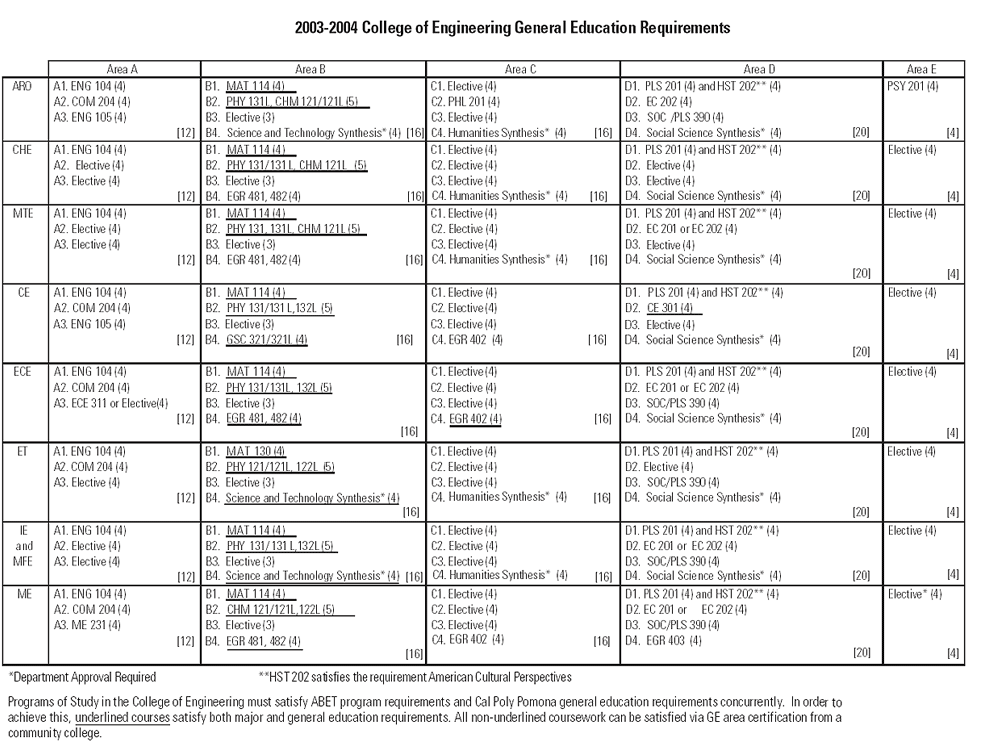
SPECIFIED PROGRAM OF ELECTIVES (SPEs)
24 units for each required. 16 from the shaded areas in one column, with a minimum of 2 labs ( 300 or 400) and 12 units of "400" level courses. General SPE requires at least 5 units each from 2 of the SPE columns with advisor approval. (Revised 1/14/03)
| ECE | Former | Course | Units | Micro | Comm. & | Control | Instru | Power | Illum. | Radio | General | ||||
| Lab | elec- | Signal | and | men- | Sys. | Biomed | Freq. | SPE | |||||||
| tronics | Processes | Robotics | tation | Ocean | Systems | ||||||||||
| 304 | Data Structures | 4 | |||||||||||||
| 317/317L | 367L | Electromechanics I | 4/1 | ||||||||||||
| 318/318L | 368L | Electromechanics II | 4/1 | ||||||||||||
| 322/322L | 372L | Op. Amps./Feedback Systems | 4/1 | ||||||||||||
| 323/323L | 373L | Instrumentation | 3/1 | ||||||||||||
| 325/325L | 375L | Electronic Digital Design | 3/1 | ||||||||||||
| 342/342L | 392L | Computer Engineering II | 4/1 | ||||||||||||
| 343/343L | 393L | Computer Engineering III | 4/1 | ||||||||||||
| 400 | SPE Problems | 1-2 | |||||||||||||
| 402 | Fields/Waves in RF Electron | 4 | |||||||||||||
| 403 | Analog filter Design | 4 | |||||||||||||
| 404/404L | 454L | Robotics | 3/1 | ||||||||||||
| 407/407L | 457L | Advanced Circuit Design | 3/1 | ||||||||||||
| 408/408L | Digital Filter Design | 3/1 | |||||||||||||
| 409 | Digital Communications | 4 | |||||||||||||
| 410/410L | 460L | Microwave Engineering | 3/1 | ||||||||||||
| 412 | Solid State Devices | 4 | |||||||||||||
| 414/414L | 444L | Digital Control/Microproc's | 3/1 | ||||||||||||
| 415/415L | Digital Design using VHDL | 3/1 | |||||||||||||
| 417 | Electric Machine Design | 4 | |||||||||||||
| 418 | IC Design | 4 | |||||||||||||
| 419/419L | 489L | Advanced Control Theory | 3/1 | ||||||||||||
| 420 | Lasers | 4 | |||||||||||||
| 421/421L | 451L | Energy Conversion Sys I | 3/1 | ||||||||||||
| 422/422L | 452L | Energy Conversion Sys II | 3/1 | ||||||||||||
| 423 | VLSI Design | 4 | |||||||||||||
| 424/477L | 477L | State Machine | 3/1 | ||||||||||||
| 425/475L | 475L | Computer Organization | 3/1 | ||||||||||||
| 426/476L | 476L | Operating Systems | 3/1 | ||||||||||||
| 427/424L | 474L | Computer Interfacing | 3/1 | ||||||||||||
| 428 | Digital Signal Processing | 4 | |||||||||||||
| 429 | JAVA | 4 | |||||||||||||
| 431/431L | 481L | Computer Networks | 4/1 | ||||||||||||
| 432/432L | 482L | Microprocessors | 3/1 | ||||||||||||
| 433/433L | TCIP/IP Internet Working | 3/1 | |||||||||||||
| 434 | Ocean Engineering | 4 | |||||||||||||
| 435/435L | 485L | Biomedical Instrumentation | 3/1 | ||||||||||||
| 436 | Optical Fiber Communications | 4 | |||||||||||||
| 448/448L | 498L | RF Design | 3/1 | ||||||||||||
| 468/468L | 478L | Power Electronics I | 3/1 | ||||||||||||
| 469/469L | 476L | Power Electronics II | 3/1 | ||||||||||||
| 490/490L | Introduction to Illumination | 4/1 | |||||||||||||
| 492/492L | Lighting Controls | 3/1 | |||||||||||||