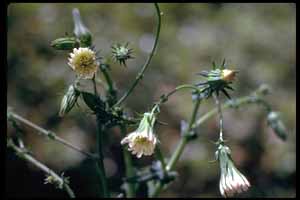
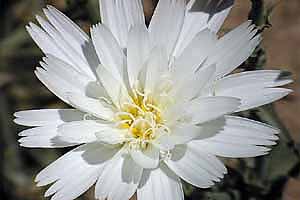
These two very similar species (the only members of the genus) occur in the Eastern Sierra. Mary DeDecker's (1) specimen cards note California Chicory's presence in the Kingston and Panamint Ranges; also found in the Whites, it extends eastward through the southern Great Basin and westward to the California coast. Desert Chicory is found in the desert valleys where the Creosote Bush reigns and extends east to Texas (Mary collected specimens in the Panamint Valley and east of Independence). Their names link three major botanists of early to mid 19th century North America: Thomas Nuttall and Asa Gray, respected pinnacles of the mainstream, and Constantine Rafinesque, a brilliant but erratic taxonomic 'bad boy'. As authors of botanical names they are referred to as Nutt., A. Gray, and Raf., respectively.
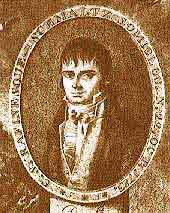
Portrait of Rafinesque from the frontispiece of his 1815 work "Analyse de la Nature".
(From an illustration in Sterling, 1978.)
|
|
Rafinesque (2, 3, 4) (1783-1840), thought of by both friend (few) and foe (lots) as eccentric, was an early 19th century naturalist with very broad interests, botany being a major one. He was born in Constantinople, son of a French merchant, and died basically friendless and penniless in a garret in a poor section of Philadelphia, in what must have been a dreadful death resulting from stomach cancer . Making his living at a remarkable variety of occupations, including university professor for a while, he led a full, if chaotic, life up until his death, and wrote prolifically on a wide range of subjects. He roamed over much of the northeast and northcentral US of the time, studying natural history and archaeology in the field. He was obsessively driven to name new species and genera. Most of his thousands of names have not been accepted, though the names of many fish, mammals, mollusks, and plants still bear his imprint.
|
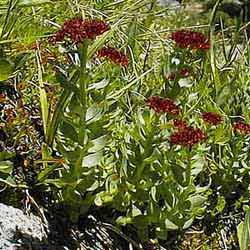
Rhodiola integrifolia, at Long Lake, Bishop Creek Drainage.
(Blakely photo.)
|
While he did not make a study of California plants, some 43 California plant taxa (with distributions extending eastward) have his stamp, including the beautiful Rosy Stonecrop, Rhodiola integrifolia Raf. (syn: Sedum roseum (L.) Scop. ssp. integrifolium (Raf.) Hulten), found in Eastern Sierra mountains. In going over a list of the some 2000 plant generic names that Rafinesque published (5), I found these 9 (I probably missed some) that are currently valid for California plants: Agoseris, Clintonia, Cymopterus, Distichlis, Ipheion, Lomatium, Orthilia, Osmorhiza and Paxistima.
He is often credited with anticipating Darwin by over two decades (though he missed the natural selection angle), based on these statements in an 1833 article: "The truth is that Species and perhaps Genera also, are forming in organized beings by gradual deviations of shapes, forms and organs, taking place in the lapse of time. There is a tendency to deviations and mutations through plants and animals by gradual steps at remote irregular periods. This is a part of the great universal law of perpetual mutability in everything. Thus it is needless to dispute and differ about new genera, species and varieties. Every variety is a deviation which becomes a species as soon as it is permanent by reproduction. Deviations in essential organs may thus gradually become new genera." He continued with a sentence that helps explain his tendency toward generosity in name-giving: "Yet every deviation in form ought to have a peculiar name; it is better to have only a generic and specific name for it, than 4 when deemed a variety." (Per Axel Rydberg (6), a more modern giver of plant names - particularly western plant names - professed a similar philosophy.)
Rafinesque's rejected Rafinesquias7
Rafinesquia coccinea (Diodeilis coccinea, Mint family)
Rafinesquia comosa (Lotus pinnatus, Legume family)
Rafinesquia caerulea (Jacaranda caerulea, Bignonia family)
|
|
Rafinesque dearly wanted a genus honoring his name, so much so that he coined a few himself! All of his Rafinesquias, however, were rejected.
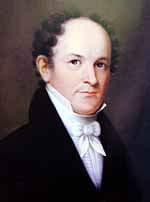
Thomas Nuttall in his 40s, ca. 1830
(Fogg Museum, Harvard Univ., printed in Gilbert, 19799)
|
|
Enter Thomas Nuttall (8, 9). In 1836, just having turned 50, he was at the end of his last and most extensive natural history excursion in North America. At San Diego, while awaiting a ship to take him and his collections back to the east coast via the Horn, he gathered specimens of the plant now called California Chicory. The description of the new genus and species (along with descriptions for other composites he had collected on his great western trip) was presented to the American Philosophical Society in 1840, and published in its Transactions in 1841 (10). Following a technical description of the new genus he explained that the name was "dedicated to the memory of an almost insane enthusiast in natural history; sometimes an accurate observer, but whose unfortunate monomania was the giving of innumerable names to all objects of nature, and particularly to plants."
Asa Gray (11) assessed the career of Rafinesque in an article published the year after his death. Gray chided Rafinesque for passing out so many improper names (caustically suggesting that Rafinesque named genera and species of thunder and lightning (12)), and implied that Rafinesque's thoughts on evolution were evidence enough of his lunacy. Nevertheless, he assiduously gave Rafinesque his taxonomic due. (Also, several years later, he saw the evolutionary light, and became the leading American disciple of Darwin [13].)
|
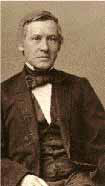
Asa Gray at age 55, 1865.
[13]
|
Gray was "general" of an "army" of explorer-collectors who sent plants to him at the Harvard Herbarium "HQ"(14). Around 1851, Charles Wright, a standout among Gray's collectors, sent back specimens from "El Paso, New Mexico" (actually Ciudad Juarez, Chihuahua (15)) which Gray deemed to be a new species of Rafinesquia; he called it Rafinesquia neomexicana in his 1853 publication on Wright's plants.
Now, as mentioned, the two species are very similar. Cronquist, et al., in volume 5 of their Intermountain Flora (16), say "The species seem wholly distinct in the field, but all the measurements of herbarium specimens are confluent." Why didn't Gray make the "New Mexican" plant simply a variety of Nuttall's plant (the full name would have been Rafinesquia californica, Nutt. var. neomexicana, Gray)? Gray had no compunctions about devising varieties. Could it be that he didn't like being linked to a man who had referred to him as a closet botanist (17)?
Whatever, Rafinesque would have approved.