

 There are two common ways to manage wetlands vegetation - burn the brush or manually cut it back. One method releases pollutants and the other is expensive and labor intensive. Both are unsustainable.
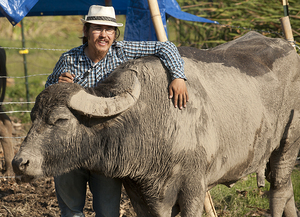
Water buffalo might be a practical, low-cost and eco-friendly solution to wetlands management, according to regenerative studies master's student Andrew Kanzler. But to bring the animals to campus and test his theory, the basis of his master's thesis, Kanzler's persistence and flexibility were put to the test.
As far as he knows, water buffalo have never settled at Cal Poly Pomona, although the campus fields include other large animals, such as cows, sheep and pigs. For months, Kanzler jumped through hoops and heard doubts from plenty of people, including faculty, friends and classmates.
Their qualms only strengthened his determination.
"They thought that bringing a large animal to campus was impossible. Some people thought I was kidding and literally laughed. They thought that the university wouldn't allow it because there were just too many hoops to jump through," says Kanzler, who received his bachelor's degree in landscape architecture from Cal Poly Pomona in 2009.
Mostly, he found that people were misinformed about water buffalo, thinking they are wild animals. "They don't know that this type is domestic," he explains.
The issues of water treatment and vegetation management are important in sustainability, and Kanzler's experiment was scientifically sound for the most part, says Kyle Brown, director of the Lyle Center for Regenerative Studies. He allowed the water buffalo to live at the Lyle Center as long as Kanzler worked with faculty in animal & veterinary sciences (AVS), received approval from the animal care & use committee, and properly addressed safety concerns.
Under the guidance of AVS professors Broc Sandelin and Shelton Murinda, Kanzler resolved the major logistical challenges, including transporting the animals from Tulare, building a pen and providing daily feedings. In early fall, three domesticated water buffalo - six-year-old Billy Brown, 13-month-old Sandelin and 8-month-old Murinda - arrived at the Lyle Center.
"I observed their droppings behavior - where they did it, where they didn't do it and how they did it," Kanzler says.
From sunup to sundown for three weeks, Kanzler monitored the animals' movements and noted whether they preferred to excrete in the pond or on dry land. The water buffalo, on loan from a dairy farm in Tulare, were fed bulrush and cattails, which grow wild at the Lyle Center and are a natural staple. He also planned to collect the feces and measure the level of nutrients in it, comparing it with the amount of nutrients the animals consumed. The more nutrients and plants they consumed, the more reason to adopt water buffalo for vegetation management.
Even with months of preparation and research, the actual experiment held a few surprises.
Billy's horns would occasionally get caught in the chain link fence, so signs were posted warning visitors against feeding and petting the animals in order to discourage Billy from approaching the fence. Because Billy repeatedly knocked over his water bucket to make mud, Kanzler added a second water bucket and buried it in the ground.
Finally, Kanzler made the tough decision to end his experiment two weeks early after Billy charged at the younger animals, perhaps out of jealousy.
"It was a huge learning experience in terms of handling them. I could have handled them a little better, knowing what I know now," Kanzler says. "Overall, I think it was successful, and I obtained a lot of valuable information.
It takes a special student like Kanzler, who has much drive and commitment, to set a demanding goal and meet it, says Brown, his thesis advisor along with Sandelin and Murinda.
"Part of our mission is to develop the leaders of tomorrow who are going to solve the environmental challenge that society is facing. You need people who are persistent, strategic and effective in influencing decision making," Brown says. "Andrew clearly demonstrated these abilities in his effort to bring water buffalo to the Lyle Center."