


A team of five aerospace engineering students designed and built a tool for astronauts to use in space as their senior project, and presented their work in a competition at the NASA Johnson Space Center in Houston.
"We designed and built a tool that could chip an asteroid at three different sites, collect a sample for each site, and store the samples without cross contaminating each other," one of the team members, Christopher Baldonado, says. "We called our tool the Research Tool for Asteroid Chipping and Collecting (RTACC)."
The team, which consisted of students Eric Ngo (team lead), Baldonado, Paul Navarro, Maciej Rosa and Austin Miller, was overseen by Aerospace Engineering Professor Don Edberg.
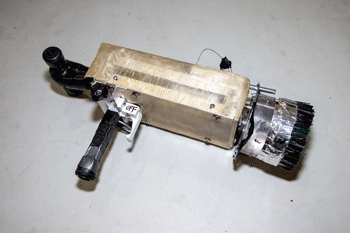 The Research Tool for Asteroid Chipping and Collecting (RTACC) is approximately a foot long and shaped like a gun.
The RTACC is approximately a foot long and shaped like a gun. One end is placed against the rock, then the trigger is pulled to drive a chisel into the rock sample. A bag-like gadget inside of the tool captures the sample safely.
In order to be operated by an astronaut in a pressurized space suit, the students tailored the device to be used by someone with limited mobility.
"We made it compact, simple and convenient to use," Baldonado says. "The handles were easy to grab and the trigger and stock didn't require too much force to use. This helped with their pressurized gloves that are about the size of ski gloves."
After their prototype tool passed the design and safety reviews, the RTACC was put to the test by NASA SCUBA divers inside of the JSC Neutral Buoyancy Laboratory. The students were connected to the divers through a headpiece and were able to instruct them on how to properly use the tool during the test.
The team then received constructive feedback from the divers who tested the tool. Although the divers said that some technical improvements could be made, the students were ultimately applauded for the simplicity of the tool and their hard work.
"Overall, it was a great experience and I loved every moment of it," Baldonado says. "I walked where astronauts have walked and trained, it was exciting. Being in an atmosphere of brilliant minds all around me was electrifying. Everything was what I expected and better."