

Working under the theme "One Team, One Goal, Student Success," about 250 faculty, staff and administrators examined strategies and methods Cal Poly Pomona can utilize to improve student success.
At the start of the nearly daylong Sept. 23 workshop, titled "Supporting Student Learning and Success: The People, The Data and the Strategies," university President Soraya M. Coley reminded attendees that "Our most important mission is student success. It's at the heart of everything we do."
The CSU Graduation Initiative 2025 calls for Cal Poly Pomona to more than double its freshman four-year graduation rate to 38 percent from 18 percent and increase the six-year graduation rate to 73 percent from 63 percent by 2025. For transfer students, the goals are to increase the two-year graduation rate from 17 percent to 29 percent and the four-year rate from nearly 75 percent to 85 percent.
"We must also close the graduation gap between underrepresented groups and their peers," Coley said.
Lawrence G. Abele, an expert on the use of student and institutional data to redesign programs and student support systems, was the featured speaker. A former professor, dean of arts and sciences, and provost at Florida State University, he has directed the Institute for Academic Leadership since 1994.
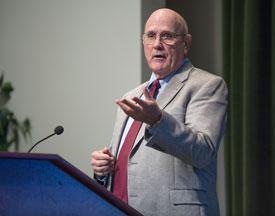 Lawrence G. Abele, an expert on the use of student and institutional data to redesign programs and student support systems, speaks to workshop participants.
"Graduation is everyone's business," Abele said. "All it takes is a complete, maniacal commitment. It's actually a simple process, but it's just not easy."
After a review of Cal Poly Pomona and national student data that ranged from graduation rates and financial aid to time to degree and degree persistence, workshop attendees began brainstorming about who should be on student success teams, devising accountability methods for the process, discussing what kind of data is needed to inform decision-making and addressing other issues that should be considered.
During Abele's decades of working to improve student success, he found that "the single most effective thing a university can do is to put together understandable academic maps with milestone classes."
The teams dug into several current Cal Poly Pomona academic plans, suggesting ideas ranging from making the documents more student-friendly with elective requirements being more clear, creating mobile-friendly materials and having alternate academic maps for students with special circumstances.
One method to help keep students on track is MyPlanner, which was introduced in spring 2016. The university's new online tool aims to make registration, course planning and scheduling easier for the campus.
At the end of the workshop, participants were asked to commit to two steps they would take to help the university move forward in developing new strategies and tools for student success.
The workshop was hosted by Provost and Vice President for Academic Affairs Sylvia A. Alva and Vice President for Student Affairs Lea Jarnagin.