


Author and business consultant Kevin Carroll lives by a childhood creed: Have a ball at what you're doing, or at least turn that passion for play into a spark for creativity.
With his signature red rubber ball at his side, Carroll's uplifting message to an enthusiastic audience at Cal Poly Pomona was laced with wistfulness and urgency, forged by a rough upbringing and happy times on the playground.
"You want more motivation, you want more creativity to problem-solve, you want more ingenuity, more of the unexpected? Sprinkle some play in there, sprinkle some fun in there," Carroll told a crowd of nearly 200 at the Bronco Student Center on Feb. 7. "The opposite of fun and play is depression. We have to find time for play."
Carroll's address, titled "Unleashing Growth through Creativity and Innovation," was part of the Kellogg Distinguished Public Lecture Series that is funded by the Kellogg Legacy Project Endowment.
That play mindset would pay dividends for Carroll in 1997 when he became one of the creative forces at Nike, the global leader in sports apparel.
"I was very concerned that we weren't playing enough. We were talking about play and sports, but we weren't having any fun," Carroll says. "We were all working so hard. In the middle of the meeting I said, 'We should just play tag.'"
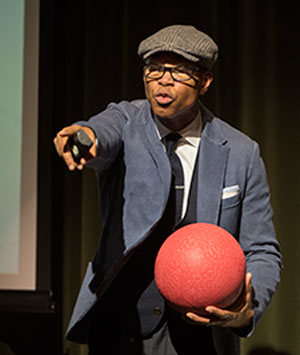 His signature red rubber ball taught Carroll the importance of play early in life.
That suggestion was put into action. For 30 minutes every Friday, co-workers in his building would play the game. The only rule was that everyone had to participate. Word spread and people from other buildings would show up and watch. More people wanted in on the game, and a day was set aside so that all 3,000 workers could play.
"It was three hours of the most beautiful bedlam that I have ever seen. That was my Nike moment, when I galvanized an entire community around play," he says.
After high school, Carroll joined the U.S. Air Force in 1980 and became an interpreter, learning Russian, Serbian, Croatian, German and Czech. He would go on to earn a master's in health education from St. Joseph's University and a bachelor's in communication with a minor in physical education from Angelo State University.
Carroll completed his military service then worked as an athletic trainer at the high school and college levels. In 1995, he landed his dream job as trainer for the Philadelphia 76ers and became the third African-American trainer in NBA history. After that lone season, he became the sports medicine liaison and translator for the Yugoslav men's basketball team for the 1996 Olympics in Atlanta. He joined Nike a year later as a creative director.
Carroll left Nike in 2004 to spread the word about the power of play and started the business consulting firm Kevin Carroll Katalyst/LCC. He also wrote the books "Rules of the Red Rubber Ball," "What's Your Red Rubber Ball?" and "The Red Rubber Ball at Work" and speaks at learning institutions and businesses about the role of play in igniting creativity.
As a child, Carroll had little room for play. Survival was his focus. Carroll recounted the incident that changed the course of his life. His mother left Carroll, then 6, and his two brothers alone in a trailer for two weeks with little food or water in Bowling Green, Virginia. Carroll asked a neighbor who came to check on the boys to telephone their grandfather in Philadelphia. The woman called and the grandfather asked her to put the boys on a Greyhound bus to Philadelphia, a long 220-mile journey.
The brothers found a haven with their grandparents. A playground down the street is where Carroll would find his lifelong motivation. He took a ball and started playing an imaginary game. Kids came out of their houses to watch. A group of boys with arms crossed called him over, and Carroll feared that he was in trouble.
"One of the boys says something that changes my life forever. He says these very simple words: 'Do you want to play with us, kid?' " Carroll recalls. "For the next five hours, something magical happened. I belonged. I was part of something.
"This ball was my spark. This ball allowed me to connect. This ball was a catalyst. On that day, I set in motion an intention. I basically said to the ball, 'If you can help me move on, if you can help connect, I'm going to keep the ball with me no matter what.' I had no idea that play would become a big part of my life," he says.
During Carroll's hour-long appearance, he also touched upon other sources of motivation and urged the campus community to find that spark - and it doesn't have to be a red rubber ball.
"When you're in school, this is the moment to find it. Be inquisitive, ask questions. Find people to support you and inspire you. Find those teachers who spark you," Carroll says. "To those faculty and staff, be a spark. You have to bring that energy every single day."
Carroll's work also caught the attention of Starbucks, which featured him in "The Way I See It" series of inspirational messages on cups in 2006. His was cup No. 77, which read in part: "The human catalysts for 'dreamers' are the teachers and encouragers that 'dreamers' encounter throughout their lives. They are invaluable in the quest to turn ideas into reality."
While Carroll celebrated how the function of play shaped his life, he insisted that the spark and ability to change lies in everyone.
"Finding a way to rise above my circumstances, and not let my circumstances dictate my destiny, was my constant motivation," he says. "There are two great days in a person's life: the day that you are born and the day that you discover why."