

Two Cal Poly Pomona engineering professors have won a $149,000 grant from the U.S. Bureau of Reclamation to continue development of a low-cost energy storage system using reverse osmosis concentrate (ROC), the byproduct of water desalinization plants.
As droughts increase, more communities, especially in the Southwest U.S., are considering desalinization plants to meet their fresh water needs. However, ROC is harmful to the environment due to its high salt content, biocides, metals and coagulents.
At the same time, the energy sector is looking for more cost-effective methods of energy storage. Solar energy plants can have higher capacity and operate during non-solar hours if they are combined with a thermal energy storage system, but the costs of these systems are significant.
The Cal Poly Pomona team is developing an ultra-low-cost, high temperature concentrate-based thermal energy storage (TES) system that would meet the needs of both the water and energy industries. The new grant will fund the design, construction and testing of a bench-scale modular system that integrates with a solar thermal plant, said Reza Baghei Lakeh, an assistant professor of mechanical engineering and principal investigator on the grant.
Because the thermal capabilities of the ROC salts depend on feedwater source and quality, the next phase of the project also includes collecting ROC samples from across the country and testing their thermal properties to see if the variability affects their thermal storage performance.
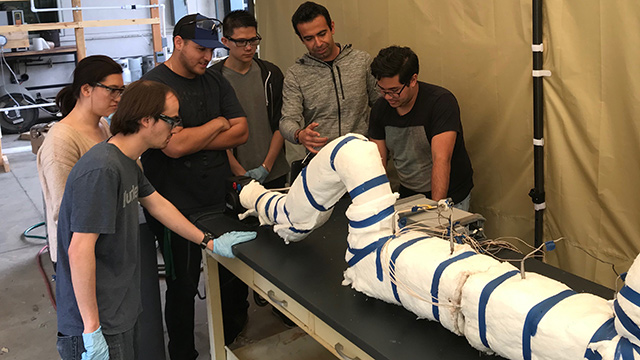
So far 25 undergraduate research students led by Lakeh and co-principal investigator Ali Sharbat, associate professor of civil engineering, have had the opportunity to work on various parts of the project.
Last year, then seniors Gerardo Maldonado, Garrison Kanazawa, Stuart Geyer, Minna Mattis and Jonathan Hai won first place at the CSU Student Research Conference for their work on the "Potential Repurposing Of Reverse Osmosis Concentrate For Energy Applications."
They conducted preliminary tests of ROC's thermal capabilities and found it offered a wide range of desirable properties for energy storage applications. Following evaporation, the extraction of the minerals and salts can become useful in offsetting disposal costs while offering a solution for an inexpensive energy storage system.
An earlier student team studied the economic and technological feasibility of using ROC salt concentrate as a TES material, under a Bureau of Reclamation Science and Technology grant. Their work included evaporating water from ROC samples, extracting the sold salt, packing it in a storage element and conducting thermal testing.
"Both teams did great work and really moved the project forward, making it possible for us to apply for the new grant," said Lakeh. "They were doing cutting-edge research at the level of an R-1 institution, in a multi-disciplinary field combining two areas (i.e., energy storage and desalination) that rarely talk with each other. Last year, several of the students got jobs based in part on their research experience working on a solution to real world problems."
A new group of senior students has been recruited for the project's next phase.
If the project is ultimately successful, the approach would reduce the operating and maintenance cost of desalinization and reduce the cost of thermal energy storage below U.S. Department of Energy cost targets.