

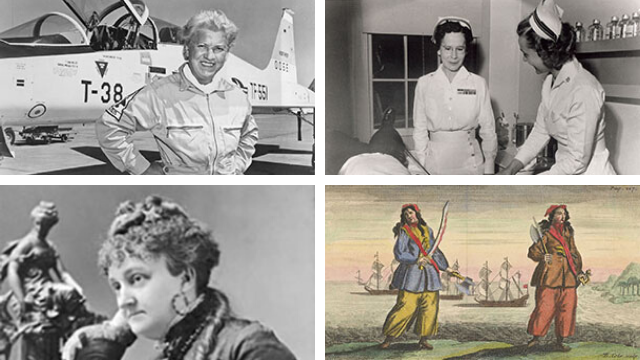
In honor of Women's history month, Rosanne Welch and Peg Lamphier, Cal Poly Pomona lecturers in Interdisciplinary General Education and editors of the four-volume encyclopedia Women in American History: A Social, Political, and Cultural Encyclopedia and Document Collection (ABC-CLIO Publishing, January 2017), have provided a list of a dozen fascinating females in history everyone should know.
Welch and Lamphier's encyclopedia was named to the 2018 Outstanding References Sources List, by the Reference and User Services Association (RUSA), a division of the American Library Association and to the 2018 list of Best Historical Materials by the Reference and User Services Association (RUSA), a division of the American Library Association.
Catharine Littlefield Greene
The widow of Revolutionary War hero Nathanael Greene, Catharine Littlefield Greene was also the forgotten co-inventor of the cotton gin. Known as 'Caty' to her friends, Greene demonstrated strength as a military wife, acumen as a businesswoman, and creativity as a contributor to invention of the cotton gin. She is notable as an early American woman active in science and innovation.
https://www.womenhistoryblog.com/2009/03/catherine-littlefield-greene.html
Glory of the Morning
Native American chief Glory of the Morning led the Winnebago/Ho-Chunk Tribe during the 1700s in what is now Wisconsin. During the 1730s and 1740s, Glory of the Morning witnessed a great deal of warfare between the Fox Indians and the French in the area that is now Michigan and Wisconsin. She aligned her people with the Winnebagos and the French and played a pivotal role in achieving an end to inter-tribal war in the late 1740s.
https://www.wisconsinhistory.org/Records/Article/CS517
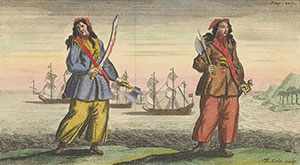 Anne Bonny
Female pirate Anne Bonny operated in the Caribbean in the early 1700s. Though she never commanded a ship she was known for her ferocious fighting skills. She and Mary Read, another female pirate, were eventually captured by authorities. Read died in prison, but Bonny may have escaped or been ransomed. Both women were legendary free spirits who rejected ideas about women's place and lived lives of relative freedom.
https://www.thewayofthepirates.com/famous-pirates/anne-bonny/
Thomasine/Thomas Hall
Raised as a girl in the early 1600s, Thomasine/Thomas Hall spent much of her adult life living as a man. Hall came to Virginia in 1607 and lived as a man until 1629, when she was discovered and ordered to assume female dress. Hall may have been a cross dresser, but she also many have been inter-sex, as there seems to be some confusion about her sex. In the 1630s a court ordered Hall to wear man's dress, but a woman's apron, suggesting the importance of clothing to colonial gender ideologies.
https://outhistory.org/exhibits/show/the-age-of-sodomitical-sin/1620s/legal-case-thomas-sine-hall-vi
Charlotte Forten
A freeborn African-American educator and anti-slavery activist, Charlotte Bridges Forten Grimke, was one of the most influential of abolitionists and civil rights activists of the mid-nineteenth century. In 1862, in the midst of the Civil War, Forten went to Port Royal, South Carolina, where slaves abandoned by their masters after they fled Union forces, were preparing for life after slavery. Forten established a school for former slaves. Her ultimate goal was to provide her students with the skills to live as free persons. After the war, Forten worked for issues such as women's rights and black civil rights.
https://www.nps.gov/places/the-charlotte-forten-grimke-house.htm
 Myra Bradwell
Bradwell v. Illinois (1873) was a landmark Supreme Court case that declared women could not be lawyers. Myra Colby Bradwell, represented in court by Matthew Hale Carpenter, sued the state of Illinois for her right to practice law after she graduated from law school in St. Louis. Despite the Supreme Court ruling, Bradwell continued to advocate women's rights through litigation including lobbying for the right to pursue professional occupations and in support of the suffragist movement.
https://www.womenofthehall.org/inductee/myra-bradwell/
Harriet Jacobs
Harriet Ann Jacobs was a fugitive slave and abolitionist whose 1861 autobiographical Incidents in the Life of a Slave Girl, published under the name Linda Brent, provided American readers with a rare inside look at the physical and sexual abuse suffered by female slaves. Primarily focused on Jacobs' journey to freedom and her struggles to obtain that same freedom for her children, Incidents in the Life of a Slave Girl details the structure of slavery from the rape of female slaves to the institution of the Fugitive Slave Law and its devastating effect on black families even in free states. Her work stands as crucial evidence against the horrors of American slavery.
https://docsouth.unc.edu/fpn/jacobs/bio.html
Lotta Crabtree
The tiny, brown-eyed redhead known to her many fans simply as "Lotta" was one of the most successful entertainers of the 19th century. Her family moved to California after the 1849 gold rush, when Crabtree was six, settling in Grass Valley. There, Crabtree reportedly befriended a neighbor, the notorious actress, dancer and courtesan, Lola Montez, who gave Lotta dancing lessons. Lotta appeared in light melodramas that showcased her talents as a banjo player, clog dancer and mimic. Crabtree began performing in the mining camps and small-town variety theatres, singing ballads and clog dancing. The miners were said to have showered her with coins and gold nuggets, which her mother collected. When she retired at 45, she was one of the richest women in America.
https://www.sfmuseum.org/bio/lotta.html
 Laura Cobb
Highly decorated member of the Navy Nurse Corps Laura Mae Cobb served as a military nurse for almost thirty years. She is best known for her leadership of the nurses, immortalized as the "Angels of Bataan," who were held captive in the Philippines by the Japanese from just after Pearl Harbor until their liberation in February 1945. Throughout her time as a prisoner of war, Cobb and other Navy and Army nurses tended to those needing care while subtly resisting their captors, even mislabeling bottles to prevent looting. Under Cobb's leadership, the nurses performed heroically and exemplarily, for which they were eventually recognized. Finally, on February 23, 1945, after four years in captivity and with almost all the nurses bordering on starvation, an American rescue team liberated them.
https://www.womenofwwii.com/navy/navy-nurses/lieutenant-commander-laura-m-cobb-navy-nurse-corps/
Angela Davis
An activist, scholar, professor, philosopher and author who came to prominence in the Civil Rights and Black Power movements of the 1960s and 1970s, Angela Davis had close ties with the Black Panther Party for Self-Defense. In 1970, Davis was arrested and charged with conspiracy in an armed confrontation that resulted in four deaths. She was later acquitted of all charges. The author of eight books, Davis is Distinguished Professor Emerita with the History of Consciousness Department at the University of California, Santa Cruz, and a former director of the university's Feminist Studies department. Davis remains a powerful advocate of gender equity, the abolition of the prison-industrial complex, and LGBTQ rights.
https://www.nytimes.com/2018/02/13/arts/angela-davis-archive-harvard.html
Dolores Huerta
Civil rights and labor activist Dolores Clara Fernandez Huerta has made a life's work of advocacy for farmworkers, immigrants, women, and the American Hispanic or Latino/a community. Her leadership and organizational skills were influential in the success of the United Farm Workers, as were her contributions in recruiting women, maintaining a non-violent union front, and successfully gaining support for the grape boycott that led to contracts for the UFW. Huerta's core philosophy always remained the same: freedom of self through choice. She has advocated for the working poor, women, children, the LGBT community, and working immigrants.
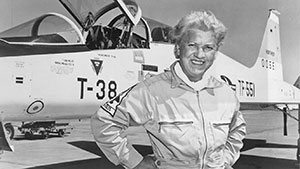 Jacqueline Cochran
The first woman to break the sound barrier and the director of the Women's Airforce Service Pilots (WASPS), Cochran was born near Muscogee, Florida and orphaned as an infant. Raised in northern Florida by a poverty-stricken foster family of migrant sawmill workers, she went to work in the mills early in life. In 1960, Cochran's friendship with Dr. Randolph Lovelace of NASA brought her into the space age. Lovelace was operating a privately funded program to give women pilots the same tests that the male astronaut candidates were receiving. Not only did Cochran participate in the tests herself, she paid to cover the tests of the other twelve women who participated. Despite several women outscoring male astronaut candidates on these tests, NASA would not actively recruit women as astronauts for another seventeen years.
https://www.nationalaviation.org/our-enshrinees/cochran-jacqueline/