Revving ‘Jungle Jumpstart’ to Life for 2026 Rose Parade
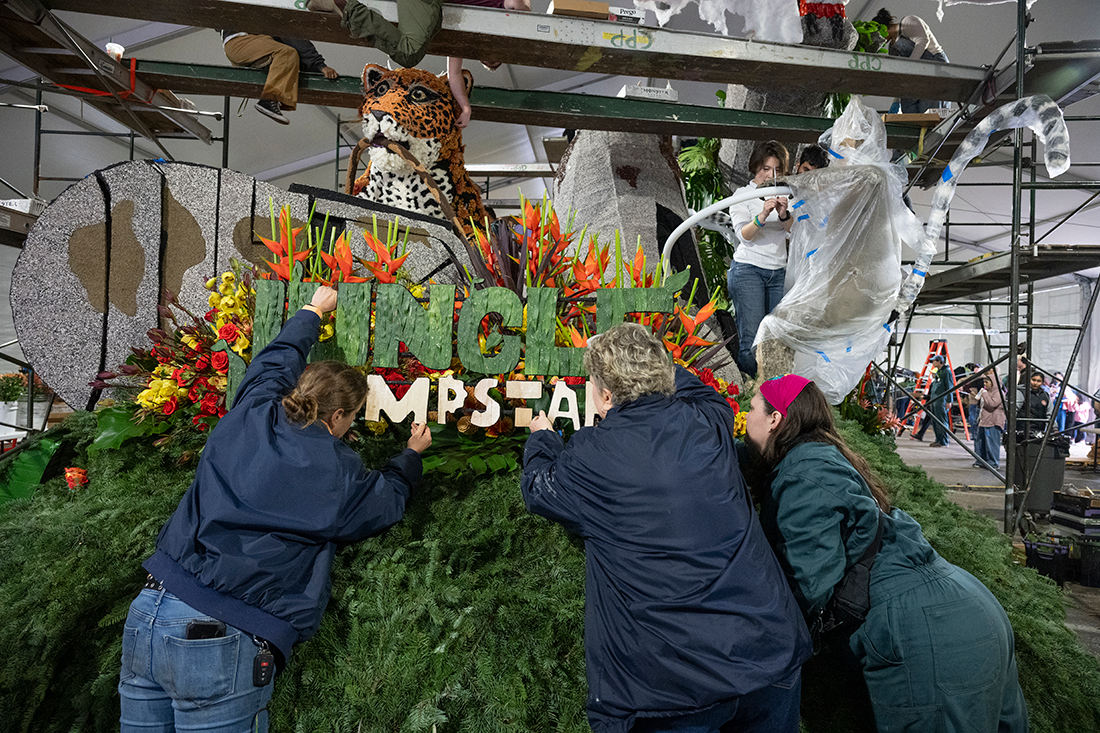
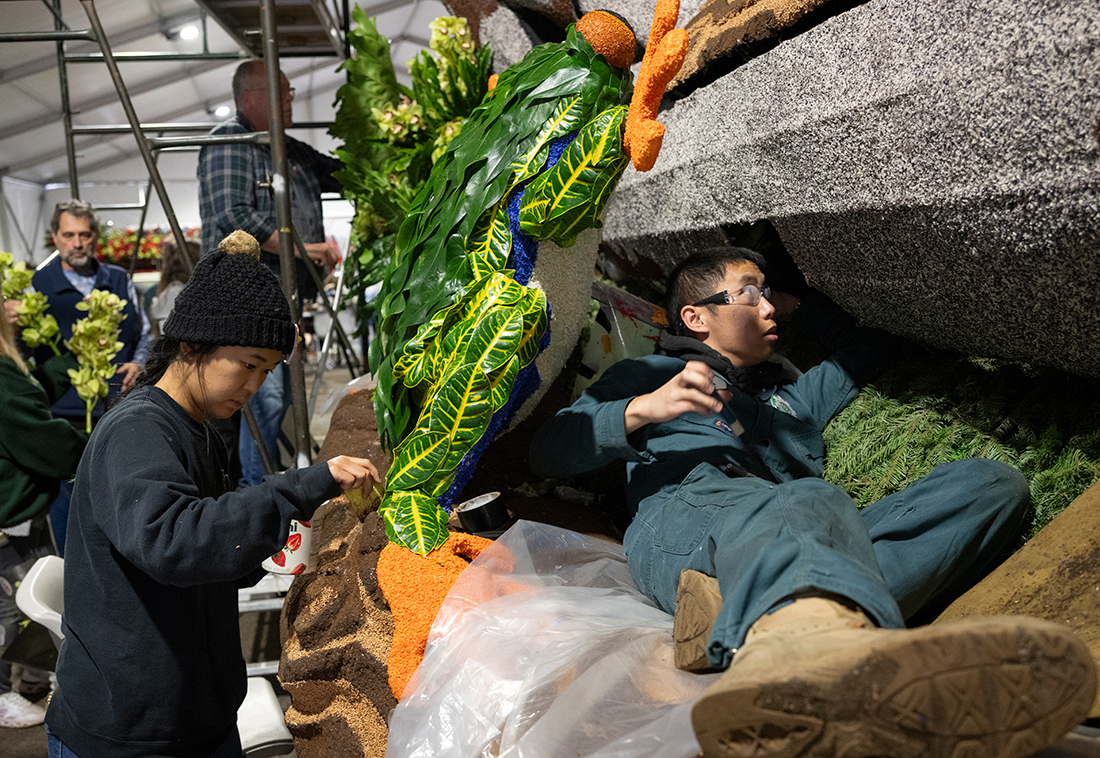
Inside a giant tent, across from the Rose Bowl, a vibrant rainforest scenecame alive beginning Dec. 26 as Cal Poly Pomona students, alongside their Cal Poly San Luis Obispo counterparts, and volunteers added thousands of flowers, greenery and an array of dry organic material to "Jungle Jumpstart," the 2026 Cal Poly Universities Rose Float.
During Deco Week, the final and most visible phase of float building, hundreds of volunteers working in shifts inside and outside the tent crafting intricate “special deco” details and vialing flowers. They transformed months of design and engineering into a fully realized rainforest scene for “Jungle Jumpstart,” Cal Poly Universities’ 77th Rose Parade float. It will be 10th in the lineup of the 2026 Rose Parade when it rolls down Colorado Boulevard on New Year’s Day.
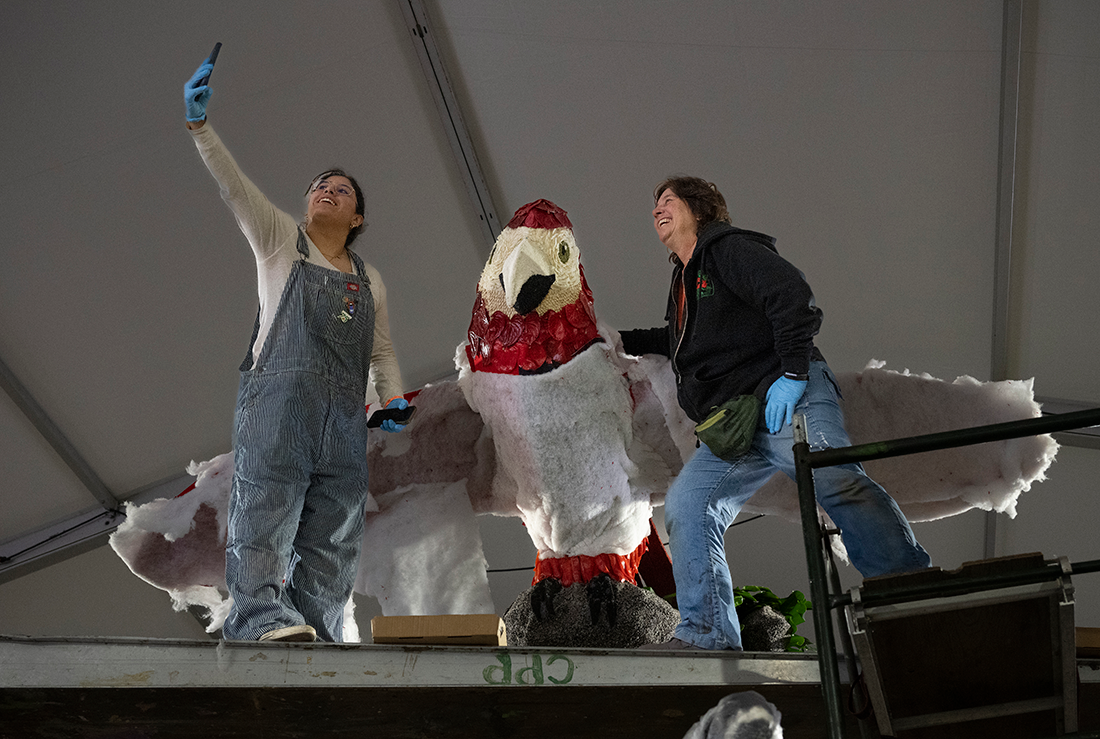
Measuring 52 feet long, 19 feet wide and 26 feet tall, the float brings to life the parade theme, “The Magic in Teamwork,” through a story that blends nature and technology. It depicts a jungle ecosystem working in harmony as animal engineers — a frog, monkey, giant jaguar, lemurs and a toucan — revive a fallen robot named Lunchbox. Once restored, Lunchbox lifts a red macaw into the air, helping it take flight. Even the robot’s spare parts are reborn, repurposed into a new habitat for birds and jungle plants growing from the stump of a fallen tree.
A student-built tradition
 “Jungle Jumpstart” is the only student-designed and student-built float in the Rose Parade, a distinction the two Cal Poly Universities have held for more than seven decades. The project is a year-round collaboration between Cal Poly Pomona and Cal Poly San Luis Obispo, with students working across disciplines and campuses despite being separated by 250 miles.
From welding and structural design to animation systems and floral testing, the learn-by-doing process engages about 75 core students and hundreds more who assist throughout the year at both universities.
During Deco Week, that collaboration reaches its peak. Cary Khatab, director of Cal Poly Pomona’s Rose Float team, says an average of 300 volunteers per day support the effort at Rosemont Pavilion, with 175 students from both campuses leading the work.
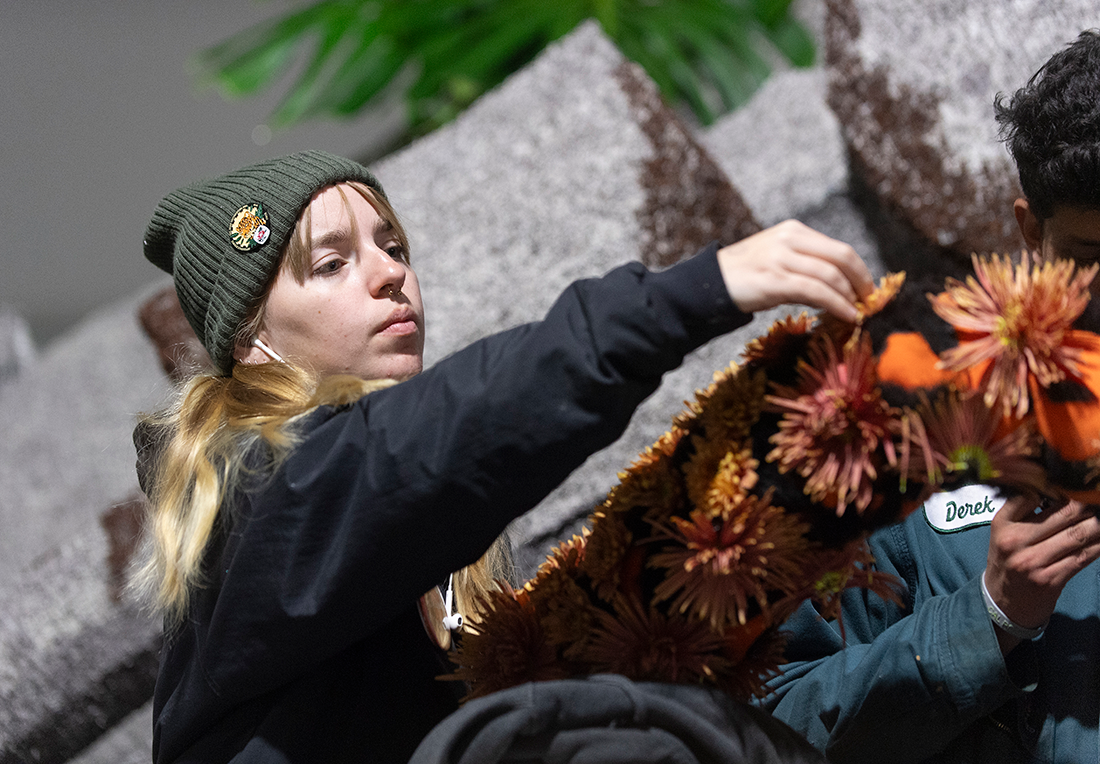
Volunteers took on everything from vialing thousands of flowers to highly detailed “special deco” work — such as gluing lentil seeds individually and removing cotton seeds by hand to shape lifelike lemur hands.
Engineering motion and emotion
On New Year’s Day, “Jungle Jumpstart” has a short window of time to wow audiences and share its story.
“The challenge is to have the float and the emotion of the story told in 30 seconds,” said Enzo Ruberto, a third-year computer science student and lead of the SLO Construction Team’s electronics squad.
 Bringing the float to life in just 30 seconds required precision, storytelling and seamless coordination across the two campuses.
Ryan Newton, a fifth-year physics and industrial engineering double major and Construction Chair from Cal Poly San Luis Obispo, helped oversee the float’s eight animated mechanisms — from a toucan shifting side to side and a frog jumping while closing Lunchbox’s panel to a lemur connecting wires and a jaguar swinging its 10-foot tail. Towering above the scene, Lunchbox stretches nearly 50 feet long, flexing a 20-foot arm holding a macaw with a 12-foot wingspan.
Students focused on storytelling through one of the float’s most expressive features: Lunchbox’s eyes.
“We wanted to help tell the story of the robot,” Ruberto said. “We thought eyes — eyes that are expressive.”
Using technology similar to electronic billboards and CPP’s electronic marquees, Ruberto’s team developed screen-based eyes bright enough for outdoor viewing. Working with the Operations Team, animated sequences were created by Jacob Pedevillano, a second-year visual communication design student from the Cal Poly Pomona team and primary graphic designer/animator, showing Lunchbox’s eyes scanning the crowd, gazing at the macaw perched on his hand and forming heart-shaped pupils. The eyes, music and all eight movements are synchronized through a centralized computer control system.
Ruberto added that despite the technical complexity, the team kept the focus on the overall design. “We also had to remember that this is a floral float. We’re here to tell the story and we want it to be beautiful.”
Once the animation systems were tested, the focus shifted from motion to materials to create a dense, colorful rainforest.
Deco brings the jungle to life
That transformation was guided by Bailey Beene, a landscape architecture senior and Deco Chair for the Cal Poly Pomona team, and her Cal Poly San Luis Obispo counterpart, Haley Kost, a fourth-year plant science student minoring in landscape architecture.
Together, Beene and Kost led the visioning and execution of the float’s natural environment, coordinating materials, color palettes and textures to mimic the complexity of a real rainforest.
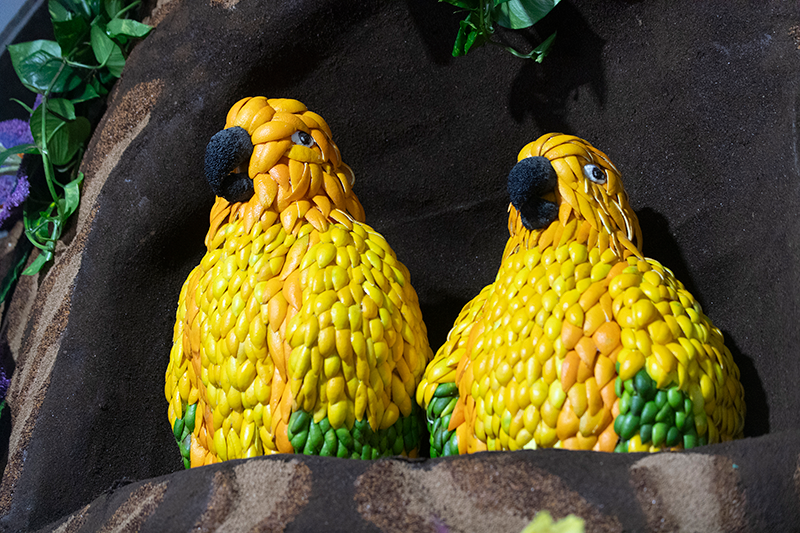 Beene introduced several distinct dry materials, including cattails harvested from her family farm for the lemur and monkey furs. The cattails were wrapped, glued and peeled to create textured strands. Other materials include California water dock seeds for rust tones in the stump and Lunchbox, and a 60-pound donation of blue corn grit from Martial Hill to cover the robot’s body.
Fresh floral elements include rainbow chard grown in front of Cal Poly Pomona’s Rose Float Lab, more than 400 citrus fruits sourced from both campuses to create the bright plumage of tropical birds, and tropical greenery such as bromeliads, ferns and split-leaf philodendron donated by The Huntington Gardens and Olive Hill Greenhouses.
Additional materials include onion seeds for deep black tones, flax for the stump mix and even reused elements from Cal Poly Universities’ 2023 float, “Road to Reclamation.” About 115 pounds of that mix were rediscovered at the Pomona campus Rose Float Lab — a meaningful moment for Beene, whose first Rose Float experience was on that earlier project.
“For me, it was a full circle moment,” Beene said.
Drawing from her landscape architecture education, Beene focused recreating natural systems, taking inspiration from the circular growth patterns of kapok trees to guide water flow toward roots. The Design Team carved the final forms based on hand-sketched patterns from the Deco Team.
In total, the float features about 13,300 roses across the decking, including Orange Crush, High Magic and Green Tea varieties, along with 2,900 Green Trick carnations, 2,300 green orchids and three types of heliconia. Lunchbox’s surface is composed of onion seed, chia seeds, blue corn grit and white rice.The macaw's red wings are covered with thousands of red carnation petals. The process of gluing those to the feathers, a process known as petaling, took 12 people 17 hours.
Leading forward
For Amelia Atwell, an architecture senior and president of the Cal Poly Pomona team, “Jungle Jumpstart” reflects both tradition and growth. Having worked on four floats and progressing through leadership roles — from Design Element Lead to Design Chair to President — Atwell sees innovation as essential to the program’s future.
“By nature of this program, every year wants to do better than the last,” Atwell said. “Using a new animation system to our advantage and looking at innovation to stay in step and maybe even ahead of the professionals.”
The team built on lessons from last year’s float, “Nessie’s Lakeside Laughs,” which featured a Loch Ness monster with expressive eyes — inspiring new ways to use animation as a storytelling device.
“The eye screens have that ability to express emotions to tell an exciting story,” Atwell said.
How to watch the Rose Parade
The 137th Rose Parade will be held on Jan. 1, starting at 8 a.m. in Pasadena.
- In person: Arrive early, possibly the day before, to secure your spot along the street or pay for premium seating tickets. The Parade Day Guide has safety tips and information about the parade route and road closures.
- National TV broadcasts: ABC, CNN, Fox, Great American Family, KTLA, NBC, Telemundo and Univision.
- Free Streaming: Pluto TV (on the Christmas channel), Fubo Sports Network (free version), Christmas Plus app, and KTLA.com or the KTLA+ app.
- Subscription Streaming: Fubo, GFam+, Great American PureFlix, Hulu + Live TV, Sling TV and YouTube TV.
- Follow Cal Poly Pomona: Follow the university’s official Instagram account (@calpolypomona) to see photos, video and behind-the-scenes moments on Jan. 1.