
Summer Conference to Explore the Future of AI in Higher Education
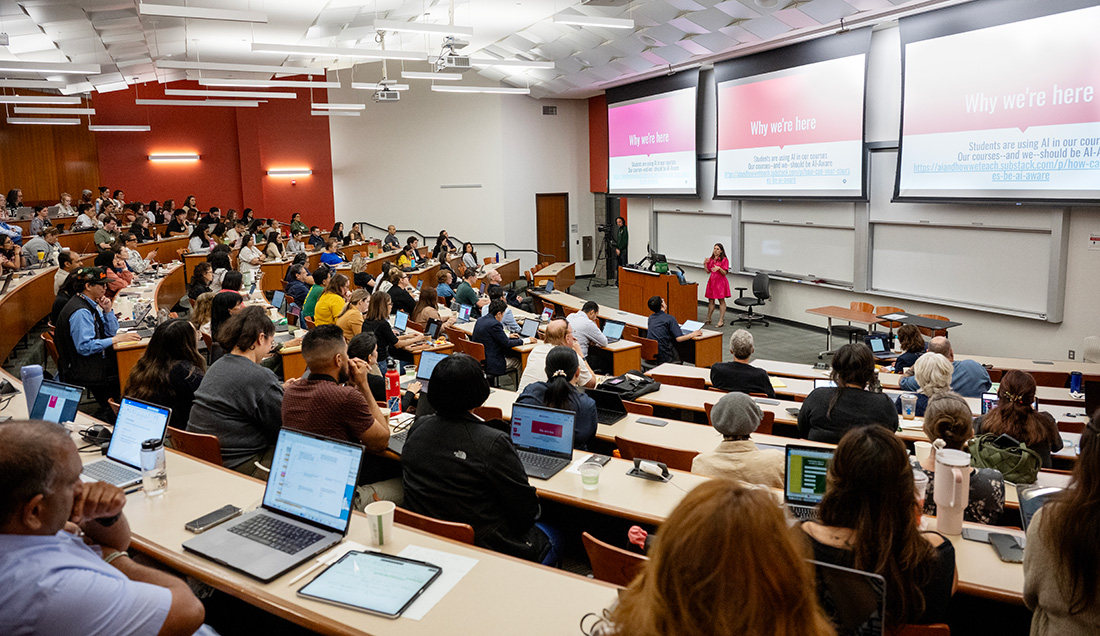
The Cal Poly Pomona Office of Academic Innovation will explore practical strategies, emerging trends, and human-centered approaches to artificial intelligence at its 2026 Summer Conference, June 3 and 4.
Centered on the theme, “Human at the Core: Navigating AI in Higher Education,” the conference will examine how educators and campus professionals can thoughtfully integrate AI while keeping student success, ethics, and meaningful human connection at the forefront. Designed for both faculty and staff, the conference will feature two tracks that highlight how AI can be used both inside and outside the classroom, offering relevant examples, applications and speakers tailored to a range of roles across higher education.
As AI continues to reshape how institutions teach, learn and prepare students for the workforce, the event offers space for participants to engage with forward-thinking ideas, practical strategies and emerging trends at the intersection of education, technology, and work.
Dr. Nina Abramzon, conference chair, professor and chair of the department of physics and astronomy, said this year’s theme reflects both the opportunities and challenges AI presents across higher education.
“The theme reflects the practical reality that AI brings both useful tools and real concerns,” she said. “It can support teaching research and service, but it also raises ethical questions. The conference creates space to look at both sides while encouraging attendees to explore how we can integrate AI in ways that enhance the educational experience.”
Attendees can expect keynote speakers from higher education and industry, engaging panels on AI’s impact on teaching, learning and workforce readiness, and interactive sessions highlighting innovative tools, practices and policies. The conference will also offer opportunities for participants to connect with colleagues and thought leaders across disciplines.
The conference’s two-track format is intended to help attendees find sessions that best align with their work, whether they are interested in AI applications for instruction, course design and student learning, or how AI can support student services, operations and institutional effectiveness outside the classroom.
A featured session developed in partnership with the Career Center will focus on how AI-enabled tools can support students while helping staff work more efficiently and strategically.
“By highlighting platforms like uConnect, VMock, Big Interview, and Focus 2, we want to share real case studies of how technology can strengthen career readiness services at scale without losing the human-centered approach students need,” said Josue Ruiz, tech and admin analyst for the Office of Academic Innovation.
“This session will be especially valuable for faculty and staff who are looking for practical ways to use student touchpoint data, digital badging, and AI tools to better engage and support their students. I encourage colleagues across campus to join us because these conversations are essential to preparing students for success in an evolving workforce.”
Abramzon hopes attendees will leave with a stronger understanding of AI’s relevance to their own work and practical ideas they can apply right away.
“Recognizing AI as an evolving part of higher education and the workplace, the institute provides space for faculty and staff across disciplines and roles to explore how AI is shaping professional practice,” she said. “I hope attendees leave with a clearer understanding of how AI connects to their specific roles, along with practical ideas they can apply in their courses, programs, or services. The Institute is designed to give attendees space to explore tools, share perspectives, and better understand the implications of AI in their day-to-day work, so they feel more prepared to work with AI in a practical way.”
The conference will take place from 8:30 a.m. to 4 p.m. on both days, in Building 162, Room 1001. Early bird registration is $175 (available until May 1), and general admission is $225 (available through May 28). Cal Poly Pomona faculty and staff may attend at no cost and can request a promo code here.
All attendees will enjoy a continental breakfast and lunch on both days. Sessions are designed to be flexible, allowing participants to mix and match workshops and discussions across both focus areas.
Educators and professionals from all institutions are encouraged to attend this opportunity to learn, connect, and help shape the future of higher education. To register for the conference, visit our website or contact the Office of Academic Innovation at ai@cpp.edu.