

The Philosophy of Making a Difference: Professor Alex Madva Receives Provost Award
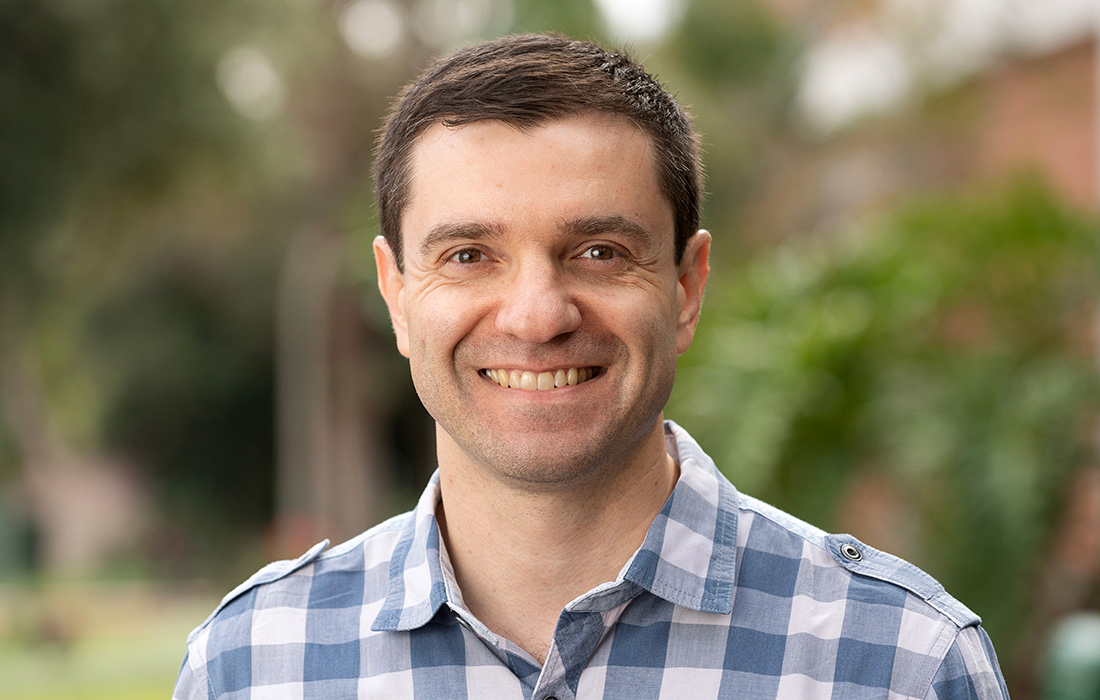
Teaching is often thought of as the simple act of passing information from professor to student. For Philosophy Professor Alex Madva, however, the real challenge lies in creating an environment where students are excited and prepared to think, question and critically engage with the world around them long after class ends.
That philosophy has shaped every aspect of Madva’s career, from nationally recognized research and interdisciplinary collaborations to community projects led by his students. This year, it also earned him the Provost Award for Excellence in Scholarly and Creative Activities. The award recognizes faculty whose research advances their field while elevating the university through innovation, collaboration and public engagement. However, Madva was quick to point out that the award represents far more than his own accomplishments.
“I was definitely very surprised and shocked,” Madva said. “But then immediately, just feelings of gratitude for all the people who have supported me and empowered me along the way. It’s definitely a shared award.”
The Collaborative Mindset
For much of his life, Madva believed addressing climate change meant reducing his own carbon footprint by making environmentally conscious choices. But after learning how oil companies had popularized the concept of a personal carbon footprint to shift attention away from corporate pollution, he began asking a different question: What actually creates meaningful change?
That question became the foundation of his nationally recognized research and the inspiration behind his recent MIT Press book, “Somebody Should Do Something,” which he co-authored with Michael Brownstein and Daniel Kelly. Rather than arguing that individuals are powerless, the book explores how people can work collectively to address large social problems such as climate change, misinformation and structural injustice.
Madva also has done extensive research on implicit bias, examining how psychology, philosophy and social systems interact to shape human behavior. Rather than viewing philosophy as abstract debates disconnected from reality, Madva believes philosophy can help solve real-world problems.
“I thought maybe I can ...contribute to creating a more positive culture where we’re more inclusive and more open-minded and more oriented toward listening to each other rather than cutting people down,” he said.
Creating Space for Critical Thinking
Madva strives to create an environment where students feel comfortable challenging ideas and learning from one another. Humor plays an important role, helping lower tension during difficult conversations and encouraging students to participate without fear of being wrong.
His classroom also operates under a strict no-device policy. As A.I. becomes increasingly accessible, Madva believes students need opportunities to develop their own critical thinking rather than relying on technology to do the work for them.
More important than memorizing philosophical theories, Madva hopes students leave his courses with the ability to understand perspectives different from their own.
“The disagreements can be most productive if both people can really understand where the other person is coming from,” he said. “Learning to take other people’s perspectives and having people experience being heard and understood are some of the skills I try to cultivate in all of my classes.”
Lessons Extend Beyond the Classroom
Rather than assigning a traditional final exam in his Philosophy and Science of Implicit Bias course, Madva asks students to create projects that can make a difference in the community.
One group organized “Cut the Bias,” a public event at the Fox Theater in downtown Pomona featuring legendary rapper KRS-One. The event combined education, entertainment and community engagement while raising awareness about implicit bias. Its success earned the students a Presidential Discovery Award.
For Madva, projects like these represent the true purpose of higher education—giving students opportunities to apply what they have learned to real-world challenges.
His commitment to connecting ideas with action extends to other initiatives he oversees. As the director of the California Center for Ethics and Policy (CCEP) and the co-director of the Digital Humanities Consortium (DHC), he has helped students tackle real-world challenges while building practical skills.
Through the DHC, students and faculty can participate in workshops on digital storytelling, video editing and other technologies that bring humanities research to life. The consortium also hosts experts who lead campus discussions on artificial intelligence and digital media and collaborates with the CCEP on civic engagement events, including Cal Poly Pomona's election fair.
"The Digital Humanities Consortium is trying to do humanistic work, humanistic research, through digital platforms. So, podcasts, digital archives, video games, ways of telling stories about history, philosophy or literature through digital technologies."
The CCEP, meanwhile, gives students opportunities to address issues affecting their communities. One example is Project Mailbox, which provides current and former students experiencing housing insecurity with a place to receive their mail at the Bronco Care Center.
Madva sees the initiative as an example of how collective action can lead to meaningful change. It "shows a way that individuals can work together to change systems," he said.
Every year the CCEP takes on a new topic. . In previous years, the center focused on artificial intelligence and the future of work. Next year, it will examine the 2028 Los Angeles Olympic Games, which will host events at the Pomona Fairplex. This will hopefully bring opportunities and positively impact the Pomona community.
A Lasting Difference
Madva’s work continues to evolve.
In addition to his teaching, leadership roles and current scholarly work, he plans to take on a new research project focused on misinformation and another that examines ageism against younger generations and how it shapes society.
After more than a decade at Cal Poly Pomona, Madva remains motivated to keep students engaged and energized by their “light bulb moments,” when students make connections, challenge assumptions and discover new possibilities. He has seen that those moments don’t end in the classroom. Students take those lessons with them into their careers, shaping how they work, engage with their communities and understand the world around them. These achievements are the most rewarding part of his job, he said.
Looking ahead, Madva hopes the programs he has helped build continue to create opportunities for students and a leave a lasting impact on the university and society.
“I just hope I leave it better than I found it.”