

When the coronavirus pandemic prompted statewide stay-at-home orders, Cal Poly Pomona quickly shifted to remote and virtual learning. Students had to adopt new technologies, a different pace and web-based ways of connecting with other people.
For some, it meant exploring new apps to aid their studies or posting their class schedules on the fridge so that family members knew not to disturb. Students soon realized that they needed to be intentional about their approach to e-learning and studying.
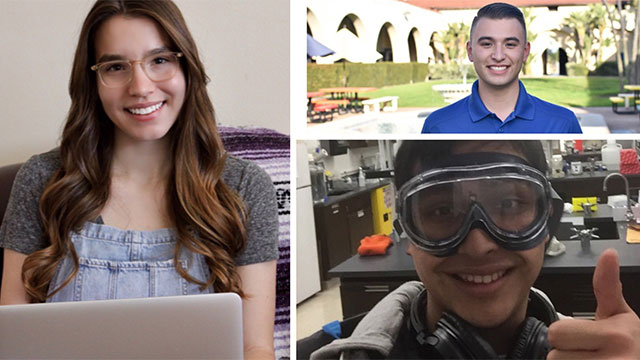
Five science and engineering students talk about how they've creatively adapted and even found some benefits to being hunkered down in their homes, including reduced commuting time and the availability of professors, who had more time for "office hours." Here's a brief look at their tricks of the online-learning trade.
Cesar A. Valdovinos, biology sophomore, Kellogg Honors College
At his family's home in West Covina, Cesar Valdovinos turned off his gaming system and any other distractions when he needed to focus on school. He took notes during online sessions, and then he took notes from those notes, to help with "further encoding information in the brain," he said.
Instead of studying the biogenetics of plants in a lab on campus, he read research papers and discussed them with classmates and professors on Zoom. His chemistry lab professor patiently walked him through the baffling equation to compute the percentage of phosphate in a solution.
The pandemic has been a mixed bag. He misses running into friends on campus. But he stays in touch with buddies through apps and calls. "It's not healthy to isolate yourself," he said, "especially in these scary times."
In his spare time, he helped provide masks to two area hospitals. And he has played Fallout: New Vegas and DnD, role-playing video games.
Celine A. Mangahas, computer science junior, Kellogg Honors College
When the school moved to remote/virtual classes, Celine Mangahas left her off-campus apartment and moved back in with her family in Tustin. An avid gamer who plans a career as a game developer, she put a stick-on white board on a wall, where she wrote problems and coding, along with a daily to-do list to track assignments. She attended Zoom lectures and used the campus-wide Blackboard tool to access assignments, quizzes and grades online.
Most professors, she said, were "looking for something to do," and she was able to contact them often. She's attending summer school - remotely, of course - to get ahead on credits.
In her limited spare time, she teaches children online how to code and build games; plays Legend of Zelda and Mario games; and walks the family's terrier-greyhound puppy.
Lauren J. Sinks, biology senior, Kellogg Honors College
At home in Placentia, Lauren Sinks used Quizlet, an online study app, to create flashcards for terms and equations. If a professor provided lecture material in advance, she would read through it so that she could ask questions in class. She awoke an hour before morning Zoom lectures to stretch or run to get her blood flowing. Each day, she set up her workstation with laptop, water, paper and pens. After class, she reread lecture material and took notes.
"My studying habits have changed completely," she said, from in-class learning to more self-teaching. She wrote out pathways for turning on specific genes and color-coded her notes with highlighters. She sometimes turned to Google and reliable instructional videos on YouTube.
She looks forward to getting back to campus, whenever that happens. "I truly do miss the laboratory aspect of being a biology major," she said.
Justin T. Nguyen, electrical engineering junior, Kellogg Honors College
Although he saved time that would have been spent commuting from the San Gabriel Valley, Justin Nguyen learned that he had to set concrete deadlines for starting and stopping his online school day. Otherwise, he would just keep studying, and that cut into dinnertime with family and Skype guitar-playing sessions with friends. He discovered the Pomodoro Technique, a time-management method that recommends working in 25-minute chunks separated by short breaks. After five or so sessions, he would exercise or run errands to give his mind a break.
While studying, he listened to white noise on his headphones and asked his family not to interrupt. He formed small study groups via Discord, a screen-sharing and video-calling app.
Nguyen typically learns by doing. He works part-time from home as a programmer for the prestigious Jet Propulsion Laboratory, where he hopes eventually to work full-time developing satellite technology and spacecraft.
Matthew B. Jacobson, civil engineering senior
Matthew Jacobson credits online tools for his success as he transitioned to remote learning: a weekly planner on his computer, Outlook calendar with Zoom links and Blackboard email notifications, which he organized in individual course folders. Before settling in for his virtual classes at home in Yucaipa, Jacobson would go for a run about 6:30 a.m. and eat breakfast. He posted his class schedule on the refrigerator to let family members know not to disturb him.
Jacobson found that he could be more disciplined when professors posted videos for students to watch at a set time. "If I didn't go to class and watch during my given time," he said, "then it was hard for me to schedule time."