

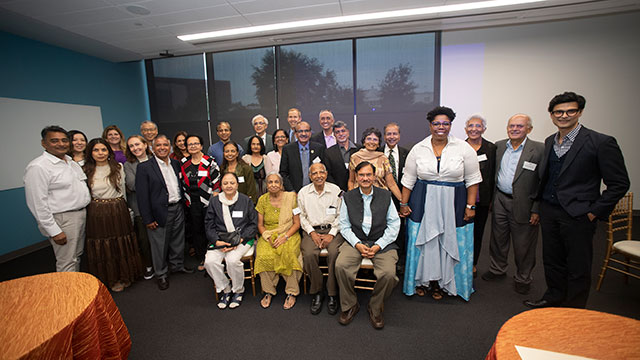
Aishwary Kumar, the director of the Ahimsa Center and a history professor, has been named the new Shri Shantinath Endowed Chair in Ahimsa Studies in the College of Letters, Arts, and Social Sciences (CLASS).
Ahimsa is the Hindu, Jain, and Buddhist doctrine of refraining from harming any living being.
Since 2003, the Ahimsa Center has been dedicated to interdisciplinary teaching and learning about nonviolence and its practical applications at various levels: personal, interpersonal, societal, national and international.
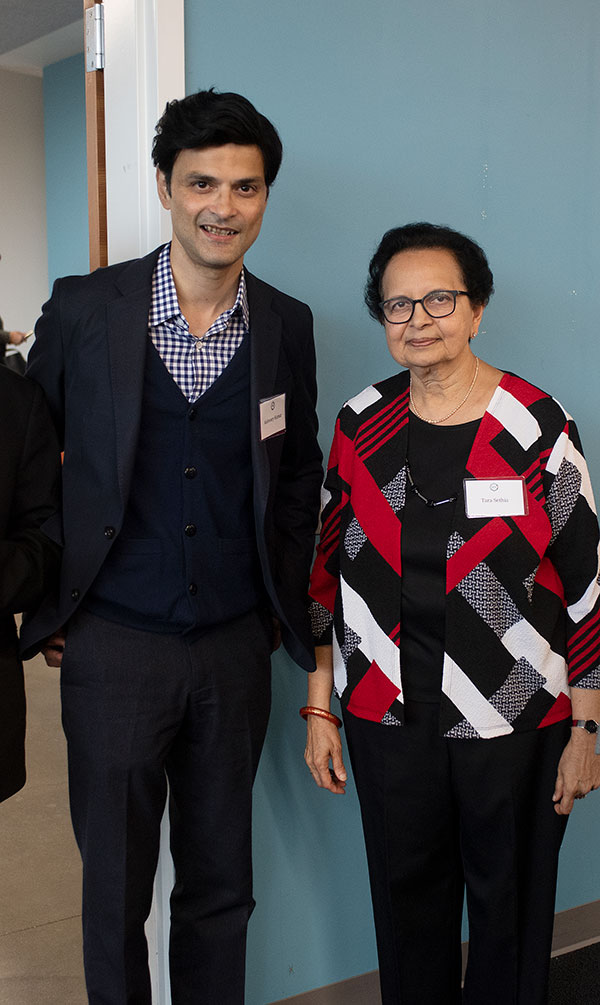 The Ahimsa Center's new Shri Shantinath Endowed Chair, Aishwary Kumar (left) next to the inaugural chair and center founder, Tara Sethia.
"I am deeply honored with what has been handed over to me with such generosity, such grace and intellectual vision," Kumar said. "I promise that I will give everything I have to uphold the idea of ahimsa, but most importantly, the dignity that past work has bestowed on us."
Kumar's work is in the fields of history and political theory, specializing in South Asian, European and American moral and political thought. Currently, he is writing two related books in his area of study.
The first is titled "The Sovereign Void: Ambedkar's Critique of Violence," which analyzes the global genealogies of radical nonviolence and the struggle with notions of force and sovereignty across philosophical, judicial and revolutionary traditions.
This book will be accompanied by "The Gravity of Truth: Disenchantment, Disappointment, Democracy," where Kumar takes the Obama Presidency as an opening to explore the place of moral and political judgement in the global constitutional imagination.
Kumar also has a forthcoming book called "Neodemocracy: Freedom and Violence after Neoliberalism," which is supported by an award from the Academy of Science in Seoul, Korea.
In addition to writing, Kumar is teaching courses on "Political Nonviolence and Democratic Life" (HST 4433). In spring 2023, he will teach "What is Freedom?" (HST 4431).
Kumar has extensive leadership experience. Before heading the center, he founded and led the global workshop series on "Civility, Cruelty, Truth" at the Stanford Humanities Center between 2011 and 2015.
He also co-founded the Institute for New Global Politics, a thinktank based in Silicon Valley that serves to educate the next generation of thinkers. It is focused on developing a global perspective on the human condition and its future and creating feasible political solutions that bring together citizens, policymakers and governments in a planetary endeavor.
Kumar has developed three major goals to build on the foundation of Ahimsa Center.
First, he would like the center to focus on the relationship between radical nonviolence and our democratic future. He wants to direct a democracy institute and recruit global scholars to talk to students, faculty and the community.
His second goal is to start a new series of justice dialogues. Lastly, Kumar plans to start a nonviolence studies bachelor's degree program to coincide with its nonviolence studies interdisciplinary minor, which is already offered as a course of study to CPP students.
At the heart of Kumar's vision is the development of the Ahimsa Center as a national and international space for the study of democratic politics and radical nonviolence.
"If there is anything profoundly exceptional about the American democratic experiment," Kumar said, "such an exceptionalism rests solely on America's powerful tradition of civil rights: a history of freedom claimed through a resolute commitment to nonviolent resistance against class and racial power, but a freedom also increasingly imperiled today by inequality and climate catastrophes."
Kumar promised that with that tradition of justice at its heart, the Ahimsa Center will strive to become one of the leading American institutions engaging with issues of global citizenship, civil disobedience, and civil rights itself.
The center also provides an institutional forum that serves important stakeholders like college students and K-12 educators.
Educational initiatives spearheaded by the center help students gain an appreciation of nonviolence at both the intellectual and practical levels.
"The Ahimsa Center has a huge impact on student lives - through that change you will see a change in political systems, in generosity of spirit, in being nonviolent," David Horner, interim dean of CLASS said. "Students can sense the impact through the education they get and the existence of the Ahimsa Center."
To integrate an interdisciplinary understanding of nonviolence and nonviolent social change in the K-12 curriculum, the center launched a fellowship program to provide professional development to K-12 educators. The center has held six summer institutes for educators in 2005, 2007, 2009, 2011, 2013 and 2015, and a seminar in 2019.
"Colleges and universities have a special role to connect societies," Dan Montplaisir, vice president for University Advancement said. "Institutions can and should challenge the status quo in important ways."
The center also provides public programs in the form of international conferences, public lectures, dialogues, workshops, and special events to advance a broader and deeper understanding of ahimsa for students and the community at large to create a culture of ahimsa.
"Cal Poly Pomona is a national leader in providing a one-of-a-kind opportunity to students," Provost Jennifer Brown said. "Transformative opportunities are the epitome of the CPP Polytechnic Experience."
The center would not have been possible without the vision and leadership of its founder and director, Professor Tara Sethia, the inaugural Shri Shantinath Endowed Chair in Ahimsa Studies, according to donors and supporters.
"We have all tried to help in whatever way we can, but the success of the program has to go to Tara Sethia and her accomplishments so far," Bipin Shah, an Ahimsa Center donor, said.
The generosity of donors is also the backbone of what helps keep the center alive.
"The visionary generosity of our donors, who twenty years ago saw the power in the idea of ahimsa, got behind it, and then made that idea a reality in the form of the center," Sethia said. "Today, 20 years later, their conviction in that ahimsa is a force of positive change has helped usher in a new phase in the future of the center supported now by an endowment. The center is their collective gift to humanity in the struggle to resist the rising tide of violence in the world."
Donors expressed the value of Ahimsa Center and the importance of donating to the cause.
"Nonviolence is practical in all walks of life," donor Jasvant Modi said. "Most, if not all, problems that humanity is facing today can be solved in nonviolent ways."
Donor Prem Jain agrees that ahimsa can help solve problems around the world.
"We can continue to implement ahimsa globally, heal and transform our planet, create an environment for a peaceful world, and help with conflict resolution. Together, we can help solve the worst problems based on the principles of ahimsa."
To support the Ahimsa Center, contact the Center at ahimsacenter@cpp.edu.