

CPP’s Horses for Heroes Program Helps Veterans Heal and Grow

Away from the rush of classes and campus bustle, a small group of student veterans walks toward the W.K. Kellogg Arabian Horse Center. The air is cool, the stables are hushed and a row of mares waits patiently at their stalls. For these students, this routine is more than a class or activity — it can be a lifeline.
The Horses for Heroes program, a partnership between the Veterans Resource Center and the Arabian Horse Center, pairs veterans and military dependents with gentle, beginner-friendly horses three times a week. Participants learn to halter, groom and walk their horses, gaining hands-on confidence through everything from lunging exercises to trail obstacle courses and weekly guest-led workshops.
Since Horses for Heroes launched in 2019, 86 students have participated, said Elke Azpeitia, director of the Veterans Resource Center. Veterans are selected through an application and interview process, ensuring a supportive, intentional cohort. The fall 2025 group held its final activity on Nov. 20, marking another successful season of growth and healing.
This fall, eight student veterans and four military dependents — representing the Marine Corps, Air Force, Army and Navy — completed the program. Though the university’s herd includes geldings, this semester’s horses all happened to be mares, a natural result of the breeding farm’s population rather than intentional selection, according to Cheyenne Thayer, student activities coordinator at the Arabian Horse Center.
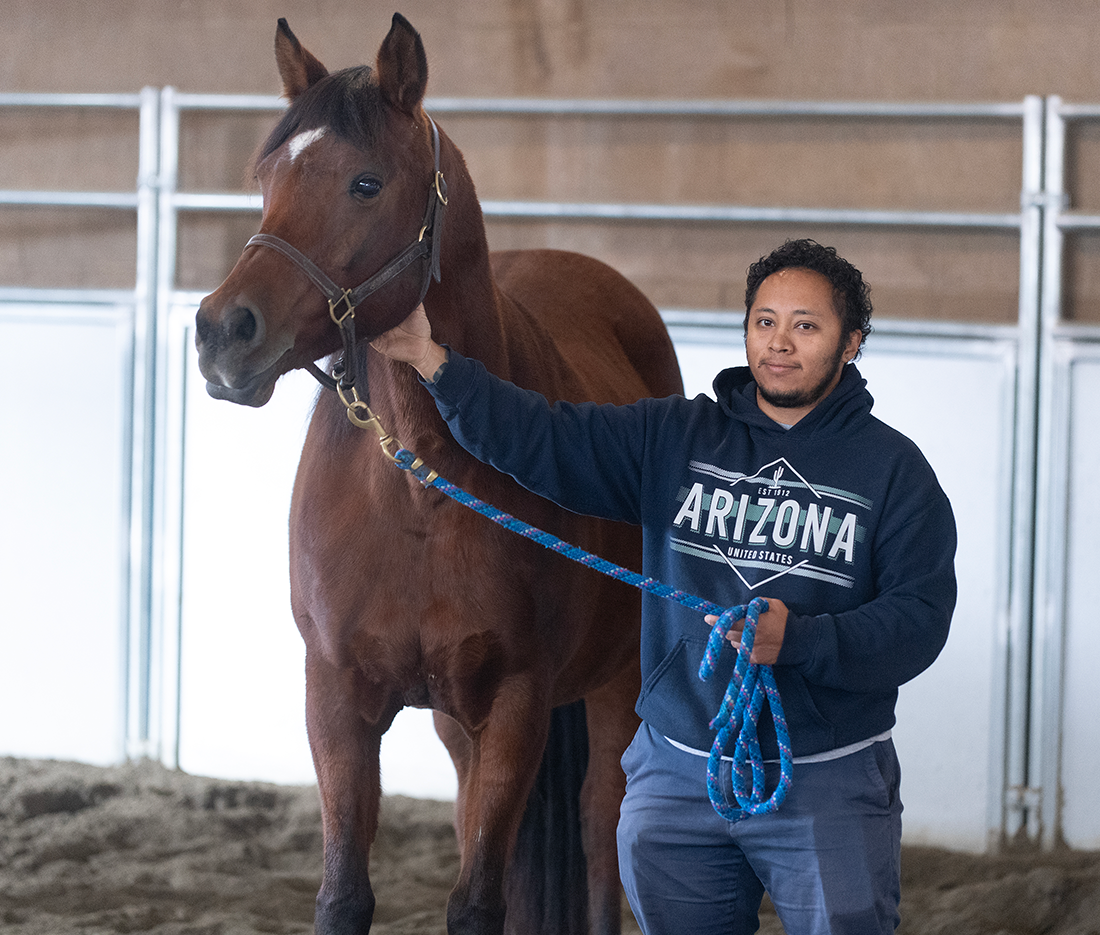 For Jesse Padilla (‘27, master’s in accounting), a U.S. Army veteran currently serving as a U.S. Army Reserve Senior Drill Sergeant, the program offered something he didn’t know he needed.
“Animals make life better and easier,” he said. “They calm the soul in a way no human can.”
Padilla joined Horses for Heroes partly because he dreams of one day running a horse farm with his sister, an aspiring veterinarian. But he also knew he needed space — a place where military urgency could soften into stillness.
“Participating in this program allowed me to put school and work aside for that time with just my horse, Sophie, and I,” he said.
Sophie, an 11-year-old bay Arabian mare with a white heart-shaped spot on her forehead, quickly became more than an assigned horse. Padilla had never worked with horses before and admitted he was intimidated at first, but Sophie made the process feel natural.
“Bonding with her was easy,” he said. “She likes being around humans, going on walks, and she has a favorite spot she likes to be scratched.”
What surprised Padilla most was the emotional resonance of the experience. “If I could sum it all up in one word, it would be connection,” he said. “Sometimes I wouldn’t even have to talk to Sophie — it felt like she knew what was going on.”
That connection extended beyond the stables. Working alongside other veterans provided rare camaraderie and comfort.
“Interacting with fellow veterans helped me mesh more, which is helpful for my networking career,” Padilla said. “It eased my social anxiety and reminded me to slow down and enjoy the little things. I’m not in the military anymore — I can take a break with Sophie or my classmates.”
That transformation is exactly what program leaders hope for.
“Horses have no expectations of people — they meet you exactly where you are,” said Thayer. “That acceptance helps veterans navigate the transition to university and civilian life.”
Padilla encourages other student veterans to take the leap: “I would highly recommend this program to all CPP student veterans. There’s something to learn about horses — but most importantly, there is more to learn about you.”
Applications for the Spring 2026 cohort open in January. Student veterans and military dependents interested in Horses for Heroes can contact the Veterans Resource Center at vetquestions@cpp.edu.