

Lecturer Rosanne Welch Publishes New Book Celebrating Women Screenwriters Worldwide

Interdisciplinary General Education lecturer Rosanne Welch recently released her latest academic volume, “Shaping Global Cultures through Screenwriting: Women Who Write Our Worlds.”
The book highlights international women screenwriters, who through their stories educate, inspire and empower. It touches on a variety of topics from constructing narratives around cultural memory to the importance of questioning dominant ideas to using writing to push for social change.
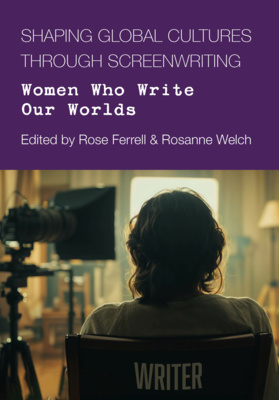 Welch said the project reflects her long-held passion to shine a positive light on women’s contributions to media.
“This book aims to raise awareness on women who use their artistic means of life as a resource for education and empowerment,” she said. “It demonstrates the power of narratives to generate a real social discussion and cultural impact.”
The collection features a spectrum of storytelling from artists who offer us a window into how women around the world are using the screen as to advocate. The book features the Samoan performance artist Angela Tiatia, known for her 2014 work, ‘Walking the Wall.” Tiatia displays her Malu Tatau tattoo, which symbolizes the preservation and documentation of cultural practice and identity in the online spaces.
One chapter focuses on a junior Pacific Islander lawyer who created a music video calling on the International Court of Justice to issue an advisory opinion on climate change, a matter of concern as rising sea levels threaten the homes and histories of island communities. Other readings in the book examine the film “Kajillionaire” by Miranda July as a platform for imagining queer utopias, the transformative power of the female gaze in the Italian documentary “Trial for Rape,” and the frequently ignored creative roles and contributions that women make behind the scenes of the beloved children’s television show “Bluey.”
“Although the chapters encompass very different media and art practices, what connects them is the ways in which these women use their creative voice to elicit and enable change and open dialogue,” Welch said. “Screenwriting in that sense is not just for film; it’s anyone using a screen to change society.”
Welch adds this volume is particularly useful for a broad variety of courses ranging from liberal studies and educational workforce studies to creative writing.
“The reason I find this collection so interdisciplinary, is it is appropriate for the classroom in which we work on representation, fairness, global media, and cultural responsibility of storytellers,” she said, adding that the book speaks to a broad range of students from diverse backgrounds and experiences.
To help faculty bring these new perspectives into their teaching, Welch has released single chapters for classroom use and encourages instructors to integrate these narratives into their lectures.
“Storytelling for students frequently feels distant from their lives,” Welch said. “But as they hear new narratives by women who are engaged in fighting climate justice, preserving culture or in more inclusive descriptions of identity, they start to grasp how creativity works with their civic lives. In this we observe that storytelling is more than expressive, it is participatory and transformative.”
Welch appeared in a segment of the CW series “TV We Love” on Dec. 1, in addition to the book. The episode followed the story of her life as a writer-producer on the hit television series “Touched by an Angel,” giving the viewers an inside glimpse into her career and her continuous embrace of meaningful, character-driven storytelling. The segment is available on the CW show’s website.
Welch hopes readers, especially young artists and writers, will view the collection as an opportunity to ponder the broader purpose of storytelling.
“With this collection, I hope that both students and emerging artists understand how storytelling can be a creative practice as well as a tool for cultural dialogue,” she said.
In order to move the needle on a cultural issue, one thing is key..
“These women have an important role to play, Welch said. “Art is not just something people watch; it is also a very useful tool for teaching, empowering and making change.”
“Shaping Global Cultures Through Screenwriting: Women Who Write Our Worlds” is available on Intellect Books.