

ENV Alumnus’ Family Ties and Time at CPP Help Shape His Success

When Mike Riley says he has deep family ties to Cal Poly Pomona, he really means it.
Not only did Riley (‘81, bachelor of science in architecture, ‘82, bachelor of arts in architecture, ’83, master’s in architecture) graduate from CPP, so did three of his four siblings. Sister Kate studied computer science, sister Beth majored in accounting, and his brother Tom focused on hotel and restaurant management. Serendipity played a part, said Riley, who grew up in LaVerne.
“For 17 years, one, two or three of us were enrolled at Cal Poly Pomona,” he said. “What are the odds that we would live that close to that quality of a university that had something all of us wanted to study?”
His father, Professor Emeritus H. Norton Riley, was an early graduate of the university’s computer science master’s degree program and later became a lecturer and full-time professor at CPP. His mother, Marie, worked on campus for 15 years, assisting with the management of the food service in the residence halls. His wife, Carol, studied home economics at CPP and his eldest son, Christopher, also graduated with an architecture degree.
The siblings left home for campus every morning in one car to arrive in time for the first person who had class. Riley recalled that when his father was working in the computer industry at an El Monte company, he would swing by the administration building around 6 p.m. to pick up any of the children who wanted a ride home early.
“Cal Poly Pomona provided a quality, affordable education, and we could all live at home,” Riley said. “In my family, a college education was a given. That was a forgone conclusion, so it worked out for all of us.”
Riley, a principal and director of architecture at the Yorba Linda-based architectural firm Tanaka Riley, parlayed the solid education he received at CPP and experience working as a draftsman at a construction company while in college into a career spanning more than four decades.
A Career by Design
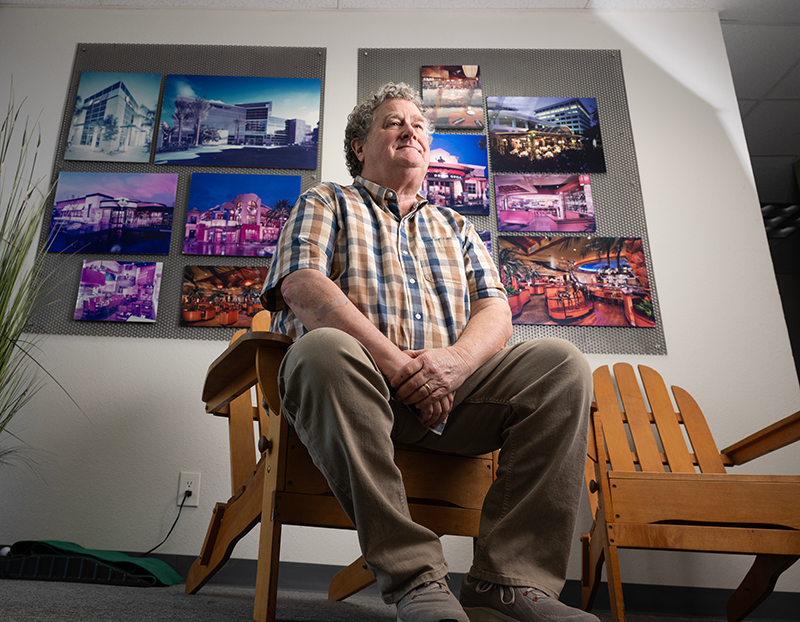 Riley always had a knack for mathematics and was good at art, so in the seventh grade, he said his mother decided he should become an architect. At Bonita High School, he took all the hand drafting classes available. It paid off when he applied to CPP because he was required to submit a portfolio. The heavily impacted program also required him to take an aptitude test and interview for a spot. At the time, the university offered both Bachelor of Science and Bachelor of Arts degrees in architecture. The Bachelor of Science took four years and with one additional year, he could complete the Bachelor of Arts, so Riley earned both degrees.
When he graduated, the country was in a deep recession, and many of his classmates were working in fast food to get by. Riley’s mother suggested he go to graduate school, so he remained at CPP. His master’s degree thesis design project won first place in a national student design competition and in June 1983, he received the 70 Annual Paris Prize in Architecture/Lloyd Warren Traveling Fellowship from the National Institute for Architectural Education in New York. Riley, who was a newlywed at the time, spent the $12,000 prize visiting architectural sites of significance around the globe for his first year of marriage. The couple went to 25 countries in Europe, Northern Africa and the Soviet Union, as well as Japan.
“We spent our first anniversary in Moscow,” he said. “Then when we came back, the recession was over and firms were hiring as fast as they could.”
After returning from his travels, Riley worked at several Southern California architecture firms in Orange County, growing professionally with diverse projects from restaurants to health clubs to commercial and industrial developments.
He served for more than a decade as principal and vice president at Scheer Tanaka Dennehy Riley Architects, an architecture and design firm recognized as a leader in the field of restaurant and health club design. In 2009, he and his business partner, Rick Tanaka, founded Tanaka Riley Architects.
“We have designed all different kinds of restaurants from larger dinner houses to quick serve, and also a variety of health clubs,” Riley said.
The firm has designed more than150 fitness clubs, including several clubs for NFL teams and is working with Fred Fitness, a German-based company that offers workouts on equipment fueled by AI.
Riley said that he has enjoyed running a business with his partner Tanaka.
“I like problem solving,” he said. “I like organization and being able to help people who want to get something done, but they don’t know where to start.”
Architecture also is a profession that has staying power.
“It’s a profession you don’t have to retire from,” he said. “I have a son, another generation. So, I could go work for my son.”
In Service to Others
Community service, which Riley also enjoys, is also something he can continue to do for a long time. The Chino Hills resident has served on the College of Environmental Design Dean’s Council for more than five years.
An Eagle Scout since he was a teen, Riley spent 25 years as a volunteer leader and member of the council board of directors. He served as council president and council commissioner of the California Inland Empire Council, Boy Scouts of America, one of the largest Boy Scout councils in the country serving San Bernardino and Riverside counties. Both sons, Christopher, and Glenn, a senior pricing analyst at a software company in Indiana, are also Eagle Scouts.
“I enjoy being able to give back to those participants currently involved in the programs. In both cases, the Boy Scouts of America and the Environmental Design department at Cal Poly Pomona have been huge influences on my life in my younger days and still today,” Riley said. “I have been involved with the Boy Scouts for more than 40 years. Cal Poly Pomona is the reason I enjoy the career that has been my life for over 40 years.”