Advanced Mass Spectrometer Expands Research and Industry Partnerships at Cal Poly Pomona

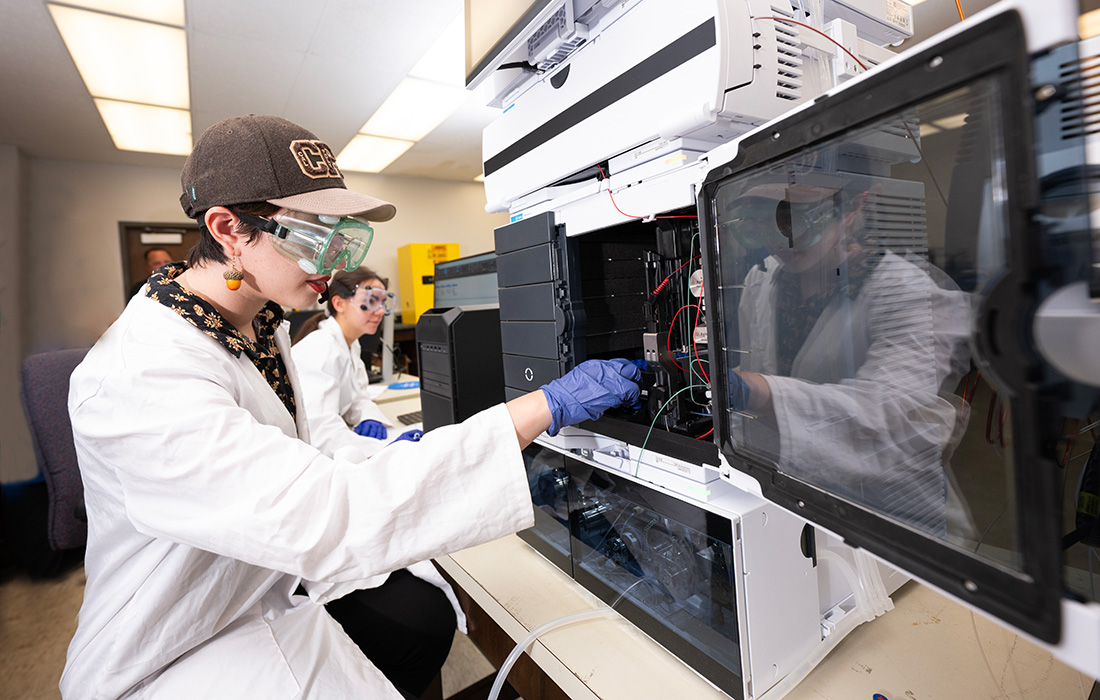
A state-of-the-art mass spectrometer installed in April at Cal Poly Pomona promises both cutting-edge technology for the university’s teaching laboratories and a regional service center that provides invaluable experience for students.
With applications spanning pharmaceutical research to environmental monitoring to food safety, mass spectrometers analyze materials to identify and quantify compounds and determine the structure and properties of molecules. For example, researchers use mass spectrometers to detect trace amounts of pollutants in water samples.
Cal Poly Pomona’s new instrument is actually three distinct pieces of equipment: a chromatography system, a high-resolution ion mobility spectrometer and a quadrupole time-of-flight mass spectrometer. The three components taken together make it one of the most advanced analytical instruments of its kind.
“This is not a standard teaching lab instrument,” said Gregory Barding, professor and chair of the Department of Chemistry and Biochemistry. “It can separate, detect, and identify molecules at extremely high precision, distinguishing very similar compounds and detecting trace-level signals that other systems miss.”
The new mass spectrometer is the foundation of a working laboratory that benefits the university as well as a host of partners and clients from across the region and beyond. Cal Poly Pomona faculty and researchers will have access to advanced analytical support for their grants and projects. Likewise, the new resource will be available to serve academic collaborators, public health agencies and environmental organizations across the Inland Empire and Southern California, as well as industry and community partners who need access to high-end analytical capability without sending samples out of state or to expensive commercial labs.
Perhaps the most unique aspect of the entire endeavor is that Cal Poly Pomona undergraduate students will be the ones doing the work. Under faculty supervision, students will run analyses on samples, interpret complex data and deliver professional-grade reports. In line with the university’s polytechnic advantage and comprehensive approach to student success, students will graduate having worked professionally on an instrument they would otherwise only encounter years later inside a top-tier pharmaceutical or biotech employer.
“We’re going to incorporate it into one of our teaching laboratories and the idea is that every student in our program will have access to this instrument,” Barding continued. “It’s not an elective. It's part of a required course. And according to the technicians from the manufacturer, we're the first institution in the Western Hemisphere that’s going to provide opportunities for undergraduates to be trained on it.”
The approximately $600,000 instrument was made possible by a historic act of generosity provided by philanthropist MacKenzie Scott. In 2021, Scott announced a $40 million unrestricted gift to Cal Poly Pomona, the largest donation from an individual in university history.
To advance the philanthropic vision and to steward the funds with responsibility, transparency and clarity, Cal Poly Pomona established the Bright Tomorrow Fund, designed to propel institutional priorities and expand opportunity for students. The university president allocated $20 million from the fund over a four-year period, from 2025 to 2029, to catalyze Cal Poly Pomona’s institutional philanthropic priorities: Future Paths, Emerging Technologies and Campus Modernization. These interrelated priorities align with the university’s Strategic Plan, Principles of Community and the university’s role as a steward of place.
“MacKenzie Scott specifically extolled higher education’s success in providing pathways to opportunity as the motivation for her gift to Cal Poly Pomona,” said Frances Teves, vice president for university advancement. “This sophisticated new technology not only serves as a unique resource for our faculty but also provides unparalleled opportunities for students.”