
Elders in Residence Pass Wisdom to The Next Generation

Through storytelling, ceremony and mentorship, Cal Poly Pomona’s Elders in Residence program, sponsored by Tribal Relations, supports future generations by helping them understand career pathways from a cultural perspective.
The program brings accomplished Native American leaders to campus to share their wisdom with current students. Learn more about how the role has impacted those who have served.
Building a Legacy of Native American Mentorship
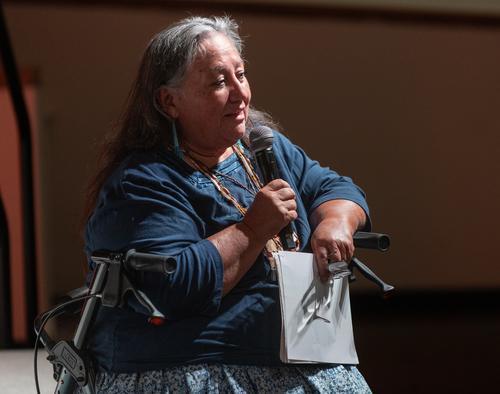 More than a decade ago, Cal Poly Pomona welcomed their very first elder in residence, Lorene Sisquoc (Mountain Cahuilla/Apache).
Sisquoc’s welcoming ceremony marked the beginning of a legacy of mentorship that has continued to blossom and support Native American students through graduation.
Before joining in 2015, Sisquoc spent more than three decades serving Native American communities. Her work began at Sherman Indian High School, where she worked as a dormitory staff member and trained under the guidance of Ramona K. Bradley, co-founder and curator of the Sherman Indian Museum.
She co-founded Mother Earth Clan Cultural Programs, serving as a volunteer curator and manager of the Sherman Indian Museum, and teaching Native American traditions and basketry.
At CPP, Sisquoc has met with many students. Sandy Kewanhaptewa-Dixon (Hopi), CSU representative and co-chair for the Cal Poly Pomona NAGPRA Committee, has noted that Sisquoc has helped students produce over 1,000 baskets. Each student begins with the basket reeds in hand and through guidance from Sisquoc, ends with a completed basket.
From Alumnus to Elder in Residence
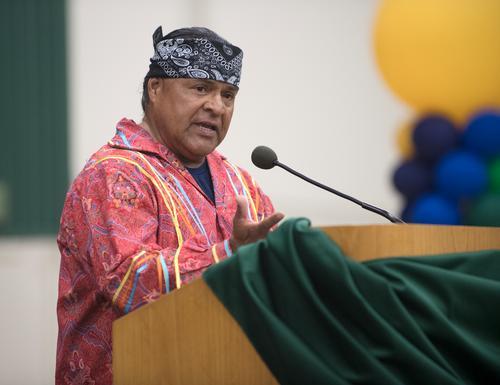 Kim Marcus (Serrano and Cahuilla) knows CPP from two different perspectives: first as a student (’82, accounting) and now as the university’s second elder in residence.
After building his career as a counselor with Indian Health Service and later as an educator, Marcus returned to CPP to share the cultural knowledge and traditions that shaped him.
Today, he offers workshops during the academic year and through the Natives Aiming to Inspire Values in Education (NATIVE) Pipeline Program, creating opportunities for students to learn from his experiences and connect with their own cultural identities.
Growing up, Marcus learned that Native American songs carry more than a melody. They carry history, prayer and memory.
The cultural knowledge Marcus received from his elders, combined with the lack of resources he saw during his time at the university, inspired him to join the Elder in Residence program. Now, he returns to the university to ensure students have access to the guidance, culture and community he values. Marcus has offered traditional welcome songs and blessings at several events on campus, including Fall Conference, Native American Student Center events and the Annual Harvest Dinner.
Exploring Native Culture and Identity
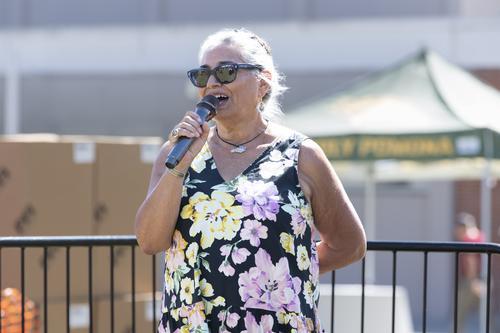 For Cindi Alvitre (Tongva), teaching has always been more than a profession. It has been a way to serve her community, share knowledge and help others better understand who they are.
After retiring from a career of more than 20 years teaching American Indian studies and anthropology and archeology at Cal State Long Beach, Alvitre accepted Kewanhaptewa-Dixon’s invite in August 2026 to join Lori Sisquoc and Kim Marcus as an elder in residence, expanding the knowledge of tradition ways of living and learning for students, staff and faculty.
Her connection to CPP began through the local tribal community and her basketry group, which meets at CPP’s Lyle Center. The connection eventually led her to meet Tribal Relations and NAGPRA/CalNAGPRA Director Desiree Martinez. Alvitre is thankful to have found a role that allows her to continue helping others explore Native culture and identity, the work she began in the classroom.
For Alvitre, teaching is a way to help students connect with who they are. She taught Native Americans students about their cultures while also inviting students from diverse backgrounds to learn about Native American traditions and explore the histories and cultural roots of their own communities. Her goal was to help students recognize the knowledge carried by their ancestors and understand how those teachings continue to shape their identities today.
Alvitre views being an elder as a service to her community. Through honest conversations involving indigenous cultures, sharing knowledge and lived experiences, she helps students understand their own identity and their relationship with the land.
“I think it’s important for students to understand, number one, who they are, to acknowledge themselves,” Alvitre said.
For Alvitre, understanding Native American identity also means recognizing the connection between Native American people and the natural world.
“They always say Native people are part of nature, but I say, ‘No,’ we are nature.”
Tribal Relations will host "An Evening with Our Elders" on Thursday, Dec. 3, from 5:30 to 8 p.m. in Building 66, room 101 right across the Bronco Bookstore. The campus community is invited. Refreshments will be served.