CPP Engineering Project Symposium and Showcase
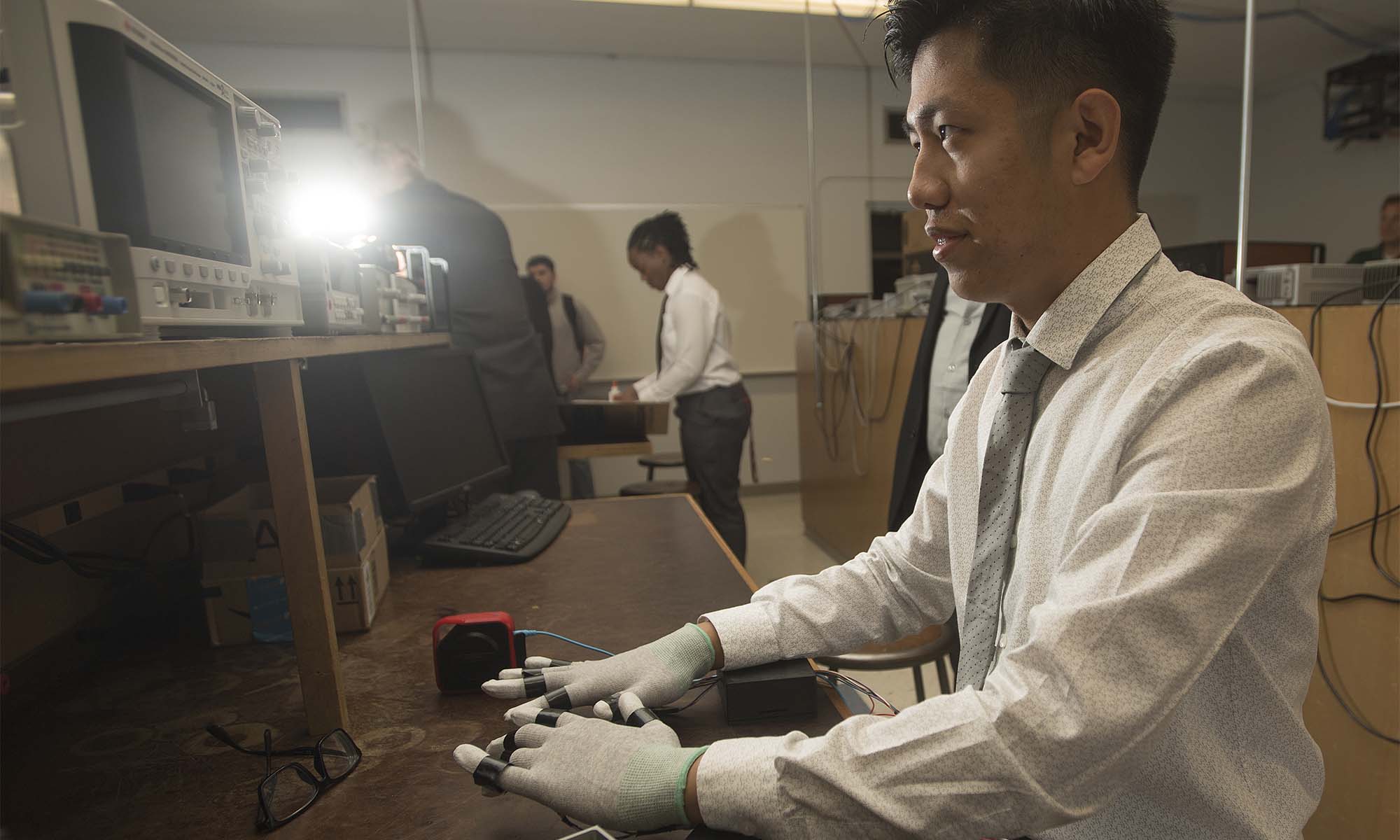
Slide1
An engineering student demonstrates his hand gesture-operated piano gloves, his team’s senior project at the Project Symposium in the College of Engineering.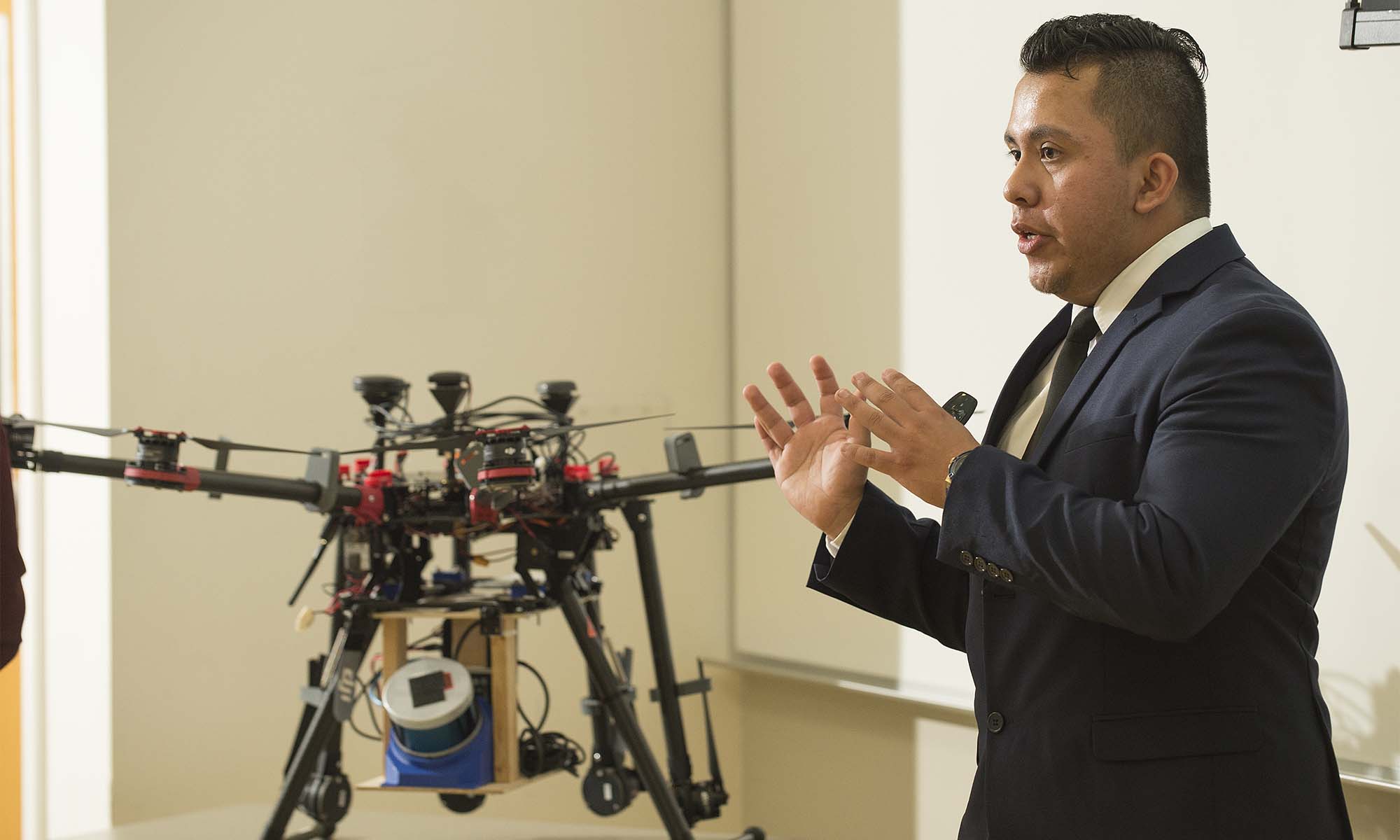
Slide2
An engineering student talks about his research into the use of LIDAR as a collision avoidance for unmanned aerial vehicles.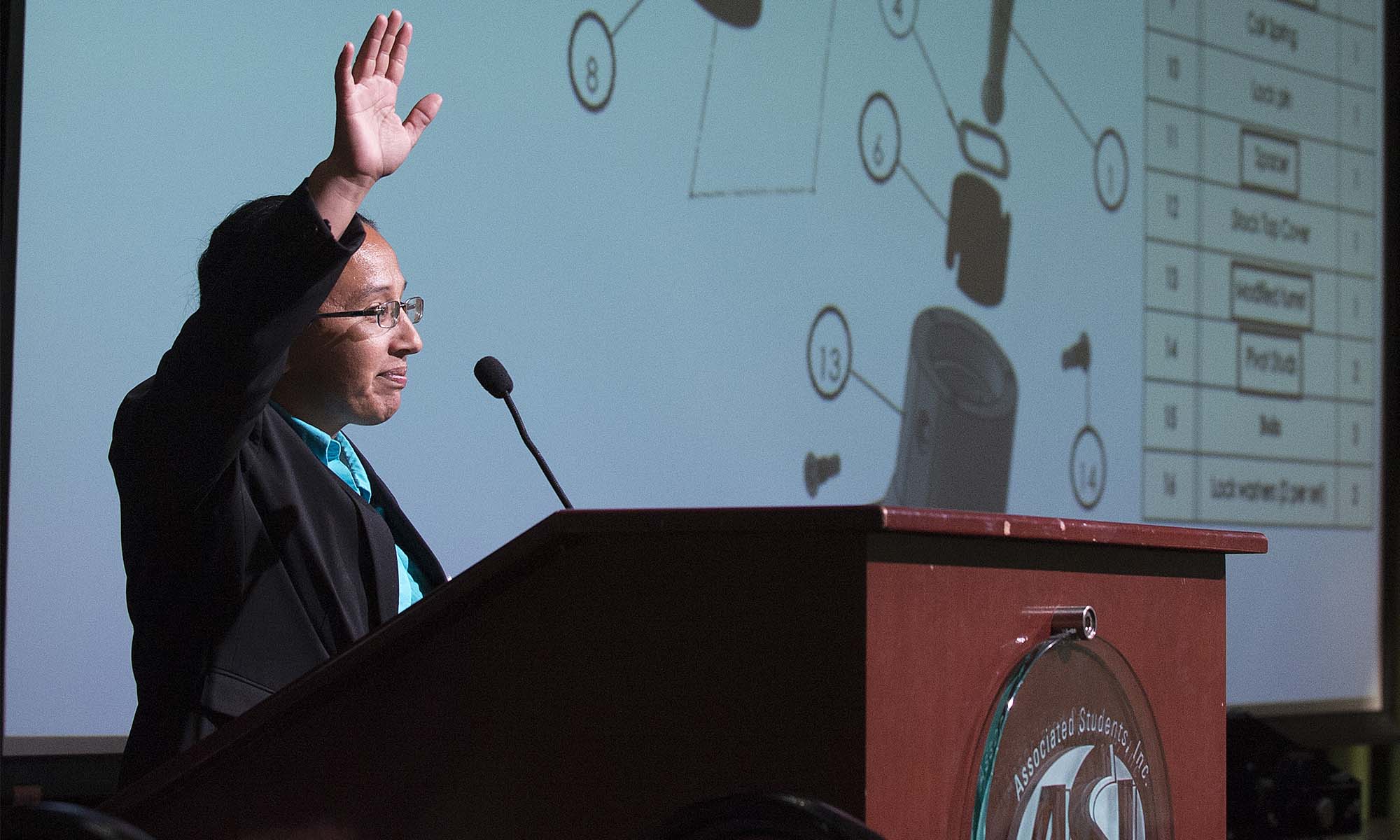
Slide3
An engineering student presents her team’s work on process improvements for cam gear and shifters. Behind her is a presentation with a diagram of a car part.2025 Project & Poster Sessions
7:30 AM – 7:50 AM @ 163-1015: Tiltrotor E-VTOL Vehicle with Distributed Electric Propulsion
Students: Gregory Saunders and Satya Patel (Leads), Jessica Escalante, Karla Amaya, Chad Timmons, Gwynn Oedell Sumagaysay, Byrn Kenriech L. Balangauan, Alisha Mehta
Advisors: Dr. Subodh Bhandari (ARO) and Prof. Tristan Sherman (ARO), Dr. Zekeriya Aliyazicioglu (ECE)
7:50 AM – 8:10 AM @ 163-1015: BANSHEE Inflight Recharging e-VTOL UAV
Students: Kai Arellano (Lead), Kai Arellano, Ethan Ballard, Juan Bosque, Matthew Cha, Paden Hall, Isaac Khan, Joshua Lazzarini, Jaime Miranda, Daniel Paek, Stéphie Soloarivony, Amirreza Yazdanfar, Aaron Zuckerman, Aidin Weissler
Advisors: Prof. Steven Dobbs (ARO) & Dr. Zhen Yu (ECE)
8:10 AM – 8:30 AM @ 163-1015: Design, Build, and Test of Toroidal Propellers Including Use of Biomimetics
Students: Joshua Sanford (Lead), Kevin Carrera, Bryan Giron, Owen Gray, Angel Juarez, Gabby Sanchez, Dylan Valencia, Julian Vasquez, Natalie Vieyra, Juan Zaragoza
Advisor: Dr. Ali Ahmadi (ARO)
8:30 AM – 8:50 AM @ 163-1015: Aerodynamic Advantages of a Modern Blended-Wing-Body Design over a Conventional one for a Commercial Jet Transport
Students: Anthony Gonzalez, Paden Hall, Arriana Brumley; Advisor: Dr. Ali Ahmadi (ARO)
8:50 AM – 9:10 AM @ 163-1015: Collaboration between Unmanned Aerial and Ground Vehicles for Search & Rescue Missions
Students: Timothy Galvan (Lead), Arya Javaheri, Jonathan Kim, Brian Norman, Diego Urias, Felix Rivera, Brandon Hernandez, Zak Hoover, Ricky Jimenez
Advisors: Dr. Subodh Bhandari (ARO) and Dr. Zekeriya Aliyazicioglu (ECE)
9:10 AM – 9:30 AM @ 163-1015: Particle Imaging Velocimetry Flow Imaging System Research in the CPP Low Speed wind Tunnel
Students: Alexandro Pedroza, Artin Khodaverdian, Connor Mustar, Eran Dutt, Esteban Alderete, George Torres, Hakop Sinanian, Henry Chen, Jose Vasquez Rosales, Josselyn Saucedo, Kian Navid, Lik Hua, Liu Leonardo, Nick Della Rocco, Nickolas D'Ambrosio, Nicole Starkman, Paden Hall, Will Gamelin
Advisors: Prof. Steven Dobbs and Prof. Charlie Royas
9:30 AM – 9:50 AM @ 163-1015: AIAA Design, Build, Fly (DBF) Competition
Students: Jordan Van (Lead), Bryce Schinke, Cristian Diaz, Emanuel Sanchez, William Song Kim, Matthias O'Reilly, Sanli Tyndal, Christian Covarrubias, Miles Bayley, Allison Hongo, Imaad Rana, Michelle Correa, Ryan Driessen, Andrew Avila, Sebastian Liong, Mia Zavala, Alex Boghossian
Advisor: Dr. Subodh Bhandari (ARO)
9:50 AM – 10:10 AM @ 163-1015: Robonation Student Unmanned Aerial System (SUAS) Competition
Students: Matthew Romero-Cornejo (Lead), Federico Serrano, Leo Chen, Justine Gayle Gabuya, Thien Nam Anh Vu, Waamiq Sharrar, Issac Gutierrez, John Fernandez, Max Gross, Kevin Kopcinski, Edgar Ortiz, Amrita Sneha Ramakrishnan, Ethan Mckendell, Ethan Ngo, Andrew John Valdez, Annika Ruggles, Jimmy Nguyen, Ryan Tran, Hannah Hornung, Elias Diosdado, Federico Serrano, Danielle King, Alissa Everman, Ricardo Paz, Adrian Spitzzeri, Lizeth Gallegos, Stephen Posner, Sergio Jimenez, Jack Najarian, Carlo Maldonado
Advisors: Dr. Subodh Bhandari (ARO) and Dr. Zekeriya Aliyazicioglu (ECE)
10:10 AM – 10:30 AM @ 163-1015: Autonomous Coordination betweeen Multiple UAVs for Search & Rescue Missions
Students: David Espana (Lead), Miguel Cabrajal, Janice Rivera, Kevin Bolanos, Rexley Tsui, Andy Ho, Jose Castro, Kassandra Avelar, Jorge Rodriguez, David Siagian, Joseph Moran, Alan Mac, Jasper Liu
Advisor: Dr. Subodh Bhandari (ARO), Dr. Zekeriya Aliyazicioglu (ECE)
10:30 AM – 10:50 AM @ 163-1015: E-VTOL Aircraft for Disaster Response- GoAERO Prize Competition
Students: Manuel Kourkounian, Daniel Klein, Vahagn Hayrapetyan, Ian Chu, Rudy Barragan, Victor Orduno
Advisors: Mark Gonda, Subodh Bhandari, Mozammal Chowdhury, Tristan Sherman (ARO)
7:30 AM – 7:50 AM @ 163 - 1029: Zenith: Spaceport America Cup Competition
Students: Marie Christine Galvan (Team Lead), Rio C. Crowfoot, Alex Walsh, Andre Melchor, Aynett Zelaya, Britney Monsalvo, Camille Clerc, Christopher Lynn, Colin Shapourmanesh, Thomas Dodge, Victor Orduno
Faculty Advisor: Dr. Subodh Bhandari
7:50 AM – 8:10 AM @ 163 - 1029: Bronco 1 Launch Vehicle
Students: Lerna Eiesagholian (Team Lead), Charles I. Johnson, Jakub Krajewski
Faculty Advisor: Frank Chandler
8:10 AM – 8:30 AM @ 163 - 1029: Zeus-Turbopump Liquid Rocket Engine
Students: Team Lead: Phillip L. Lee; Jackson Quang, Lizette Susana Villar, Andre L. Dumas, Daya Zavolokina, Eric Argueta, Osheen Gupta
Faculty Advisor: Frank Chandler
8:30 AM – 8:50 AM @ 163 - 1029: Student Ion Propulsion Design Project (SIPDP)
Students: Team Lead: Natalie Cruz; Brian A. Reyna Mota, Elmer J. Portillo Pacheco, Shivam Shah
Faculty Advisor: Pejman Akbari
8:50 AM – 9:10 AM @ 163 - 1029: CubeSTEP Cerberus Mission Design
Students: Susana I. Padilla (Team Lead), Lucas D. Mcgarity, Dylan L. Vogel, Harout Boyajian, Nicholas J. Witucki, Kyle T. Yang, Bijou B. Raj, Kaitlyn R. Bryer, Andre Melchor;Matthew J. Casillas
Faculty Advisor: Navid Nakhjiri and Marco Maggia; Industry Sponsor: NASA, JPL
9:10 AM – 9:30 AM @ 163 - 1029: CubeSTEP Cerberus Flight System Design
Students: Andrew J. Adams (Team Lead), Ali H. Ahmad, Adam S. Donis, Roland Nguyen, Matthew C. Sieger, Nicholas A. Lopez, Dustin Duke, Civena Jomo, Shamim Tehraniha, Diana P. Quezada, Helen G. Schwartz, Gabriel S. Di Ciaccio;
Faculty Advisor: Navid Nakhjiri and Marco Maggia
Industry Sponsor: NASA, JPL
9:30 AM – 9:50 AM @ 163 - 1029: S-Kubed: Advancing Small Satellite ADCS Testbed with Integrated Helmholtz Cage and Sun Simulator
Students: Justin Millsap (Team Lead), Matthew Portugal; Andre Turpin, Elijah Sanchez, Jaden Totilaz, Kevin Bowman, Ethan Cascio, Jonathan Chacon, Pavel Marquez, Khan Nguyen, Daniel Panameno, Johnson Lam, Melissa Shaw, Stephanie Torres, Emily Truong, Diego Urias, Eric Valenzuela, Randy Vazquez
Faculty Advisor: Marco Maggia
9:50 AM – 10:10 AM @ 163 - 1029: UMBRA Exo-Bronco: A Reusable Two-Stage Launch Vehicle for Advanced Flight Dynamics and Recovery Systems
Students: Haochuan Lin (Team Lead), Caleb Yoon, Kiefer Luken, Shwetank Bhat, Adrien Chang, Adrian Spitzzeri, Ty Claire, Shridhi Seth, Aivie Quinto
Faculty Advisor: Marco Maggia
10:10 AM – 10:30 AM @ 163 - 1029: UMBRA Inferno: A Modular Test Stand and Regenerative Liquid Rocket Engine Development Platform
Students: Reyes Cabral (Team Lead), Nestor Rizo, Emily Millward, Parsa Pakdel, Lerna Eiesagholian, Jacob Showman, Simon Uttam
Faculty Advisor: Marco Maggia
10:30 AM – 10:50 AM @ 163 - 1029: UMBRA SpeedRacer: Student-Led Hypersonic Vehicle Development for Mach 5+ Flight
Students: Enzo Nelligan (Team Lead), Tori Roaf, Ian Byres, Nathaniel Aud, Gabriel Grieger, Tim Bogman, Garrett Spearow, Ryan Lee
Faculty Advisor: Marco Maggia
9:00 AM – 9:15 AM @ 17-2123: Design and Performance Evaluation of a Fluidized Bed for Powder Processing
Students: Jesus Zavala, Kevin E. Simmons, Wisam Hagsaleh, Viet Vu
Advisors: Dr. Laila Jallo, Dr. Marta Amirsadeghi, Dr. Christianto Wibowo
9:15 AM – 9:30 AM @ 17-2123: Process Optimization and Reaction Kinetics in Soybean Oil-Based Biodiesel Production
Students: Amanda C. Snow, Roy R. Dutkiewicz, Aarha S. Bhoot, Arielle Rendon, Aaron M. Mcelrea
Advisors: Dr. Laila Jallo, Dr. Marta Amirsadeghi
9:30 AM – 9:45 AM @ 17-2123: The Effect of Varying Sintering Temperatures on Ti-C Coatings for Efficient Oil/Water Separation
Students: Sonia Egenburger, Claudia Wong, Logan Lu, Kayla Laguana
Advisors: Dr. Mingheng Li
Sponsors: CSU COAST
9:45 AM – 10:00 AM @ 17-2123: A comprehensive comparison of biowaste processes: advantages of hydrothermal carbonization over conventional processing methods.
Students: Kayla Laguana, Sonia Egenberger, Gladys Martinez Franco
Advisors: Dr. Mingheng Li
10:00 AM – 10:15 AM @ 17-2123: The Effects of Transition Metal Doping on ZSM-5 in the Thermal Decompostion of Polypropylene into Crude Oil
Students: Vanessa Velasco, Kelcey Velazquez, Dominic Gogue, Jack Tobin, Liam Taylor
Advisors: Dr. Mingheng Li
Sponsors: ACS PRF
10:30 AM – 10:45 AM @ 17-2123: Assessing Reverse Osmosis Membrane Health Using Computational Analysis and Machine Learning Tools
Students: Gladys Martinez Franco, Logan Lu, Jeffrey Naydin, Christian Solis
Advisors: Dr. Mingheng Li
Sponsors: NSF
10:45 AM – 11:00 AM @ 17-2123: Machine learning modeling of band gap for photovoltaic applications
Students: Ashley Garcia, Aldo Romanos, Cindy Rubio-Carrillo
Advisors: Dr. Huseyin Ucar
11:00 AM – 11:15 AM @ 17-2123: Machine learning modeling of superconducting critical temperature
Students: Otto Saiki, Julia Tetrault, Andrew Dao
Advisors: Dr. Huseyin Ucar
9:00 AM – 9:15 AM @ 17-2133: Image Segmentation by Neural-network Model – Data Generation and Augmentation
Students: Luz E. Gonzalez, Amanda A. Baur, Giovanni Yanez, Jesse Ramirez
Advisors: Dr. Jonathan Puthoff
9:15 AM – 9:30 AM @ 17-2133: Image Segmentation by Neural-network Model – Model Development and Training
Students: Valerie F. Menna, Thi N. Tong, Daniel Gamino, Kevin Sarabia
Advisors: Dr. Jonathan Puthoff
9:30 AM – 9:45 AM @ 17-2133: Pack Aluminizing of Selected Austenitic Stainless Steels
Students: Bryan Posada, Jocasta Do, Narek Teimourian, Azure Heirshberg
Advisors: Dr. Vilupanur Ravi
9:45 AM – 10:00 AM @ 17-2133: Electrochemical Characterization of Nickel Chromium Alloys in a Molten Salt
Students: Kasandra Ortiz, Kimberly Gaspar, Landon Trinh, Brandon McDonald
Advisors: Dr. Vilupanur Ravi
10:00 AM – 10:15 AM @ 17-2133: Electrochemical Characterization of Additively Manufactured Al 7050 in a sodium chloride solution
Students: Benjamin Fujii, Kanon Klassen, Matthew Sianarta, Erica Washington
Advisors: Dr. Vilupanur Ravi
10:30 AM – 10:45 AM @ 17-2133: Enhancement of Lithium Ion Battery Performance by Design Paramter Optimization
Students: Alexandria Estrella, Osvaldo Hernandez Maldonado, Henry Kim, Caitlyn Loi, Jovani Melendez, Hao Jie Mo, Bara Nabhani, Eamonn Ryan
Advisors: Dr. Lloyd Lee
10:45 AM – 11:00 AM @ 17-2133: Evaluating Faujasite Zeolite Framework as a Drug Carrier for Indomethacin
Students: Alyssa Tran, Roberto Perez, Yuseli Pelico Gozalez
Advisors: Dr. Laila Jallo, Dr. Chantal Stieber, and Dr. Moises Bravo
11:00 AM – 11:15 AM @ 17-2133: Process Design and Optimization of an Ibuprofen (API) Manufacturing Plant
Students: Alexander Nava, Alexis Ortiz, Brandelyn Mariner, Jusurjon Ayubov, Mathieu Reyes, Raquel Mendez
Advisors: Dr. Laila Jallo, Dr. Marta Amirsadeghi, Dr. Christianto Wibowo, and Dr. Jia Li
11:15 AM – 11:30 AM @ 17-2133: 3D Visualization and Design of Industrial Process Equipment for Chemical Engineering
Students: Vinh Phuc Nguyen, Jesus Zavala
Advisors: Dr. Laila Jallo, Dr. Marta Amirsadeghi
8:20 AM – 9:00 AM @ 163-2005: Sustainable Ground Improvement
Students: Abdulkarim, Anas Hasan Bates, Celine Joyce Centeno, Ricardo Cespedez, Cesar Fodor, Benjamin Michael Guzman, Melissa Kohankhaki, Hanieh Lara, Manuel Ignacio Lee, Joshua Alex Ma, Kim Yingming Montoya, Marc Andrew Pham, Vince Quang Stanikzai, Shir Shah
Advisors: A. Shafiee (CPP), S. Ariannia (Geo-Advantec), Bailey Uy (Keller)
Description/Abstract: This project focuses on sustainable ground improvement techniques for a site located on liquefiable soils. Students will explore the design of various foundation types, including shallow foundations, deep foundations (such as piles), and stone columns. Their design approach will adhere to the latest standards and codes, including CBC 2022, AASHTO (2020), CALTRANS (2023), ASCE 7-16/22, and FHWA guidelines. Additionally, students will develop proficiency in using software programs such as Cliq, LPILE, Settle3, and RAM Concept. The project benefits from collaboration with an industry partner, enhancing students' ability to achieve the project objectives. CEM students are also required to perform estimating, scheduling, life cycle analysis, and develop a 4D model of the project.
8:20 AM – 9:00 AM @ 163-1004: Practical Design-Build Project of Reinforced Concrete Parking Structures
Students: David Angel, Erc Arballo, Robert Delatorre, Jackie Guan, Ethan Ho, Deigo Kontorovsky, Shao-Wen Larios, Nathan Lopez, Kimberly Maldonado, Evelyn Moreno, Joseph Orozco, Kenton Trinh, Justin Vega, Michael Velado, James Villalobos
Project Advisor: Prof. Lisa Wang, Ph.D, P.E.
Description/Abstract: This senior project consists of planning, designing and building a large-scale parking garage (2500 parking spaces). The scope of the project includes structural design and foundation design using the current building code, as well as traffic design (internal and external circulations). The traffic circulation and layout are crucial to a functional parking garage. Both the gravity and lateral load resisting systems were selected and designed accordingly. The ideal size of structural bays was used for maximum number of parking spaces and flow of automobiles dependent upon site and structural systems. The project cost estimating and scheduling were also completed as a part of the project’s scope.
8:20 AM – 9:00 AM @ 163-1032: Bronco Innovation Center
Students: Julian Maldonado, Youssef Darwiche, Omar Espino, Isaac Olalde, Rigoberto Romero, Amy Gilbert, Sebastian Lopez, Ryan Cobb, Yesenia Tlaseca, Cory Chagolla, Cameron Valenzuela, Mohammad Uddin, Eidy Escobedo, Jesus Hernandez, Abraham Hinojosa.
Advisor: Dr. Hovel Babikian
Description/Abstract: Cal Poly Pomona is expanding to meet the needs of its growing student population by developing a multi-functional student hub and a campus retail center. Designed to enhance campus life, this project will provide essential resources for students, including study areas, social spaces, a state-of-the-art gym, and a modern child development center. The student hub will feature collaborative and private study zones, lounge areas, conference rooms, and a balcony for open-air refreshment, all designed to foster academic success and community engagement. The child development center, strategically relocated to the front of campus, will offer improved accessibility, a new playground, and a welcoming environment for student parents. Complementing these spaces, the retail center will bring convenience to students and faculty by offering a grocery market, dining options, and essential services within walking distance of academic buildings. Sustainable design elements, such as low-E glass curtain walls for natural lighting and energy efficiency, will enhance the environmental performance of the new structures. Additionally, the project includes a three-story underground parking structure and egress pathways to support accessibility from all areas across campus. This initiative is a strategic investment in student well-being, providing a dynamic space for learning, networking, and relaxation while reinforcing Cal Poly Pomona’s commitment to sustainability and innovation. By integrating modern design with practical functionality, the project will enrich the student experience and serve as a cornerstone for the university’s evolving campus community.
8:20 AM – 9:00 AM @ 163-2027: College of Engineering Visionary Hall Design - Sustainable Mass Timber Construction
Students: Abboushi, Abdulrahman Nino, Britt, Hunter Thomas, De La Hoz, Garcia, Gina Paola, Fahmi, Andro Somaweil, Gutierrez, Andrea Guadalupe, Huerta, Fernando, Hui, Mindy Tin Mun, Javier, Daryl Kae R, Montelone, Michael, Nemri, Fadi, Nguyen, Thy, Rallo, Tristan, Ramos, Ellyka Mae Jacob, Robles, Antonio, Romero, Fernando Jose, Whatley, Justin Stephen.
Advisor: Mikhail Gershfeld
Description/Abstract: The proposed College of Engineering Visionary Hall at Cal Poly Pomona is a proposed innovative and dynamic space for fostering collaboration, creativity, and advanced learning in the fields of engineering and design. The building features state-of-the-art laboratories, classrooms, and student projects workspaces. The building design integrates modern technologies and sustainable design principles with the goal of meeting living building challange. The building is designed to enhance user experience, creating spaces that prioritize the needs of students, faculty, and staff. The architectural design incorporates natural light, open spaces, and green building features. The sustainability is showcased through the use of mass timber to minimize embodied energy and to demonstrate the versatility of engineered wood. The integrated bridge and canopy over exisitng building highlights innovative structural solutions that blend functionality with aesthetic appeal. The areas for study, teamwork, and relaxation are thoughtfully designed to promote well-being and engagement. Sustainable features, such as energy generation, energy-efficient systems contribute to a healthy environment. The building is crafted to inspire creativity and innovation while offering a supportive, user-friendly experience that encourages productivity and interdisciplinary collaborations.
9:05 AM – 9:45 AM @ 163-2005: Lyle Center Stormwater Improvements
Students: Susan Giang (Project Manager), Miriam Collazo (Assistant Project Manager), Colton Pietila (Hydrology Team Lead), Diana Maniacop (Environmental Team Lead), Christopher Kao (Outreach Team Lead), Alyssa Arana (Outreach), Jessica Wang (Outreach), Isaac Kim (Hydrology), Chris Landin (Hydrology), Alexander Lam (Hydrology), Ingrid Camacho (Environmental), Kimberly Estabillo (Environmental), Ryan Huang (Environmental)
Advisors: K. Majid Sadeghi, Ali Sharbat
Description/Abstract: WaterWise CPP aims to showcase the impacts of green stormwater infrastructure (GSI), low impact development (LID), and nature based solutions for treating storm runoff, while providing an educational space for students, faculty, and the community to gather.
9:05 AM – 9:45 AM @ 163-1004: Design of Sustainable & Affordable Residential Buildings
Students: Maysa Barakat, Diego Buenrostro, Johnathan Bustillos, Jenny Castro, Matthew Duong, Mikayla Escobar, Joshua Fegalquin, Camryn Gabor, Cage Knorr, Jib Lodhi, Lucia Matos, Alan Medel, Madison Rabina, Yecenia Ramos Baltazar, Naythan Salas, Dianna Villasenor, Da Eum Yoon, Advisor: Sunai Kim
Description/Abstract: This project focused on designing sustainable and affordable, prefabricated residential house. The main goal was to address two increasingly important matters: (1) the lack of affordable housing in California and (2) ways to implement more sustainable practices to respond to global climate change. The project was broken down into various disciplines and tasks, such as Literature Review, Sustainable Design Certification Considerations, Architecture and Interior Design, Construction and Engineering, Sustainability and Life Cycle Analysis, and Market Potential. The students worked on the tasks individually as well as collectively to apply and integrate their combined knowledge they have gained during their undergraduate academic careers to real-world issues. The students designed four accessory dwelling unit (ADU) homes of various sizes, in Southern California. All designs will achieve a rating Leadership in Energy and Environmental Design (LEED) rating, are net-zero energy, and contributes to significant water conservation. These improvements were then compared to a traditional, timber-framed home to evaluate the pros and cons of all designs. In the fall semester, students collaborated with an architecture professor and an industry professional (code compliance check) to receive feedback. The students went on two field trips: (1) Santa Monica City Hall East (government building that was built to the Living Building Challenge standards), to learn more about sustainability in the fall semester and (2) Silvercreek Modular in Perris, CA (prefabricated construction factory) to learn about mass production of homes, which can cut costs in construction.
9:05 AM – 9:45 AM @ 163-1032: Paving the Future: Improving Connectivity at Kendall & Palm
Students: Carlos Aldaco, Anna Cuellar, Allen Diep, Rona Essayli, Karina Hernandez, Sasayan Kaliugavarathan, Joseph Kolta, Arman Maheronnaghsh, Frances Osayamwen, Ethan Rama, Yuminnie Rodriguez, Shin Shirakawa, Chase Simpson, Noua Vang
Sponsors: CalTrans District 8
Description/Abstract: Traffic congestion and safety concerns are prevalent issues at the intersection of Kendall Drive and Palm Avenue in San Bernardino. This project focuses on designing new on and off ramps to enhance traffic flow, improve accessibility, and ensure safer conditions for all commuters. Our design includes better lane configurations, smoother merging areas, and improvements in signal design. By using industry standards, we aim to create a practical and sustainable solution that benefits both commuters and the community.
9:05 AM – 9:45 AM @ 163-2027: Net Zero Carbon Concert Hall - SIK structures
Students: Ryan Gauthier, Alex Cabunoc, Joseph Reynoso, Julian Montesdeoca, Derek Palacios, Evan Wright, Erica Jwijat, Kevin Ortiz, Nicko Soliman, Erika Rubio Nunez, Josue Mayorga, Lily Cordero, Rovida De Vera
Advisors: Dr. Giuseppe Lomiento, Dr. Ghada Gad Sponsor/Mentor: MATT Construction
Description/Abstract: This senior project emphasizes interdisciplinary collaboration between Civil and Construction Engineering students, aligning with industry trends in Design-Build project delivery. The team was tasked with designing the Orange County Net-Zero Carbon Concert Hall, a high-performance venue designed to offset its annual operational carbon footprint through sustainable design and energy efficiency. The project began with a detailed analysis of the Request for Proposals (RFP), leading to the development of a comprehensive structural and construction plan. Civil engineering students focused on geotechnical analysis, foundation and structural design, and architectural planning, while construction engineering students managed estimating, scheduling, feasibility studies, and risk management. Sustainability remained a core objective, with strategies such as solar energy integration, advanced HVAC systems, and low-carbon materials incorporated to meet LEED Gold certification requirements. To enhance functionality, the team introduced Alternative Technical Concepts (ATCs), including a sustainability exhibit, a premium club area, and a daycare, all designed to improve the guest experience and maximize revenue potential. By utilizing BIM and Procore, the team ensured seamless coordination between design and construction, enhancing efficiency and minimizing conflicts. This project provided valuable hands-on experience in structural design, sustainability, and construction management, equipping students with practical skills for careers in the built environment. The Orange County Concert Hall serves as a testament to the team's ability to develop innovative, real-world solutions for net-zero carbon infrastructure.
9:50 AM – 10:30 AM @ 163-2005: Infiltration Design along Plunge Creek, Highland CA
Student Team: Matthew Romero (PM); Samantha Santoro Flores (Assistant PM); Matthew Romero (Project Manager), Samantha Santoro Flores (Assistant Project Manager), Luis Aguilar, Jeffrey L. Bearden, Carlos P. Bobadilla (Geospatial Team Lead), Kiara N. Cruz (Geotechnical and Environmental Team Lead), Lam Doan, Adam Doverspike, Adam K. Erickson (Hydraulics Team Lead), Olivia Faye, Maryo A. Hakim, Safiya M. Hassan, Joe Kebbeh (Hydrology Team Lead), Nguyen Pham, and Shane V. Santos
Advisors: Seema C. Shah-Fairbank
Industrial Advisors: Joseph & Jacob Castaneda JLC Engineering and Consulting Inc., Tom Ryan Q3 Consulting, Michael Fam Riverside County Flood Control, and Hans Ferrel Tolksdorf Kleinfelder
Project Client: Betsy Miller and John Lambie from San Bernardino Valley Water Conservation District
Description/Abstract: San Bernardino Valley Water Conservation District is looking to reduce its dependency on imported water and develop a local approach to water supply. The objective of the Infiltration Design along Plunge Creek project is to design a groundwater infiltration system that assists in increasing local water reliability by reducing the need for imported water. This is being accomplished by diverting streams flow from Plunge Creek into a future infiltration basin. The interdisciplinary team consisted of geospatial, geotechnical, environmental, hydrology, and hydraulics engineers to bring this project to fruition. Through the project students will:
• Determine the site location for the groundwater infiltration project along Plunge Creek;
• Evaluate the soil to determine soil properties, any limiting zone depths, and infiltration rates;
• Perform a hydrologic analysis using design return intervals and gage data;
• Develop a hydraulic model of Plunge Creek which will include sediment analysis;
• Design alternative to divert flows from Plunge Creek to the project location;
• Design alternatives for a pre-treatment and groundwater infiltration system;
• Develop a subgrade design of the system that includes the structural stability of the soil;
• Develop an overall site-specific design plan, with roadway access and grading; and
• Develop a maintenance and operation plan to extend the overall performance of the system.
The team collaborated throughout the project with industry professionals, receiving feedback from technical support advisors and the client, San Bernardino Valley Water Conservation District. They have developed a final product for SBVWCD, that looks a developing sustainable solution to water supply.
09:50 AM – 10:30 AM @ 163-1004: Rose Garden Rehabilitation I
Students: Oscar Arellano, Wilver Arita Quezada, Bradley Baker, Quinn Benitez, Levi Dominguez, Sambram Espinoza, Bryant Funez, Fabian Garcia-Alvarez, Joel Garcia, Isabell Gutierrez, German Jara, Dulce Jazmin Jurado, Richard Le, Joey Li, Oscar Lopez, Maximiliano Michel, Natalie Nguyen, Edmund Yeboah
Advisors: Dragos Andrei and Siddharth Banerjee
Description/Abstract: Cal Poly Pomona’s Rose Garden is a cherished landmark on campus, featuring several structures and walkways in need of restoration. After a thorough assessment, students developed various rehabilitation and improvement strategies for the gazebo, walkways, and restroom at the site. Several of these proposed strategies were implemented in the project’s second phase.
09:50 AM – 10:30 AM @ 163-1032: I-15 Interchange Improvement Project: Temescal Canyon Road and Bundy Canyon Road
Students: Defeng Chen, Diego Simmonds, Angela Watkins, Kaylynn Huynh, Iram Rahman, Charles Tran, Jose Cabezas, Riley Mitchell, Yanetzy Rodriguez, Alvin Han, Brandon Nguyen, Azriel Olmedo, Dania Shaker, Vincent Truong, Samuel Kala, Jenny Nguyen, Sebastian Echeverri, Avery Patrick, Isaac Lee, Leslie Valencia
Advisors: Yongping Zhang, Justine Niu, Jason Collado
Sponsor: Caltrans District 8
Description/Abstract: This project aims to enhance the I-15/Temescal Canyon and I-15/Bundy Canyon interchanges to accommodate traffic needs, maintain an acceptable level of service, and improve bicycle and pedestrian facilities to support multimodal transportation. Given the anticipated development in these areas, it is critical to ensure these interchanges can handle future traffic demands while incorporating complete street elements. The project follows the K Phase of the Caltrans Project Development Process, corresponding to the Project Initiation Document (PID) phase. The traffic analysis considers three key milestones: the base year (2019), opening year (2035), and horizon year (2055). Through comprehensive traffic and environmental analyses, the team has developed two design alternatives for each interchange: I-15/Temescal Canyon Interchange: Lane widening and a Hook/Cloverleaf hybrid. I-15/Bundy Canyon Interchange: Lane widening and a Diverging Diamond Interchange (DDI). A final recommendation will be determined using a decision matrix that evaluates multiple factors, including traffic impact, environmental considerations, design feasibility, cost, and safety. The objective is to deliver a well-researched preliminary plan that enhances these interchanges' functionality, efficiency, and long-term sustainability.
09:50 AM – 10:30 AM @ 163-2027: The Net-Zero OC Pearl Concert Hall
Students: Isabella Lazaro, Rianne Joy Enguancho, Sheryl Reyes, Eduardo Martinez, Dominic Estrada, Jakob Bailey, Matthew Perez, Ayema Hussain, Vincent Johnson-Lee, Geeo Barrios, Gabriela Sigala, Ricky Garcia, Tsu Chang,
Advisors: Ghada Gad, Giuseppe Lomiento
Sponsor/Mentor: MATT Construction
Description/Abstract: The Net-Zero OC Pearl Concert Hall is a design-build senior project, completed by the student team, Legacy Incorporation, promoting collaboration between civil and construction engineering. Focused on sustainability, the OC Pearl achieved net-zero energy and net-zero carbon goals, aligning with global efforts toward carbon neutrality. In addition, LEED Platinum was achieved, further showcasing the ability to integrate sustainability in future construction work. The design process for this project included geotechnical investigations, structural analysis, and architectural renderings, with an intricate roof design resembling a seashell, requiring advanced structural modeling. Many aspects of construction management were utilized, including scheduling, estimating, constructability reviews, feasibility analysis, and risk management. In order to balance feasibility with the desired aesthetics of the hall, seamless collaboration and communication between design and construction was key to success. This project replicated real-world industry procedures and practices, undergoing the full project lifecycle. In the first semester, the bidding process was completed, with 40% design complete and a preliminary estimate, schedule, and 2 alternative technical concepts proposed to enhance the owner’s vision for the concert hall. The second semester simulated the design-build construction phase, where both design and construction overlapped. Weekly project progress updates were given, where roughly 2 months of construction was shown through renderings and schedule updates. Challenges occurred often due to design delays, promoting a need for creative thinking and working together in order to mitigate the problem. By integrating sustainability, engineering, and construction management, the Net-Zero OC Pearl Concert Hall replicates the teamwork, forward-thinking, and experience seen in both the civil and construction engineering industry.
10:35 AM – 11:15 AM @ 163-1004: Rose Garden Rehabilitation II
Students: Alberto Acevedo, Rene Borja, Erik Carver, Ian Cordova, Nebonid Dooman, Jimmy Duran, Sebastian Enriquez, Germayn Gomez, Sonja Kozak, Jerry Lozano, Rayan Malik, Alexis Michel, James N. Nguyen, Joaquin Orellana, Justin Pagura, Dean Pulido, Alejandro Quijano, Nicole Rasmussen, Jonah Saad, Kashyap Shah
Advisors: Siddharth Banerjee and Dragos Andrei
Description/Abstract: Cal Poly Pomona’s Rose Garden is a cherished landmark on campus, featuring several structures and walkways in need of restoration. After a thorough assessment, students developed various rehabilitation and improvement strategies for the gazebo, walkways, and restroom at the site. Several of these proposed strategies were implemented in the project’s second phase.
9:00 AM – 9:15 AM @ 9-409: Solar Sunshade with AC
Students: Author: David Nuckolls
Advisor: Dr. Tim Lin
Description/Abstract: Create a Solar power Sun Shade that will power an external AC unit for a car.
9:20 AM – 9:35 AM @ 9-409: MRI IMAGE ENHANCEMENT AND DISEASE CLASSIFICATION USING DEEP LEARNING
Students: Author: Jacky Li
Advisor: Dr. Tim Lin
Description/Abstract: Use deep learning and computer vision to enhance MRI image quality and classify brain tumors (glioma, meningioma, pituitary, and no tumor) to assist in medical diagnosis.
9:40 AM – 9:55 AM @ 9-409: Android App Controller for RC Car
Students: Alondra Valero, Advisor: Dr. Tim Lin
Description/Abstract: Develop an Android application that controls an RC vehicle through wireless communication
10:30 AM – 10.45 AM @ 9-409: Rocket Powered Lander Project
Students: Ezekiel Zizo
Advisor: Dr. Tim Lin
Description/Abstract: Collaborate with peers in the avionics sub team to synthesize an optimal data acquisition board to implement and support the guidance and navigation system.
10:50 AM – 11:05 AM @ 9-409: Remote Pilotless Vehicle
Students: Erick Piche, Diego Diaz, Edward Galindo, Felipe O. Tellez
Advisor: Tamer Omar
Description/Abstract: The nationwide shortage of firefighters, coupled with the increasing frequency and severity of wildfires, necessitates innovative and cost-effective solutions. Autonomous ground vehicles provide a promising approach to addressing these challenges by assisting in fire suppression and emergency response. However, while existing autonomous fire emergency vehicles are available, their high costs often exceeding tens of thousands of dollars, restrict widespread adoption. This project addresses the cost barrier by developing an affordable autonomous ground vehicle capable of aiding in fire emergencies. The vehicle is equipped with a Raspberry Pi 5 connected to thermal cameras, enabling real-time fire detection, heat mapping, and hazard assessment. A Raspberry Pi 4 is dedicated to handling the vehicle’s mechanical controls, including braking, acceleration, shifting, and capturing live video feeds for remote monitoring and navigation. Another Raspberry Pi 4 manages the vehicle’s fire suppression system by controlling a mechanical arm that triggers the fire extinguisher. Additionally, stepper motors are used to direct the hose connected to the fire extinguisher, allowing precise targeting of flames. By leveraging inexpensive, readily available components, this project significantly reduces costs—achieving autonomous fire suppression at just one-fifth the expense of traditional alternatives. This approach makes firefighting technology more accessible, enabling a broader deployment of autonomous vehicles to combat wildfires and other fire emergencies effectively.
11:10 AM – 11:25 AM @ 9-409: The Sustainable Smart Home Project: Achieving Net Carbon Neutrality with Automation and Solar Energy
Students: Calvin Duong, James Perez, Kareem Rasoul Advisor: Tamer Omar
Description/Abstract: The growing demand for sustainable living solutions drives the need to integrate smart home technologies with renewable energy systems. This project presents a scalable smart home design that achieves net carbon neutrality by combining IoT-driven automation with solar energy optimization. Leveraging Home Assistant, an open-source home automation platform, the system integrates custom smart devices (e.g., lighting, fans, sensors, and breakers) with photovoltaic panels to enable autonomous control, real-time energy monitoring, and adaptive load management based on energy availability. The design prioritizes energy efficiency by dynamically adjusting device operations to align with solar generation data, ensuring renewable energy offsets all power consumption. A prototype was developed to demonstrate feasibility, incorporating Wi-Fi-enabled devices, photovoltaic panels, and battery storage on a portable testbed. Results show that the system effectively maintains self-sufficiency under typical household loads, with energy consumption data centralized on a single dashboard for convenient real-time monitoring. This work addresses the critical challenge of reducing residential carbon footprints while maintaining modern conveniences, offering a replicable framework for off-grid, sustainable smart homes. The project also demonstrates the viability of open-source software to drive affordable and scalable green technology solutions.
9 AM - 11 AM for all Poster Sessions
Building 9, Fourth Floor: Drone Detection and ReplayAttacks with Software-Defined Radios
Students: Jordan Smith, Gabriel Fedelin-Natividad, Tuan Le Advisor: Tamer Omar
Description/Abstract: This senior design project explores the use of software-defined radios (SDRs) for drone detection and drone replay attacks. With the increasing presence of unmanned aerial vehicles (UAVs) in various industries, security concerns have arisen regarding unauthorized drone activity. This project focuses on detecting drones using radios frequency (RF) signals and machine learning models trained on a dataset of drone commands. The system captures and processes RF signals with a HackRF SDR, utilizing Universal Radio Hacker (URH) and GNU Radio for analysis. Machine learning techniques, including Mel-Frequency Cepstral Coefficients (MFCC) and the k- Nearest Neighbors (kNN) classification algorithm, are used to identify drone types based on their RF signatures. Additionally, the project investigates replay attacks, where captured signals are re- transmitted to interfere with drone operations automatically via an executable giving operators discretion in regards on when to use the replay attack. The findings highlight the effectiveness of RF- based drone detection and signal replay techniques while addressing regulatory challenges associated with RF interference due to many of the frequencies being regulated by the FAA and when frequency is not a concern, power of a signal is as one frequency may be used by multiple operators.
Building 9, Fourth Floor: Smartwatch-Based Health and Activity Monitoring System for Cattle
Students: Hoan Tran, Joe Torrico , Alfredo Quinonez Advisor: Tamer Omar
Description/Abstract: This project focuses on developing a smartwatch device designed to monitor the health and activities of cattle. The device integrates multiple sensors, including an ADXL335 accelerometer for movement tracking, a BME688 sensor for temperature monitoring, a GPS module for location tracking, and a heartbeat sensor for vital sign measurement. The collected data will be transmitted to a cloud-based platform for real-time analysis and monitoring, enabling farmers to detect potential health issues early and improve livestock management efficiency. By leveraging IoT technology, this system aims to enhance animal welfare and optimize farm productivity.
Building 9, Fourth Floor: Gesture Recognition
Students: Jeremiah Houston, Aaron Choi, Jason Lopez; Advisor: Dr. James Kang
Description/Abstract: The goal of this project is to create a device that could take a visual input of a hand and output interesting feedback like finger count, gesture recognition, etc.
Building 9, Fourth Floor: SkyGuardian UAV
Students: Alan Valencia, Brandon Siu, Sun Park, Tobe La; Advisor: Dr. James Kang
Description/Abstract: This project involves developing a UAV quadcopter with an integrated terrain and object collision avoidance system to enhance flight stability and navigation. The cost-effective system uses HC-SR04 ultrasonic sensors for real-time obstacle detection, chosen for their low power consumption in battery-powered UAVs. An Arduino Uno R3 controls communication between the ArduPilot APM 2.8 flight controller and Flysky FS-i6X transmitter.
Building 9, Fourth Floor: ML Plant Care Device
Students: Jan Lemar Baltazar, Paul Yang; Advisor: Dr. James Kang
Description/Abstract: A device powered by Machine Learning takes several paramters (such as oxygen, carbon dioxide, humidity, water intake, etc.) and decides which is best for the wellbeing of the plant.
Building 9, Fourth Floor: Autonomous Traveling Robot
Students: Tien Le, Ryan Tran; Advisor: Dr. James Kang
Description/Abstract: Taking inspiration from HitchBOT, our project is an attempt to recreate HitchBOT using our knowledge from previous ECE courses with additional features that fixed issues in the original design.
Building 9, Fourth Floor: Vision-Guided Autonomous UAV Flight and Landing
Students: Andy Siu, Dalton Hoang, Saul Aguilera, Joseph Harwood, Andres Martinez;
Advisors: Jenny Zhen Yu, Steve Dobbs;
Sponsors: Lockheed Martin, CPP SPICE, US Airforce Research Laboratories, and ROBOTIS Inc.
Description/Abstract: The BANSHEE Communications Team specializes in the development and integration of advanced electronics and communication systems for autonomous drone applications. Our primary project features an ArUco marker-tracking gimbal engineered for real-time visual tracking and stabilization, enabling precise autonomous navigation and targeting. Complementing this system is a fully autonomous landing algorithm, allowing the drone to independently identify, approach, and land on a designated ground station with high accuracy.
Beyond vision-based control, our team manages data acquisition and telemetry transmission, ensuring seamless communication between the drone and the ground station. By interfacing with the drone’s flight computer, we enable real-time monitoring and control through the reliable transmission of telemetry data.
Through cutting-edge sensor fusion, robust communication protocols, and intelligent automation, the BANSHEE Communications Team is advancing drone technology for enhanced autonomy, precision, and reliability in real-world applications.
Building 9, Fourth Floor: Autonomous Battery Swapping Solutions for UAV Operations
Students: Yeachan Okh, Mohit bisht, Tom solomon, Clay kim, Joshua Carrasco, Joseph gharibian, Raymond palacio, Yanming feng, Alan thich, Allen hernandez, Vince madrigal, Sam duong, Maher salem, John tran
Advisors: Jenny Zhen Yu, Steve Dobbs;
Sponsors: Lockheed Martin, CPP SPICE, US Airforce Research Laboratories, and ROBOTIS Inc.
Description/Abstract: BANSHEE Robotics is dedicated to pioneering fully autonomous battery swapping solutions for UAV operations. Our system is built around three seamlessly integrated subsystems:
1. Ground Control Station (GCS): Utilizing precision ArUco marker-based localization, our GCS autonomously aligns and guides the drone for accurate landing and battery swapping.
2. Autonomous Swapping Mechanism: A linear rail system paired with the Open Manipulator X robotic arm executes precise battery exchanges. By dynamically tracking ArUco markers on each chamber, the manipulator locates, removes, and replaces drone batteries efficiently.
3. Battery Vending Machine: Designed for high-throughput operations, our modular vending machine houses up to 8 battery chambers, enabling rapid swapping, secure storage, and continuous mission readiness.
All subsystems are coordinated through a LattePanda Sigma Linux computer running ROS 2 Humble, ensuring smooth, real-time communication and control. Additionally, an ESP-NOW-based wireless network monitors battery health and status across all chambers, while also managing actuators to lock and secure batteries during operation.
Our cutting-edge system enables fast, reliable, and autonomous battery management — drastically reducing drone downtime and supporting persistent aerial operations.
Building 9, Fourth Floor: Transmission Line Protection Project
Students: Gregory Kneuer, David Wong; Advisor: Sean Monemi
Description/Abstract: Abstract: This project implements an automated relay switching system to detect and protect a transmission line against ground faults and overheating. Utilizing real time camera feed, thermal imaging, temperature sensor, and current transformer, users can remotely monitor and control the camera and protection system through a webserver from a phone or laptop over Wi-Fi.
Building 9, Fourth Floor: SEL-311L Fault Detection on an RTDS Simulated Grid
Students: Gabriel Lujan, Evan Stone; Advisor: Sean Mojnemi
Description/Abstract: Abstract: Design and test a RSCAD power grid, implementing SEL-311L relays to protect and monitor the system for faults. Implement predesignated fault parameters to prove that the implemented protection array is viable.
Building 9, Fourth Floor: Increasing solar panel efficiency and optimizing energy storage systems
Students: Thinh Ho, Darryl Chen, Jazmin Rivera; Advisor: Sean Monemi
Description/Abstract: Abstract: This project focuses on increasing solar panel efficiency and optimizing energy storage systems for sustainable power solutions. By investigating innovative techniques like light focusing and auto-cleaning systems, the goal is to maximize the conversion of solar energy into electrical power. A dynamic Battery Management System (BMS) will efficiently manage multiple batteries, switching between them based on charge status and health to ensure seamless operation. The system will include thermal management to prevent battery overheating, extend battery life, and ensure scalability for both residential and grid-scale applications. A user-friendly monitoring and control interface will allow real-time tracking of system performance and battery health, with possible remote access for diagnostics and alerts for critical system events. This integrated approach will offer a robust, scalable solution to renewable energy storage and management.
Building 9, Fourth Floor: Kona’s Krew (ACE)
Students: Jonathan Karkafi, Kareen Manuelian; Advisor: Sean Monemi
Description/Abstract: Abstract: Our aim is to create a transportable PLC based entertainment system (think Disneyland’s Tiki
Room) using industrial components. It will operate based on the weather, time of year, what
mode you have it in, and how you interact with the system. There will be three large
technical portions of this project: Design and components selection for all Hardware, PLC
Programming using Ladder Logic, and the commissioning of the whole system. Industrial
Controls and Automation is oddly not really mentioned in Academia even though it's such a
massive industry, and this will serve as a wonderful introduction to our campus.
Building 9, Fourth Floor: RTDS Cyber Defense: Understanding, Attacking, and Securing Real-Time Power Systems
Students: Daniele Ricciardelli; Advisor: Sean Monemi
Description/Abstract: Abstract: Understanding of the RTDS system and RSCAD software, analyze what type of attacks/vulnerabilities the system
could be under, attack/penetrate the system, find solutions to stop the attack/penetration, create a process
and/or environment that could protect/prevent the system from future penetrations/attacks
Building 9, Fourth Floor: Lightsaber
Students: Matthew Bott, David Castillo, Alex K. Jamgochyan, Alex Le, Edgar Lucas-Castro, Matthew Martinez, Andy Morrow, Marrek Pope, Advisor: Brita Olson, Sponsor: Titan Haptics
Description/Abstract: This senior project involves the design and implementation of two interactive “light sabers”: one for lightsaber dueling with a virtual reality option, and the other integrating sensors and motors to create an aesthetically pleasing design. The aesthetically focused design features a motor-controlled retractable blade with programmable NeoPixel LED lighting, and audio-output. These functions are managed by a ProffieBoard v3.9 microcontroller on the Arduino IDE platform. The dueling "lightsaber" branches off the aesthetic design adding a ruggedized optical blade for physical contact with piezo-electric haptic contact-sensing. The virtual reality enhancement option utilizes the “lightsaber” as a controller in the game engine, Unity; a headset with audio-output, and custom haptic vest are integrated to enhance user experience.
Building 9, Fourth Floor: Zero Trust Dual Authentication: Continuous Verification of Logical and Physical Access Using Remote Biometrics and RBAC
Students: Audry L. Molinari, Hadas Ben-Noun, Victor E. Mendoza, Nicholas J. Heckers, Advisor: Valerio Formicola, Sponsor: Kwikset Smartlocks
Description/Abstract: In high-security environments, the misalignment between physical access and logical access rights presents a significant vulnerability, particularly against internal attackers.
To address this, we propose a Zero Trust architecture that continuously verifies user identity by correlating two independent data streams: logical signals generated by a user's interactions with a system and physical signals captured by a remote camera-based biometric system. Unlike traditional setups where biometric sensors are integrated with the login terminal, our framework decouples the two, ensuring that the camera continuously recognizes and verifies the individual’s identity and associated role. This dual-layer authentication model leverages Role-Based Access Control (RBAC) to map and validate that the recognized physical identity and role are consistent with the user's logical activities. By maintaining a continuous, dynamic verification loop between these disparate signals, the system enforces the Zero Trust principle of "never trust, always verify," significantly mitigating risks associated with internal breaches and ensuring robust access control.
Building 9, Fourth Floor: Integrated Cybersecurity Monitoring for Radar Systems:
A Combined OT and IT Approach Using a SIEM System”
Students: Udoka L. Ozonevo, Nhat Hoang H. Ha, Linh P. Lam, Dylan Lam, Vincent D. Truong, Advisor: Valerio Formicola
Description/Abstract: This work presents a cybersecurity framework developed to protect radar systems from intrusions, whether physical or logical, and adheres to NIST and IEC 62443 standards. Key operational metrics, such as rotational speed, angular position, and scanning mode, are monitored alongside IT system events like user access and OS-level modifications. The framework integrates data from operational technology and IT domains, enhancing situational awareness and enabling real-time anomaly detection. An innovative cybersecurity architecture has been devised to shield a radar installation from both physical and digital threats. The method records vital operational indicators—such as rotational velocity, angular displacement, and scan mode transitions—alongside IT events like user logins and system modifications. Using OSSIM as the SIEM engine, custom correlation algorithms merge and analyze data streams to quickly uncover irregularities. A proof-of-concept trial confirmed the approach’s effectiveness, with the radar ultimately deployed on a Raspberry Pi platform.
Building 9, Fourth Floor: AIOps-Driven Automation: Enhancing
Kubernetes Management with AI and Ansible
Students: Ricardo Godinez, Advisor: Valerio Formicola
Description/Abstract: This project explores the integration of Kubernetes (K8s) environments with automated configuration management using Ansible playbooks to enhance operational efficiency, scalability, and system resilience. The core objective is to monitor critical K8s metrics—such as CPU and memory utilization, pod status, node health, and service availability—using Prometheus for data collection and Grafana for visualization. Based on predefined metric thresholds, Ansible playbooks are automatically triggered to optimize the environment by dynamically scaling workloads, addressing resource bottlenecks, and ensuring overall system stability.
Additionally, the collected metrics will contribute to building a robust dataset for training an AI model capable of automating Ansible playbook execution based on real-time system conditions. This AI-driven approach aims to streamline system management, reduce human error, and enhance the responsiveness and adaptability of Kubernetes management tasks. The project highlights the potential of combining monitoring, automation, and machine learning to advance the efficiency and reliability of containerized environments.
Building 9, Fourth Floor: Sensor Fusion for Autonomous Vehicles
Students: Hyosung Kim, Kyle Barnes, Jakob Herrera, Cesar Lopez Esparza, David Doss, William Chu, Marcus Campbell, Advisor: Zekeriya Aliyazicioglu, Sponsor: Lockheed Martin Corporation
Description/Abstract: Sensors are generally defined as devices that receive signals or stimuli and provide feedback to a machine to give data for decision-making. These sensors come in a large variety, including using light, sound, or other physical methods of gathering data, all with their strengths and drawbacks. Sensor fusion uses multiple sensors in tandem with algorithms to make the best decision with as much data available. Using both filters and algorithms, any data from the sensors can be made more accurate and utilized more effectively by machines. This combined with using multiple types of sensors, and using multiple sensors to measure the same data results in higher accuracy.
This project aimed to utilize sensor fusion to create an unmanned ground vehicle (UGV). Multiple sensors are used to test the strengths and weaknesses of each sensor in controlled environments to account for as many obstacle variants as possible. This UGV would use Lidar, ultrasonic sensors, and a camera attached to a central Raspberry and esp32. With the Lidar using light, and the camera using images, they both create a map of the area around the UGV, and the ultrasonic sensor uses high-frequency sound waves to detect immediate obstacles. Considering obstacles of all varieties these sensors were chosen to ensure the UGV can navigate any environment.
Building 9, Fourth Floor: UAV Search and Rescue
Students: Andy Ho, Jorge Rodriguez , Kevin Bolanos
Advisors: Zekeriya Aliyazicioglu, Subodh Bhandari, Sponsor: Lockheed Martin Corporation
Description/Abstract: Unmanned Aerial Vehicles (UAV) are used today in a wide range of industries, such as military
defense, surveillance, agriculture, and emergency responses. Most of these UAVs are controlled and monitored remotely by humans. Our project aims to develop a system for coordinated search and rescue missions utilizing multiple UAVs. This system will be performed completely autonomously. Through path planning implementation, our UAVs will navigate to our desired coordinates, where they will detect the human of interest and transmit their location back to the ground control station in real time. If rescue is needed, then rescue drones will be sent out fully equipped to drop payloads that contain medical kits and communication devices for further assistance. Our ongoing research for these missions includes RRT* path planning, Yolov8 human detection, XBee wireless communication between the drone and GCS, and power systems for distribution and consumption.
Building 9, Fourth Floor: Student Unmanned Aerial System (SUAS)
Students: Justine Gabuya, Matthew Romero
Advisors: Zekeriya Aliyazicioglu, Subodh Bhandari, Sponsor: Lockheed Martin Corporation
Description/Abstract: This project focuses on developing an autonomous unmanned aerial vehicle (UAV) for object recognition and payload delivery, designed for the Student Unmanned Aerial System (SUAS) competition. The UAV integrates advanced computer vision, autonomous flight control, and real-time communication to enhance mission efficiency.
Key components include a Pixhawk Cube Orange flight controller for precise navigation, a Jetson Orin Nano for real-time image processing, and a LiDAR module for enhanced object detection. The UAV leverages YOLOv8-based image recognition to detect and classify objects such as humans, traffic cones, and other mission-critical targets. A high-resolution, gimbal- mounted camera provides stable imaging, with real-time processing performed by the Jetson Orin Nano. Upon detecting a target, the UAV uses GPS data to return to the target location and execute a precise payload release via a servo-actuated MAVLink-controlled system.
For long-range missions, the UAV follows a flight plan managed via Mission Planner, ensuring seamless waypoint navigation and dynamic adjustments based on real-time object detection. To comply with FAA regulations, the UAV operates on a modular battery system, using sub-100Wh battery packs for legal flight operation.
This project is a collaborative effort between Broncos Aerial Systems and Cal Poly Pomona, developed specifically for the SUAS competition. Designed for scalability, the system has potential applications in search-and-rescue missions, aerial reconnaissance, and precision payload delivery. Future developments may include multi-UAV coordination, real-time data streaming, and AI-based flight path optimization.
Building 9, Fourth Floor: NGCP UAV
Students: Zak Hoover, Ricky Jimenez, Brandon Hernandez
Advisors: Zekeriya Aliyazicioglu, Subodh Bhandari, Sponsor: Northrop Grumman Corporation
Description/Abstract: Abstract: The Northrop Grumman Collaboration Project (NGCP) is an interschool collaborative initiative between California State Polytechnic University Pomona and California Polytechnic State University San Luis Obispo. Sponsored by the Northrop Grumman Corporation, NGCP seeks to develop an autonomous system to address disaster response scenarios. The emphasis of this project is on the collaboration between Unmanned Aerial Vehicles (UAVs), Unmanned Ground Vehicles (UGVs), and a Ground Control System (GCS) to solve a mission-based approach for patient identification, recovery, and transportation in a combat zone or disaster-stricken area. In terms of the work personally done, the Electrical Team for NGCP’s Multi-Role Aircraft (MRA) developed and implemented a robust and reliable power system to support the aircraft’s onboard avionics as well as researched, tested, and integrated a radio location device to identify and locate a patient’s position by radio frequency triangulation
Building 9, Fourth Floor: Pegasus: UAV Fire Detection, Suppression, and Monitoring
Students: Hayden Miller
Advisors: Zekeriya Aliyazicioglu, Subodh Bhandari, Sponsor: Lockheed Martin Corporation
Description/Abstract: : Our project develops an autonomous UAV system for wildfire detection, suppression, and continuous operation through battery swapping. The Ground Control Station (GCS) enables real-time monitoring and mission coordination, while the mechanical team designs and builds the drones and battery swapping platform. The system allows UAVs to autonomously land, swap batteries, and take off without human intervention, ensuring efficient and extended mission capabilities. By integrating hardware, software, and mechanical components, this project improves UAV effectiveness in wildfire response.
Building 9, Fourth Floor: Development of Unmanned Aerial and Ground Vehicles (UAGV) to Enhance Support for the ARTEMIS Lunar Mission (Gliese-514b)
Students: Huaishu Huang, Jesus Ruvalcaba, Isabel Warth
Advisor: Mohamed Aly
Sponsor: US Navy, Lockheed Martin, NASA MINDS2025
Building 9, Fourth Floor: AQUAD: Aerial and Underwater Quadcopter for Autonomous Discovery LHS-1140b
Students: Mauricio Herrera, Michael Rosales, Kenneth Bach, Branden Wang, Gil Gandionco, Fepronia Gendy, Noah Mendoza
Advisor: Mohamed Aly
Sponsor: US Navy, Lockheed Martin, NASA MINDS2025
Building 9, Fourth Floor: Flying Telescope for Artemis: Pioneering Galaxy Tracking via Computer Vision (Kepler-22b)
Students: Josiah Wiggins, Aman Adhikari, Arjay Bulaong, Angelo Legaspi
Advisor: Mohamed Aly
Sponsor: US Navy, Lockheed Martin, NASA MINDS2025
Building 9, Fourth Floor: GJ-1214b: Reconfigurable CubeSat Clusters for Planetary Surface and Atmospheric Exploration
Students: Antonuos Kerollos, Brad Kim, Sunny Nguyen, Francis Tanglao, Jaziel Viera,
Advisor: Mohamed Aly
Sponsor: US Navy, Lockheed Martin, NASA MINDS2025
Building 9, Fourth Floor: Autonomous Drone-to-Drone Docking (TOI-1231b)
Students: Bryan Rains, Logan Zimmerman, Andre San Mateo, Arriana Flores, Andrew Ruiz, Eric Tran, Melvin Contreras
Advisor: Mohamed Aly
Sponsor: US Navy, Lockheed Martin, NASA MINDS2025
Building 9, Fourth Floor: Transformer Drone (WASP-39b)
Students: Jess Leal, Salam Hasaniya, Davin Alejo, Nathanial Case
Advisor: Mohamed Aly
Sponsor: US Navy, Lockheed Martin, NASA MINDS2025
Building 9, Fourth Floor: Lightweight Cryptographic Applications for Secure Robotic Systems Kepler-1708b
Students: Omar Briano, Aaron Kernhoff, Ignacio DeJesus Velasco, Marshall Ung, Aidan Acheta, Nicolas Gomez, Cindy Chiu, Zaid Omar
Advisor: Mohamed Aly
Sponsor: US Navy, Lockheed Martin, NASA MINDS2025
Building 9, Fourth Floor: JET (Jet-Powered Exploration Technology): Advanced Turbine Quadcopter for NASA Missions
Students: Parsa Rezaei, , Michael Bauer, Zori S. Marfazelian, Jackson T. Haubursin, Antonio Perez-Saignac, Enzo F. Nelligan
Advisor: Mohamed Aly
Sponsor: US Navy, Lockheed Martin, NASA MINDS2025
Building 9, Fourth Floor: Solar Powered Fixed-Wing Drone: Kepler-186f
Students: Youssef Iskander, Parke Zetsman, Alondra Alvares, Jose, Teagen
Advisor: Mohamed Aly
Sponsor: US Navy, Lockheed Martin, NASA MINDS2025
Building 9, Fourth Floor: Drone Cannon for Precision Payload Deployment in Planetary Exploration
Students: Bernard Stein, Zachary Her, Matthew West, and Noah Bocanegra
Advisor: Mohamed Aly
Sponsor: US Navy, Lockheed Martin, NASA MINDS2025
Building 9, Fourth Floor: Tesla Coil-Powered Drone: Revolutionizing Energy Networks for the Artemis Mission Trappist
Students: Sebastian Ledesma, Erick Menjivar, David Obah, Mohit Bisht, Ibrahim Elsousi, Andrew Alexandrescu
Advisor: Mohamed Aly
Sponsor: US Navy, Lockheed Martin, NASA MINDS2025
Building 9, Fourth Floor: Artemis Ionic Thruster: Revolutionizing Propulsion Systems for the NASA MINDS Lunar Mission Challenge : Proxima-Centauri
Students: Justin Arias, Thu Ta Hein, Juan Trejo, Rohin Sampeur
Advisor: Mohamed Aly
Sponsor: US Navy, Lockheed Martin, NASA MINDS2025
Building 9, Fourth Floor: PQC Dilithium Signature for Quantum-Resistant Secure Communications in Space Exploration
Students: Jack Gaon, Landry Reynard
Advisor: Mohamed Aly
Sponsor: US Navy, Lockheed Martin, NASA MINDS2025
Building 9, Fourth Floor: Post-quantum Key Exchange for Space Applications
Students: Phineas Cozmiuc, David Peck, Caden Nihart, Marwah Alasady
Advisor: Mohamed Aly
Sponsor: US Navy, Lockheed Martin, NASA MINDS2025
9:30 AM - 10:30 AM for all Poster Sessions
9-117: Autonomous Pointing Gimbal
Students: Bryan Rivera Ocampo
Advisors: Farbod Khoshnoud
9-117: Torque Vectoring Differential
Students: Maxim Melheim, Philopater Mahrous
Advisors: Farbod Khoshnoud
9-117: Electro-magnetic suspension
Students: Alex Akasaka, Andres Salinas Rueda, Harris To, Shant Bekverdyan, Edgar Berumen
Advisors: Farbod Khoshnoud
9-117: The Ball-Balancing Platform
Students: Jacob Juarez, David Long, Maliki Wheeler
Advisors: Farbod Khoshnoud
9-117: Applications for Electrical Impedance Tomography
Students: Lorenzo Edwards, Brian Tran
Advisors: Farbod Khoshnoud
9-117: An Autonomous IR fork lift
Students: Awe Thu Han
Advisors: Farbod Khoshnoud
Description: The robot to trace and at certain locations it will pick up and drop the load.
9-117: UMBRA Project Inferno-Fluid Systems Panel
Students: Ernest Chin
Advisors: Farbod Khoshnoud
Description: Development of the fluid system for a liquid rocket engine with cryogenic propellent.
9-117: WALL-E
Students: Argueta, Brianna Marie, Brisco, Grace Elise
Advisor: Scott M Boskovich
9-117: Amusement Park Ride Model
Students: Elias, Ezekiel Narciso, Reyes, Alex Javier
Advisor: Scott M Boskovich
9-147: Cyclist Helmet for Enhanced Situational Awareness
Students: Campos, Nicholas Tayle, Rosas, Jazmin Love, Ruiz, Sebastian Abehl
Advisor: Scott M Boskovich
9-147: An Autonomous Vehicle Object Tracker and Control System
Students: Medrano Ruiz, Rony Joel, Nguyen, Florina J, Flowers, Ryan Daniel, Diaz, Kevin
Advisor: Scott M Boskovich
9-147: An Autonomous Vehicle Object Tracker and Control System
Students: Henricksen, Jared, Soeum, Richard Vicheth
Advisor Scott M Boskovich
9-147: An Autonomus Ground Vehicle Software Control System for the Northrop Grumman Collaboration Project
Students: Fonseca, David Joeseph, Land, Alexander Koji, Okoro, Christopher Pereowei, Schoerghuber, Korbinian Ludwig, Trias, Jeremy Morante
Advisor: Scott M Boskovich
9-147: Snow Scooter
Students: Herrera, Eric, Vivar, Ian J, Stevens, Roger Laurence, Congrove, Tyler Scott
Advisor: Scott M Boskovich
9-147: Pixy pursuer
Students: Gavino Manriquez, Angel Hernandez, Juan Murillo
Advisor: Scott M Boskovich
9-147: Digital AI Connect4 Game
Students: Josh Jacob, Elvis Juarez, Anthony Montes, Jose Zavala
Advisor: Professor Herder
9-147: Tower of Hanoi
Students: Gabriel F Flores-Cabrera, Jeremy Esperanza, Victor Flores
Advisor: Professor Herder
9-147: Speed Radar
Students: Dylan Schwierjohann, Ijaz Mohammad, Long Teng Ao
Advisor: Professor Herder
9-147: Autonomous Gel Blaster Turret
Students: Nicholas Dover, Calista Wong, Kyle Huang, Anthony Aguilar
Advisor: Professor Herder
9-147: HAM Heads
Students: Valeria Berrospid, Paul Tran
Advisor: Professor Herder
Description/Abstract: Designing and building a handheld radio transceiver to work on the 6-meter (50 MHz) HAM radio band.
9-147: Solar Powered RC Car
Students: Joshua Linares
Advisors: Professor Herder
Description/Abstract: Design and development of a Remote-Controlled toy car, designed for outdoors play, while implementing solar energy with wireless control systems. The vehicle itself will be remotely controlled via a wireless communication module for its user.
9:00 – 9:15 @ 17-2626: Academic Planner Project
Students: Isaiah Alvarez, Arturo Martinez, Daniel Martinez, Atallah Shalash
Advisor: Dr. Placencia
Sponsors: Bronco Advising Center
Description/Abstract: Optimizing an Academic Planner to be used by Cal Poly Pomona Students
9:20 – 9:35 @ 17-2626: Business Optimization of Cal Poly Pomona’s Veterans' Resource Center
Students: Justin Chavez, Aaron Chen, Jesus Torres, Orlando Popper, Kiara Pascuzzo
Advisor: Dr. Greg Placencia
Sponsor: Veterans Resource Center
Description/Abstract: Optimizing the veteran and dependents benefits process
09:40 – 09:55 @ 17-2626: Best Practices For Manufacturing George Washington sword
Students: Michael Molina, Paul Pere, Jose Raygoza, Oscar Zambrano, Andrew Zanganeh
Advisor: Dr. Okhuysen
Sponsor: Miller Casting
Description/Abstract: Design and manufacture George Washington's sword. Design Manufacturing system and best practices.
10:00 – 10:15 @ 17-2626: Cast in Steel Competition - Sand Casting Swords
Students: Ezra van Rooyen, Daniel Carillo Hurtado, Noah Kilpack, Odalys Zapata, Chelsey Aparicio
Advisor: Dr. Okhuysen
Description/Abstract: Design and Manufacture a sword to fit within George Washington's collection using sand casting as the method of manufacture.
10:20 – 10:35 @ 17-2626: ModalAI Facility Improvement
Students: Sanjeev Rangan, Alex Sun, and Glenn Chang
Advisor is Dr. Masehian
Sponsor: ModalAI Inc.
Description/Abstract: Analysis on doubling output in a new facility for ModalAI
10:40 – 10:55 @ 17-2626: Meeting Future Demands
Students: John Robinson, Edwin Valdez, Mikko, Encina, John Ho
Advisor: Ellips Masehian
10:20 – 10:35 @ 17-2626: Optimization of Return Merchandise Authorization (RMA) Repair Through Lean and Expert System Integration
Students: Kevin Szeto, Zachary Meas, Christopher Rubio, Alonzo Armendariz
Advisor: Ellips Masehian
Company: TDK
Description/Abstract: Implementation of Expert Systems, 5S Principles, Facility Layout, Time Study, and Simulation Analysis for TDK's Return Merchandise Authorization Repair Process.
9:00 – 9:15 @ 17-2640: Operations Analysis and Layout Design for EBOC Dental Lab
Students: Lance Cisneros Nikolas Bianchetti, Thomas Mills
Advisor: Dr. Payam Parsa
Company: EBOC Dental Lab
Description/Abstract: Layout Optimization and Redesign
9:20 – 9:35 @ 17-2640: Capacity Analysis and Operations Expansion at Pankl Aerospace
Students: Fabiola Acosta, George Awad, Jacob Nichols, Olamilekan Adeolu
Advisor: Dr. Payam Parsa
Sponsor: Pankl Aerospace
Description/Abstract: Maximizing product output
09:40 – 09:55 @ 17-2640: Calendaring Quality Improvement
Students: William Chen, Jordan Sycip, Danny Guerra, Emilio Hernandez
Advisor: Dr. Seif; Company: Rubbercraft
Description/Abstract: Reduce variation in measured material thicknesses within the rubber calendaring process
10:00 – 10:15 @ 17-2640: Streamlining ATAGS Production, Vinyl Technology LLC
Students: Ashley Yeaman, Steven Pena, Alma Gonzalez, Osvaldo Morales
Advisor: Shokoufeh Mirzaei Company: Vinyl Technology
Description/Abstract: Determine the exact lead time for manufacturing ATAGS & to propose solutions that can reduce this time by at least 10%.
10:20 – 10:35 @ 17-2640: Special Order Workflow Optimization at Simpson Strong-Tie
Students: Leandro Candray, Benjamin Cardenas, Matthew Parker
Advisor: Shokoufeh Mirzaei
Sponsor: Simpson StrongTie
Description/Abstract: Analysis of system to birth workflow and layout optimization
10:40 – 10:55 @ 17-2640: Preventive Maintenance and Reliability Analysis of Equipment Failures at Simpson Strong-Tie
Students: Jawad Fakhouri, Mustafa Shehab, Jose Meraz
Advisor: Dr. Javad Seif
Sponsor: Simpson Strong-Tie
Description/Abstract: Our senior project focuses on developing a preventive maintenance (PM) strategy for the V631 drill machine at Simpson Strong-Tie. Using tools such as Failure Mode and Effects Analysis (FMEA), Root Cause Analysis (RCA), and statistical analyses (Pareto charts, histograms, box plots), we identified critical failure modes and proposed optimized PM schedules. These actions aim to reduce equipment downtime, increase operational reliability, and minimize long-term maintenance costs. The project delivers actionable insights that support maintenance planning and data-driven decision-making.
08:30 – 08:45 @ 9-217: AI-Driven Arrow Shooting Robot
Students: Jenn Chavez, Jesse Amador, Deangelo Jabido
Advisor: Yizhe Chang
Sponsor: Windtree Education
08:30 – 08:45 @ 9-219: Roller Coaster Drop Track Element
Students: Martin White, Jonathan Ramirez, William Edwards, Emily Buecheler
Advisor: Mehrdad Haghi
08:30 – 08:45 @ 9-239: Night VisioVehicle Autonomy Behavioral Cloning with Thermal Imaging
Students: Adam Rodriguez Sorenson
Advisor: Behnam Bahr
08:30 – 08:45 @ 9-251: Torque Vectoring System
Students: Tristin Cozine, Julissa Martinez, Christian Reyes Munoz
Advisor: Carlos Castro
08:30 – 08:45 @ 9-285: Anechoic Chamber for Quiet Propulsion
Students: Benjamin Fernandez, Joseph Garcia, Edward Moisa, Bryant Nguyen
Advisor: Subodh Bhandari
08:45 – 09:00 @ 9-211: Northrop Grumman Collaboration Project: Landing Gear Design in Medium Sized UAVs
Students: Harley Calonder, Daniel Cuevas, Adam Tan
Advisor: Henry Xue
Sponsor: Northrop Grumman Corporation
08:45 – 09:00 @ 9-217: Steering System for Human-Powered Vehicle Competition
Students: Carlos A. Juarez, Jinesh S. Shah, Julian D. Pedroza
Advisor: Yizhe Chang
08:45 – 09:00 @ 9-219: Feasibility Study of 3D-Printed Computer Stands
Students: Wesley Hung
Advisor: Mehrdad Haghi
08:45 – 09:00 @ 9-251: CPP Solar Boat Team
Students: Talia Dorian, Issac Castillo, Jeryl Fernandez, Matthewes Zemoy, Maya Itelman
Advisor: Gerald Herder
08:45 – 09:00 @ 9-285: Tiltrotor Modular Airframe Design Research
Students: Gregory Saunders, Karla Amaya, Jessica Escalante
Advisor: Subodh Bhandari
08:45 – 09:00 @ 9-239: Lower Extremity Exoskeleton for Injury Recovery
Students: Andrew Calcanas, Calroline Herrera, Jack Warsaw, Jiin Lee
Advisor: Behnam Bahr
09:00 – 09:15 @ 9-217: Powertrain System for Human-Powered Vehicle Competition
Students: Jake Wong, Nathan N. Tran, Ryan J. Souza
Advisor: Yizhe Chang
09:00 – 09:15 @ 9-219: Plastic vs. Urethane Skateboard Wheel
Students: Gabriel Tuzon
Advisor: Mehrdad Haghi
09:00 – 09:15 @ 9-251: Pack Aluminization of Selected Austenitic Stainless Steels
Students: Bryan Posada
Advisor: Brian Ramirez
09:00 – 09:15 @ 9-285: Rotary Flow Nozzle Design
Students: Connor Ruef, Harrison Wright, Kevin Zadoori
Advisor: Jaehoon Seong
09:00 – 09:15 @ 9-239: BroncoStride: Single-Legged Lower-Lim Robotic Exoskeleton
Students: Adien Chang, Zoe Mae Andal, Neelam Mistry, Khoa Le Andres Henandez, Erika Nicole Consebido, Emily Ruitz
Advisor: Behnam Bahr
09:15 – 09:30 @ 9-211: Formula SAE: Carbon Fiber Monocoque Design
Students: David Quiroz, Dylan B. Rheingans, Legolas Chen, Kion F. Veitschegger
Advisor: Brian Ramirez
09:15 – 09:30 @ 9-217: Frame for Human-Powered Vehicle Competition
Students: Devin C. Hendrajaya, Sabastein Nghia M. Huynh, Jonathan Nguyen
Advisor: Yizhe Chang
09:15 – 09:30 @ 9-219: Design of an Alternative Electronic Massage Tool
Students: Andre Lim, James Kobel, Ethan Pellicane
Advisor: Mehrdad Haghi
09:15 – 09:30 @ 9-251: Electrochemical Characterization of Nickel Chrome Alloys in Molten Salt
Students: Brandon McDonald
Advisor: Brian Ramirez
09:15 – 09:30 @ 9-285: Investigating Hydrogen Leakage
Students: Hayden Kapanen, Hailey Huggins, Kevin Vo, Gonzalo Martorello
Advisor: Alejandra Hormaza
09:15 – 09:30 @ 9-239: Nitinol Spring Tires
Students: Yosef Abdallah
Advisor: Behnam Bahr
09:30 – 09:45 @ 9-211: Formula SAE: Steering System Design
Students: Ramon Martinez
Advisor: Brian Ramirez
09:30 – 09:45 @ 9-217: An Affordable Suspension System for an Omni-Directional Vehicle
Students: Andres Garcia, Brian Rodgers, Hyder A. Ali
Advisor: Yizhe Chang
09:30 – 09:45 @ 9-219: The Effect of Printing Parameters on the Mechanical Strength of 3D Printed Parts
Students: Conrad Coomler, Kevin Lopez, Brandon Luu, Jacob Nieblas, Mikel Robles, Matthew Sanchez,
Advisor: Mehrdad Haghi
09:30 – 09:45 @ 9-251: EMG-Driven Actuation Technology for Exoskeleton Arm Applications
Students: Elloisius Ortaleza, Jake Good, Mark Swan, Tyler Nguyen, Fabian Ibarra, Thomas Wu
Advisor: Brian Ramirez
09:30 – 09:45 @ 9-285: Monitoring Seawater Corrosion: Comparative Analysis of 6061 Aluminum and 1018 Steel Across Varying Salinity Levels
Students: Cheyenne Valderrama, Joseph Abboud
Advisor: Yong Gan
09:30 – 09:45 @ 9-239: Bipedal Robot Companion
Students: Ryo Ishiguro, Benjamin Ruangsangthai, Cyrus Hoi Ken Kwok
Advisor: Mehrdad Haghi
09:45 – 10:00 @ 9-211: Formula SAE: Suspension
Students: Andrew Tatevosian
Advisor: Carlos Castro
09:45 – 10:00 @ 9-217: Comfort Suspension System for an Omni-Directional Vehicle
Students: Morgan Vu, Sammie La, Ethan Gian L. Alvarez
Advisor: Yizhe Chang
09:45 – 10:00 @ 9-219: Roller Coaster Lift Hill Design & Analysis
Students: Joshua Cervania, Brian Nguyen
Advisor: Mehrdad Haghi
09:45 – 10:00 @ 9-251: Remote Controlled Residential Trash Can Mover
Students: Amornwat Kitisri, Joshua Miner, Jeriah Perez, Andy Vo
Advisor: Brian Ramirez
09:45 – 10:00 @ 9-285: Comparative Analysis of Simulated and Manufactured Shell and Tube Heat Exchanger Performance
Students: Conner Neely
Advisor: Yong Gan
09:45 – 10:00 @ 9-239: An All-Terrain Soft Robot
Advisors: Yizhe Chang & Nolan Tsuchiya
Sponsor: Projects Hatchery
10:00 – 10:15 @ 9-217: Northrop Grumman Collaboration Project: Unmanned Ground Vehicle
Students: Andrew Ballard, Garrett Brown, Jared Dusky, Andy D. Le, Saketh Nunna, Rebecca Porras,
Advisor: Carlos Castro
Sponsor: Northrop Grumman Corporation
10:00 – 10:15 @ 9-217: Northrop Grumman Collaboration Project: UAV - Payload Design & Integration
Students: Amanda Huang
Advisor: Henry Xue
Sponsor: Northrop Grumman Corporation
10:00 – 10:15 @ 9-239: Mechatronic Rubik's Cube Solver
Students: Lucas Bolanos
Advisor: Nolan Tsuchiya
10:00 – 10:15 @ 9-211: Vehicle Suspension System Optimization Using Control Theory
Students: Tristan Mcpherson
Advisor: Pezhman Hassanpour
10:00 – 10:15 @ 9-219: Laboratory Applications of the Epsilon ONE Optical Extensometer
Students: Satwinder Thiara
Advisor: Mehrdad Haghi
10:00 – 10:15 @ 9-251: Rapid Response UAV
Students: James K Lee, Thomas F Minahan, Jonah Gatlin, Kevin Tien, Willem C Sniffin, Christian M Juncaj,
Advisor: Brian Ramirez
10:00 – 10:15 @ 9-285: ADS-B Range Limitations: Analysis of Theoretical Software Defined Radio Limits
Students: Tariq Naboulsi, Pablo Lares, Joseph Sudam
Advisor: Yong Gan
10:15 – 10:30 @ 9-239: Bicycle Drivetrain Dynomometer
Students: Mia Kuyumijan, Alex Kurisu, Gavin Sullano, Maghen Saltzman
Advisor: Nolan Tsuchiya
10:15 – 10:30 @ 9-217: Design of a Small-Scale Submarine
Students: Isai Alcaraz, Jordan Baker, Dylan De La Cruz, Corey Yoshida
Advisor: Carlos Castro
10:15 – 10:30 @ 9-219: Application of 3D Printed Propellers for UAV's
Students: Alexander Ann
Advisor: Mehrdad Haghi
10:15 – 10:30 @ 9-251: Mini Maker Mill
Students: Christopher Lee, Ethan Lam, Roberto C Teran, Hudson Brann, Jessie Lopez, Anthony Taguchi,
Advisor: Brian Ramirez
10:15 – 10:30 @ 9-285: Electro-thermal Energy Storage for Decarbonized Heating
Students: Shaun Mari Patrick Teves Cuevas, Seamus Christopher Duffy, Justin Bronson Lopez, Noah Sung Il Menz, Matthew Julius Zazkowski
Advisor: Reza Lakeh
Sponsor: California Energy Commission & WST LLC
10:15 – 10:30 @ 9-211: SAE Aero Design West 2025 Competition
Students: Ryan Driessen, Juan Mojica-Martinez
Advisor: Pezhman Hassanpour
10:30 – 10:45 @ 9-239: Bicycle Tire Testing Experiment
Students: Jacob Campos, Brady Hart
Advisor: Nolan Tsuchiya
10:30 – 10:45 @ 9-211: Optical Biosensor
Students: Andy Le, Isaac Sorrells
Advisor: Pezhman Hassanpour
10:30 – 10:45 @ 9-217: Tabletop Vertical Wind Tunnel
Students: Daniel Cardona, Matthew Workman
Advisor: Carlos Castro
Sponsor: Lockheed Martin Corporation
10:30 – 10:45 @ 9-219: Reutilization of Composite Waste for Aerospace Applications
Students: Shelby Mcneice
Advisor: Mehrdad Haghi
10:30 – 10:45 @ 9-251: Impact Tower
Students: Andy Ortiz, Nicholas Yazell, Trent Darsow, Austin Bertalot, Nicholas Salcedo, Luis Ramirez
Advisor: Brian Ramirez
10:30 – 10:45 @ 9-285: Backcountry Ski Lift
Students: Conrad Molloy, Quillan Chamberlain
Advisor: John Caffrey
10:45 – 11:00 @ 9-285: Go-Kart Wheel Redesign
Students: Adam S. Hammer
Advisor: John Caffrey
10:45 – 11:00 @ 9-239: Bicycle Thru Axle Deflection Experiment
Students: Ethan Gibbons
Advisor: Nolan Tsuchiya
Sponsor: Robert Axle Project
10:45 – 11:00 @ 9-211: Assistive Technology
Students: Eason Li, Raymond Sun
Advisor: Pezhman Hassanpour
10:45 – 11:00 @ 9-217: Solar Panel Solar Tracking
Students: Isaiah Williams, Christian Boyd
Advisor: Yong Gan
10:45 – 11:00 @ 9-219: Roller Coaster Chain Lift and Anti-Rollback System
Students: Cassidy Xu
Advisor: Mehrdad Haghi
10:45 – 11:00 @ 9-251: Modular Workholding System for a 5-Axis Mill
Students: Brandon Tarasyuk , Axel Waldron, Sean Crowley
Advisor: Brian Ramirez
View Previous Project Symposium and Showcase Events
Thank you to all who attended the Project Showcase 2023. View the recorded presentations below. A Bronco login is required to access the recordings:
Thank you all who virtually attended the 2021 Project Symposium & Showcase. To view the event's pre-recorded presentations, visit:
Thank you all who virtually attended the 2020 Project Symposium & Showcase. To view the event's pre-recorded presentations, visit: