

Full Circle: Architect Jimmy Macias Brings Real-World Design into the Classroom

When faculty member Jimmy Macias steps into the studio, he’s not just teaching architecture, he’s continuing a story that began in that very same room. A two-time CPP alumnus and architect, Macias guides students through the same learn by doing philosophy that shaped his own path.
Macias is a senior project designer at HMC and a lecturer in the Department of Architecture at Cal Poly Pomona. He leads the Healthcare Design Studio, which introduces students to the world of health and wellness facility architecture and design.
Creating His Path Forward
Macias’s connection to architecture began early. As a child, he was fascinated by how buildings stood, breathed and shaped human experience.
“Architecture never felt like a choice,” he said. “It was just always there.”
After high school, he set his sights on Cal Poly Pomona’s architecture program but wasn’t admitted on his first try. Undeterred, he enrolled at the New School of Architecture in San Diego, an experience that reinforced his desire to study at CPP. When he returned, he found a creative workaround: earning a liberal studies degree with a self-declared minor in architecture.
“I tell my students all the time, sometimes the door you want isn’t open yet,” he said. “You just have to find another way in.”
While completing his undergraduate degree, Macias took every course he could within the College of Environmental Design (ENV). By taking classes in urban and regional planning, art, and landscape architecture, he saw the value in interdisciplinary design, long before it became an ENV-wide theme.
During graduate studies, Macias (’03, liberal studies; ’08, master’s of architecture) discovered his purpose through design that serves communities. His early studios focused on community and cultural projects, including one based in Tijuana that became the foundation for his thesis. Students designed and built a bus shelter in an underserved neighborhood — an experience that connected deeply to Macias’ family roots in Mexico.
“It was powerful to see how something as small as a bus shelter could make a difference,” he said. “The community showed up. They wanted to help. It reminded me that design isn’t about ego; it’s about empathy.”
His thesis focused on a children’s center and community outreach hub in Tijuana. The project was inspired by his family’s roots in Mexico, his experience as first-generation Mexican-American, and the belief that architecture can uplift communities through inclusion and care.
While in school, Macias worked 25 to 30 hours a week, gaining experience across city agencies, homebuilders and architecture firms. He interned at Lord Architecture, Kaufman & Broad and the City of Los Angeles before landing his first full-time healthcare design role as an architectural designer and project coordinator at HDR, one of the largest healthcare firms in the United States. Now as a Senior Project Designer at HMC Architects, he has contributed to major projects such as Kaiser Permanente Ontario and Fontana, and large-scale hospitals in Abu Dhabi and Shunde, China.
“Healthcare architecture immediately made sense to me,” Macias said. “You see the direct impact of your work — patients getting care, communities gaining access, lives improving. It’s architecture with a clear purpose.”
Building a Collaborative Future
The Healthcare Design Studio that Macias leads is part of a broader ecosystem of learning and professional connection in ENV’s Health and Wellness Design Collaborative.
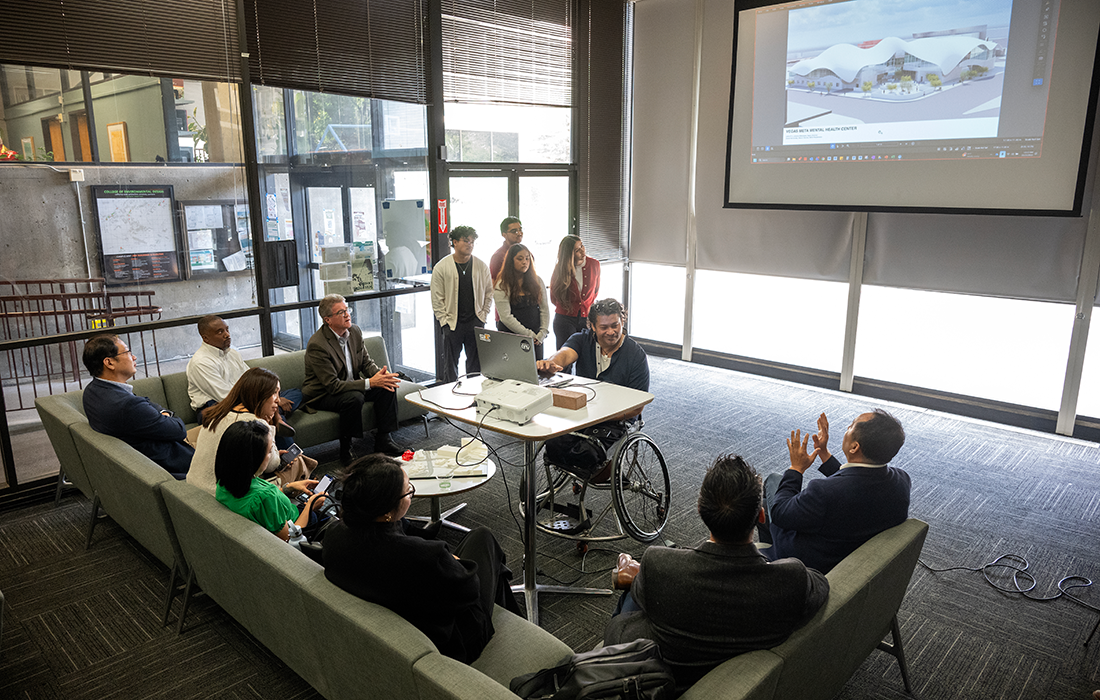 The collaborative grew from a shared vision between Architecture Professor Hofu Wu (now professor emeritus) and alumnus Sanford Smith (’79, architecture), who was the Senior Vice President of Real Estate and Facilities at Hoag at the time and is now semi-retired and serves on the CPP Philanthropic Board and ENV Dean’s Advisory Council. Through dedicated studios on healthcare facility design, students would have PolyX learning opportunities in a growing industry that had not previously been emphasized in the curriculum. The initiative has since expanded into a multidisciplinary network linking students with industry mentors.
Today, the Health and Wellness Design Collaborative includes more than 10 healthcare design professionals from organizations such as Hoag, Kaiser Permanente, LPA, and others who work with ENV leadership to bridge academia and practice. Through mentorship, lectures and events, students learn about the field’s challenges and opportunities, which prepare them to design for human well-being.
Designing for Wellness and Dignity
As a faculty member, Macias blends creativity with professional experience. His studio covers the full spectrum of healthcare design from conceptual visioning to spatial organization, human experience and technical delivery.
“In the first half of the semester, I tell students there’s no budget,” he said. “That’s their chance to think big, to dream. After midterm, we start layering in structure, systems and materials. They’re learning how to actually build what they’ve imagined.”
That big picture approach brings a level of professionalism and depth that sets his studio apart.
“He has significantly enhanced our learning by sharing his personal projects and providing in-depth analysis of their development and collaborative strategies,” said Marvin Alexander, a student in the Healthcare Design Studio. “The exposure to tangible, complex architectural programs, for instance, the spatial sequencing of a hospital, has had a profound impact on our understanding, providing critical insights that would be unattainable in a theoretical setting.”
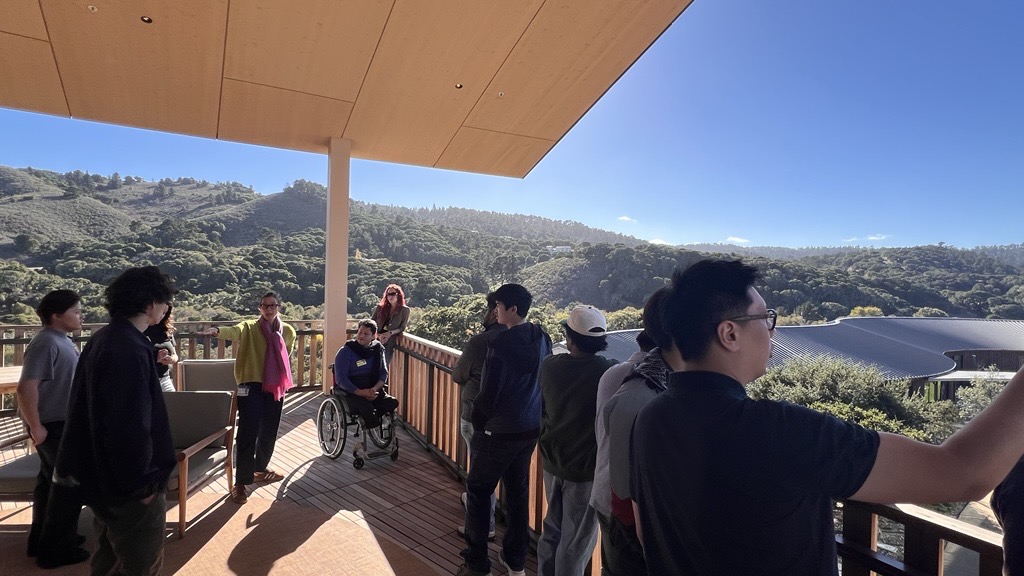 Alexander also shared that Macias teaches by demonstrating how to perform tasks, which is a refreshing shift from other studios. Macias’ encouraging and adaptable approach helps ensure every student understands the material. This semester, Macias led his students on a field trip to the Monterey Ohana Mental Health Facility, a landmark project designed around principles of healing, sustainability and compassion. For many students, it was their first time experiencing a completed healthcare environment that embodies the design ideas they discussed in class.
Standing in sunlit courtyards and therapy rooms, students witnessed how architectural choices like light, material, and circulation could tangibly influence emotional and physical recovery.
“The trip brought everything full circle,” Macias said. “It gave students a chance to see that the principles we talk about — patient experience, wellness, dignity — can and should exist in real buildings.”
Become by Mentoring
For many students, Macias’ mentorship extends beyond design. His mentorship models how to balance technical precision with empathy.
“My experience with Professor Jimmy Macias has been deeply enriching,” said architecture student Heidy Chiu. “His experience as a practicing architect is reflected in how he leads the studio, with genuine care for both his students and the communities we design for.”
“His mentorship expanded the structure behind my process, reinforcing how precision and empathy can coexist within methodical, evidence-based design.”
For Macias, teaching is both a privilege and a responsibility to give back to his mentors and the profession.
“I had professors who saw something in me, even when I was still figuring it out,” he said. “Now I get to do the same for my students. That’s the best part.”
In many ways, his story reflects the heart of ENV: education grounded in opportunity, fueled by persistence and realized through hands-on experience.
“Every time I walk into studio, I remember being in their seat,” Macias said. “It’s a reminder of how far determination can take you and how important it is to give back once you’ve made it through the door.”