Model UN Delegation Prevails Over Global Teams to Earn Fourth Straight Top Prize

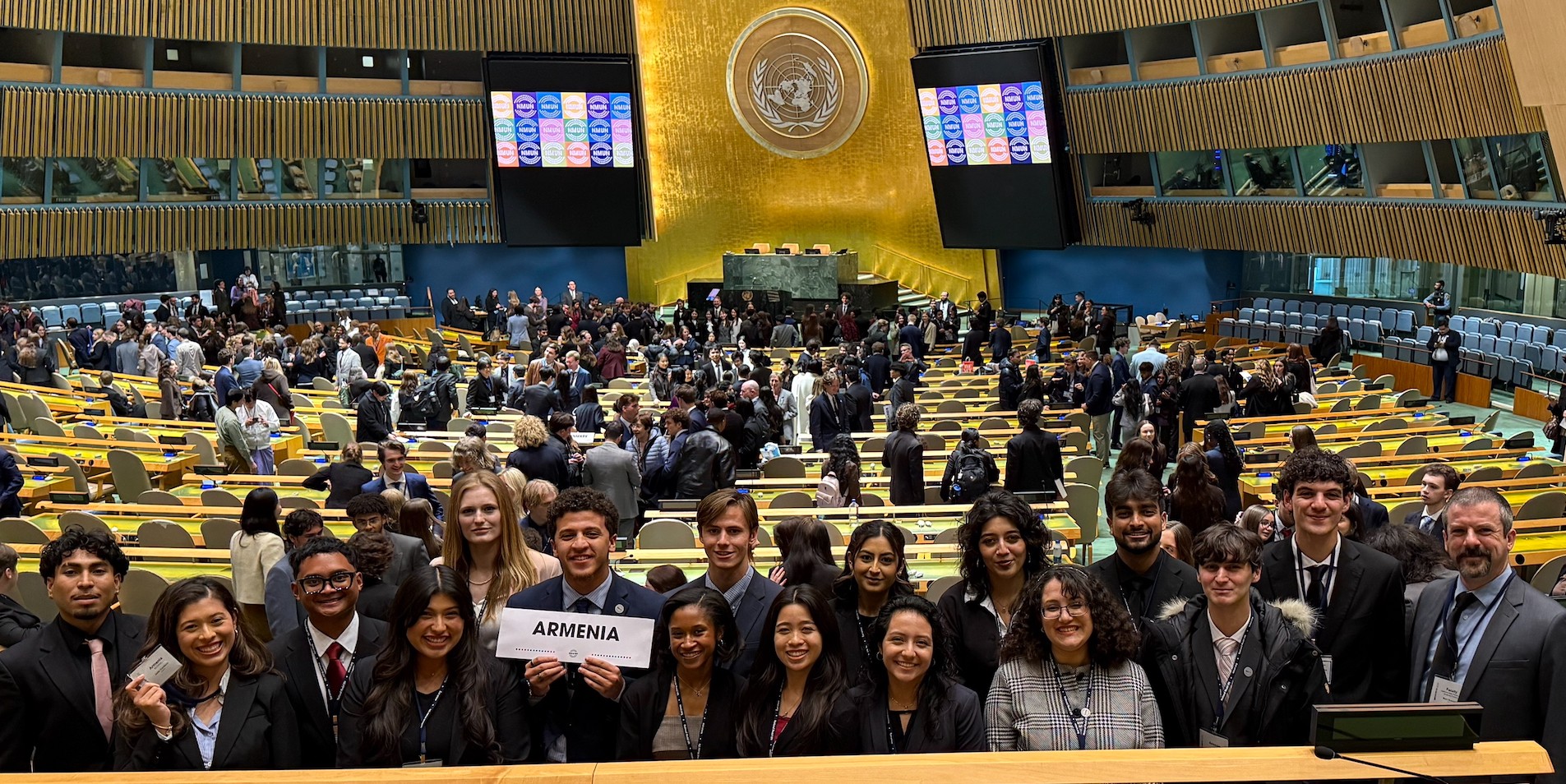
For the fourth year in a row, Cal Poly Pomona’s Model United Nations team captured top honors, earning Outstanding Delegation at the National Model United Nations (NMUN) Conference April 6-10 in New York City.
More than 2,600 students from colleges and universities around the globe attended the competition, which is the oldest, largest and most prestigious Model UN conference in the world.
“It’s been one of the stunning successes of this campus for about half a century,” said team advisor and Political Science Professor Marc Scarcelli of the winning program.
Securing a Victory
At the conference, students act as diplomats for their respective countries. As members of simulated UN committees, they draft resolutions on global problems, debate pressing issues, network with peers from around the world to learn about different cultures, interact with policy experts and attend sessions at UN headquarters when available.
CPP’s team of 16 represented Armenia at the conference. The students worked in pairs as a committee with each committee covering a range of topics from housing for refugees to strengthening international relationships to combat the use and distribution of narcotics to safeguarding education during conflict or post disaster.
Political science students Amary Corona and Kailey Gonzalez served as head delegates. They managed the committees, helped new members learn how to write position papers, and prepared the team for speeches and for a local practice conference.
Gonzalez, who will graduate in May, has been on the Model UN team since her freshman year. She applied to be a head delegate so that she could repay the mentorship and support she received from her senior members.
“I wanted to push the team members forward the way my old committee partner did for me,” she said. “I just want to keep pushing the program. Even though I am head delegate, it really comes down to the whole team. We have to really collaborate and lean on each other.”
In past years, the teams have been notified about their wins the night before they are announced at the conference. However, this year the wins were announced in front of all the attendees at the UN, Academy-Award style.
“When I heard them announce Outstanding Delegation, I was really excited. I was tearing up,” Gonzalez said. “I felt emotional because this is my last year competing. The team members spent a lot of hours in the library preparing, so I know it means a lot to them.”
Besides the highest-tier team award, the students won several committee-specific awards, including Outstanding Position Paper and two Outstanding Delegate awards (one for the Commission on Narcotic Drugs and a second for the UN Educational, Scientific and Cultural Organization).
A Legacy of Excellence
The Model UN team at CPP was formed in 1974 as a one-time experience. After a three-year hiatus, Political Science Professor Emeritus John Moore took on the team in 1977 and turned the program into a success, serving as the advisor for more than 30 years. Scarcelli became the advisor in 2016.
The process to join CPP’s Model UN team is competitive. Applicants must submit their GPA, a statement about why they want to join the team and a writing sample to be considered for an interview in November.
Those who are selected must enroll in CLS 4100: Model United Nations to learn the process and prepare for the conference. The students put in long hours to prepare to compete, often staying in the library until closing time.
Scarcelli said the key to the team’s success lies in the way the class is integrated and in the willingness of students to share what they know.
“It’s not just a club, but also a class, so it provides more structure and opportunity for extended preparation for the conference,” he said. “Also, every single year, we get some students who have done it before who come back and do it again. They help lead students new to the team and the new students benefit from experienced peers.”
The team includes students from a variety of majors, ranging from engineering to anthropology to environmental biology. It is important to have a mix of majors because of the variety of topics that must be covered at the conference, Scarcelli said. The skills learned, including public speaking, negotiation and teamwork, will benefit students in every career, he added.
Gonzalez said the diverse range of students’ fields of study benefits the team’s performance, and she also has benefited personally from meeting students outside her major.
“The team is like a sampling of the whole university,” she said. “I am able to connect with people outside of my college that I probably never would have met without Model UN. It’s about the environment and the friendships you make that keep you coming back.”
Learn more about CPP’s Model UN team.