

CPP Celebrates Juneteenth with Event Focused on Belonging, Support for Black Thriving Initiative

Over plates of soul food and shared conversation, members of the Cal Poly Pomona community gathered to celebrate Juneteenth and reaffirm the university's commitment to fostering belonging and opportunity for Black students and the broader campus community.
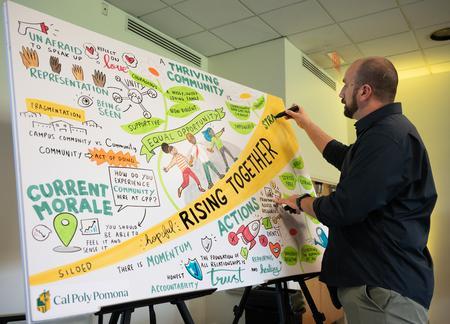 Around 160 faculty and staff attended the June 16 event, which was themed “Remembrance, Reckoning, and the Courage to Rise Together.” Organizers served up smothered chicken, red beans and rice, collard greens, hot water cornbread and banana pudding, all recipes from faculty and staff featured in the newly released “Juneteenth Cookbook.”
Attendees also reflected on the history, enduring significance and contemporary relevance of Juneteenth, a federal holiday that marks June 19, 1865, when enslaved people in Galveston, Texas learned they were free, more than two years after the Emancipation Proclamation.
“Cal Poly Pomona, one of the most diverse universities in the United States, is precisely the kind of community that Juneteenth was always reaching toward, a place where freedom is not something rationed by power or earned by suffering, but the quiet unspoken assumption beneath every footstep on this campus that you belong here fully and without condition,” said Karen Harris Tyrrell (’24, doctorate in educational leadership) in her keynote speech.
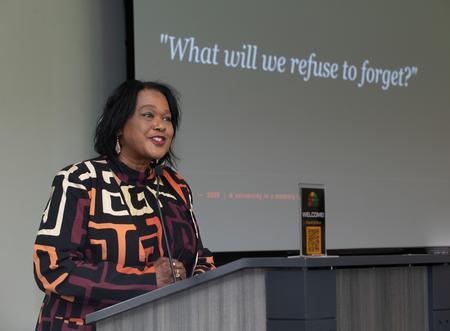 Harris Tyrrell, a lecturer in the College of Education and Integrative Studies doctoral program and a faculty mentor for the Afrofuturism Initiative, called for vigilance and resistance in the face of legislative and judicial efforts to erase historical truths and take away hard-fought civil rights.
She also drew parallels between laws that once legalized slavery and segregation and the ways laws are being used today to redraw voting districts to reduce the power of Black voters and rewrite the history taught in schools. Institutions like Cal Poly Pomona must exercise their influence to determine what is studied, taught and preserved, Harris Tyrrell said.
“We, as the institutional memory, are the ones who decide what gets studied, funded, published and taught. We are the ones who draw the borders of what counts as knowledge, and who gets to stand inside them,” she said. “What will we preserve? What will we teach? What will we refuse to forget? Juneteenth is not a distant milestone. It’s a diagnostic. It tells us with precision what freedom costs when the people in power decide the cost is worth paying.”
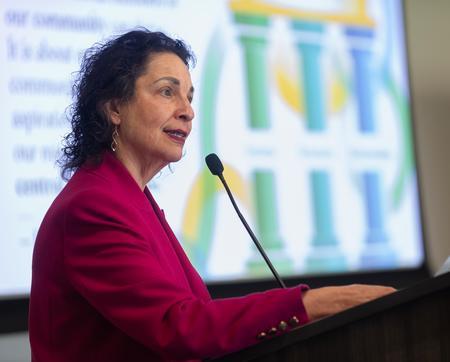 Interim President Iris Levine reflected on the work still needed to ensure all students have equitable opportunities to succeed and lauded the Black Thriving Initiative, an effort launched in 2022 to expand access to resources, connections and opportunities that support student success.
Following the event, Levine announced that the university plans to commit $100,000 annually over the next three years to on the work that the Black Thriving Initiative is undertaking.
“Over the past several years, the Black Thriving Initiative has helped deepen conversations about equity and belonging, strengthened our understanding of the experiences of Black students, faculty and staff and other underserved communities, and challenged us to think more intentionally about how we support student success and thriving for all,” Levine said in a campus email.
“As we look ahead, we have an opportunity to build on that progress by evolving the Black Thriving Initiative into a more fully integrated institutional approach that recognizes community and belonging as essential drivers of student success and institutional excellence.”
Cal Poly Pomona’s celebration came a few days after the CSU Juneteenth 2026 Symposium at Cal State LA, which included Chancellor Mildred Garcia and keynote speaker Marc H. Morial, president of the National Urban League and a former New Orleans mayor.
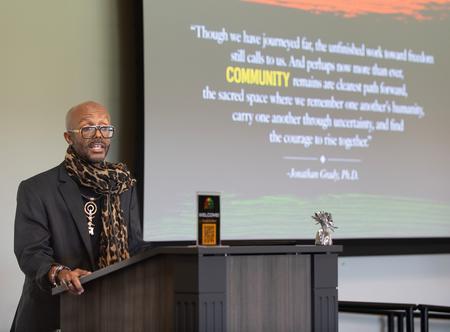 Jonathan Grady, CPP’s senior associate vice president of equity and belonging, said the university is facing challenges, including an equity gap that is the widest for Black students. However, he said hope for closing that gap and strengthening belonging lies in the work ahead.
“I believe that the future is not something that happens to us. It is something that we can shape together through the choices that we make, the relationships we build and the courage we summon in moments such as this today,” Grady said.
“The work asks more of us. It asks us to not only to remember but to imagine, not only to acknowledge the past, but to help create a different future. If we are serious about creating a thriving campus community, then we must be equally serious about asking difficult questions, identifying where disparities persist and examining whether our polices, practices and investments are producing the outcomes we intend.”