
IRB Application Process
Protocol Application Process- Getting Started With a New or Existing Protocol
Welcome to the IRB Guidance page
This page is designed to help researchers navigate the Institutional Review Board (IRB) process for research involving human participants. Whether you're a student, faculty member, staff researcher or external collaborator, understanding your responsibilities is key to conducting ethical and complaint research.
Step 0: Does your study require IRB review?
Take the IRB Determination Survey
If your project does require IRB review, follow the 5 steps to IRB Success outlined below.
IRB Approval Process
Pre-Review Stage
IRB Review Stage
Expedited Review
- 1-2 IRB reviewers
- No more than minimal risk to participants
- Duration 2-3 weeks after Pre-Review
- OHRP categories
Full-Board Review
- Convened IRB board reviewers
- More than minimal risk to participants
- Duration months after Pre-Review
Exempt Determination
- IRB analyst or 1 IRB member reviewer
- Less than minimal risk to participants
- Duration 1-2 weeks after Pre-Review
- OHRP Categories
5 Steps to IRB Success
STEP 1: Complete CITI training
- CITI training should be completed by PIs and all personnel listed on the protocol engaged in research
- CITI training is free for our campus community
- Registration Registration tutorial
- Go to the CITI Program website and create an account
- Register using your Bronco email and any password you choose.
- Select California State Polytechnic University, Pomona as the institution
- Provide your Bronco ID under "employee number"
- Selecting Courses
- select the group basic CPP Introduction to human subjects 101 or
- Select CEIS Mandated Social Science Research (required for many social sciences)
- You must complete all courses with a passing score of 80% to receive a certificate of completion
- When finished a Certificate of completion and CITI transcript will be available.
- Certificate of completion should be provided to your Principle Investigator, Faculty Advisor or Professor
- CITI training is valid for five years, at which point, a renewal training must be completed.
- External (non-CPP) investigators must submit a transcript that lists all completed modules so the IRB can compare equivalency with CPP-required courses.
STEP 2: Request authentication
If this is your first time submitting an IRB protocol in Cayuse please email the following information (listed below) to irb-office@cpp.edu to be added into the system, additionally send a screenshot of your error message ( when attempting to log in https://cpp.cayuse424.com error message will read "We're sorry. This account has been disabled on the Cayuse424 system"):
- Highest degree attained (Ph.D., MS, MA, BS, BA, associates, high school, etc., as appropriate)
- First and last name
- Bronco ID (the nine-digit number, which will eventually be used to link with CITI training data)
- Bronco email (e.g., billybronco@cpp.edu)
- Status (faculty, staff, student, unaffiliated, etc., as appropriate)
- CPP College and Department
STEP 3: Train yourself to use Cayuse IRB
- Review the Cayuse tutorial “Submitting a New Protocol” to learn how to submit an IRB protocol.
- Blank IRB Protocol Template
STEP 4: To submit an IRB protocol
Enter the Cayuse IRB site using your Bronco Credentials (from #2 above) and start a "new study".
- For the Cayuse IRB site to start or continue with an existing protocol, use the Cayuse IRB site.
STEP 5: IRB protocol upkeep
To revise, modify, renew, report an adverse event, or close your IRB protocol, follow as below:
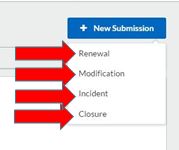
Revise: Submitted protocols are commonly returned to PIs with IRB comments; refer to the presentation on navigating revisions (PPT).
Modification: After IRB approval, any changes to the approved protocol require submission of a Modification. Please review this presentation to learn how to submit a modification in Cayuse IRB.
Renew: PIs are notified as a protocol approaches expiration. To renew approval for another year, a Renewal Submission must be submitted prior to the expiration date.
Adverse Event (Incident): Research does not always go as planned, and adverse events or unanticipated problems may occur. Adverse events must be reported to the IRB within 48 hours through the Cayuse system.
Closure: A Closure Submission is required when data collection for the study is complete.
FAQs
Protocols with an expiration date may be approved for a period of up to one year before renewal is required. Approved protocols must be renewed one to two months prior to expiration if ongoing interaction with research participants is anticipated. Choose the renewal option within Cayuse IRB.
Visit the IRB's Resources page for CPP’s informed consent form templates, and refer to the U.S. Health and Human Services Informed Consent Form Checklist for additional guidance.
Should there be any changes to your research plan as described in the approved protocol, you will need to submit a modification.
Examples of changes include, but are not limited to:
- A change of study design, methodology, or recruitment methods
- Changes to any data collection documents, including surveys and questionnaires
- Changes to consent documents
- Changes to the population proposed in the approved protocol
- Changes in funding
- Addition/Deletion of investigators (PIs), co-PIs, and research assistants
- Change of Project Title
- Addition/Deletion of research performance sites
No.
After the expiration date, you may no longer continue to collect data. According to federal regulation investigators must not engage in research with subjects after a protocol's expiration date. However you may continue to work on analysis of the data. This is because the interaction with subjects/participants has concluded.
The Cayuse IRB protocol software sends a renewal reminder as a courtesy to you before the expiration of the approval. If you have received a notice and your project is not complete, then contact the IRB office to inquire about options.
Per federal regulation, it is the PI's responsibility to report adverse events of any kind to the IRB. Reporting adverse events promptly will enable the IRB and university research community to respond appropriately, to help the researchers continue their work, and to protect human subjects in research investigations from avoidable harms.
To submit an adverse event report through Cayuse. Use the "+ new submission" button and choose the option "Incident".
Please refer to Adverse Event Reporting Page for more detials.
research-compliance/irb/adverse-event_new#Adverse Event Reporting Page
You can test the consent form by inserting only the text of the document into a readability calculator, like Hemingway App (https://www.hemingwayapp.com)