Curriculum
What Does IGE Satisfy?
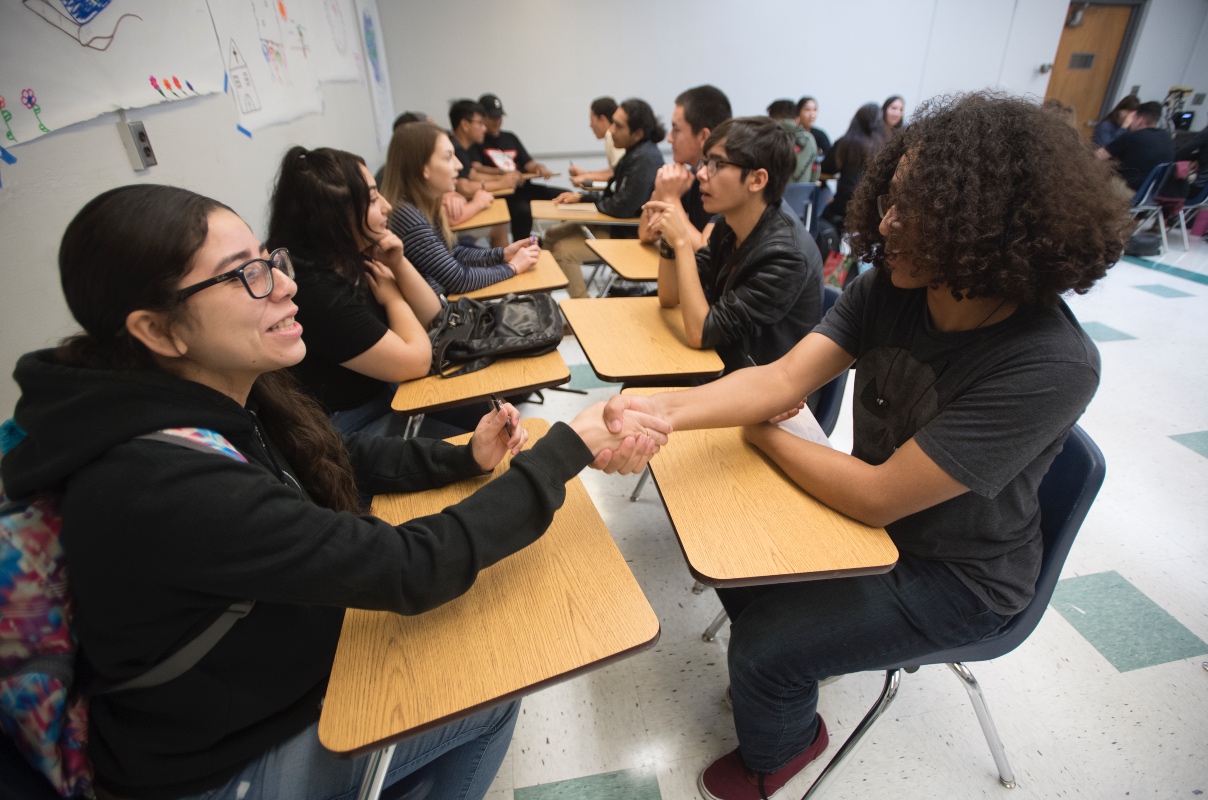
The Interdisciplinary General Education pathway (IGE) is a small learning community that offers an innovative GE pathway within the University GE Program where students can satisfy up to 21 units of University GE requirements in GE areas 1, 3, and 4 (AY2025) and A, C, and D (Prior AY2025). The IGE curriculum provides an integrated, interdisciplinary, discussion-based approach to learning about the humanities, social sciences, and arts, preparing students to lead socially responsible, productive, and satisfying lives in a changing diverse world.
Active-learning classes develop core professional skills and intellectual versatility across a breadth of areas. The more courses students take in IGE, the richer their experience. While students are encouraged to take as many courses that they would like, each individual course is designed to welcome all students regardless of whether they’ve taken an IGE course before.
The IGE pathway has the following common Learning Outcomes:
- Effective Communication
- Critical Thinking
- Historical, Social, and Multicultural Understanding
- Understanding and Appreciation of Aesthetic Experiences
- Articulation of Values
- Information Literacy
- Integrative Learning
How Does IGE Fulfills GE Requirements
| GE Area | Courses |
| 1A | IGE 1100 and IGE 1200 Category II students are eligible to enroll in IGE 1100 (Fall) and IGE 1200 (Spring) as a two-course sequence to fulfill GE Area 1A. Students who choose this sequence will also satisfy GE Area 3B. Category III and IV students need to enroll in English composition courses in the 1A GE course list. Students with incoming 1A credit (Category I) can take either IGE 1100 or IGE 1200 for 3B credit. |
| 3A | IGE 2350 |
| 3B | IGE 1100, IGE 1200, IGE 2150, or IGE 2250 |
| 3C | IGE 3100 (3C or 4C; cannot double count for both 3C and 4C) |
| 4A | IGE 2150 or IGE 2250 Also satisfy American Institutions Part A |
| 4C | IGE 3100 (3C or 4C; cannot double count for both 3C and 4C) |
| 6 |
Other Courses:
- IGE1020H - Engaged Education: Integrating Knowledge, Learning and Success
- IGE 3200 Mad Scientists and Aliens: Science and Technology in Popular Culture - (3C/C3)
- IGE 3300 Demons, the Undead, and the Monstrous Other - (3C/C3)
- IGE 3500 The Creative Process: Innovation and Transformation - (3C/C3 or 4C/D4).
- IGE 3600 UFO, Illuminati, and Other Conspiracy Theories - (4C/D4)
| GE Area | Courses |
| A2 | IGE 1100 and IGE 1200 Category II students are eligible to enroll in IGE 1100 (Fall) and IGE 1200 (Spring) as a two-course sequence to fulfill GE Area A2. Students who choose this sequence will also satisfy GE Area C2. Category III and IV students need to enroll in English composition courses in the A2 GE course list. Students with incoming A2 credit (Category I) can take either IGE 1100 or IGE 1200 for C2 credit. |
| C1 | IGE 2350 |
| C2 | IGE 1100, IGE 1200, IGE 2150, or IGE 2250 |
| C3 | IGE 3100 (C3 or D4; cannot double count for both C3 and D4) |
| D1 | IGE 2150 or IGE 2250 Also satisfy American Institutions Part A |
| D4 | IGE 3100 (C3 or D4; cannot double count for both C3 and D4) |
| F |
Other Courses:
- IGE1020H - Engaged Education: Integrating Knowledge, Learning and Success
- IGE 3200 Mad Scientists and Aliens: Science and Technology in Popular Culture - (3C/C3)
- IGE 3300 Demons, the Undead, and the Monstrous Other - (3C/C3)
- IGE 3500 The Creative Process: Innovation and Transformation - (3C/C3 or 4C/D4).
- IGE 3600 UFO, Illuminati, and Other Conspiracy Theories - (4C/D4)
Lower Division Pathway Courses
- IGE 1100** Who Am I?: Understanding Ourselves, Our Communities, and Our Worlds (3)
- GE 1A & 3B if taken with IGE 1200 OR 3B if taken solo.
- IGE 1200** Faith, Passion, and Power: The Saga of the Ancient and Medieval Worlds (3)
- GE 1A & 3B if taken with IGE 1100 OR 3B if taken solo.
- IGE 2150 A Sustainable Tomorrow: From Industrialization to Ethical Environmentalism (3) [GE 3B or 4A] [AmInst-A]
- IGE 2250 The Stranger: Encountering Difference and Creating Coexistence (3) [GE 3B or 4A] [AmInst-A]
- IGE 2350 Rival Empires: Representation and Resistance (3) [GE 3A]
- IGE 2600 Digital Culture, Race, and Ethnicity (3) [GE 6]
- IGE 3100 Interdisciplinary Perspectives: Capstone Seminar (3) [GE 3C or 4C]
**More Details About Satisfying the Written Communication GE through IGE: Students ready for GE 1A/A2 area with support (categories III and IV) need to enroll in the English stretch courses with support for GE 1A/A2 area credit and can enroll in either IGE 1100 or IGE 1200 for GE area 3B/C2 credit. Students who have fulfilled GE area 1A/A2 (category I) can also enroll in IGE 1100 or IGE 1200 for GE area 3B/C2 credit. Please refer to the University Programs section in the course catalog for IGE course descriptions.
- IGE 1100** Who Am I?: Understanding Ourselves, Our Communities, and Our Worlds (3)
- GE A2 & C2 if taken with IGE 1200 OR C2 if taken solo.
- IGE 1200** Faith, Passion, and Power: The Saga of the Ancient and Medieval Worlds (3)
- GE A2 & C2 if taken with IGE 1100 OR C2 if taken solo.
- IGE 2150 A Sustainable Tomorrow: From Industrialization to Ethical Environmentalism (3) [GE C2 or D1] [AmInst-A]
- IGE 2250 The Stranger: Encountering Difference and Creating Coexistence (3) [GE C2 or D1] [AmInst-A]
- IGE 2350 Rival Empires: Representation and Resistance (3) [GE C1]
- IGE 2600 Digital Culture, Race, and Ethnicity (3) [GE F]
- IGE 3100 Interdisciplinary Perspectives: Capstone Seminar (3) [GE C3 or D4]
**More Details About Satisfying the Written Communication GE through IGE: Students ready for GE 1A/A2 area with support (categories III and IV) need to enroll in the English stretch courses with support for GE 1A/A2 area credit and can enroll in either IGE 1100 or IGE 1200 for GE area 3B/C2 credit. Students who have fulfilled GE area 1A/A2 (category I) can also enroll in IGE 1100 or IGE 1200 for GE area 3B/C2 credit. Please refer to the University Programs section in the course catalog for IGE course descriptions.
Upper Division GE Synthesis
IGE offers four Upper Division GE Synthesis courses in Areas 3C/C3 and C/D4. These courses are open to all students with Junior and Senior standing—taking the IGE lower division sequence is not required. Courses are designed in the same format with active and project based learning as its focus. Many of these courses are offered year round, even with some summer offerings.
In this course, we will look at ways in which science and technology are represented in literature, film, and other cultural artifacts. We will examine these representations primarily from the perspectives of history, philosophy, gender, race, and culture. To achieve this, the course will also be informed by theoretical approaches to representation. Throughout, we will explore where ideas about science and technology arise both currently and historically. We shall see ways in which science and technology both are cultural and social constructs. These issues will be investigated from a theoretical, interdisciplinary perspective. This course might include a service learning component.
GE Upper-Division Synthesis course for area 3C/C3.
Personifications of evil through time and diverse cultures; constructions of the monstrous 'other' in arts, religious, and political discourse; cross-cultural analysis of ghost and the undead narratives; supernatural horror; the cultural use of demonic encounters; pseudoscientific discourse within cultural context; institutional and cultural use of binary oppositions of good vs. evil. Themes explored mainly through literature, film, and theoretical works.
GE Upper-Division Synthesis course for area 3C/C3.
Culture and historical background of the peoples of Central Asia and their relation to neighboring regions of Eastern Europe, the Middle East, China, and India from the ancient to the modern period. Tribalism, nomadism, conquest and empire. Study of political, economic, and social organization as well as religious beliefs of Turko-Mongol peoples along the Silk Road.
GE Upper-Division Synthesis course for area 4C/D4.
Interdisciplinary theories of human creativity and the creative process; practical tools for generating innovative ideas. We will look at principal research on creativity, and use these theories to make us more innovative whatever our chosen field. Students get practical experience in generating and developing new ideas in group and individual settings, through in-class exercises and outside assignments. We will examine the lives of highly innovative thinkers in various fields to determine the individual traits and environmental conditions that stimulate ground-breaking work, and how to set up an environment conducive to your and others’ creativity.
GE Upper-Division Synthesis course for area 3C/C3 or 4C/D4.
Exploration of the meaning, attraction, proliferation, and potential dangers of conspiratorial thinking within historical context. Topics will include: conspiracy narratives as expressions of anxieties about the relationship between the individual and the state; cross-cultural examinations of conspiracy narratives; and the historical, social, and cultural discourse around conspiracy theories about UFOs and Area 51, the JFK assassination, 9/11, the moon landing, the sphericity of the earth, and the Illuminati, among others.
GE Upper-Division Synthesis course for area 4C/D4.