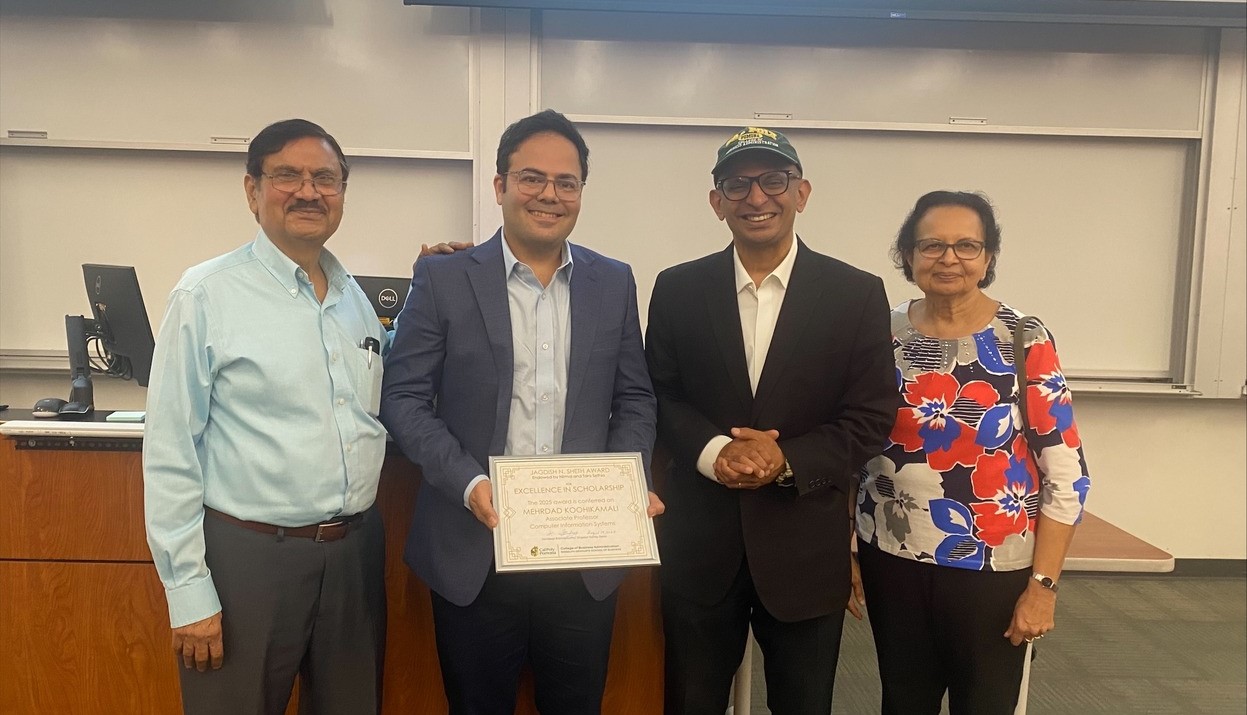
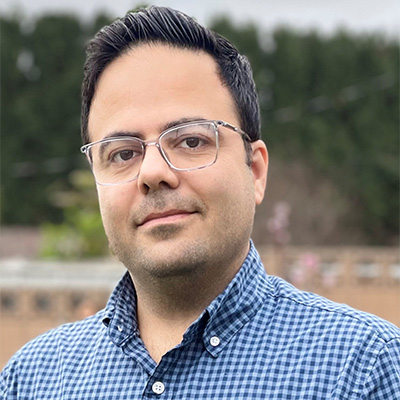
Mehrdad Koohikamali, associate professor in the Department of Computer Information Systems, has been named the 2025 recipient of the Jagdish N. Sheth Award for Excellence in Scholarship established by Nirmal and Tara Sethia. Koohikamali teaches courses at both undergraduate and graduate levels, including location analytics, data mining, social media and text mining, and big data technology.
Koohikamali was also recently honored with a prestigious CSU AI Award for his innovative work on integrating Generative AI into the freshman curriculum for Computer Information Systems (CIS) and Computer Engineering (CE) students. In addition, he is actively engaged in research on digital twin and virtual reality technologies, a focus that has led to the submission of two significant grant proposals to the National Science Foundation (NSF).
Founded by Nirmal Sethia, professor emeritus in management and human resources, and Tara Sethia, professor emeritus of history and founding director of Cal Poly Pomona’s Ahimsa Center, the financial award recognizes CBA faculty who have demonstrated consistent, high-quality scholarly contributions over the past five years. Professor Nirmal Sethia, who conferred the award during the 2025 Fall Conference, noted, “Tara and I were very pleased to launch this award in 2019, naming it after Professor Jagdish N. Sheth of Emory University, who has made seminal contributions in many fields of business scholarship. We are very gratified that since its inception the Sheth Award has already recognized five outstanding scholars in the CBA, and this year the sixth award is once again honoring a highly accomplished scholar in the College, Dr. Koohikamali.”
Koohikamali’s research spans location intelligence, social media analytics, text mining, and information privacy. His work has appeared in leading journals, including Decision Support Systems, Computers in Human Behavior, and Information Technology & People. He explores topics such as privacy trade-offs in mobile apps, the dynamics of information re-sharing on social media, and spatial behavior in the sharing economy — notably within platforms like Airbnb. Koohikamali also brings extensive expertise in using distributed computing frameworks like Spark to analyze large-scale datasets.
One of Koohikamali’s most impactful publications examines the spread of “fake news” and its societal impacts, with a specific focus on its dynamics during social movements like Black Lives Matter (BLM) and Women Life Freedom. Beyond this, his recent research on medical chatbots explores how they can help people overcome challenges in receiving appropriate care due to a lack of knowledge of medical terminology.
With more than a decade of professional experience in GIS — including roles as consultant, analyst and manager — he remains deeply committed to mentoring students and advancing research in the field.


