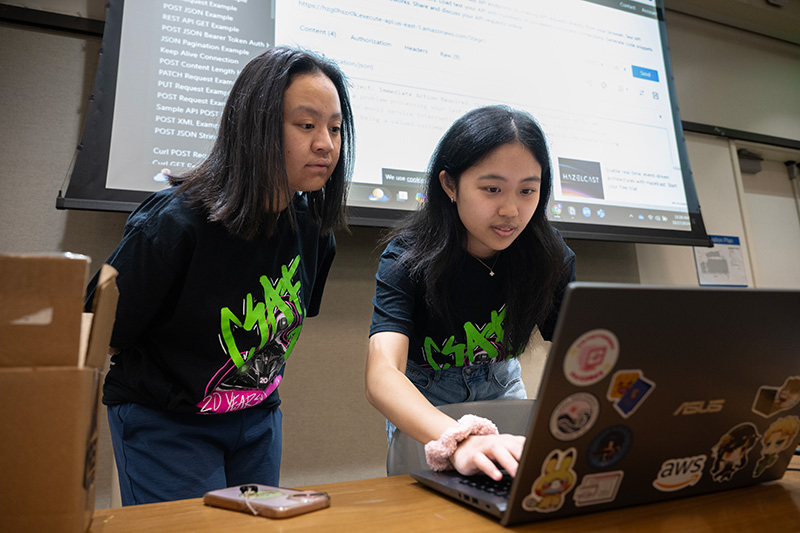
Coursework teaches concepts and techniques under conditions that are designed to be clear: the method is specified, the inputs are known, and the expected output is defined. A master's project removes that scaffolding. The student has to frame an ambiguous problem, choose an approach, evaluate alternatives, test the result, and explain what was learned to people who were not in the room. That is why applied graduate work matters: it is the only part of a degree that rehearses the full arc of technical judgment rather than one step of it.
This article explains what a culminating project asks of a student that coursework does not, and what to ask a program before enrolling.
Coursework and projects answer different questions
Coursework provides structured opportunities to study concepts and practice techniques. A course in algorithms may ask students to analyze complexity or compare methods. A course in software engineering may examine design and testing practices. The structure is the point: it isolates a skill so it can be learned.
A culminating project connects ideas from different areas and asks which ones matter for a particular problem. Neither is superior to the other. The educational value comes from the combination, and from the project being the place where coursework is finally used on something that does not come with an answer key.
Defining the problem is itself technical work
Real computing problems arrive ambiguous. A request to make a service faster does not specify which performance measure matters, what constraints exist, or how success should be judged.
A substantive project often begins by clarifying those questions. What does the system need to accomplish? Which users or processes are affected? What resources are available? Which assumptions must be tested before anything is built? The ability to frame a problem carefully is part of technical judgment, and it is rarely taught explicitly in a course because courses, by design, hand students a framed problem.
Design choices have consequences
A project may require choosing among algorithms, architectures, or implementation approaches, each with tradeoffs in performance, complexity, security, cost, and maintainability.
Consider an illustrative project involving analysis of a large dataset. A student would need to decide how data is stored, how computation is organized, whether it can be parallelized, and how results are validated. Each decision closes some options and opens others. The point of the project is not to find the one right answer. It is to make defensible choices and understand what was given up. This example describes the kind of question applied work raises; it is not a claim that any specific project is offered or guaranteed.
Testing turns a claim into evidence
A working demonstration is one step, not the finish. Technical evaluation asks whether a solution behaves as expected, under which conditions, and with what limitations. Depending on the project, that may involve correctness tests, performance measurement, usability studies, or comparison with alternative methods.
A strong technical explanation separates observed results from assumptions and makes limitations visible rather than hiding them behind an impressive demo. This habit is what distinguishes engineering evidence from marketing, and it is one of the most transferable things a graduate project teaches.
Communication is part of the engineering work
Technical work must be explained to people who did not build it. A project typically requires describing the problem, defending design decisions, documenting methods, and presenting results.
These skills matter because even a sound solution is hard to assess or maintain when its reasoning is unclear. Communicating limitations accurately is especially important when a system incorporates AI components or processes sensitive data, where overstated claims carry real consequences.
Questions to ask before choosing a program
Any program can use the word "applied." These questions reveal what it means in practice:
- How does the program prepare students for the culminating project before it begins?
- When do students start defining a topic, and how is scope negotiated?
- How is faculty guidance structured, and how are advisors matched to students?
- What are the expectations for evaluation, documentation, and presentation?
- Can a professional interest or a workplace problem inform a project, subject to program approval?
- What happens if a project needs to change direction partway through?
How the applied project fits Cal Poly Pomona's Online MSCS
Cal Poly Pomona's Online MS in Computer Science culminates in an applied project. The published curriculum describes it as the place where students bring advanced knowledge together around a focused problem or technical challenge, and the program's stated learning outcomes include conducting independent work in a specialization and communicating and defending technical results. The degree is 30 units and designed for completion in about two years.
Prospective students should consult the curriculum page and the program for project requirements, timing, approval procedures, and available support. They should not assume that a particular topic, faculty supervisor, employer partnership, or external sponsor is guaranteed. The value of the project lies in the process this article has described: framing a question, making defensible choices, evaluating results, and communicating what was learned. For professionals considering graduate computer science, that process may matter more than any single technology used along the way.