Digital Twin-Based Factory


Overview
Digital Twin
Despite the growing body of literature on digital twins in smart manufacturing, most studies primarily focus on simulation with either no data exchange or only a one-way flow of data from physical assets to their digital counterparts. To the best of our knowledge, only a few research studies have focused on creating a true digital twin for a factory. A true digital twin is capable of bidirectional data exchange, where the digital replica not only reflects real-time updates and predictions from physical assets but also sends actionable commands back to the physical factory.
Research Thrusts Plans
Digital Twins and Cyber-Physical Systems
Research in this area will advance digital twins and cyber-physical systems through real-time data integration, artificial intelligence, predictive modeling, and intelligent decision-making. Activities will focus on improving the adaptability, safety, sustainability, and system-level optimization of complex physical systems, with manufacturing as a leading proving ground alongside applications in aerospace, energy, and infrastructure.
Current Research Foundation
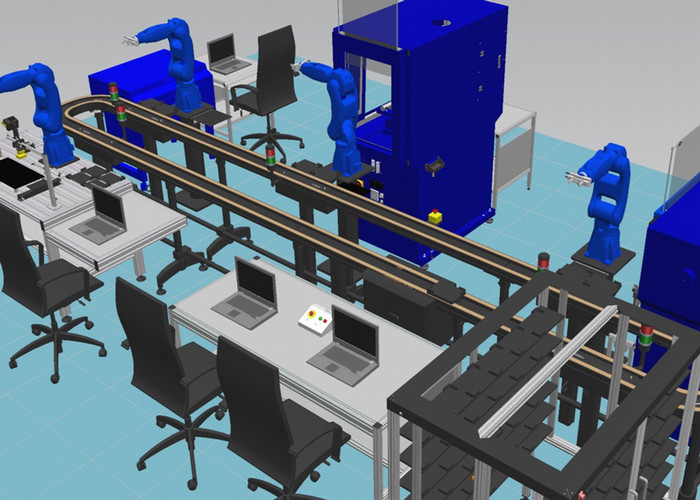
Current research foundation: Faculty researchers are developing digital replicas and digital-twin models for manufacturing systems and robotic assets. Work documented during 2025–26 includes modeling of an automated storage and retrieval system (AS/RS), development of a working dynamic model of the Yaskawa GP8 industrial robot, Robot Operating System (ROS)/ROS 2 and PyBullet modeling, and development of communication between simulation models and manufacturing-system components. The research team is also developing a minimum viable digital-twin architecture for the Smart Factory and investigating data flows across manufacturing stations.