Virtual/Augmented Reality


Overview
Virtual/Augmented Reality
Manufacturing in the U.S. is growing rapidly, but automation and AI are reshaping workforce skill demands. As Industry 4.0 evolves into Industry 5.0, Extended Reality (XR)—including AR, VR, and MR—offers new opportunities for training and process improvement. However, current XR tools lack adaptability and effective visualization, limiting their impact in complex smart manufacturing environments.
Research Thrusts Plans
AR/VR Human-System Integration
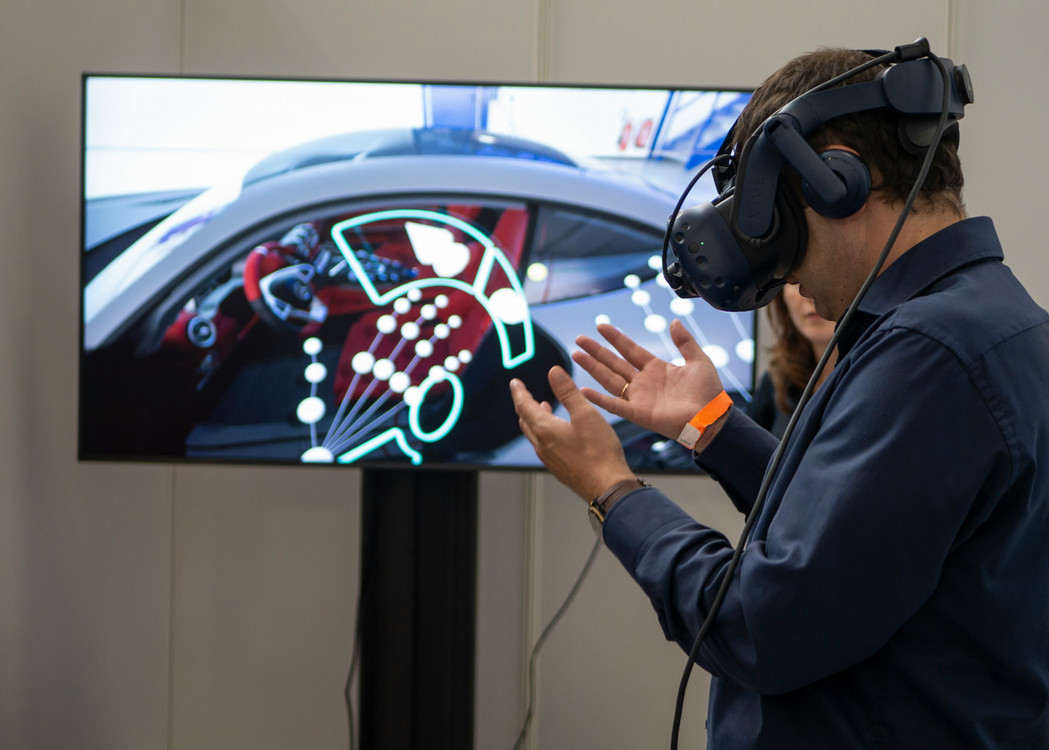
Research will explore immersive technologies for human-system interaction, operator training, monitoring, visualization, and decision support across complex operational environments. AR/VR capabilities will be integrated with cyber-physical systems and digital twins to improve human performance, safety, and interaction with intelligent systems, with manufacturing, training, and human-systems research as core application areas.
Current Research Foundation
Current research foundation: The AR/VR research portfolio has established substantial experimental capability, including 10 Meta Quest 3 headsets, HaptX gloves for tactile feedback, and four high-performance workstations with RTX 5090 GPUs. Faculty have completed interactive 3D models for all five SmartCIM stations and developed training scenarios covering inventory management, Computer Numerical Control (CNC) milling, CNC turning, laser engraving, and robotic assembly. The team has also developed a three-layer architecture connecting physical equipment, digital twins, ROS, Unity, and assessment analytics. Mesh optimization reduced polygon counts by approximately 40–60% while preserving training-relevant visual fidelity. Two conference papers from this research were accepted and presented, including work on cyber sickness in immersive VR simulation.