Robotics and Automation


Overview
Robotics and Automation
Modern manufacturing requires robots capable of handling diverse parts with varying shapes, orientations, and motion. In smart factories, robots must grasp and regrasp moving and stationary objects for efficient assembly and transfer. Yet most systems rely on static tasks and fixed paths, limiting adaptability. Limited research on dynamic grasping and reorientation continues to constrain advanced automation.
Research Thrusts Plans
Robotics and Autonomous Systems
Research will address adaptive robotics, intelligent control, machine learning, robotic perception, manipulation, and human-robot collaboration. Activities will support the development of flexible, responsive robotic and autonomous systems capable of operating in dynamic environments, spanning applications in manufacturing, agriculture, logistics, and beyond.
Current Research Foundation
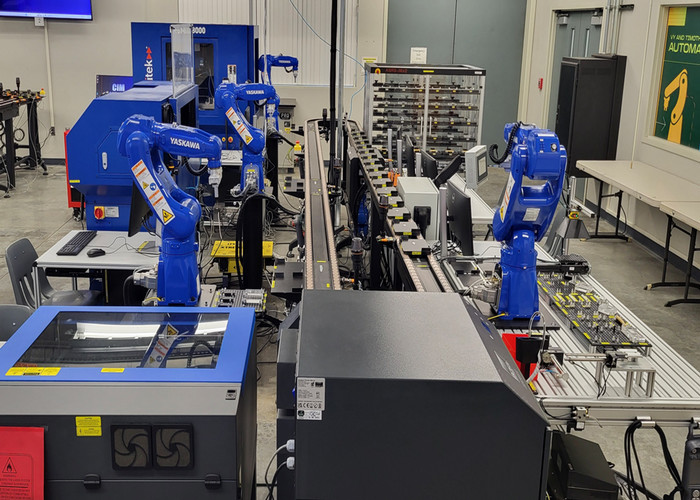
Current research foundation: Robotics research includes two EPSON Selective Compliance Assembly Robot Arm (SCARA) robots, four compatible grippers, five Intel RealSense RGB-D cameras, an anthropomorphic robotic hand, and Robotino-based teleoperation and sensing. Faculty and students have completed a literature review of more than 100 papers on robotic grasping and regrasping, developed a taxonomy of regrasping problems and solution methods, conducted robot control experiments, and initiated vision-based assembly and safety research. Current activities also include ROS 2/Gazebo teleoperation, MATLAB connectivity, RealSense depth-data streaming, Programmable Logic Controller (PLC) and sensor data extraction through OPC Unified Architecture (OPC UA), and digital-twin development and verification for the Yaskawa GP8 industrial robot.