Education and Workforce


Overview
Education and Workforce
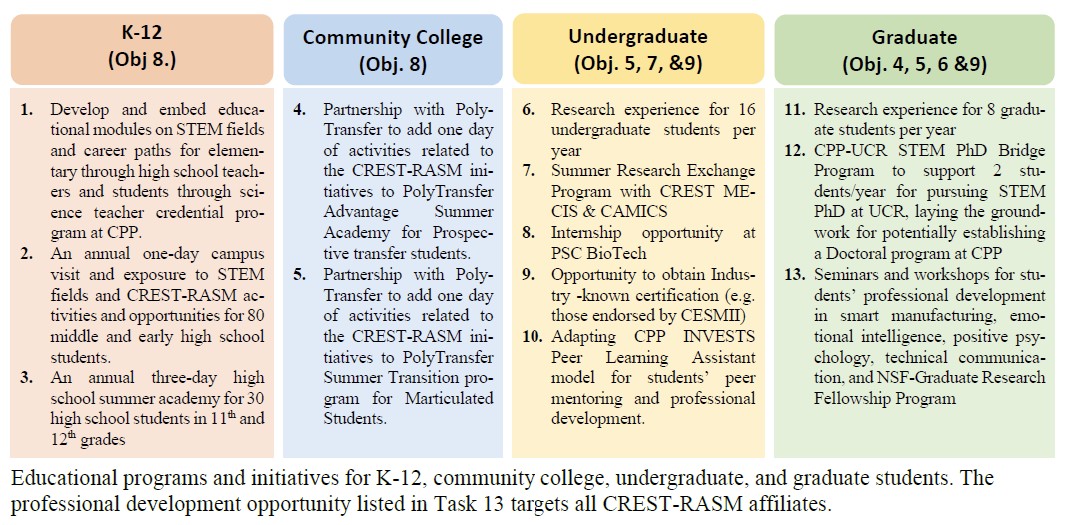
The vision of RASIM’s education and workforce development plan is to create a comprehensive program spanning elementary, middle, and high school, continuing through community college and undergraduate studies, and culminating in a graduate pathway leading to a Ph.D. fellowship at a research-intensive institution. The plan outlines 13 key tasks highlighting unique opportunities and collaborative approach beyond individual grants.
Research Thrusts Plans
Educational and Workforce Development Plan
Goal
The goals of the RASIM K-12 education program are:
- To increase awareness and interest of students in STEM education and career opportunities in smart manufacturing.
- To create a pipeline of students to support RASIM initiatives.
Selected Evidence of Existing Research Capacity
The following examples document existing capacity that RASIM will integrate and expand.
|
Research capability |
Documented 2025–26 evidence |
Center-level value |
|
Digital Twins / Cyber-Physical Systems |
Working Yaskawa GP8 dynamic model; AS/RS and conveyor modeling; ROS/ROS2 and PyBullet development; digital-twin publications. |
Common cyber-physical foundation for integrated research across manufacturing and related domains. |
|
AR/VR Human-System Integration |
10 Meta Quest 3 headsets; HaptX gloves; four RTX 5090 workstations; five SmartCIM station models; 40–60% mesh optimization; accepted conference papers. |
Experimental platform for immersive training and human-system research. |
|
Robotics and Autonomous Systems |
Two EPSON SCARA robots; four grippers; five RealSense RGB-D cameras; Robotino teleoperation; 100+ paper regrasping review; robotic digital-twin paper submitted. |
Supports perception, manipulation, teleoperation, safety, and agile automation across application domains. |
|
Cybersecurity / IIoT |
Network TAP; adversary workstation; EtherNet/IP analysis; 40+ paper security review; spoofing, MITM, and tampering experiments; reusable attack scripts. |
Controlled basis for industrial cybersecurity and resilient cyber-physical systems. |
|
External research development |
Funded Agricultural Research Institute (ARI), CPP Research, Scholarship, and Creative Activities (RSCA), Strategic Interdisciplinary Research Grant (SIRG), and CSU Learning Innovation for Future-Forward Teaching (LIFT) projects; multiple submitted federal, state, and industry proposals. |
Demonstrates a developing interdisciplinary funding pipeline. |
RASIM’s education plan spans K–12 to graduate levels, building a diverse pipeline into research careers in STEM, with manufacturing application among the primary application areas. Key components include summer academies, community college partnerships, undergraduate research, graduate fellowships.
The education strategy will be directly connected to the Center’s active research portfolio. Students will participate in research involving digital twins, AR/VR, robotics, and IIoT cybersecurity through laboratory-based projects, research teams, proposal development, technical training, and external research exchanges.