
Filling the Need for More K-12 Math and Science Teachers
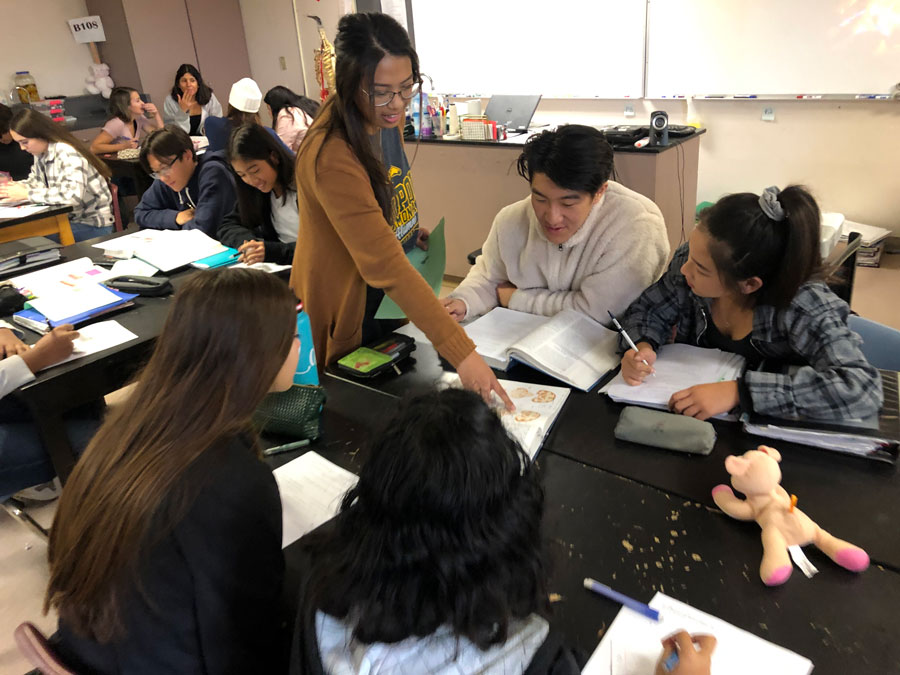
Katrina Poniente teaches anatomy and physiology to juniors and seniors at Ayala High School in Chino Hills.
The CSU has committed $10 million over four years to increase the number of credentialed K-12 math and science teachers. MSTI is the CSU Math and Science Teacher Initiative and Cal Poly Pomona will use some of the $180,000 in funding received this year to continue providing scholarships of $5,000 per year for up to two years.
“This initiative addresses a shortage in math and science teachers. Locally we see that shortage across all Southern California where substitute teachers are often teaching these subjects,” said Nicole Wickler who is Research Director at the Center for Excellence in Math and Science Teaching (CEMaST) at CPP.
The CSU reports that 33,000 new math and science teachers will be needed in California in the next 10 years. “It’s the result of many teachers who delayed their retirement due to the economy, now retiring, combined with not enough people choosing teaching as a profession,” Wickler said.
“The need is great and we are grateful for the commitment of the CSU to MSTI and the additional support they’ve provided. Our Science for All Initiative in the College of Science is dedicated to developing a diverse STEM workforce and in order to do that we need to train more math and science teachers,” said Alison Baski, Dean of the College of Science.
“We currently have 15 MSTI Scholars; however, three are student teaching right now so they’ll be completing their credential requirements and seeking employment in the spring,” said Wickler. CEMaST has supported 43 MSTI scholars since 2014.
The credentialing program is administered by the College of Education and Integrative Studies. CEMaST, which is in the College of Science, facilitates the funding.
Scholarships are available to those seeking a single subject teaching credential in Biology, Chemistry, Geology, Mathematics, and Physics. Because the scholarships are two years, MSTI Scholars are accepted as juniors or seniors. Students interested in applying should visit the CEMaST website.
“I visited CEMaST to find out about the credentialing program and Becki King told me about MSTI. I’ve been a MSTI scholar for one year,” said Katrina Poniente (’18, biology). “Becki, and Laurie Riggs at CEMaST have been amazing. They’re always quick to respond if I have a question or need something.”
“My favorite part is the monthly meetings. We have guest speakers that help prepare us for teaching careers. At those meetings I’ve met other students who are further along in the program. Their experience has been a great resource,” said Kelsey Fielding (’18, biology).
“MSTI is more than scholarships, it includes preparation for the CSET exams, money for students to attend conferences, a computer science boot camp for supplemental authorizations in that discipline, and there’s also funding for students to work as Learning Assistants, assisting professors,” Wickler said.
“Before finishing our credential we do clinical practice which means teaching eight hours a day, five days a week. It’s volunteer which is why financial support is so important. I wouldn’t be able to do it without MSTI,” Fielding said.
“I’m with them at a time in their life when they’re navigating the SAT’s and college applications. To be with students is my favorite part of the job. I get to watch them grow a lot in a short period of time,” said Poniente, who plans to teach biology and is currently teaching high school juniors and seniors.
“I believe teaching is a noble profession. It is extremely rewarding to help someone learn. There’s so much pressure to go for status and money but those aren’t the only rewards in life,” CEMaST Research Director Wickler said.
“Teaching is hard. There’s a lot that’s required behind the scenes in preparation for class but it’s all worth it because making an impact on these students is so rewarding,” Fielding said. She’s doing her clinical practice at a middle school. “There’s a student who the other teachers told me was rude and often slept in class but I’m able to reach them and get them to participate. I’m giving the students a positive learning experience. I love every day with my students.”