Geophysics Helps us Understand our World and Beyond
Geophysics is one of the focus areas students may choose to study in the Department of Geological Sciences. By definition, geophysics encompasses the earth’s physical processes, which includes hydrology or the study of water, as well as atmospheric science. The discipline also applies to the study of planetary bodies such as the moon or Mars.
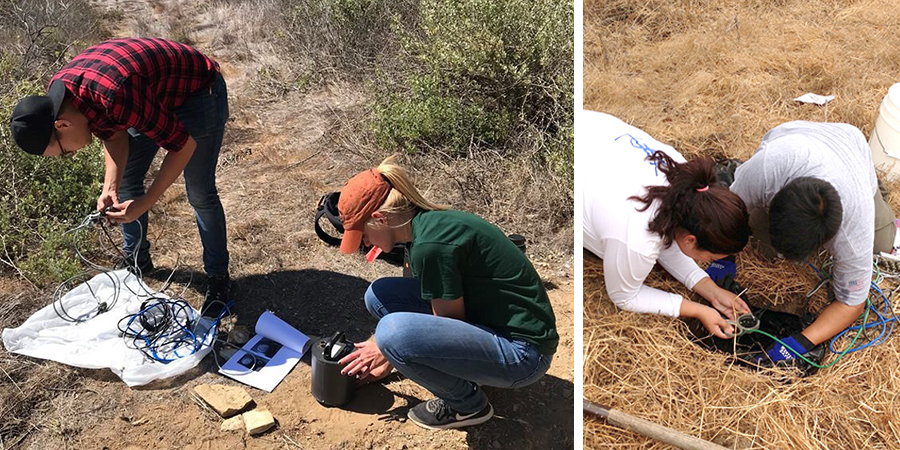
Jascha Polet is a professor in the geological sciences department. Her specialty is seismology and she’s involved in a collaborative project that includes four graduate and four undergraduate students, as well as representatives from Caltech, Jet Propulsion Laboratory (JPL), Harvard University, University of Utah, and Louisiana State University. In May, a group of 5 teams placed 200 seismometers, provided by Caltech, in the Chino Basin.
“Acquiring data on the Chino, San Gabriel, and San Bernardino Basins will allow us to better predict the propagation of seismic waves. The ground motion predictions from the Great California ShakeOut are based on a detailed structural model for the L.A. basin but not these other basins.” Polet said. “The other three basins actually act like a funnel, channeling energy toward the L.A. basin.” That amplification could result in ground motions lasting as long as two minutes.
Polet said, “The research being done in the basins doesn’t require waiting for an earthquake. The seismometers can measure ambient motion created from human and atmospheric activity. The purpose is to get an idea of how the ground will move during an earthquake. Two master’s theses from CPP students have already been completed on this and two more are currently underway.”
Because of Cal Poly Pomona’s participation in the project, the College of Science will have exclusive access to the seismic data for 1 ½ years. After that it will be made available to all.
Having an idea how an area will move during a quake can help builders build safer buildings. There is also a resonance frequency for an earthquake as well as for buildings. When the natural resonance of a building is the same as the resonance frequency of an earthquake, the result is that the motion is compounded.
“In the L.A. basin we’re looking at a primary resonance period of 6 to 10 seconds. This resonance period is comparable to that of the tallest high rise buildings in downtown L.A.” Polet said.
The Department of Geological Sciences has many tools to study the earth. A gravimeter which costs over $100,000 was donated by a private firm. It measures differences in gravity that are so slight it can build an accurate picture of the material below the surface. The department also has ground penetrating radar (GPR), a magnetometer which measures the Earth’s magnetic field, and its most recent addition is ground-based LiDAR equipment.
LiDAR stands for light detection and ranging. 70% of the cost of the $100,000 piece of equipment came from lottery funds and the other 30% was funded by the college. The LiDAR uses lasers for imaging and allows geophysicists to create 3D models of terrain.
There are many practical uses of LiDAR imaging. Polet will also use it to compare images over time to study landslides and to monitor fault creeping. The college can also use it to analyze road cuts in hillsides to determine points of weakness and help design road cuts that aren’t susceptible to sliding.
Graduates of the geological sciences program find jobs in their field because there’s a demand for their skills. Polet said, “The geotechnical industry needs workers who can take geophysical measurements, and image the subsurface. Builders need to understand building sites in order to design safe structures. Our graduates also find work in the environmental industry where an understanding of soil and water is important.”
The geosciences encompass everything related to the earth so there’s a wide range of fields in which our graduates can find work. Geoscientists work in the energy industry both in wind, solar and geothermal industries where an understanding of atmosphere and terrain is critical and in the petroleum and natural gas industries where knowledge of subterranean structures can aid in the discovery and extraction of those resources.
Geoscientists’ value isn’t limited to the study of the earth; they’re also involved in space exploration as it relates to planetary bodies. Moon and Mars quakes need to be understood before safe bases can be built there. An earthquake causing a crack in a building here on earth can mean risk and costly repairs, but on the moon or another planet, a compromised structure would be catastrophic.