
Monitoring and Restoring the California Coast
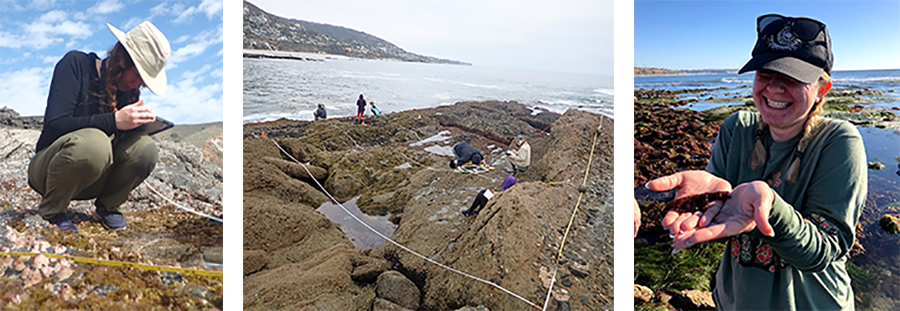
(left) Sierra Sutton (’18, biology) surveys tide pools. Larissa Fields (right) holds a California Sea Hare, an inhabitant of the intertidal rockweed environment.
Seaweed is an important part of the intertidal ecosystem. It supplies food and shelter for a variety of sea life. Associate Professor Jayson Smith has recently received two grants. One grant supports the restoration of rockweed, (Silvetia compressa) a type of seaweed, on the California coast. The other grant supports monitoring of sea life in the intertidal zone.
Monitoring the coast for changes in sea life enables scientists to see trends and potentially recognize problems before they become too big to address. With the help from a Multi-Agency Rocky Intertidal Network (MARINe) grant, Smith’s Coastal Ecology Lab collaborates with UC Santa Cruz to explore trends and track biodiversity.
“The MARINe data goes back 20 years. It means we can observe shifts due to climate change or anthropogenic disturbances, such as oil spills. The data provides a solid foundation to base conservation and management decisions,” said Sierra Sutton, who continued working with Smith after graduating (’18, biology).
Monitoring means the team could spot changes like the decline of rockweed in certain areas, a problem that the restoration project will address. Smith has been involved in monitoring the coastline since 1996 when he was a student.
“My college advisor was a Principal Investigator (PI) on the work. I continued with it through grad school and joined the collaborative as co-PI when my predecessor retired,” Smith said. “The monitoring done by the MARINe team allowed for early detection of sea star wasting syndrome which is caused by densovirus. It affected the whole species range, and they’re still recovering.”
The rockweed species is important to California intertidal ecology. “It provides a canopy for species that live underneath. Without the rockweed they’d die from desiccation at low tide.
It increases diversity by providing a safe refuge and is home to other sea weeds, limpets, snails, and can serve as a nursery for fish species,” Smith said.
The restoration is a collaboration between PI’s Smith, and marine scientist Robert Miller from UC Santa Barbara, and co-PI’s from UCSB, Channel Islands National Park, UC Santa Cruz and UCLA.
One technique Smith’s lab will use in restoring the rockweed is transplantation. They are currently figuring out the donor and recipient sites. Smith said, “Robert Miller is figuring out the genetics so we don’t try to transplant a population that won’t succeed there. We also don’t want to mess with the genetics of an area, but our sites are not long distances apart so that shouldn’t be a problem.”
Smith’s Coastal Ecology Lab is providing many opportunities for students to learn by doing. CPP’s part of the restoration project spans an area from San Diego to Palos Verdes. During restoration students will break off sections of rock where the rockweed is growing abundantly and transplant it to sites where the plant’s population is dwindling.
Graduate student Larissa Fields will be exploring other restoration methods. “For my thesis research I’m investigating how abiotic factors affect gametogenesis in rockweed and if gamete transfer is a viable method of rockweed restoration,” Fields said.
In layman’s terms, she’ll be taking rockweeds into the lab, harvesting their gametes which can then be transplanted to the sea, or fertilized on discs in the lab. The discs, intended to simulate rocks, would then be epoxied to coastal rocks during low tide.
An interesting fact about rockweed is that it can be monoecious, have both male and female reproductive parts, or dioecious, have male and female parts on different plants.
Sutton, who also works on the restoration project, sees community outreach and education as a vital part of restoration. “It’s clear that the public has an important part in the success of restoration, particularly in areas that are heavily utilized,” she said.
Fields says her work with Smith’s lab taught her the importance of communication, and collaboration among scientists. After she completes her MS degree in 2021 she would like to work at the Department of Fish and Wildlife or the National Park Service.