 Can farmers expand income opportunities without expanding land use?
The Huntley College of Agriculture and Pitzer College are collaborating on a research project to find out.
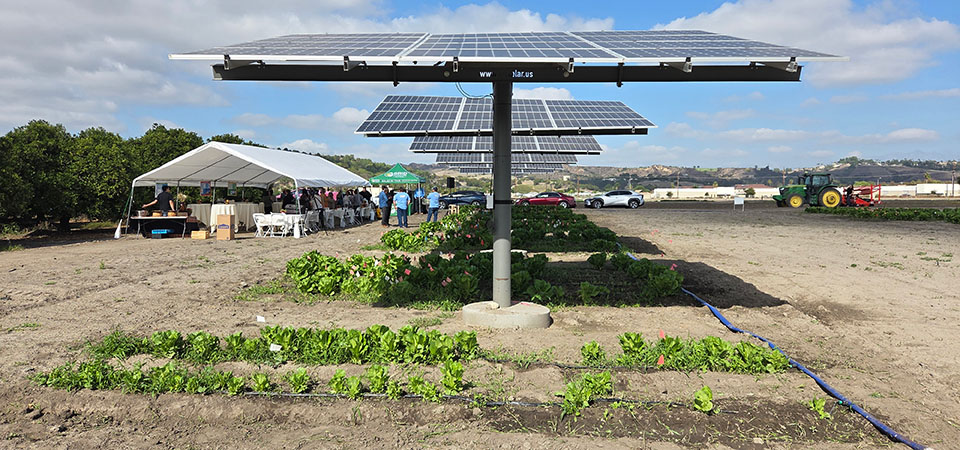
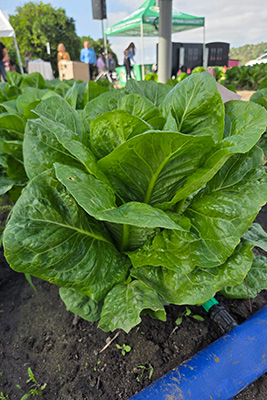
They are growing romaine lettuce at Spadra Farm on the Cal Poly Pomona campus under six photovoltaic solar panels, a concept called “agrivoltaics.” The Spadra Farm system is believed to be the first commercial agrivoltaics system in Southern California.
“We’re really proud to be the host site for this and provide opportunities for our students to work on really dynamic research projects,” Plant Science Associate Professor Aaron Fox said.
The project is a partnership between the Huntley College and the Robert Redford Conservancy for Southern California Sustainability at Pitzer College.
First proposed by German scientists in 1981, agrivoltaics integrates sustainable agriculture with renewable energy creation.
By growing under photovoltaic panels, farmers can reduce thermal stress on plants and the amount of water lost to evaporation. In addition, it can improve worker safety by providing shade for farmers in regions that have hot climates.
The photovoltaic system at Spadra Farm can generate enough power to supply four to six homes for a year, depending on usage.
The project was funded through a $1.8 million grant from the Foundation for Food and Agriculture Research to Pitzer College to study the environmental potential and benefits of agrivoltaics across the state.
“Ultimately, our goal with this grant is to empower people to power themselves, to develop microgrids, to grow food at the same time they’re tackling challenges like heat, and drought and swollen energy systems, and extreme weather,” said Susan Phillips, director of the Robert Redford Conservancy for Southern California Sustainability.
Virginia Jameson, the California Department of Food & Agriculture’s deputy secretary for climate and working lands, joined representatives from the Huntley College and Pitzer College at an Oct. 23 ribbon-cutting ceremony at Spadra Farm to celebrate the new agrivoltaic system.
The agrivoltaics system is a microcosm of what farmers do daily, she said.
“They wake up with the sun. They start thinking about ways to do what they do better,” Jameson said. “Farmers don’t just plant and harvest. They fix things: fences, tractors, tools, systems. And along the way they invent things.”
“When we look at problems like urban land encroachment, water issues, a power grid that needs redundancy,” Huntley College Dean Ethan Orr said, “in a project like this, you see a solution to multiple problems.”


