Clippers Tech Chief and Cal Poly Pomona CIO Share Lessons on Data, AI, and Careers at Leadership Dialogue
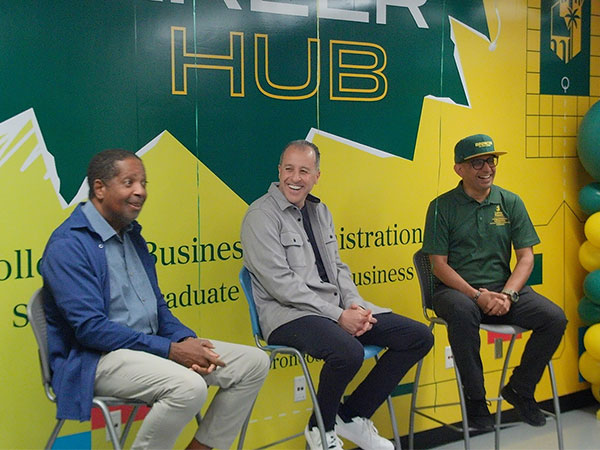
Long before he built the data strategy behind one of the NBA’s most technology-forward arenas, George Hanna (’99, computer information systems) was a Cal Poly Pomona (CPP) student taking computer information systems classes by day and riding along with campus police on the swing shift by night.
Hanna, now chief technology and digital officer for the Los Angeles Clippers and Intuit Dome, as well as member of CPP’s Industry Advisory Council, returned to campus for the Leadership Dialogue hosted by the College of Business Administration Career Hub (CBACH). He was joined by John McGuthry, Cal Poly Pomona’s vice president of technology and chief information officer, for a conversation about technology, artificial intelligence, and the career lessons that took each of them decades to learn.
Chasing One Point
Hanna said every decision at Intuit Dome is driven by data, and the data says home-court advantage is worth one to two points in an NBA game. About half of that comes from the crowd, and a crowd can’t be loud if it’s stuck in line. “Whatever the solution is, we know what our North Star is. We know what the end goal is, and that’s to get you in your seat,” Hanna said.
That goal drives the arena’s cashier-free frictionless stores, where fans buy 2.3 times as much as they do at traditional stands. It also shaped halftime. In most NBA arenas, about half the crowd is back in their seats when the third quarter starts. After the Clippers partnered with Candy Crush on an arena-wide halftime game played from buttons built into the seats, that number climbed to an average of 76 percent. “And guess what? Candy Crush pays us to be able to do that. Pretty good, right?” Hanna said.
Removing Friction on Campus
McGuthry described a similar mission at Cal Poly Pomona. The student portal draws between 500,000 and 700,000 visits a month, more traffic than any physical place on campus, and his team now runs focus groups that watch students complete tasks in it.
“When I was thinking about going to university and graduating, I wasn’t thinking, ‘I can’t wait to stand in line in financial aid,’ or, ‘I can’t wait to stand in line because I lost my ID card and I have to go to this place,’” McGuthry said.
The solution, he said, is a portal that guides students instead of waiting for them to know what to do. He pointed to his son, a Cal Poly Pomona graduate who had the advantage of a father who knew every deadline. “So wouldn’t it be great if that portal eliminated his advantage, so that everything I told him to do either happened automatically, or the portal said, ‘You need to do this’?” he said.
A Reality Check on AI
Asked for a sanity check on AI, McGuthry invited the room to challenge him, then drew on his years with early internet startups. “Right now, I feel like we’re in — I’m going to date myself — we’re at the Netscape stage. Right? That’s not to say it’s not exciting now; it is exciting,” he said. Generational platform humor notwithstanding, McGuthry went on to praise the adaptability of today’s tech leaders and startups. The real breakthrough, McGuthry said, will come when AI connects safely to the physical world through cars, planes, and robots. Hanna urged students to help shape where the technology goes, borrowing a line from “The West Wing”: Decisions are made by those who show up. “Show up. Be a part of the process. Voice your opinion, vote, call your congressman, run for office — whatever it is, to help influence that,” Hanna said.
The Skill That Gets You in the Room
When students asked how to stand out, both speakers landed on the same answer: the ability to explain something complicated simply. “That’s why I got the job, by the way. Steve said I can take a complex piece of subject matter and explain it in ten seconds,” Hanna explained, referring to Clippers owner Steve Ballmer.
McGuthry said the skill didn’t come naturally for him. Early in his career, he gave his first presentation to a CEO, felt it went badly, and watched the executives head into a meeting without him. “I don’t ever want to be the person that’s left out. I want to be in that room,” he said. “But your ability to explain is your key to success. You may not know what it is you want to do, but you can practice that,” McGuthry said.
Asked about their biggest lessons, Hanna recalled a system change early in his career that put $250 million at risk for a former employer. “I learned so much about admitting when there’s a mistake, asking for help when you need it, and not trying to solve problems if you’re not capable of solving them or you’re not sure,” he said. He also passed along the Clippers’ president’s formula for loving 80 percent of the job and getting paid for the rest. “But try to make it that ratio, right? Love 80 percent of it, and make them pay you for the other 20,” Hanna said.
McGuthry, who retires at the end of December after over 15 years of service at Cal Poly Pomona, said his definition of success has changed over the course of his career. “For me, success is really about how the people grow. Very early on, it used to be how much money I made. In the middle, it was the impact I had on the organization. Now, as I’m preparing to go play golf, it’s the impact I’ve had on people, because people pretty much do it all,” he said.
Students on hand, including Chaichana Prasertsrithong (’27, Master’s in Business Administration) appreciated Hanna and McGuthry’s guidance and advice. “I took away many lessons from today’s discussion, especially when they spoke about leadership and what it takes, as well as the value of self-development, and constantly upskilling to better develop ourselves as professionals,” he said.