 Whether you're a devoted K-pop fan or not, chances are you have heard Netflix’s most successfully movie in history, KPop Demon Hunters. The global sensation streamed its way into mainstream America, introducing households to South Korean craze, racking up multiple Oscar nominations and more than 500 million views along the way.
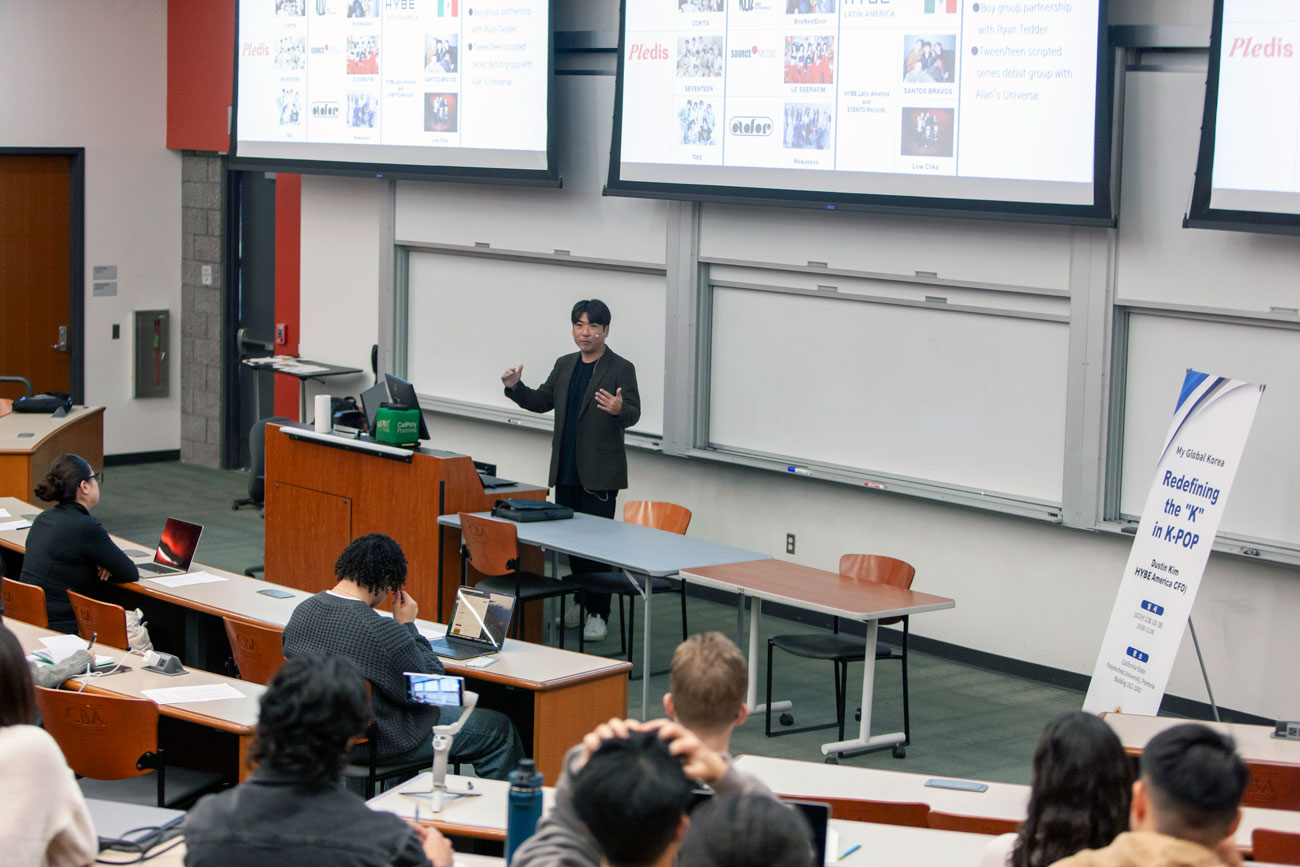
Recently, students had a chance to hear from an executive behind the world’s most popular K-pop group visited Cal Poly Pomona’s College of Business Administration that offered a glimpse at what it takes to launch an international sensation.
Dustin Kim is the chief financial officer for HYBE America, the record label and music company behind K-Pop icons BTS and the 13-member mega-group, SEVENTEEN. He was invited to campus by International Business and Marketing Management Professor Anthony Kim and the guest lecture drew K-Pop fans from multiple disciplines.
“In the U.S., artists make most creative decisions and labels function more like partners,” Dustin Kim said. “HYBE’s model is different. We don’t see ourselves as a music company—we see ourselves as a fandom business.”
 According to Dustin Kim, U.S. labels tend to sign hundreds of artists, playing a numbers game while hoping a few achieve stardom. HYBE outlines a group’s image and narrative, seeks out performers that fit into a role, and invests in developing the artists, a process that can take up to three years. He says HYBE has nearly 100 percent success with this approach.
Although BTS is the company’s most popular group, Dustin Kim focused mainly on upcoming acts like Katseye laying the foundation for long-term sustainability, along with the HYBE’s global reach with hubs in Korea, the United States, Latin America, and Japan.
“BTS and SEVENTEEN’s fanbases are aging,” Dustin Kim said. “BTS Army is now largely in their late 20s to 30s. We must secure the next generation of fans.”
Developing talent requires a significant investment, with the process taking up to two years as members are trained in vocals, dancing, songwriting, and style.
According to Dustin Kim, HYBE is deliberate in differentiating sounds and looks between its labels so fans don’t say, “This sounds like HYBE.” He continued to use Katseye as an example, noting the all-female multinational group’s music is more mainstream pop than traditional K-Pop.
 “We don’t see ourselves as a music company—we see ourselves as a fandom business,” Dustin Kim said. “Fans buy into not just the music, but content, merchandise, concerts, storylines, and identity.”
The December visit from a HYBE executive marked Professor Anthony Kim’s latest effort to connect students with relevant, industry-focused speakers and techniques. He recently accompanied students to South Korea during an intersession study abroad program focused on sports marketing.
“When students are already excited about a global phenomenon like K-pop, it opens the door to deeper learning,” Professor Anthony Kim said. “HYBE is a huge industry name and exposure to leading executives in invaluable in preparing students for successful careers."


