The Cal Poly Pomona College of Business Administration brought students, faculty, alumni, and industry professionals together for its second annual Innovation Symposium on April 10, focusing on a timely and evolving theme: advancing leadership and problem-solving in the age of artificial intelligence.
The half-day event offered an optimistic look at how emerging technologies are transforming the workplace. Through keynote insights, panel discussions, and hands-on breakout sessions, attendees explored not only what AI can do, but how people can partner with it to drive meaningful innovation.
Singelyn Family Dean Sandeep Krishnamurthy opened the symposium with a forward-looking message, encouraging students to rethink how they approach technology. Rather than focusing on mastering a single tool, he emphasized adaptability, systems thinking, and the ability to connect multiple technologies to solve complex problems. “When students enter the workplace, they will be expected to use and leverage AI extensively,” he said. “The more fluent they are in moving between different AI systems, the better positioned they’ll be.”
Keynote Takeaways
The keynote address featured Vibhanshu Abhishek, associate professor of information systems at the University of California, Irvine, and founder of Alltius.AI. His talk, “The Centaur Economy: Building, Pivoting, and Thriving at the Human-AI Frontier,” explored the growing partnership between human intelligence and artificial intelligence. “Ever since I was a kid, watching Star Trek, I was really fascinated by the idea of humans building intelligence systems. It was a big part of me growing up, imagining how this system should look in the future. Now, I've been on that learning journey for almost 25 years. Today, there are all these new advancements around us, and many of these ‘dream technologies’ are very real and exist now. It is a bit scary, but we are living in a fascinating time in the world.”
Abhishek framed AI as a powerful complement to human capability, describing a future where success will come to those who can combine creativity, judgment, and adaptability with the speed and scale of AI systems.
Industry Panel and Perspectives
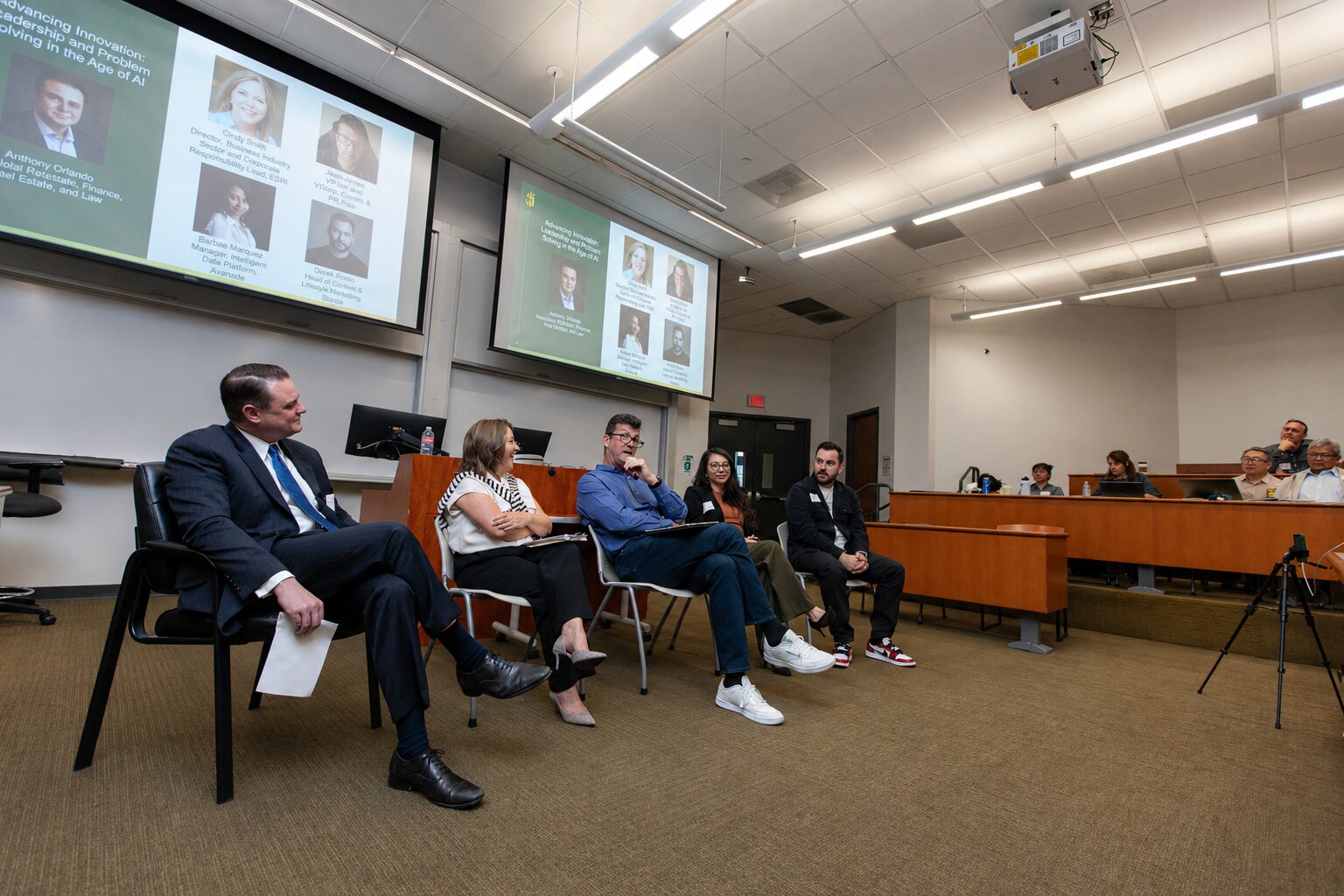
A panel of industry experts brought real-world insight to the conversation. Moderated by Anthony Orlando, associate professor of Finance, Real Estate, and Law, the discussion featured Cindy Elliott, director of business industry sector and corporate responsibility lead at Esri; Jason James, partner and VCISO at Regents & Park; Barbae Marquez, intelligent data platform manager, Avanade; and Derek Romo, head of CRM and lifecycle marketing for Stance. Panelists shared a common theme that innovation is driven not just by technology, but by how people choose to apply it. The four panelists respectively showcased examples of technology, cybersecurity, consulting, and marketing applications to examine how they see AI as being utilized in real-world settings.
Elliott highlighted the evolution of AI from practical uses like insurance “change detection” to emerging “agentic commerce,” noting that “data is now like the field AI is harvesting from,” enabling increasingly autonomous systems. James shared striking examples, including how Space Force went from being overwhelmed by data to analyzing all of it with AI, and how an AI-suggested airport bus route—which was initially dismissed—turned out to be historically accurate and valuable.
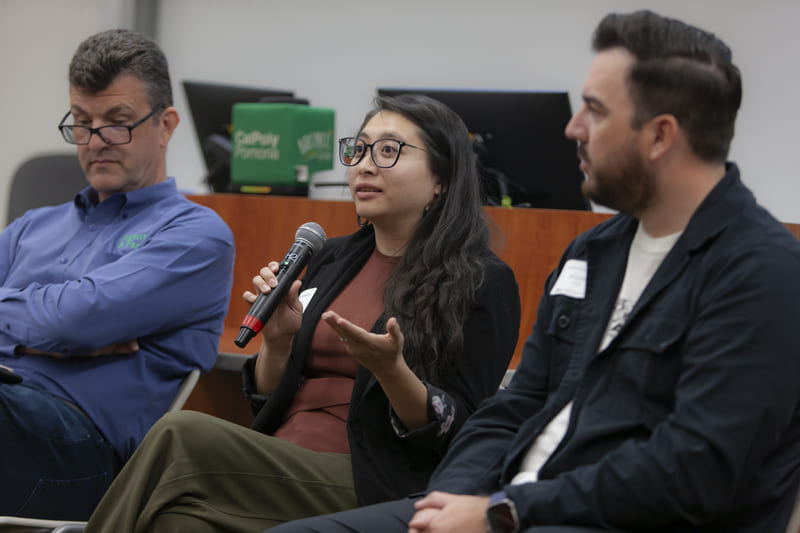
Marquez noted that while the excitement around AI adoption is high, many organizations are still building the data foundations needed to use AI effectively, emphasizing that critical thinking remains essential. “The client often doesn’t even know what their problem is,” she said, underscoring the importance of defining challenges clearly before applying technology. Across the panel, a recurring theme was the importance of human judgment, with Marquez advising attendees to “embrace AI, but embrace it responsibly.” Romo added that AI should act as a partner rather than a replacement for original thinking.
Panelists also discussed ethical considerations, including data privacy, governance, and responsible use. With AI already unlocking new efficiencies and insights, the optimism for its benefits across industries is palpable. When paired with human judgment, the panel concurred that AI has the potential to drive lasting value in a variety of capacities and industries.
Breakout Sessions and Hands-On Learning
Beyond discussion, the symposium placed strong emphasis on experiential learning.
Three different breakout “innovation sprint” sessions gave attendees the chance to tackle real-world challenges using AI tools.
One session, led by CPP Dining Services Director David Corral, challenged participants to explore how AI can be used to reduce food waste on campus. Using real data on menu production and consumption, students analyzed trends, generated insights, and proposed actionable solutions.
The other two breakout sessions focused on using AI to build an SEO-optimized website, and applying AI in cybersecurity capacities, respectively. Participants learned how security operations centers use AI to analyze large volumes of system data, identify potential threats, and respond in real time.
These interactive experiences reinforced the day’s central message: innovation thrives at the intersection of technology, collaboration, and creativity.
“The breakout session on AI-powered innovation to reduce food waste at CPP was particularly interesting,” said Kennon Holton-Tran (EBZ, ’26). “We were able to analyze real-world data and share insights directly with a main stakeholder, Dining Services Director Corral. It was clear that he was just as excited as we were to see how the information gained could be used to further optimize dining operations.”
“At the CCIDM workshop, we saw firsthand how AI-driven ‘Vibe Design’ and ‘Vibe Code’ empower creators to deploy functional, well-designed websites using natural language,” said Jarrod Griffin (MSDM, ’26), a member of the OptiMark Digital Marketing & Analytics Society. “By the end of the session, participants had launched live sites that reflected their creative visions. This experiment provided invaluable insights into human-AI interaction, demonstrating that while AI is an incredibly powerful partner, translating a complex vision into code still requires a thoughtful, strategic approach.”
Fellow Optimark member Leeann Lewis-Waddell (MSDM, ’27), agreed on the power of the session insights. “This hands-on innovation experience is a hallmark of Cal Poly Pomona and exactly what we are championing through the OptiMark Digital Marketing & Analytics Society.”
A Collaborative Effort
The symposium was organized by the CBA Centers, spearheaded by Faculty Directors Rita Kumar (Singelyn Center for Innovative Analytics), Jae Min Jung (Center for Customer Insights and Digital Marketing), Indira Guzman (Mitchell C. Hill Center for Digital Innovation), and Weijun Zheng (California Center for Cyber Risk).
“The CBA Centers serve as hubs for experiential learning opportunities,” said Kumar. “Events like this help stretch the mind and reimagine what’s possible in a changing world.”
As the day concluded, one message stood out. The future of business will not be defined by AI alone, but by how people engage with it. With the right mindset, strong foundational skills, and a willingness to adapt, today’s students are well positioned to lead in an evolving landscape. While the technology continues to evolve, success will depend on the ability to think critically, adapt quickly, and collaborate across disciplines.
By bringing together diverse perspectives and creating space for hands-on exploration, the Innovation Symposium reflected the College of Business Administration’s commitment to preparing students for what comes next, where innovation is driven as much by people as it is by technology.


