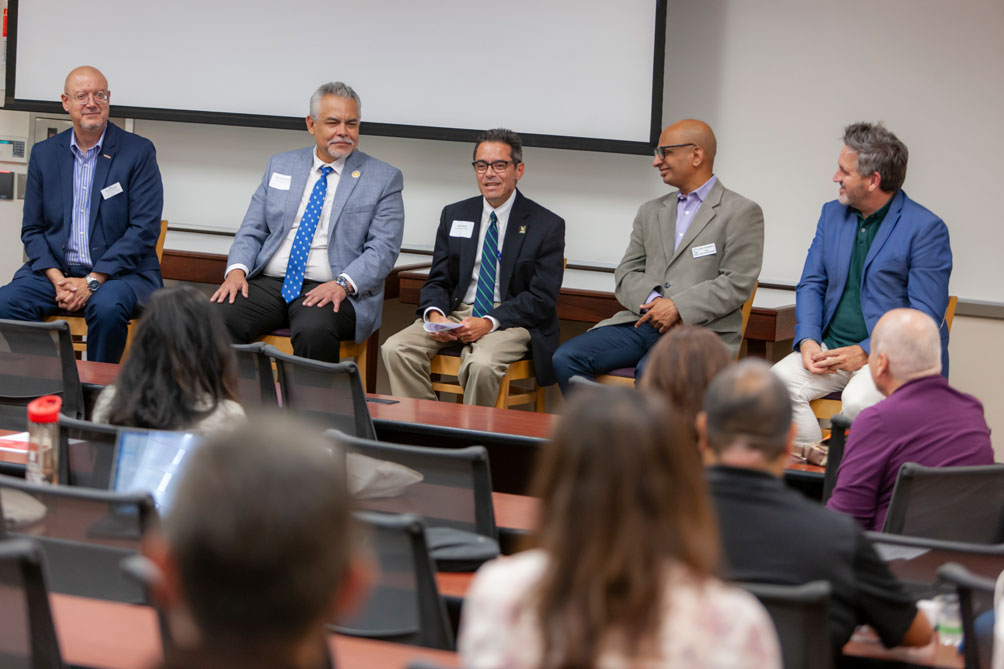
Cal Poly Pomona's College of Business Administration hosted the inaugural LaFamilia Management Scholars & Allies Conference, drawing deans, provosts, faculty, and students from across the country to Kellogg West Conference Center for two days of panels, workshops, and roundtable discussions dedicated to Latine representation in business education. The organization is focused on developing practical strategies to advance student success, investments in faculty development, and expanding leadership pathways for Latine students and scholars in business education.
The conference, themed "Latinos and Latinas in Business Schools: Challenging Invisibility," was sponsored by CPP's College of Business Administration and the Paul Merage School of Business at UC Irvine. It marked the first large-scale gathering for LaFamilia Management Scholars, a national organization founded in 2019 by Carlos B. González, a management and human resources professor at Cal Poly Pomona, Patricia G. Martínez, a Cal Poly Pomona alumna and professor at Loyola Marymount University, and Monica C. Gavino, a professor at San José State University.
Day One
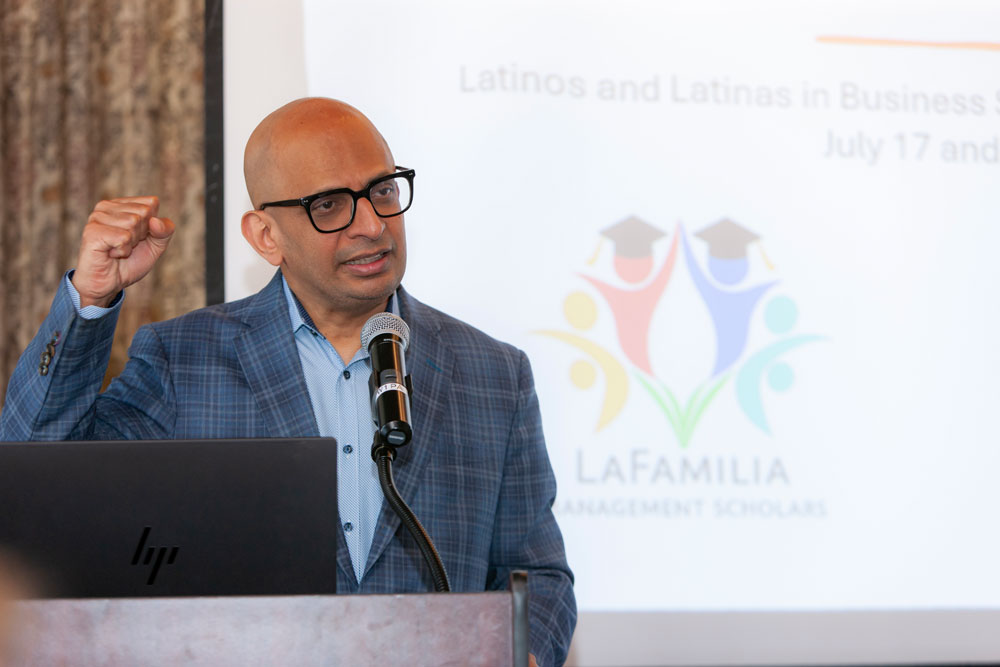 The conference opened with welcome remarks from González, Singelyn Family Dean Sandeep Krishnamurthy, and then-Provost S. Terri Gomez (now President of Cal State San Bernardino), followed by a keynote address from Sylvia Hurtado, a distinguished professor of education at UCLA and president-elect of the American Educational Research Association. Hurtado, who directed UCLA's Higher Education Research Institute for more than a decade, discussed her research on Latine student success and its implications for business schools, followed by a question-and-answer session and an evening reception complete with a themed menu and Mariachi band.
“As I built my career, I realized I needed to have the research skills to understand what's going on, particularly in support of students and resources and I wanted to use evidence-based kinds of practices to support their advocacy,” said Hurtado. “I found research life extremely empowering overall. Using data for change is very powerful, and sometimes it can help to change minds— but it doesn't always change behaviors. So, we're really focused on changing behaviors that will ultimately change institutions.” Hurtado described an interaction with a student that framed the importance of LaFamilia in the educational space. “The student said, “You can’t be what you can’t see,’” explained Hurtado. The quote moved the room of attendees and provided an illustration of the need for representation within faculty in the sense that if students do not see themselves in the faculty, they get the message that becoming a faculty member at an institute of higher education is not a possibility for their specific humanity, in this case Latine.
LaFamilia Board Member and associate professor of organization and management University of California, Irvine's Paul Merage School of Business, Maritza Salazar Campo, echoed Hurtado’s equity-mindedness approach for Hispanic Serving Institutions (HSI). "An HSI designation tells you who enrolls. It doesn't tell you who graduates, who feels they belong, or who gets access to the networks that turn a degree into a career. LaFamilia matters because it moves the conversation from designation to service. It gives institutions a place to compare what actually works to serve a growing student population who are entering the business world, and it puts intentionality around how we enable and build capacity for our shared future."
The afternoon's panels focused on academic transitions and representation. One session, featuring senior scholars from UCLA and the University of Houston, offered roadmaps for Latine doctoral students and faculty moving from industry practice into management research. A second brought together deans, associate deans, and provosts for a roundtable on the historical underrepresentation and isolation of Latine faculty in business schools. “All of the LaFamilia board has been instrumental with their contributions for moving our work along for the last two years after officially establishing our board and bylaws, so seeing our logo light up the screen the first day was overwhelming in the best way,” explains Gavino.
Day Two
The second day at the conference kicked off with an introduction to LaFamilia from its co-presidents, Donna Maria Blancero of Bentley University and Gavino, followed by a session examining the diversity, origins, and identities of Latine individuals and their implications for business organizations and business schools. The day's panels shifted toward data and alliance-building, with national data-sharing workshops on recruitment, hiring, and tenure pipelines for minority educators, and breakout sessions aimed at building long-term institutional alliances and toolkits for boosting Latino student success and professional retention.
The two-day program featured a roster of deans and academic leaders from across the state and beyond, including Luis A. Perez-Batres, dean of the A.R. Sanchez, Jr. School of Business at Texas A&M International University; Mark Suazo, dean of the College of Business at Cal State Long Beach; Tomas Gomez-Arias, dean of the Jack H. Brown College of Business and Public Administration at Cal State San Bernardino; and Ismael López Medel, dean of the Patty Arvielo School of Business and Management at Vanguard University. Also on the program were Bernardo M. Ferdman, a distinguished professor emeritus at Alliant University; Cecilia Santiago-González, associate vice president for student success at Cal Poly Pomona; and Christina Chavez-Reyes, interim associate dean at Cal Poly Pomona.
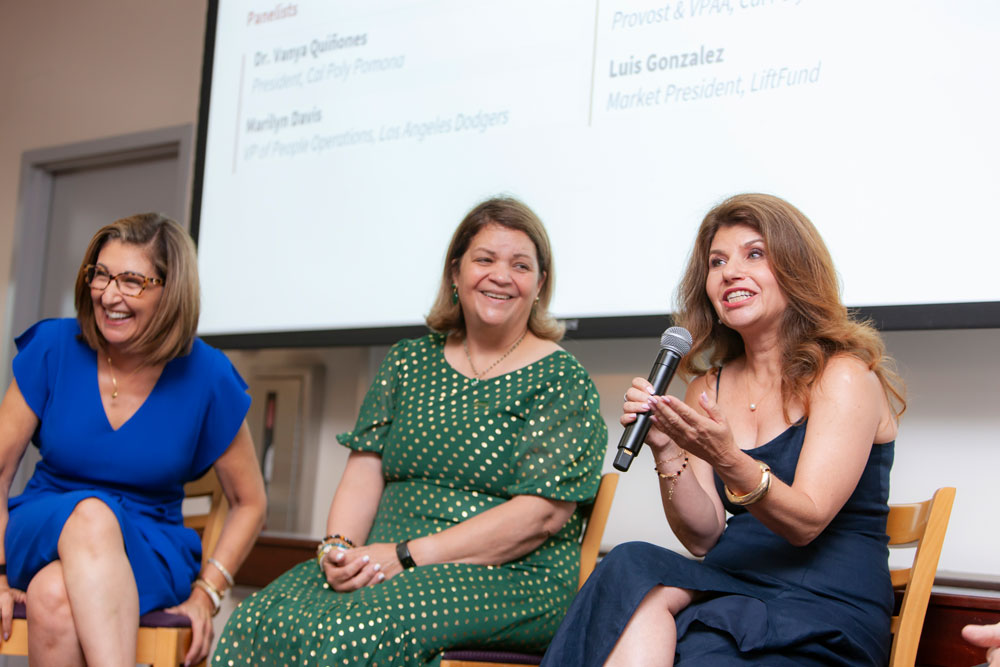
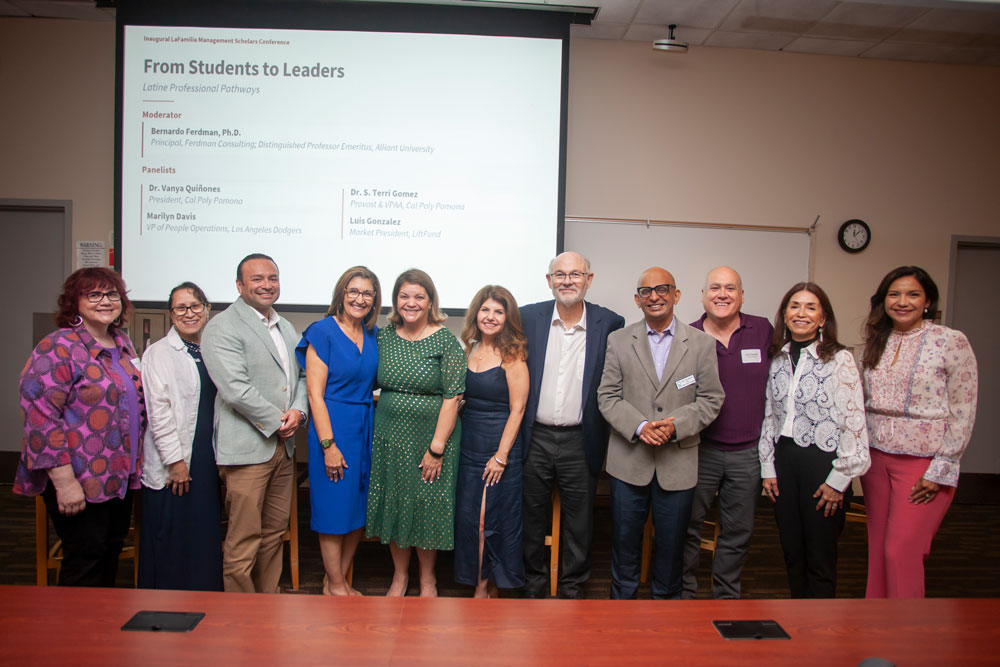
Industry voices rounded out the roster, including Luis Gonzalez, vice president for business growth philanthropy at Wells Fargo Bank, and Marilyn Davis, vice president of people operations for the Los Angeles Dodgers, as well as Salazar Campo, who also serves as a faculty lead for the Latine Initiative at UC Irvine's Paul Merage School of Business.
The conference also introduced attendees to Cal Poly Pomona's new leadership. President Vanya Quiñones, who assumed the university presidency July 1, 2026, becoming CPP's eighth president and the first Latina to hold the role, met with attendees just weeks into her tenure.
“Representation has the power to expand what we believe is possible. When students see people who reflect their experiences in positions of leadership, scholarship, and influence, they can envision themselves on those same paths. And when institutions embrace different perspectives and ways of thinking, we create stronger communities and better futures. That is the spirit of LaFamilia, and it is the spirit of sí se puede: when we see one another, learn from one another, and build together, we can achieve more than we ever could alone,” said Vanya Quiñones, president, California State Polytechnic University, Pomona.
Reflections
For students, the conference offered a rare chance to hear directly from Latina leaders steering some of the region's largest institutions and companies. Sophia Veliz (MKT, ’27) and Rianna Esparza (BSBA, ’28), co-presidents of Cal Poly Pomona's Latino Business Student Association, attended both days and said the advice they heard resonated well beyond the conference room.
"I really appreciated the practical advice and words of encouragement from the panelists," Veliz said. Among the lines that stayed with her: Gomez's reminder that "you can't have it all," Quiñones' call to "bring your own seat to the table," and a message from Davis that "you don't have to have it all figured out." "These simple yet powerful words reminded me that I don't have to be everything before its time," Veliz said. "There is no rush, and I should focus on what I am truly passionate about." Veliz was also inspired by meeting incoming Cal Poly Pomona President Quiñones as a highlight of the two days. "She was so warm, approachable, and respectful, taking the time to listen to us and offer her help," Veliz said. "It was such an exciting moment for all of us, knowing that CPP is officially being led by a powerful Latina in President Quiñones."
For Esparza, the standout moment came from a conversation with Martínez, one of LaFamilia's co-founders and a former LBSA president during her time as a CPP undergraduate. "She even showed us her memorial 'member' pin, and I still remember the smile she had on her face while doing so," Esparza said. "That moment made me realize how much of an impact we have the opportunity to make on every student who chooses to become part of our familia.'"
Both students said the experience motivated them to keep pushing for greater visibility for Latine students in business education. "What fueled this motivation the most was the passion that radiated from everyone in the room," Esparza said. "It spoke volumes without anyone needing to say a single word."
Organizers say the inaugural gathering is meant to be the start of an ongoing effort, not a one-time event. LaFamilia's founders have described the organization's mission as building a national network and repository of research and mentorship to help Latine faculty, students, and administrators support one another as they move through business academia. With its first conference behind it, the organization is looking toward building on the momentum from Cal Poly Pomona, as institutions across the country continue grappling with how to better recruit, retain, and elevate Latino students and scholars in business schools.
Singelyn Family Dean Sandeep Krishnamurthy said hosting the inaugural conference at Cal Poly Pomona was especially meaningful given the College’s commitment to creating pathways for students, faculty, and future academic leaders.
“Cal Poly Pomona is proud to provide a home for this important national conversation,” Krishnamurthy said. “Business schools have an opportunity, and a responsibility, to ensure that talented students and scholars can see a place for themselves in our classrooms, our faculty, and our leadership. Bringing LaFamilia to our campus allowed us to convene people from across the country who are committed not only to discussing representation, but to identifying practical ways we can strengthen pathways and create lasting change. Thanks to all involved, we are already looking forward to hosting next year’s LaFamilia conference right here at Cal Poly Pomona.”
Special thanks to:
The inaugural conference organizing committee:
- Carlos B. Gonzalez (Chair), Cal Poly Pomona
- Donna Maria Blancero, Bentley University
- Mariana Lebron, Towson University
- Maritza Salazar Campo, UC Irvine
- Miguel Olivas-Lujan, PennWest University
The LaFamilia leadership group:
- Monica Gavino, Co-president, San Jose State University
- Donna Maria Blancero, Co-president, Bentley University
- Patricia Martinez, Co-vice-president, Loyola Marymount University
- Carlos B. Gonzalez, Co-vice-president, Cal Poly Pomona


