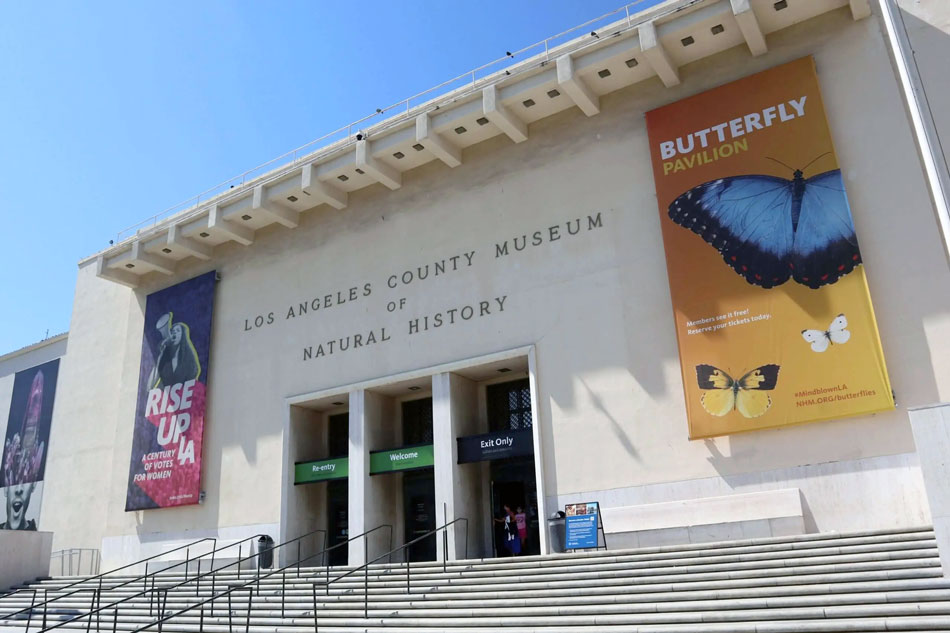
 When the Natural History Museum of Los Angeles County (NHM) needed a clearer picture of its visitor demand, pricing, and scheduling, it turned to an unexpected team of consultants: six graduate students from Cal Poly Pomona. Starting in fall 2025, a team of Master of Science in Business Analytics (MSBA) students in the Singelyn Graduate School of Business's Capstone course worked with the museum, digging through years of visitor data to help management better understand attendance patterns and identify opportunities for the institution's future.
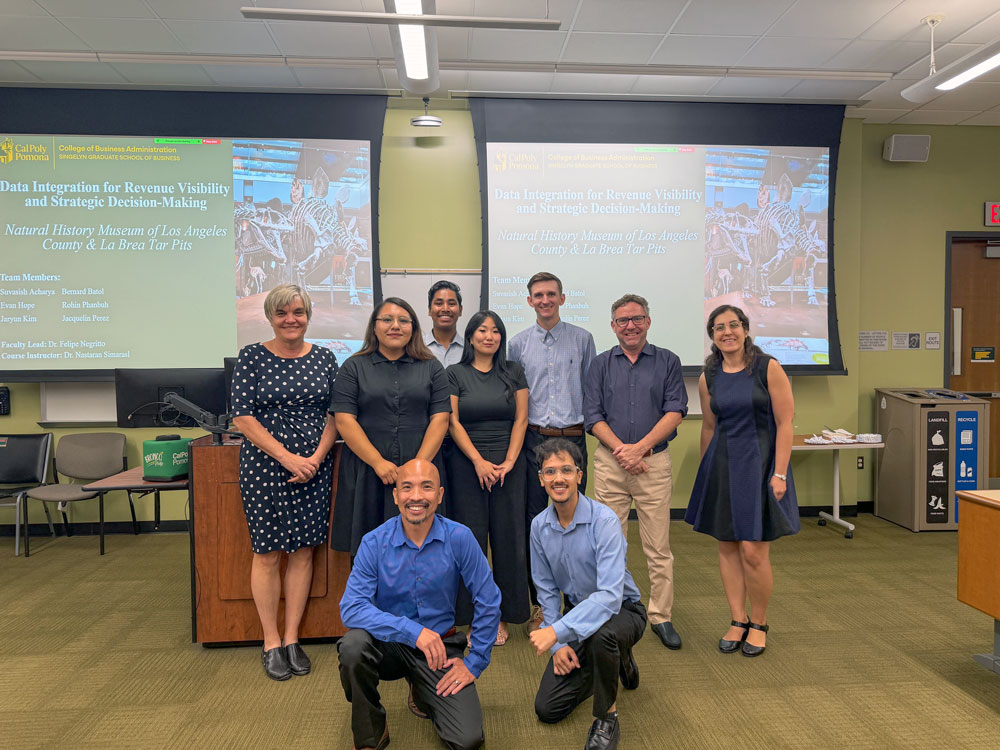
 The student team, led by Bernard P. Batol (’26 MSBA) and Suvasish Acharya (’26, MSBA), along with Evan Hope (’26, MSBA), Jacquelin Perez (’24, IBM, ’26, MSBA), Jaryun Kim (’26, MSBA) and Rohin Phanbuh (’26 MSBA), worked under two faculty mentors: Felipe Negritto, an adjunct professor who advised on technical strategy, and Nastaran Simarasl, associate professor and director of the Singelyn Graduate School of Business, who coached the team on writing and client presentations.
A Partnership Built on Trust
The project's origins were personal. Negritto had previously guided students through similar consulting projects and was glad to connect the university with the museum. “[CIS Professor] Carlos Navarrete initially approached me with the idea and sold me on it. Of course, I was interested in students getting real-world experience,” explained Negritto.
Negritto’s background made him a natural fit to guide the engagement, as he had years of experience as an information technology consultant, and had also previously worked in portfolio management for The Walt Disney Co.'s technology division. “This team was acting as a consultant to the Natural History Museum, and while the museum knows they are students, they're bringing their business intelligence knowledge, their data knowledge, and their time, which some folks at the museum simply don't have.”
From Raw Data to a Real Dashboard
Early on, Negritto had the students immerse themselves in the museum's goals before meeting face-to-face with its leadership, including the chief financial officer and vice president of information technology. “I wanted them to get direction and collaboration straight from the client. They needed to understand what the NHM staff cared about and what they wished they had more time to do,” Negritto said. The goal, he added, was to help leadership spot opportunities to increase revenue via work aimed at giving the museum a dashboard it can keep using after the students graduate.
For Simarasl, the technical work was only part of the assignment; the course was designed to push students to translate their MSBA coursework into recommendations a real client could act on. “We wanted students to apply the technical knowledge they learned in other MSBA classes to a real business case and offer relevant, useful solutions to the client,” she said.
 Learning to Think Like Consultants
Along the way, the students learned skills that go beyond data analysis; they had to make business-relevant recommendations from a limited data set and pivot their approach more than once to match data availability and the client's needs. Negritto cautioned that showcasing data was not the end goal. “I wanted them to learn that in a consultant-client relationship, offering data isn't enough. You need to offer direction with it,” he said. “These are professionals who know what they're doing, so you need to present findings with respect to serving their specific needs as clients.” The students quickly adapted to that lesson. “I initially thought this project would only be about maximizing revenue, attendance, sales, and so forth,” says Hope. “Working with a non-profit organization and their mission to educate and inspire the community changed the overall tone of our project and how I wanted to leverage the real data.” Perez added that the biggest early challenge was simply making sense of the data itself. “Since the information came from different sources, it took time to ensure everything was accurate and consistent.”
“Guiding students navigate those dynamics was one of the most rewarding parts of teaching the course,” explained Simarasl. The student team split into a data group, an insights group, and a finance and forecasting group, with members choosing roles that matched their strengths. “We talked about our skills, experiences, and availability to figure out how each member could contribute to the project effectively,” says Batol. “Overall, the cohesiveness of the team truly surprised me. With all the challenges that we faced throughout the capstone project, everything we did thus far went smoothly.”
A Win for Both Sides
Negritto said the project has already paid dividends for the museum by reviving conversations about data and strategy that had stalled internally. “At a minimum, the museum got nudges and pushes toward concepts and opportunities they should focus on,” he said. “The project triggered conversations that weren't happening before, and that's a win.”
Looking back, Negritto said the growth he saw in the students, from handling raw data to understanding a client's needs, made the project worthwhile. “It requires a lot more time talking to clients, understanding their needs, and using the data to tell a story of opportunities,” he said. “For a first-time project like this, it's been an amazing experience.”
For Perez, the reward was personal. “My analysis of student ticket data was my favorite part of the project. The data showed me that attendance is more than numbers because it reflects how well the museum is reaching students and supporting educational opportunities in the community.” Acharya said the experience mirrored the demands of the profession the students are entering. “This project provided us with a real-world consulting experience, with an amazing organization local to Los Angeles,” said Acharya. “We feel incredibly honored and lucky to have an experience like this happen while we were in school, as it really simulated what business analysts are doing in the workforce today.”
The capstone project wrapped up this summer and the students graduated having delivered a working dashboard and hands-on lessons in what it takes to serve as a trusted consultant to a major Los Angeles institution. Their final presentation was delivered before the client, the museum's chief financial officer, the two faculty mentors and their peers.


