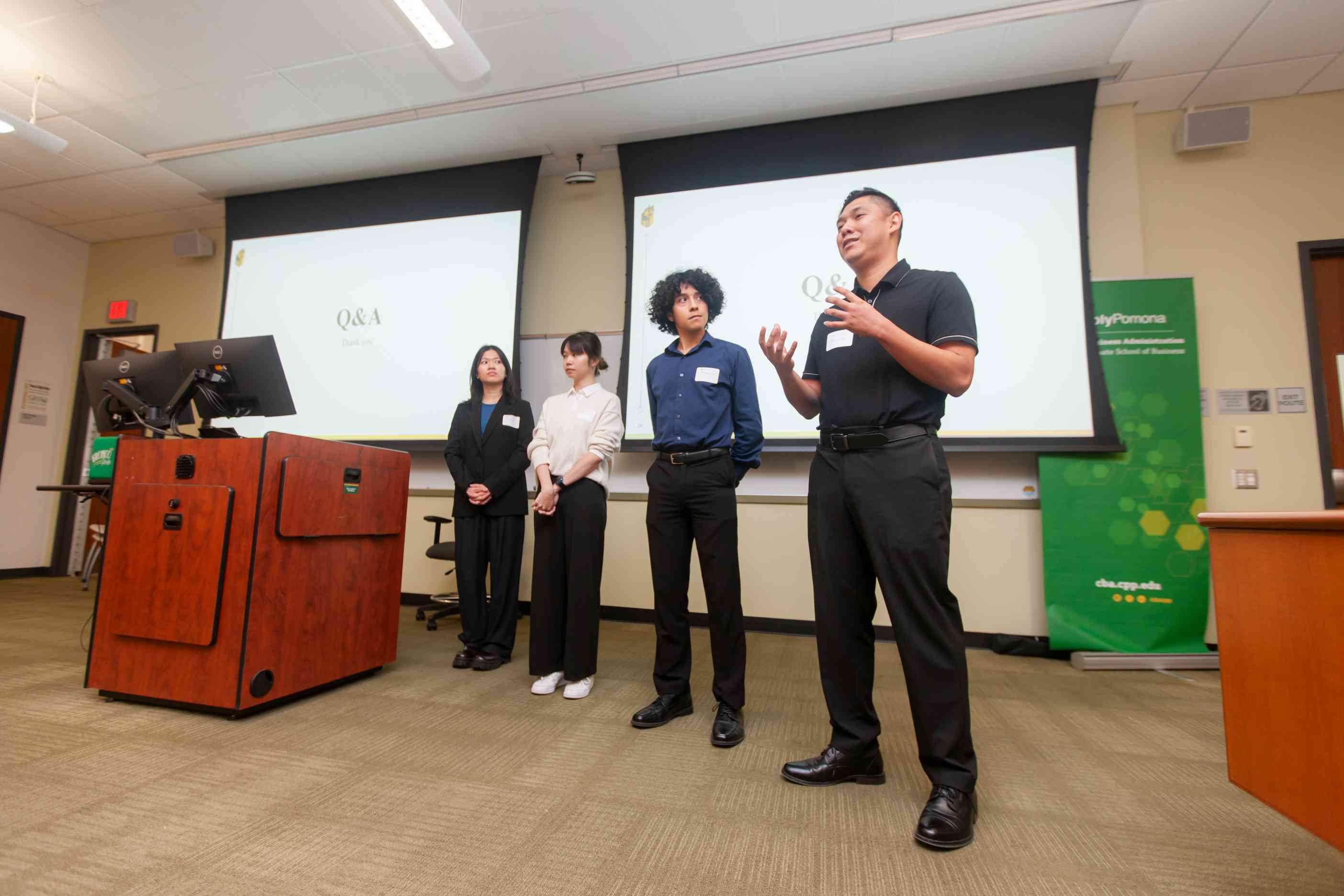
From generative AI in hospitality to predictive analytics for financial markets, Cal Poly Pomona’s Master of Science in Business Analytics (MSBA) students put data to work at the Power of Analytics Conference, held at the Singelyn Graduate School of Business.
The all-day capstone showcase— the culmination of months of research and collaboration — drew faculty, industry judges, and guests to campus to see how graduate students are turning analytics into organizational impact. Eleven teams presented across two themed tracks, underscoring the MSBA program’s emphasis on applied learning and data-driven decision-making.
“We are proud of our students’ dedication and the real-world relevance of their work,” said Singelyn Family Dean Sandeep Krishnamurthy in his opening remarks. “Today’s projects highlight not only the technical excellence of our graduate students but also their commitment to solving today’s most pressing business problems through analytics.”
Two Tracks, One Mission: Data for Impact
The conference featured two tracks — Artificial Intelligence Business Applications and Improving Business Performance with Data — each with two parallel presentation sessions of student presentations.
In Track A, students explored how artificial intelligence is transforming industries from healthcare and e-commerce to renewable energy and financial services. The day opened with a team led by Lisa Luiten (’25, MSBA), who examined how AI-powered chatbots can enhance patient-doctor communication during remote consultations. Analyzing common challenges such as ambiguity and empathy gaps and offered practical recommendations for developers and healthcare providers deploying AI in telehealth. “Working on our capstone project, which focused on AI-powered medical chatbots, gave me the opportunity to explore a cutting-edge trend in healthcare business,” explains Luiten. “Collaborating closely with my team not only strengthened my teamwork skills but also sharpened my analytical abilities. The capstone project, along with the opportunities that came with it, was one of the most valuable experiences of the MSBA program."
Next, the team led by Alex Lira, (’25, MSBA) investigated live chat negotiations in business-to-consumer sales, using AI to determine the most effective tactics for closing deals. Their model, trained on Fortune 500 sales data and tested in simulations, showed that combining delay tactics with discounts significantly increased purchase rates. “The conference was a highlight and allowed us to share the results of a challenging and rewarding project,” says Lira. “Our team's perseverance and the invaluable mentorship we received taught us that success lies not just in building a model, but in thinking critically and communicating its value clearly, skills we will carry forward from the MSBA program."
The morning wrapped with a team focusing on Airbnb, which applied machine learning and generative AI to summarize 1.7 million guest reviews. Their analysis identified key satisfaction drivers and created a framework to help hosts improve their listings at scale.
The afternoon session introduced Solarscope, a data-driven approach to community engagement in solar development. Using sentiment analysis on public documents and Reddit posts, the team uncovered widespread regulatory barriers and negative sentiment in town hall discussions. Their findings informed a generative AI tool designed to streamline solar project planning and permitting. Another project leveraged FinBERT, a financial-domain NLP model, to analyze stock market news headlines, significantly outperforming general-purpose sentiment tools in forecasting. The final team developed a comprehensive e-commerce analytics platform addressing delivery delay prediction, customer feedback analysis, product recommendations, and automated support for Brazil’s Olist marketplace, using models such as XGBoost and collaborative filtering.
Data for Business Optimization

Track B shifted the focus to performance enhancement through data strategy. One standout project examined how minority-owned businesses maintain digital visibility on platforms like Yelp. The team predicted minority ownership using open datasets and identified review patterns that correlated with higher success rates, offering actionable insights for underrepresented entrepreneurs.
Another team addressed bankruptcy prediction using the Synthetic Minority Oversampling Technique (SMOTE) on an imbalanced dataset of Taiwanese firms, finding ways to improve model accuracy while raising important ethical considerations. A third group compared IT and R&D spending across industries, concluding that returns on these investments vary greatly and depend on sector-specific strategies.
The afternoon continued with a case study in operational modernization for a Southern California metallurgy lab. Students developed a relational database and ran Monte Carlo simulations to optimize order tracking and turnaround times. “After giving it some thought, this project gave me and my team a great opportunity to apply what we’ve learned throughout the program in a practical manner for a real, local business,” said Jay Toney. “Building data insights from the ground up challenged us to think critically and adapt quickly, while each course added a new dimension to our analysis. The client-based structure made our work more focused and allowed for clear, effective storytelling during the conference presentation. I’m especially grateful to my peers for joining me on this project, because I felt our diverse perspectives and willingness to explore something different were key to its success.”
The final project assessed Reddit discussions related to the Israel-Palestine conflict and their influence on public sentiment toward brands. The team found that mentions of boycotts often followed emotionally charged events, though the financial impact was generally limited. Their work demonstrated how real-time monitoring could help companies anticipate and respond to emerging reputational risks.
Celebration and Recognition

Throughout the day, networking breaks and lunch provided opportunities for students, faculty, and industry guests to exchange ideas and build connections. The conference concluded with an awards ceremony recognizing standout presentations. The judging panel, made up of industry experts, praised the clarity, creativity, and impact of the projects.
“These projects represent more than technical expertise,” said Yuanjie He, MSBA program co-director. “They are examples of how data can be used to elevate industries, inform decisions, and serve the greater good.”
Nastaran Simarasl, Director of the Singelyn Graduate School of Business and Associate Professor of Strategic Management and Entrepreneurship, reflected on the cohort’s growth. “Our Business Analytics graduate students developed and improved so much in technical skills, professional writing, and public speaking in the span of three semesters,” she said. “We are so glad that we partnered with 14 leaders and experts from different industries to judge our students’ capstone projects and give them feedback. We hope that these partnerships lead to more industry projects and extensive collaborations between the Singelyn Graduate School of Business and different organizations.”
Assistant Professor of Marketing, Yufan Lin agreed, adding, “It was a great joy to see students presenting their work under my supervision to industry experts. They felt the importance of their efforts and the excitement from the engaged audience. We need more events like this to showcase CPP’s ‘Become By Doing’ motto!”
As the 2025 cohort packed up laptops and presentation boards, the day’s message was clear: Cal Poly Pomona isn’t just training analysts. It’s preparing data-savvy leaders who can turn complex problems into actionable solutions — and who are ready to step into a rapidly evolving, data-driven world.
For more information about the MSBA program at Cal Poly Pomona, visit https://www.cpp.edu/cba/graduate-business-programs.


