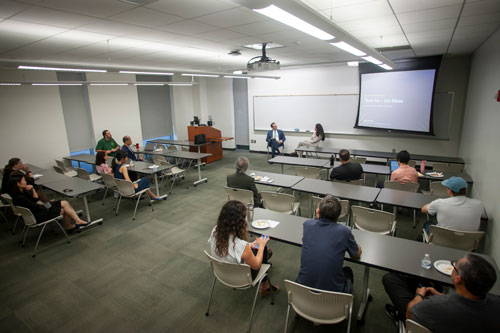
 The College of Business Administration’s Tarkington Business Futures Institute (TBFI) has launched Tarkington Research Horizons, a cross-disciplinary monthly speaker series that brings scholars from across Cal Poly Pomona into conversation with the business community.
The premise for the Research Horizons series is to present and discuss the trends and innovations that will affect business before the impact lands. Each session features an expert from a discipline outside the business realm in a moderated conversation about the biggest developments in their field and what companies need to do to prepare. The first two conversations in the series highlighted engineering and philosophy, two very different fields already reshaping business amid a new wave of automation.
 Automation Is Arriving Faster Than the Workforce
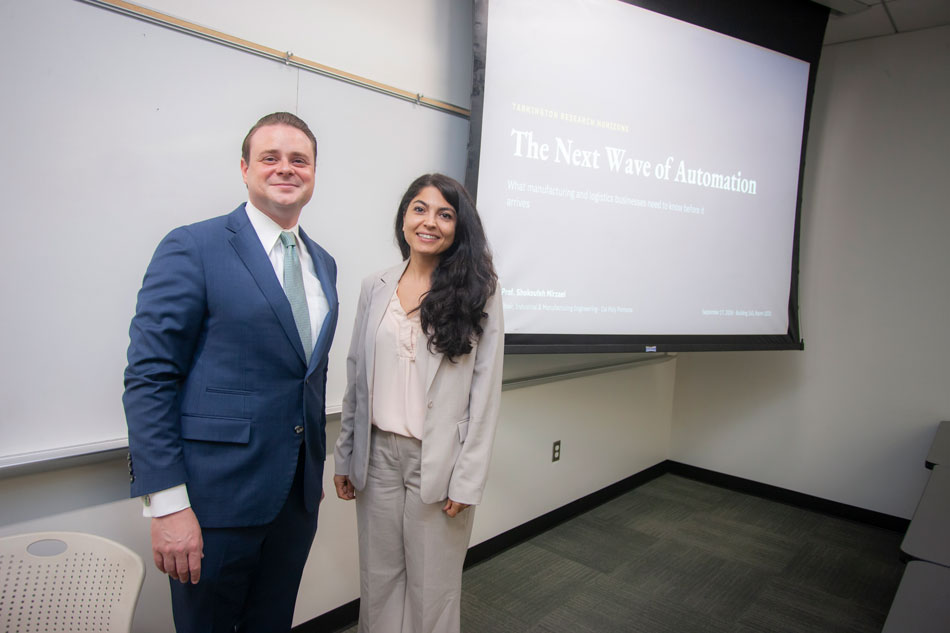
The series opened with Shokoufeh Mirzaei, chair of the Department of Industrial and Manufacturing Engineering and director of the National Science Foundation-funded CREST-RASIM center (Centers of Research Excellence in Science and Technology (CREST) Research in Adaptive Systems and Intelligent Manufacturing Center (RASIM). Mirzaei also runs the university’s new Vy and Timothy Li Automation Lab.
Mirzaei walked attendees through where automation is headed in manufacturing and logistics, and she shared data points that frame the stakes for American businesses:
- About 4.3 million industrial robots are now operating worldwide.
- The warehouse robotics market is projected to grow from $6.5 billion to $25.4 billion by 2034.
- The U.S. is expected to have 1.5 million to 2 million unfilled manufacturing jobs by the early 2030s.
“I think the biggest barrier is old infrastructure at small and medium US manufacturers,” explains Mirzaei. “Big companies — Amazon, Target, Walmart — have the investment capital to build fully automated facilities. But when you go to small and mid-size manufacturers, you see they're way behind the curve. That's the area I really want to touch on, because these are the kinds of businesses we need to push forward,” she says. “I think we need to start with people. The gap now is not the technology. The gap is the people who aren't yet knowledgeable about these systems and who need to work and find a way to move forward. They're going to look at their company and ask, "Who are the people who actually know what to do with the data from this fully automated machine we just bought?"
These areas of automation and smart manufacturing offer not only potential jobs, but also room to grow for efficiencies in innovation and research. “The goal of the CREST-RASIM center is to increase the research capacity of faculty across Cal Poly Pomona, and we try to help with anything that has synergy with, or is relevant to, the work we do. The lab provides hands-on training and applied research, and right now we have 30 students actively working there. And thanks to the National Science Foundation grant — a very significant $7.5 million that gives us five years of runway for research — we've been actively partnering with faculty outside our center.” By providing learning opportunities and hand-on experiences, centers like this one at Cal Poly Pomona exist to help scholars keep pace with technological innovation.
In short, Mirzaei explained that technology is arriving faster than the people who can run it. For companies, that means any automation strategy also requires a new workforce strategy, a message with direct implications for the students the college is preparing to enter those industries.
 Who Should Do Something?
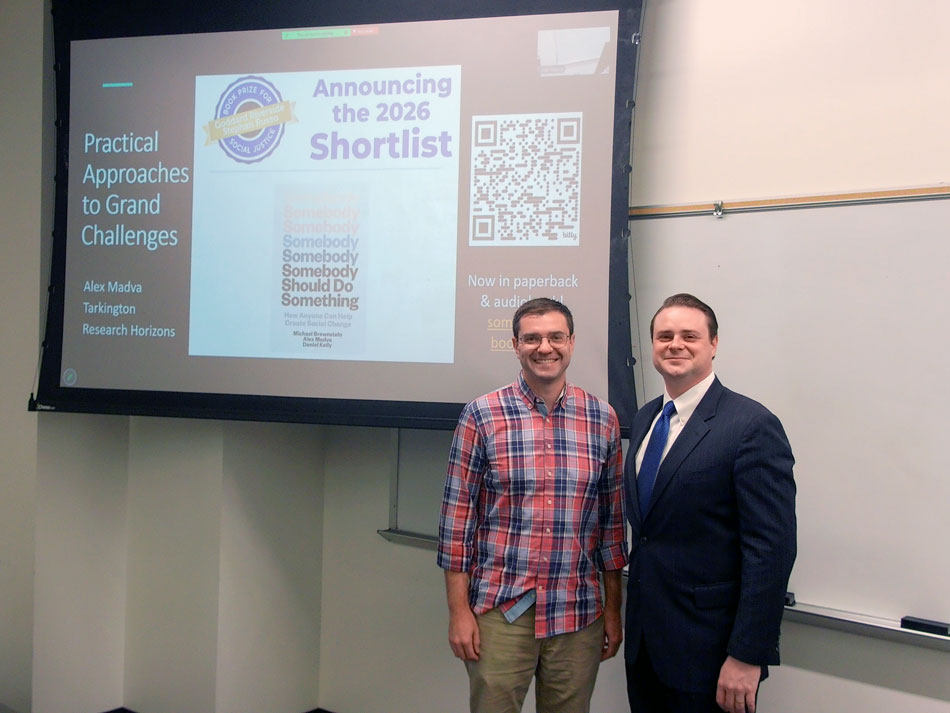
The institute hosted its second conversation in partnership with the California Center for Ethics and Policy. TBFI Chair Anthony W. Orlando moderated a discussion with Alex Madva, professor of philosophy, director of the center and co-director of the Digital Humanities Consortium at Cal Poly Pomona. Madva is also a co-author of the recent best-selling book, “Somebody Should Do Something.” The conversation examined the roles that businesses, governments, and individuals play in addressing the grand challenges of our time.
Madva noted that corporations often ask individuals to take responsibility for social problems while resisting the structural reforms that would actually solve them.
“We’re so used to immediate feedback from our actions, Madva says. “Whereas if you're working for social change, it's this massive trust fall where you're likely not going to see the effects. That's just not part of your experience, and that's part of what makes it hard to trust that the work is going to pay off. Social dynamics are much more complicated than adding a drop to a bucket; a better analogy for individual action than adding drops to a bucket would be gradually increasing the temperature on a pot of water. When you add a drop to a bucket, each drop is the same as the one before. But when you gradually increase the temperature, each degree isn't the same as the one before. Eventually the water starts to boil, and you have a phase change, and that one extra moment of heating can transform the entire system into something else. Social dynamics work the same way. It can seem like no change is happening, no change is happening — and then social movements start to boil up.”
Madva explained that modern social change requires us to not give up on individuals, but to instead point them toward the structures. Individuals and businesses, working with others, can identify the most pressing challenges and demand real solutions. Big structural change, he argued, is not just something that happens to people. It is something they can help make and build relationships with like-minded people.
“It's really important for people who commit themselves to a larger social cause not to do it in isolation, alone in their room, but to find a community of people to do that work with,” says Madva. “One of the things that keeps people going is the camaraderie they have with the people they're working alongside.”
What’s Next
“We’re not just in the business of studying business. We’re in the business of changing it,” explains Tarkington chair Orlando. “And that means, every once in awhile, we have to step outside of business and see it anew. We believe that business leaders need to know what technologies are around the corner, what public policies are around the corner, what popular movements are around the corner, and so forth. We also believe that outside expertise helps us see the world in new ways, challenges our groupthink, and inspires us to come up with new ideas, new paradigms, new ways of doing business. In fact, The Tarkington Business Futures Institute, which is only a few months old, is designed to be interdisciplinary — to show that businesses, business leaders, and business scholars should care about a lot of things we don't usually talk about in business schools. We believe that the biggest challenges are interdisciplinary challenges and the best way to tackle them is to harness all of our university’s brainpower, not just the business school’s.”
The next Tarkington Research Horizons talk is scheduled for Thursday, Nov. 12, with Phyllis Nelson, director of Cal Poly Pomona’s new Center for Exploration and Space Technology. Additional details will be announced.
In the meantime, the Tarkington Business Futures Institute shares new content every week on LinkedIn and Instagram.


