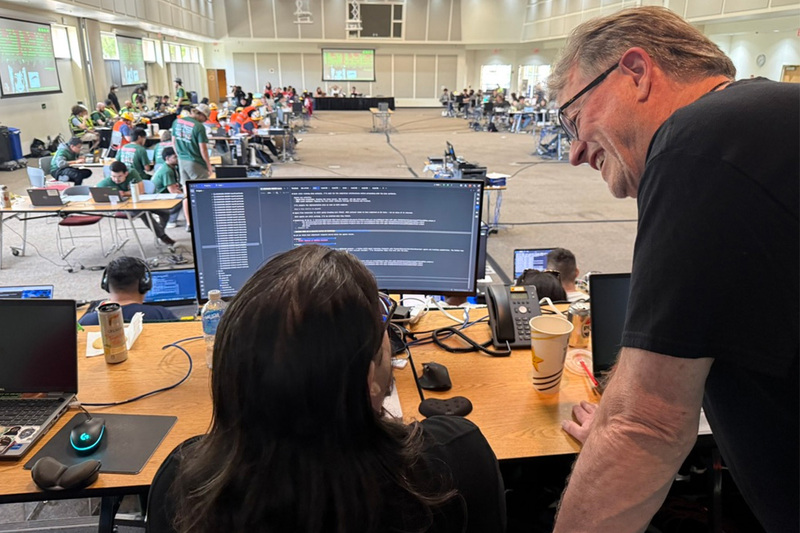
At Cal Poly Pomona, cybersecurity education extends far beyond the classroom. It unfolds in real time, increasingly under the watch of industry leaders.
The university recently hosted the Western Regional Collegiate Cyber Defense Competition (WRCCDC), a multi-day event that challenges students to defend a live enterprise network against active cyberattacks. Scheduled March 27–29, 2026, the regional competition simulates the operational realities of cybersecurity, where teams must maintain business services while responding to evolving threats. Unlike traditional competitions focused on building systems, WRCCDC places students directly into existing infrastructure.
“It’s about stepping into a real-world environment and keeping it running,” organizers said.
A Competition Built on Community
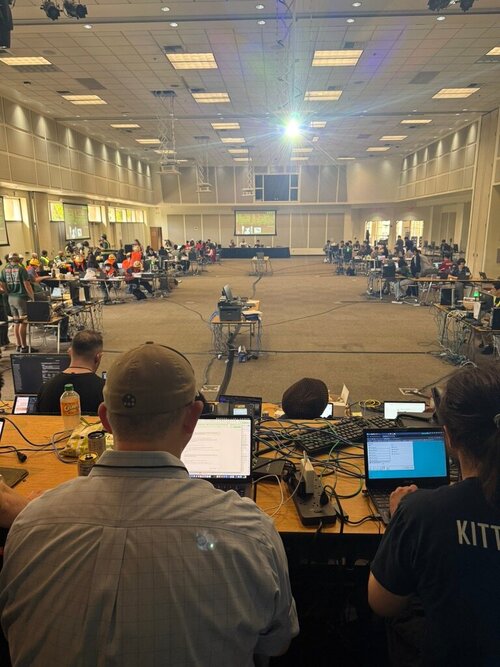 What began as a regional competition has evolved into a sustained cybersecurity community rooted at Cal Poly Pomona.
“One of my favorite things is seeing people come back,” said Dan Manson, professor emeritus, Computer Information Systems (CIS), a longtime leader of the university’s cybersecurity programs. “Students compete for years, and after they graduate, they come back as volunteers. We have alumni from the original red team in 2008 still here.”
That continuity has transformed WRCCDC into more than an event. “It’s like a reunion,” Manson said. “But it’s also a community that keeps growing.” Students, alumni and professionals return year after year, mentoring, competing and building connections that extend into industry.
Learning by Doing at Scale
The competition reflects Cal Poly Pomona’s polytechnic philosophy: learning through experience. “I tell students to think about this like sports,” Manson said. “You start with fundamentals early, and by the time you get to college, you’re playing at a high level.”
That development pipeline begins in elementary and middle school outreach programs and continues through high school competitions like CyberPatriot, culminating in collegiate events like WRCCDC. “CyberPatriot gave me exposure to what careers in cybersecurity could look like before college,” explains Alessandra Gonzalez, (CIS ’25), co-founder of CPP’s Women in Tech student club and Identity Security Software Engineer, CrowdStrike. “A lot of students don’t even know these opportunities exist.”
Via campus clubs, weekend competitions, and a track record of standout performances, Cal Poly Pomona is increasingly becoming known as a talent bed for the ever-changing tech and digital industries. “At Cal Poly, there’s a “scrappy” culture. Students create their own opportunities. Clubs aren’t just extracurricular—they’re how you build experience, networks, and confidence,” says Gonzalez.
Inside the competition, that preparation is tested. “We’re building muscle memory,” Manson said. “Students learn to recognize attacks and respond instinctively. The clock is ticking, and you’re working as a team. There’s no time to figure things out slowly — you just have to solve the problem.”
Pressure That Mirrors the Real World
WRCCDC stands apart for its operational focus. Teams must:
- Detect and respond to cyberattacks
- Maintain critical services such as email and web servers
- Fulfill business requests while protecting systems
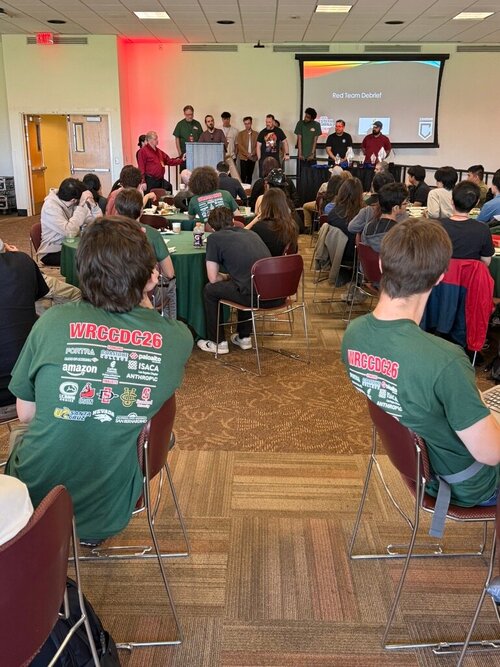
The experience closely mirrors industry environments. “You learn the most when something breaks,” explains Gonzalez. “That’s when you actually understand what’s happening.” Even competition setbacks become part of the learning process. “If you lose a competition, you still have a great story,” she says. “And you learn something that sticks.”
Behind the scenes, even the competition’s attacks are designed with purpose. “We’re very specific about what we do,” a red team member said. “The question is always, ‘What are students going to learn?’”
In one scenario, organizers disabled the foundational DNS service, without destroying the system. “Some teams couldn’t figure it out at first,” the red team member said. “So, we repeated it.” Over time, teams improved dramatically. “That’s when you know learning is happening.”
Industry Turns to Cal Poly Pomona
As the competition has matured, industry engagement has deepened, shifting from recruitment to collaboration. Companies now view WRCCDC, and Cal Poly Pomona in particular, as a live testing ground for emerging technologies.
Anthropic, a leading artificial intelligence company, participated through its fellows program, using the competition to evaluate its AI models in cybersecurity scenarios. “Our main goal was to assess cybersecurity capabilities in a real-time attack-and-defense environment,” said Yernat Yestekov, a fellow with Anthropic. “We wanted to understand what kind of uplift these models provide, for experienced users and beginners.”
The company deployed its Claude model directly into the competition, allowing students to interact with it. “We compared human performance, humans augmented with AI, and the model itself,” says Georgiy Kozhevnikov, who is also an Anthropic fellow. “It’s not something you can fully replicate in a lab. It was interesting to see how the model’s ‘personality’ changed depending on how students engaged with it.”
From Competition to Career
For industry partners, the value of WRCCDC lies in its participants. “These students represent the active future of cyber defense,” one industry participant said. “They’re already operating at a high level.” In some cases, students may even be ahead of the curve. “We’re at an inflection point with AI,” an industry expert said. “These students sometimes have more current knowledge than people already working in the field.”
The connection between WRCCDC and career opportunities is immediate. In some instances, entire teams have been hired following competition performances. “They didn’t just see individuals, they saw a team that could operate,” says Manson.
These outcomes are increasingly common, reinforcing the competition’s role as a pipeline into cybersecurity careers. “Almost every competition, somebody gets an internship or a job,” Manson said.
A Growing Innovation Hub
Today, Cal Poly Pomona stands at the center of a rapidly expanding cybersecurity network.
Through WRCCDC and related programs, the university has become a host site for national-level competitions, a pipeline for cybersecurity talent, a collaborative hub for industry and academia, and a testing ground for emerging technologies
“We’ve created a community that wants to stay involved,” Manson said. “That’s the difference.”
As cybersecurity threats evolve, the role of experiential education continues to grow. At Cal Poly Pomona, that reality is embraced. Through competitions like WRCCDC and campus clubs, students are preparing not just for jobs, but for leadership in a rapidly changing field.
Return to News List...


