Project Symposium & Showcase
Friday, May 1, 2026
Project Symposium & Showcase 2026
About the Event
Welcome to the event page of our annual Project Symposium & Showcase! Every year, over 450 students across all seven engineering departments will present their designs and findings in a public forum. This is an opportunity for engineering students to showcase their hard work and ability to communicate and organize their findings for a public forum—important skills in an engineering career.
This page is updated annually with the each year's project and poster sessions, which is available every April.
Symposium Project Schedule 2026
Aeronautics
7:30 AM - 7:50 AM @ 163-2005: AIAA DBF Competition
Students: Matthias O'reilly, Julie Liu, Sajjad Sharif, Imaad Rana, Kevin Tang
Advisor: Subodh Bhandari
Sponsors: Lockheed Martin, CPP IRA
7:50 - 8:10 AM @ 163-2005: Collaboration between UAV and UGV for Search & Rescue Missions
Students: Caden Maw, Gilbert Go, Byrn Balangauan, Alexander Burghardt, Gwynn Oedell Sumagaysay, Kevin Brim
Advisors: Subodh Bhandari, Scott Boskovich, Zekeriya Aliyazicioglu
Sponsor: Northrop Grumman
8:10 - 8:30 AM @ 163-2005: Student Unmanned Aerial Systems (SUAS) Competition
Students: Danielle King, Alissa Everman, Jose Mora, Ashton Vogel, Areg Hovumyan, Pawel Chowdhury
Advisors: Subodh Bhandari
Sponsors: Lockheed Martin, CPP
8:30 - 8:50 AM @ 163-2005: Aerodynamic Advantages of a Modern Blended-Wing-Body (BWB) Design Over a Conventional One for a Commercial Jet Transport.
Students: Ryan Emerton (Team Lead), Isaiah Donoso, Seth Floiles, Andrea Higham, Ryan Keating, Mohammed Khan, Pablo Urena, Corbin Young
Advisors: Ali Ahmadi, Charles Royas
8:50 - 9:10 AM @ 163-2005: Particle Image Velocimetry (PIV) for the Investigation of Vortex Production and Flow Interaction using Wind Tunnel Models
Students: Adam Ervin, Aiden Holley, Andrew Gerges, Anthony Tran, Axel Rojas Huerta, Chiranjeev Vyas, Daniel Lopez, Ethan Peterson, Francisco Moreno, Jenisse Chitay Espinoza, Jonathan Reyes, Julian Rodriguez, Madeline Davies, Mohammad Masoud, Nam Bui, Roxana Ramirez, Shelby Garcia, Syed Ali, Taylor Currier, Tracy Hu, Victoria Tapia
Advisors: Steven Dobbs, Charlie Royas
Sponsors: Air Force Research Laboratory, CPP ASI
9:10 - 9:30 AM @ 163-2005: Project Pegasus: e-VTOL for Autonomous Disaster Response
Students: Luis Landa-Agundez, Alana McCracken, Changwe B. Musonda, Jessalin T. Jiangkhov, Luis Rivera, Brian Vu, Cooper Carillo, Pedro Aguirre, Ethan Ray, Eli Asadoorian, Khanh Tran, Brandon Huynh
Advisors: Subodh Bhandari and Tristan Sherman
Sponsors: Lockheed Martin, CPP
9:30 - 9:50 AM @ 163-2005: Ground Control Station for Command and Control of Multiple UAVs for Fire Detection and Suppression
Students: Diego Grijalva , Ode Laing, Joseph Ruiz De Paz, Carlos F Vargas, Megan Bee, Kevin P Perez
Advisors: Subodh Bhandari
Sponsors: Lockheed Martin, CPP
9:50 - 10:10 AM @ 163-2005: Tiltrotor e-VTOL Research Vehicle with Distributed Electric Propulsion
Students:Gregory Saunders, Andri Irbe, Mayceo Flores, George Salib, David Phung, Demajay Francis, Gwynn Oedell Sumagaysay
Advisors: Subodh Bhandari, Tristan Sherman, Zekeriya Aliyazicioglu
Sponsors: Lockheed Martin, CPP
10:10 - 10:30 AM @ 163-2005: Coordination between Multiple Autonomous UAVs for Search & Rescue Missions
Students: Kassandra Avelar, Eric Lee, Jose Castro, Michael Ehrenberger, Austin Duong, Tirth Thakkar, Rexley Tsui, Dominick Mason
Advisors: Subodh Bhandari
Sponsors: Lockheed Martin, CPP
10:30 - 10:50 AM @ 163-2005: Experimental Investigation of Jet Engine Performance Using Compressor Exit Air for Cold Gas Preheating via Heat Exchange
Students: David A. Iniguez, Bronson D. Chaputa, Ricardo Paz, Julian Hsu
Advisors: Pejman Akbari, Michael Ol
Sponsor: USAF
Astronautics
7:30 – 7:50 @ 163-2015: CubeSat Exploration Program Detailed Design and Testing
Students: Matthew Casillas, Dustin Duke, Tireni Oyenusi, Amer Hammoud, Ronald Dumlao, Jacqueline Lorenzana, Sanli Tyndall, Garbriel Di Ciaccio, Michael V. Pilster, Samer M. Alqam, Zachary Van Gemert, Maranda Laws, Nicholas Witucki, David Tao, Diana Quezada, John Lee, Husain Saifuddin, Lazaro Mendoza
Advisors: Navid Nakhjiri, Marco Maggia
Sponsor: NASA
Description/Abstract: This year, the CubeSTEP team at Cal Poly Pomona focused on advancing subsystem validation and integration readiness for a student-developed CubeSat supporting JPL-derived payloads. Efforts included EPS power verification, OBC and ADCS bench validation, and development of testing procedures and interface documentation. The team emphasized cross-subsystem coordination, hardware readiness, and cleanroom operations to support upcoming integration and testing phases, preparing students for careers in aerospace engineering.
7:50 – 8:10 @ 163-2015: The Design of a Reusable Rocket Powered Lander
Students: Brooklyn Bennett, Daniel Barr, Jordan Aquino, Kyle Effinger, Leonard Palma, Ryan Santos; Advisor: Navid Nakhjiri, Elias Wilson
Sponsor: Exquadrum
Description/Abstract: The Rocket Powered Lander Project began the 2025-26 AY with the goal of throttling the LASR within margins of a narrow thrust curve. Throughout the course of the academic year, the team conducted simultaneous system testing and lander preliminary design activities, resulting in a complete SRR and PDR by the end of the academic year.
8:10 – 8:30 @ 163-2015: CPP LRL Bronco 1 Launch Vehicle
Students: Andrew Bae, Anthony Castaneda, Ryan Fazio - Lead 2, Matthew Leonesio, Nina Levin - Lead 1, Jesse Odhiambo, Michelle Ramirez, Paloma Rubio, Cyrill Russell, Owen Sayre.
Advisor: Frank Chandler
8:30 – 8:50 @ 163-2015: CPP LRL Bronco 2 Launch Vehicle
Students: Ty Alabdallat, Angel Navarro, Antonio Ortiz, Ayush Srinivasan - Lead 2, Oscar Thai, Ethan Wong - Lead 1.
Advisor: Frank Chandler
8:50 – 9:10 @ 163-2015: CPP LRL Zeus Rocket Engine
Students: Osheen Gupta, Ryan Lin - Lead 1, Josephine Ly, Hitarth Mehta, Troy Nicola, Param Sharma.
Advisor: Frank Chandler
9:10 – 9:30 @ 163-2015: S-Kubed: Making Advancements in Attitude Dynamics and Testbeds
Students: Fenris Adriano, Ronald Dumlao, Jaden Totilaz, Khoa Tran, Adrian Poitras, Branden Raygoza, Tyler Thai, Richard Yu, Marbella Hernandez, Juan Muldong
Advisor: Marco Maggia
Description/Abstract: This work presents the development of a laboratory testbed for pre-flight validation of CubeSat attitude determination and control systems (ADCS). The system integrates a tri-axial Helmholtz cage, capable of reproducing time-varying geomagnetic fields with <1% error over a 6U volume, and a modular sun simulator that generates collimated, directional illumination to emulate orbital lighting conditions, including umbra and penumbra transitions. Attitude ground truth is provided by an OptiTrack motion capture system, enabling sub-degree accuracy for real-time error analysis in MATLAB. Together, these components enable high-fidelity hardware-in-the-loop testing of ADCS algorithms and flight software under representative low Earth orbit conditions. Ongoing work focuses on precision validation.
9:30 – 9:50 @ 163-2015: Project Inferno: Liquid Engine Test Stand
Students: Josiah J. Lopez, Edgar A. Poot Cruz, Matthew Y. Buntiy, Gere Wang, Simon Uttam, Andy Calle, DeAngel Argueta
Advisors: Marco Maggia, Elias Wilson
Description/Abstract: This presentation summarizes three years of iterative development and final design work in fluid systems, structures, and thermodynamics. The project involved the design, analysis, and fabrication of a blowdown, dual-propellant, cryogenic-capable liquid engine test stand. Building on a liquid engine concept developed by a previous senior design team, the system was expanded into a modular testing platform with adaptable mounting and fluid delivery capabilities for both fuel system and engine testing. The resulting test stand provides a flexible foundation for continued experimentation and future advancements, including thrust vector control concepts and regenerative cooling studies.
9:50 – 10:10 @ 163-2015: Project Lazarus: High Power Rocketry With Dispensed Payload Integration
Students: Daniel Paek, Aaron Barnett, Roger Moreno, Guido Espinet, Noah Bender, Huy Tran, Justice Fishkind, Taylor Barada, Jessica Dhillon
Advisor: Marco Maggia
Description/Abstract: UMBRA’s Project Lazarus is a high power rocketry collegiate competition team formed to rebuild Cal Poly Pomona's skill level and presence in competitive rocketry following several years of relative inactivity. The team has developed a launch vehicle and payload system engineered for robustness and competition-level performance. The
solid-rocket-powered launch vehicle ascends to a target 10,000 ft., safely releases a
water ballast at apogee, and then recovers while deploying a quadcopter UAV that is
piloted back to the launch site through FPV controls. The design is projected to
complete its full mission profile, recover in reusable condition, and demonstrate viable
payload dispensing techniques. These outcomes are expected to secure a high
competition ranking for the school and prepare the team for future competitions.
10:10 – 10:30 @ 163-2015: Project ExoBronco: A Mechanism Test Demonstrator to Validate Passive Drag Separation Technique for Launch Vehicles
Students: Bruce Duong, Adrian Spitzzeri, Jose Del Aguila, Emily Morales, Kristopher Van Duyn, Shridhi Seth, Caio Martins, Alexander Li, Matthew Tran, Kailie Hernandez, Ria Malik
Advisor: Marco Maggia
Description/Abstract: Exo Bronco is a multi-year project from Cal Poly Pomona’s Undergraduate Missiles Ballistics and Rocketry Association (UMBRA) with the goal of building a spaceshot capable rocket. For the 2025-2026 school year, the team aimed to develop an original launch vehicle, MTD3, to validate a passive stage separation mechanism and improve rocket stability, building upon knowledge gained from the previous MTD1 and MTD2. From the launch of MTD3 in February, the drag separation interstage along with improved aerodynamic stability resulted in a successful stage separation and sustainer ignition within a 2° trajectory change, reaching an apogee of 14.7k feet. Failure analysis revealed recovery, structural, and avionics related flaws. Lessons learned from this trilogy of demonstrators will inform key design considerations moving towards Exo 0, the first of incrementally increasing apogee launch vehicles to an initial goal of 60k feet.
10:30 – 10:50 @ 163-2015: CE-MARC : Autonomous Recovery of Launch Vehicles via Parafoil Guidance
Students: Matthew Marz, Reece Kosaki, Jose Del Aguila, Andrew Bae, Auston Chung, Chris Costagliola, Josephine Ly
Advisor: Marco Maggia
Description/Abstract: Project CE-MARC's (Modular Autonomous Recovery Capsule) primary goal is the development of a launch vehicle payload that provides guided, autonomous recovery to the launch vehicle by controlling the brake lines of a parafoil. A parafoil is an inflatable, ram-air (leading-edge is open to atmosphere) parachute with a wing-like shape that generates lift, allowing it to glide and be steered rather than simply falling straight down like a traditional parachute. By approximating the complex dynamics of the parafoil-vehicle system and line system, multiple simulations of trajectory and flight path were made to determine the entire mission sequence. The control line mechanism, sensor suite, on-board avionics, parafoil, and control suite were all developed by the contributors of this presentation. Development of the project started in 2024, and the culmination of many physical drop tests, ejection tests, and mechanism changes resulted in the opportunity to test the capsule using an aircraft drop (Expected June).
Posters
163-2005: Model Predictive Path Integral Control for Quadrotor Stabilization
Students: Samuel Tonies
Advisor: Mozammal Chowdhury
Description/Abstract: This work presents a Model Predictive Path Integral (MPPI) approach to low-level quadrotor control. A quadrotor dynamic model is first derived from the nonlinear rigid-body equations. The MPPI algorithm utilizes the model to sample thousands of randomized control trajectories to optimize the control action over a finite time horizon, achieving both attitude and position control. This approach offers an alternative to PID control better suited for handling the nonlinear dynamics of quadrotors. The performance of the controller was evaluated in hovers, position tracking, and disturbance rejection and demonstrated competitive results to PID control.
163-2005: Q-Learning and Dubins Path Integration for Safe Quadcopter Navigation and Collision Avoidance
Students: Oliver Kiarashpour
Advisor: Mozammal Chowdhury
Description/Abstract: Autonomous navigation in environments with obstacles requires path planning algorithms capable of collision avoidance while still finding feasible routes to goal locations. This work presents a planning approach that combines Q-learning with Dubins path generation to create smooth routes through such environments. An agent is trained on a discrete GridWorld using an epsilon-greedy Q-learning algorithm. To speed up learning, a local planning step performs simulated Q-table updates at each visited state. The agent’s rewards are structured to incentivize reaching the assigned target location while penalizing collisions and traveling within obstacle proximity. This is done through both hard collision penalties and softer penalties if the agent enters a safety radius around an obstacle. After convergence, the greedy policy is processed into a smaller set of waypoints based on changes in direction, distance, and heading. These grouped waypoints are then connected with a Dubins path planner to generate smooth trajectory segments that meet minimum turning radius constraints. The resulting path is a smooth, compact trajectory that is useful for simulation or hardware guidance applications.
Track 1
9:15 AM - 9:30 AM @ 17-2123: Ibuprofen (API) Manufacturing Process Design 1
Students: Cristian Gaspar, Jesse Z. Estrada, Jennifer C. Tan, Maya Elsamad, Alec N. Campbell, Joshua A. Romero, Ebubechukwu C. Jideonwo, Rochelle Mhae S. Dichoso
Advisor: Dr. Jia Li
9:30 AM - 9:45 AM @ 17-2123: Ibuprofen (API) Manufacturing Process Design 2
Students: Cristian Gaspar, Jesse Z. Estrada, Jennifer C. Tan, Maya Elsamad, Alec N. Campbell, Joshua A. Romero, Ebubechukwu C. Jideonwo, Rochelle Mhae S. Dichoso
Advisor: Dr. Jia Li
9:45 AM - 10:00 AM @ 17-2123: Hybrid Biochar-ZSM-5 Catalytic System for Polypropylene Pyrolysis
Students: Elizabeth Chafe, Paul Siapin, Jenna Tran, Christian Sendrowski, Cassie Rhodes
Advisor: Dr. Mingheng Li
Sponsor: American Chemical Society Petroleum Research Fund
10:00 AM - 10:15 AM @ 17-2123: Hysteresis in Dynamic Operation of Reverse Osmosis
Students: Melanie Evans, Tiffany Miskjian
Advisor: Dr. Mingheng Li
Sponsor: National Science Foundation
10:30 AM - 10:45 AM @ 17-2123: The Effect of a Titania-Alumina Bilayer Coating for Oil-Water Separation
Students: Elizabeth Chafe, Daniel Alvarado, Alyssa Emnas, Jenna Tran
Advisor: Dr. Mingheng Li
10:45 AM - 11:00 AM @ 17-2123: Design of a Neural-Network-Based Application for High-Throughput Materials Characterization, Pt. 1
Students: Christian Sendrowski, Jacob S. Gilsing, Peter T. Tran, Joseph T. Barajas
Advisor: Puthoff
11:00 AM - 11:15 AM @ 17-2123: Design of a Neural-Network-Based Application for High-Throughput Materials Characterization, Pt. 2
Students: Christian Sendrowski, Jacob S. Gilsing, Peter T. Tran, Joseph T. Barajas
Advisor: Puthoff
Track 2
9:15 AM - 9:30 AM @ 17-2133: First Principles Calculation of Key Magnetic Properties of L1o Binary Compounds
Students: Daniel Agee, Ryan Cortez, Victor Del Toro, Rosie Farnham
Advisor: Dr. Huseyin Ucar
9:30 AM - 9:45 AM @ 17-2133: First Principles Calculation of Mechanical Hardness for Novel Intermetallics
Students: Gabriel Picasso, Ramond Quesada, Jack Quezada
Advisor: Dr. Huseyin Ucar
9:45 AM - 10:00 AM @ 17-2133: Pack Aluminizing of Selected Austenitic Stainless Steels
Students: Jonathan Garcia, Quentin T. Owens, Matthew Brothers, Alvaro Sanchez, Andreas K. Zimmermann
Advisor: Dr. Vilupanur Ravi
10:00 AM - 10:15 AM @ 17-2133: Early Stage Oxidation of Titanium Alloys
Students: Spencer Franklin, Gia De Martini
Advisor: Dr. Vilupanur Ravi
10:30 AM - 10:45 AM @ 17-2133: Droplet Electrochemical Tests on Ferrous Alloys
Students: Kimberly Ramirez, Adrixx Reyes Rivera, Thi Nguyen
Advisor: Dr. Vilupanur Ravi
Session 1: Water & Environment (Building 17, Room 1631)
Moderator: Dr. Seema Shah-Fairbank, PE
8:00 – 8:40 AM @ 17-1631: Underground Stormwater Capture Project at Oak Park in the City of Fontana, CA
Students: Oscar David Alegre, Bryan De Jesus Arriaga, Jeffrey Steve Cristales, Dylan Daniel Diaz, Clemente Ulises Elizalde Palafox, Ovadys Garcia, Sean Wayne Martinez, David Andrew Nazarian, Erik Ortega, Christian Rodriguez, Jonathan Alejandro Sanchez, Christina Szot, Gage W Toth, Reginald WebsterAdvisors: Saul Melgarejo, PLS; Dr. Seema Shah-Fairbank, PE
8:45 – 9:25 AM @ 17-1631: Oak Creek Diversion and Infiltration Basin Project
Students: Lauren Nicole Banuelos, Johnny Ray Centeno Flores, Brandon Khai Lam, Alyssa Lee, Joshua James McHale, Benjamin Carlos Myo-Flores, Leina Nunez-Honda, Andres Nuno, Marie Catherine O'sullivan, Jorge Alberto Ochoa, Peter Thomas Otoshi, Khushi Alkeshkumar Patel, Robert L Seip, Gwayne Soriano, Alice Cameron Toschak, Jonathan Phu Tran, Vincent Qui TranAdvisor: Dr. Seema Shah-Fairbank, PE
9:30 – 10:10 AM @ 17-1631: Innovation District Design
Students: Andy Aguilar-Lopez, Madailein Daza, Janessa Gomez, Isaac Han, Makayla Hernandez, William B Ho, Jose Larioscastillo, Timothy Loboda, Kyle Garrett Mentink, Manee Monjezi, Jasbeth G Perez, Abel Israel Romero, Soraya Elysia Sanchez, Robert WilliamsAdvisors: Dr. Majid Sadeghi, PE; Dr. Ali Sharbat, PE
10:15 – 10:55 AM @ 17-1631: Rubidoux's Water Infrastructure Improvements and Education Center
Students: Christopher Alvarado, Tyler Ando, Ryan Patrik Briegel, Venice Mariano Cabote, Binx Demchik, Noah Alan Gregory, Gabriel Mari Antonio Javier, Anthony Li, Estevan Carlos Martinez, Kyle Christopher Masmela, Victor Prieto, Tanner Richard StiversAdvisors: Dr. Monica Palomo, PE; John Robinson; Ben Macaluso; Joseph Cardillo, PLS
Session 2: Construction (Building 162, Room 1002)
Moderator: Dr. Giuseppe Lomiento
8:00 – 8:40 AM @ 162-1002: Build Mixed Use Student Success Center and Health Center
Students: Katherine Alcala Leyva, Isaac Avila, Mario Albert Bobadilla, Christopher Robert Calderon, Diego Diaz, Jorge Luis Espinoza Cardoza, David Flores, Nauta Hashimi, Kevin Ku, Josue Loera-Romo, Luis Mendoza, Joshua Mario Salvador, Aryan Sirousbakht, Sarah Joanne Talavera, Arun Ramesh Talwar, Justin Li Tsang
Advisor: Dr. Hovel Babikian, PE
8:45 – 9:25 AM @ 162-1002: Heavy Civil Mixed Use Parking Garage, Pedestrian Bridge and Roadway Improvements
Students: Joel Adam Carvajal, Julius William Castro, Angel Eduardo Delgado-Diaz, Amanda Jeanette Flores, Keiner W Gomez Sanchez, Mohamad Rachid Halabi, Noh Ah Han, Edgar Ibarra-Jimenez, Jamia Nicole Kemp, Kelly Luna-Flores, Matthew Patrick Mcgrody, Jerianne Z Nivar Hernandez, Yosef Osman, Ricardo Perez, Michael Petrut, Benito Ramirez, Jerric WuAdvisor: Dr. Hovel Babikian, PE
9:30 – 10:10 AM @ 162-1002: The CLAW: A Net-Zero Design-Build Athletic and Recreational Facility
Students: Xoshil Alas- Felipe, Alaina Austin, Stephen Nicholas Bailey, Jose De Jesus Ceja, Levi James Sunkawatakpe Duffy, Lama Fayoumi, Misha Feoktistov, Juliana Hurtado, Samuel Benjamin Lena, Isabel Mendoza, Alan Moreno Uribe, Lukas Nathaniel Pohl, Joel Ramirez, Grant Robert Thomas, Angella Valentina Valpolini PineroAdvisors: Dr. Ghada Gad; Dr. Giuseppe Lomiento
10:15 – 10:55 AM @ 162-1002: The Den at Stanford Eastlake: A Design-Build Net-Zero Carbon Athletic and Recreational Facility
Students: Nicholas Ammari, Jason Emanuel Bernal, Anthony Chalikyan, Kevin Julian Chicombing Garcia, John Adam Gonzalez, Anna Lee Kaylor, Harvey Lai, Jenny Nguyen, Megan Paderanga, Christopher J Rivera, Geovanny Rodriguez, Hovhannes Simonyan, Dylan Chan Long To, Kaven Chethia Udukumbura, Andres UrrutiaAdvisors: Dr. Ghada Gad; Dr. Giuseppe Lomiento
Session 3: Transportation (Building 163, Room 1005)
Moderator: Dr. Wen Cheng, PE; Dr. Yongping Zhang, PE
8:00 – 8:40 AM @ 163-1005: Project Title: I-215/Kendall Drive Interchange Design Project
Students: Jonathan Michael Bieligk, Nikolas Antun Chaij, Edward Ivan Contreras, Ian Lemuel Alonzo Estabillo, Santino Paul Galante, Rushdi Ayman Rushdi Helo, Nallely Lizeth Hernandez, Daniel Herrera, Ethan Ian Huang, Tyler James Kelly, Sabrina Khan, Sean Ryoji Nickell, David Matthew Provazek
Advisor: Dr. Wen Cheng, PE
8:45 – 9:25 AM @ 163-1005: I-215 & Little League Drive New Interchange Senior Project
Students: Danelia Teran, Daniel Yohalmo Arispuro, Alejandro Torres, Jeromey F Shanteau, Josiah Mccarthy, Justin B Wu, Jad Ayad Jaber, Pricilla Rodriguez, Wesley Marquis Duque, Armando Jordan Cortez, Eshana Naveed, Jazlyn Valerie GarciaAdvisors: Dr. Yongping Zhang, PE; Justine Niu, PE; Jason Collado, PE
9:30 – 10:10 AM @ 163-1005: California State Route 18 Improvement Project
Students: Charbel Salloum, Noah Orion Collado, Rey Anthony Lallave Reynaldo, Nathan Firas Kakish, Zach Crow, Andres Sevilla, Dylan Setsuo Hudson, Luis Eduardo Prado, Kenny Yaesol Kim, Andrew Alfredo Perez, Pablo Edgar Sanchez, Yuyi WuAdvisors: Dr. Yongping Zhang, PE; Justine Niu, PE; Jason Collado, PE
10:15 – 10:55 AM @ 163-1005: California Interstate I-215 Garbani Interchange Senior Project
Students: Ethan Nguyen, Luis Carrillo, Justin Riley Mills, Angelica Ann Ramos, Cristian R Hernandez, David Chea Bui, Jabez Java, Khang Thienly Nguyen, Nathan Nam Chau, Andrew An Tran, Joseph Hwanee Kim, Fernando Emmanuel SanchezAdvisors: Dr. Yongping Zhang, PE; Justine Niu, PE; Jason Collado, PE
Session 4: Structure (Building 163, Room 1004)
Moderator: Dr. Lisa Wang, PE
8:00 – 8:40 AM @ 163-1004: Design of Sustainable and Affordable Residential Buildings
Students: Sebastian Umali Alidio, Emilio Andres Alvarado, Andrew David Avila, Mason Robert Bamberger, Job Flores Carando, Ashley Marie Diaz, Victor Dong, Aaron J Grush, Gabriel Lopez-Ramos, Hannah Pearson, Brandon Pham, Dylan Ethan Santamaria, Angel Serratos, Anna Zhuo WuAdvisor: Dr. Sunai Kim, SE
8:45 – 9:25 AM @ 163-1004: Structural Design of a Mass Timber Home Manufacture Facility
Students: Jack Ian Bussiere, Aaron Chiong, David Galaviz, Elaine Lily John Kaddis, Lance Michael Lukaszewicz, Miguel Morales, Aidan Ortega, Daniel Ortega-Telles, Andy Perez, Christian Serrano, Evan Blake Templeman, Carlos Eduardo ValenzuelaAdvisor: Dr. Yasser Salem, SE
9:30 – 10:10 AM @ 163-1004: Analysis and Design of Reinforced Concrete Shear Wall Structure
Students: Kaden Tyler Chiok, Xander Clough, Camille Taylor Driscoll, Jasmine Herrera, Ethan K Huynh, Torialai Stanikzai, Kay Thai, Aye Myat Thu, Jim Thanh TrieuAdvisors: Dr. Lisa Wang, PE; Zhe Qu, PE
10:15 – 10:55 AM @ 163-1004: Structural Design of University Multi-Purpose Building
Students: Kritiswa Aryal, Diana Bermudez Escobedo, Dylan Andrew Brown, Matthew Michael Cari Cari, Antonio Jose Castillo, Marcelline Shawky Demyan, Kobe Escobar Bibiano, Eric Kekoa Grijalva, Allyson King Lee, Jennifer Samortin Marquez, Derek Maitri Ngo, Taylor Michele ScheuberAdvisor: Dr. Lisa Wang, PE
Session 5, Pavement and Land Development (Building 163, Room 1015)
8:45 – 9:25 AM @ 163-1015: Maintenance and Rehabilitation of CPP Campus Flexible Pavements
Students: Tom Joseph Adams, Saba Amirghahremani, Alex Ayano, Genesis Adriana Becerra, Christian Coss, Paige C Coultrup, Fernando Juarez, Munir Mughrabi, Aaron Osorio, Nathaniel Nicolas Perez, Anthony Reynaga, Reyna Sakakine, Maddie Sophia Sawaya, Erwin Honorio Vasquez-Hernandez, Bryan Raseac ZuritaAdvisors: Dr. Nicole Elias; Dr. Ali Shafiee, GE
9:30 – 10:10 AM @ 163-1015: Land Development - Small Lot Subdivision
Students: Eduardo Abraham Aron, Mohamad Awad, Pablo Damian Barboza, Juan Luis Celis Gonzalez, Jordan Tyler Chung, Brandon Cole Donnelly, Daisy Flores Mendez, Ivan Yahir Garcia, Joan Gonzalez, Sebastian Gutierrez, Ryan James Lopez, Daniel Luna, Lorenzo Pagulayan Mangantulao, Joshua J Menjivar, Laura Leslie Navarro, David Arman Navazi, Troy Nguyen, Ahnaf Tajwar Rajin, Kennedy S WilliamsAdvisor: Dr. Omar Mora, PLS
Track 1: Room 9-409
8:45 AM - 9:00 AM @ 9-409: ARIS (Augmented Reality Integrated Systems)
Students: Marc Soss, Arvind Mohanraj, Michael Casicio
Advisors: Tim Hong-Chuan Lin
9:05 AM - 9:20 AM @ 9-409: AI-assisted SQL-to-ROS Motion Framework
Students: Arriana Flores, Czyrone Agbayani, Mariam Nadeem
Advisors: Valerio Formicola
9:25 AM - 9:40 AM @ 9-409: NGCP MRA: Power Systems and RF Direction Finding
Students: Jan Pastor, Michael Mielke, Samuel Regan, Jesus Ruvalcaba, and Bryan Ramillano Advisors: Subodh Bhandari, Zekeriya Aliyazicioglu
10:05 AM - 10:20 AM @ 9-409: SUAS
Students: Ryan Tran, Waamiq Sharrar, Michael Kaydanik, Isaac Gutierrez, Francisco Pulido Advisors: Subodh Bhandari, Zekeriya Aliyazicioglu
10:25 AM - 10:40 AM @ 9-409: Sensor Fusion–Based Autonomous UGV for Unstructured Environments
Students: Conor Rhys St. John, Dan Nguyen, Irving Romero, Arturo Magaña, Ryan Takei
Advisors: Zekeriya Aliyazicioglu
10:45 AM - 11:00 AM @ 9-409: Northrop Grumman Collaboration Project - Electrical System of an Unmanned Ground Vehicle for Search and Rescue Operations
Students: Justin Herrera, Nathan Rahbar, Nathaniel Kwan, Daniel See, Roberto Cuestas, Jonathan Huynh
Advisors: Subodh Bhandari, Zekeriya Aliyazicioglu
11:05 AM - 11:20 AM @ 9-409: Northrop Grumman Collaborative Project - Software System of an Unmanned Ground Vehicle for Search and Rescue Operations
Students: Derek Jacoby
Advisors: Subodh Bhandari, Zekeriya Aliyazicioglu
Track 2: Room 9-403
8:45 AM - 9:00 AM @ 9-403: Reinforcement Learning-Based Autonomous Driving with Structured State and Vision-Ready Representations
Students: Dia Agrawal
Advisors: Sedat Ozer
9:05 AM - 9:20 AM @ 9-403: Design and Implementation of a Deep Reinforcement Learning System for Continuous Autonomous Driving in the CARLA Simulator
Students: Andrew Ravadan Castillo
Advisors: Sedat Ozer
9:25 AM - 9:40 AM @ 9-403: Entertainment animatronic cat with characterized responses selected by an AI classification model
Students: Emma Doiron
Advisors: Sedat Ozer
10:05 AM - 10:20 AM @ 9-403: Battery Management System Design and Integration for a Formula SAE Electric Racecar
Students: Chris Ferrante & Sean K. Go
Advisors: Sedat Ozer
Track 1: Room 17-2640
9:00 AM – 9:20 AM @ 17-2640: Allfast Packaging Dept. Operations Analysis
Students: Vadym Levertov, Mark McLaughlin, Chaun Galang, Alee Assadian, Zi Gui
Advisor: Dr. Payam Parsa
Description/Abstract: This project optimizes for order increase by strategically redesigning the facility layout to support a high-throughput Packaging and Logistics system. This includes ergonomics improvements, quality analysis, and various proposed solutions focused mainly on the packaging department. The primary goal is to resolve a critical departmental bottleneck through process improvements and logistical realignment, ensuring efficient material flow and maximized order throughput within the existing facility footprint.
9:20 AM – 9:40 AM @ 17-2640: Celazole PBI Rod Manufacturing Process Improvement
Students: Justin Mac, Hwangjo Kim, Julia Avila, Kevin Ieng Kruoch
Advisor: Dr. Payam Parsa
Description/Abstract: This project aimed to improve the manufacturing process of Celazole PBI rods by analyzing the production system to identify bottlenecks and non-value-added operations. A discrete-event simulation model was developed to evaluate throughput performance and capacity constraints across process stages. Proposed improvements included alternative cutting techniques designed to reduce material waste from over 46%. Cost and throughput analyses were conducted to assess the impact of the proposed changes on operational performance. The results demonstrate that targeted process modifications can enhance material utilization, increase throughput, and support long-term operational efficiency. The findings provide a data-driven foundation for process optimization and continuous improvement in high-performance polymer rod manufacturing.
9:40 AM – 10:00 AM @ 17-2640: CMMS for IME Lab
Students: Mohammad Elhajjmoussa, Dorsa Kolahi Aval, Warda Bangash, Sarah Ghoneem, Michelle Rodriguez
Advisor: Dr. Javad Seif
Description/Abstract: This project focuses on the development of a Computerized Maintenance Management System (CMMS) for the Industrial and Manufacturing Engineering (IME) laboratory to improve asset management and maintenance operations. The system is designed to centralize equipment information, track maintenance activities, and support preventive maintenance scheduling for laboratory machines such as CNC equipment and other manufacturing assets. By organizing asset records, service logs, and maintenance schedules within a single platform, the CMMS aims to increase equipment reliability, reduce downtime, and streamline maintenance workflows for technicians and lab managers. Additionally, the system will provide reporting capabilities that allow stakeholders to analyze maintenance history, monitor asset utilization, and support data-driven decision making for equipment management and planning.
10:00 AM – 10:20 AM @ 17-2640: Process Improvement at Able Industrial Products INC.
Students: Eduardo Manzano, Luis Torres, Amer Flyeh, Cody Lucas, Mathew Correa
Advisor: Dr. Saeideh Fallah Fini
Description/Abstract: ABLE Industrial Products, a manufacturer of specialized goods ranging from aerospace insulation to medical-grade adhesives, is forecasting a significant increase in product demand. However, the company currently faces operational challenges including low efficiency, long cycle times, suboptimal space utilization, and remotely located die tooling storage.
To address these challenges, this senior project aims to redesign the facility layout to minimize non-value-added movement, improve workflow, and reduce operational delays.
A comprehensive analysis was conducted on these issues, along with the Returned Manufactured Authorization (RMA) process, using process flow charts, time studies, Value Stream Mapping (VSM), departmental relationship modeling (A-score/D-score), and simulation modeling.
Based on the analyses and collected data, several solutions were developed, including alternative facility layouts and targeted strategies to address RMA trends.
Ultimately, the proposed strategies are expected to reduce cycle times, improve utilization of facility space, and enhance ABLE Industrial Products’ operational capacity to support the anticipated increase in market demand.
10:20 AM – 10:40 AM @ 17-2640: Sustainable Packaging: Yamamotoyama
Students: Hailee Kusumoto, Nathan Park, Brian Le, Pauline Galacgac, Fady Tawfiek
Advisor: Dr. Shokoufeh Mirzaei
Description/Abstract: This project focuses on evaluating and improving Yamamotoyama’s tea packaging to reduce material use, environmental impact, and cost while maintaining product quality. The team is applying Lean and Industrial Engineering methods to analyze current packaging designs and identify opportunities for improvement. Potential solutions may include packaging redesign, material optimization, and process improvements to enhance efficiency and sustainability.
10:40 AM – 11:00 AM @ 17-2640: Opertaional Efficiency and Process Impovement at Ignition Collision Center
Students: America Rodriguez, Jobany Urapo-Paz, Ethan Zhen, John Jing, Juwon Lee
Advisor: Dr. Shokoufeh Mirzaei
Description/Abstract: This project will focus on analyzing and improving operations at Ignition Collision Center. Because the business is new, many of its processes are not fully standardized or optimized, which can lead to longer repair times, bottlenecks, or wasted effort. By applying industrial and manufacturing engineering tools, our team hopes to design improvements that will make the shop more efficient, reduce wasted motion, and create a better experience for customers. The goal is to help Ignition Collision scale their operations effectively and prepare for long-term growth.
Track 2: Room 17-2626
8:40 AM – 9:00 AM @ 17-2626: Student Services Building Queue Analysis Project
Students: Gabriel Velador, Jeffrey Anatian, Romy Hassoun
Advisor: Dr. Greg Placencia
Description/Abstract: This project looks at queue and service data from Cal Poly Pomona’s Student Services Building to better understand how students move through offices like Financial Aid, the Cashier’s Office, and the Bronco Advising Center. Since these offices serve a large number of students every day, long wait times and service delays can make the process frustrating. By looking at patterns in student arrivals, wait times, and busy periods, this project aims to find where delays are happening and what may be causing them.
The purpose of the project is to use that information to come up with practical recommendations that could improve service and make the experience smoother for students. This could include ideas related to staffing, scheduling, or changes to the service process itself. Overall, the project is meant to help the Student Services Building run more efficiently while better serving students.
9:00 AM – 9:20 AM @ 17-2626: Process Optimization and Automation for the Veterans Resource Center
Students: Amtoj Gill, Jeanette Gonzalez, George Guirguis, Kevin Simeth, Yahir Vasquez
Advisor: Dr. Greg Placencia
Description/Abstract: This project aims to improve operational efficiency at the Cal Poly Pomona Veterans Resource Center (VRC) by developing integrated digital tools that streamline several key processes. The project focuses on three primary improvements: (1) an expert system for benefits screening that can function as an interactive web-based tool to help student veterans navigate benefit pathways, (2) enhancements to the student check-in data system to improve data accuracy and accessibility, and (3) an automated reminder system for loaned equipment returns. These solutions are designed to reduce repetitive staff tasks, improve data organization, and increase process transparency. By implementing these systems, the project seeks to enhance workflow efficiency while improving the overall support experience for student veterans using the VRC.
9:20 AM – 9:40 AM @ 17-2626: Investment Casting Ceramic Material Research
Students: Rodolfo Avila Ayala, Drew Solomonson, Jesse Lawson, Lawrence Tran, Peter Batch
Advisor: Dr. Victor Okhuysen
Description/Abstract: The goal of this project is to research the feasibility of recycling used ceramic materials in an investment casting process. A literature review was conducted to ascertain the economic viability of the recycling process and to investigate existing research on ceramic recycling. This specific portion of the project focuses mainly on finding the most efficient parameters for a ball milling machine to break the used material into usable stucco and flour. An experimental design was generated and revised to find the most efficient and workable parameters such as speed, loading amount, and run time. Industrial engineering principles were incorporated to improve the loading and unloading time for the ball mill. Sample castings will be made to check the viability of the recycled material and will be evaluated based on dimensional accuracy and surface finish.
9:40 AM – 10:00 AM @ 17-2626: Cast in Steel 2026 competition and product production design
Students: Victor Wang, Seung Nam, Jesse Reyes, Mariana Gutierrez, Ernesto Carias
Advisor: Dr. Victor Okhuysen
Sponsor: SoundCast
Description/Abstract: This project has two major components: CiS competition and production planning. In the first phase of the project the student team must compete in SFSA Cast in Steel competition and design a horseman's axe while following all guidelines provided by the organizer. The student team will work with an industry sponsor, SoundCast, to design and cast their competition piece. Phase two of the project will require students to research and create a plan to mass produce their axe using a potential demand for such product.
10:00 AM – 10:20 AM @ 17-2626: Manufacturing Process Development and Tooling Integration for Bronco Motorsports Formula SAE Carbon Fiber Monocoque (IE/MFE focus)
Students: Jason Anda, Emely Leiva Martinez, Julian Romero, Benjairo Velarde
Advisor: Dr. Ellips Masehian
Description/Abstract: The project focuses on the development and evaluation of the manufacturing system used to fabricate a carbon fiber monocoque for a Formula SAE vehicle, with emphasis on process planning, tooling integration, and production flow rather than structural design. A sheet metal mold approach was implemented, requiring analysis of vendor fabrication lead time, mold integration procedures, and the overall manufacturing workflow from tooling release through composite layup and cure. Industrial and Manufacturing Engineering principles were applied to evaluate cost, cycle time, throughput, and process stability in order to assess the efficiency and feasibility of the selected manufacturing method. Ultimately, the proposed strategies are expected to reduce cycle times, improve utilization of facility space, and enhance ABLE Industrial Products’ operational capacity to support the anticipated increase in market demand.
10:20 AM – 10:40 AM @ 17-2626: Manufacturing Process Development and Tooling Integration for Bronco Motorsports Formula SAE Carbon Fiber Monocoque (MFE focus)
Students: Axel Celis, Leo Davoodianes, Jennise Alfaro, Diana Martinez
Advisor: Dr. Ellips Masehian
Description/Abstract: This portion of the project focuses on the development and execution of the manufacturing process used to fabricate composite components for Bronco Motorsports Formula SAE carbon fiber monocoque. The work includes tooling integration using sheet metal molds, process flow definition, mold acceptance procedures, and documentation of layup, cure, and post-processing steps to ensure repeatable production. Manufacturing Engineering principles were applied to establish a controlled workflow, improve process stability, and support efficient composite fabrication within the constraints of the project timeline and available resources.
10:40 AM – 11:00 AM @ 17-2626: Modernizing Inventory and Control Systems at Martinez Finishing Systems
Students: Ricardo Guillen, Alondra Martinez, Dalton Nguyen, Verena Makary, Jose Manuel Calderon Solares
Advisor: Dr. Ellips Masehian
Description/Abstract: Martinez Finishing Systems currently has no inventory data or tracking system. Their machines are controlled by a relay control panel, which is an outdated practice that requires complex wiring and skilled technicians for maintenance and troubleshooting. The primary objective of this project is to modernize operations by implementing an automated inventory tracking system and PLC-based control system. Additionally, the project will incorporate 5S methodology principles to improve workplace organization, increase equipment and facility utilization, and reduce excess labor hours.
Track 1: Room 9-303
9:00 AM – 9:15 AM @ 9-303: Formula SAE: Cooling
Student: Alex Block
Advisor: Carlos Castro
9:15 AM – 9:30 AM @ 9-303: Formula SAE ELECTRIC: Battery Enclosure
Student: Matthew Kinney
Advisor: Carlos Castro
9:30 AM – 9:45 AM @ 9-303: BAJA SAE: Transaxle
Students: Matthew Schoppa, Nicholas Tran, Dhruv Madiraju
Advisor: Brian Ramirez
9:45 AM – 10:00 AM @ 9-303: BAJA SAE: Front Differential
Student: Jack Dorman
Advisor: Brian Ramirez
10:00 AM – 10:15 AM @ 9-303: BAJA SAE: Shafts
Student: Ethan Kim
Advisor: Brian Ramirez
10:15 AM – 10:30 AM @ 9-303: BAJA SAE: CVT Test Bench
Students: Estefania Espinosa Cerda, Eduardo Ponce Gil
Advisor: Brian Ramirez
10:30 AM – 10:45 AM @ 9-303: BAJA SAE: Front/Rear Hubs
Students: Emilyn Kong
Advisor: Brian Ramirez
10:45 AM – 11:00 AM @ 9-303: BAJA SAE: Shifter
Student: Bryant Tieu
Advisor: Brian Ramirez
11:00 AM – 11:15 AM @ 9-303: BAJA SAE: Steering
Students: Andrew Girgis
Advisor: Brian Ramirez
11:15 AM – 11:30 AM @ 9-303: BAJA SAE: Chassis
Student: Tyler JulioAdvisor: Brian Ramirez
Track 2: Room 9-305
9:00 AM – 9:15 AM @ 9-305: BMW Active Aero Wing
Students: Eyad Abusair, Saleemah Ahmed, Kaisei Hirano, Anthony Manzano, Hamzeh Qandeel, Ahmad Shamim
Advisor: Brian Ramirez
9:15 AM – 9:30 AM @ 9-305: Lifting Assisstance Exoskeleton
Students: Jose Cano, Nathan Capilitan, Nolan Hacker, Anthony Zarazua, Madison Ngo, Leila Fuerte
Advisor: Brian Ramirez
9:30 AM – 9:45 AM @ 9-305: Hybrid Torque Vectoring Vehicle
Students: Brandon Morita, Cameron Collins, Saul Quezada, Tyler Dawson, Ashley Bautista Cuesta, Nathan Thomas
Advisor: Brian Ramirez
9:45 AM – 10:00 AM @ 9-305: The Launch-Enabled Navigation & Surveillance (LENS)
Students: Graham Siedschlag, August Bernota, Kelly Howard, Andranik Sargsyan, Andranik Sargsyan, Jose Acevedo
Advisor: Brian Ramirez
10:00 AM – 10:15 AM @ 9-305: 3D Printed Temperature Sensing Prosthetic Hand
Students: John Lim, Yosef Abdalla, Anh Hua, Noor Alshakarchi, Christian Fernandez, Alyssa Serrato
Advisor: Brian Ramirez
10:15 AM – 10:30 AM @ 9-305: Project PegaSYS
Students: Bryan Suarez Mosqueda, Porfirio Bojórquez, Lizbeth Galindo, Fernando Padilla, Michael Mistica, Thandar Aung
Advisor: Brian Ramirez
10:30 AM – 10:45 AM @ 9-305: Industrial Monitoring System
Students: Isabelle Mix-Vachon, Nicholas Lopez, Huy Tran, Patric Bello, David Siagian, Tim Mijares
Advisor: Brian Ramirez
10:45 AM – 11:00 AM @ 9-305: Welding Positioner
Student: Pedro Flores
Advisor: Brian Ramirez
11:00 AM – 11:15 AM @ 9-305: Acoustic Characterization of Meta Materials
Students: Nico Pence, Michael Attia, Anthony UriosteguiAdvisor: Chris Chen
Track 3: Room 9-307
9:00 AM – 9:15 AM @ 9-307: Amusement Ride: Spinning Drop Tower
Students: Haley Mossembekker, Jacquie Perisho, Alisa Sanders
Advisor: Mehrdad Haghi
9:15 AM – 9:30 AM @ 9-307: Roller Coaster Track Switch
Students: Trent Hollingsworth, Henry Nation, David Relich
Advisor: Mehrdad Haghi
9:30 AM – 9:45 AM @ 9-307: Torque Vectoring Controller for EV
Student: Jose Higareda
Advisor: Mehrdad Haghi
9:45 AM – 10:00 AM @ 9-307: HANASPAR LIFT ASSIST
Student: Andrew Gutierrez
Advisor: Mehrdad Haghi
10:00 AM – 10:15 AM @ 9-307: Simulation-Driven Design and Fabrication of a 3D-Printed Animatronic Arm
Students: Jonathan Justice, Allyson Jane Castillo
Advisor: Mehrdad Haghi
10:15 AM – 10:30 AM @ 9-307: Prevention of Gimbal Lock in Space Shuttle Dynamics Using Quaternion Modeling
Students: Caroline Kwan
Advisor: Homin Choi
10:30 AM – 10:45 AM @ 9-307: Spherical Robot with an Internal Mechanism Using Omniwheels
Student: Nathan Antonio
Advisor: Homin Choi
10:45 AM – 11:00 AM @ 9-307: Mechanical and Electrochemical Properties of Ti Wires
Student: Thong Ho
Advisor: Yong Gan
11:00 AM – 11:15 AM @ 9-307: Electrical and mechanical properties of composite adhesive bonded 6061-T6
Student: Arturo LugoAdvisor: Yong Gan
Track 4: Room 9-311
9:00 AM – 9:15 AM @ 9-311: Electrospinning for Nanofiber Sheet Fabrication
Students: Pete Chayapirad, Eric Andrade, Luka Peterman, Kyle Nguyen
Advisor: Yun Chen
Sponsors: ME Department, Dr. Keith Foward (CME Department)
9:15 AM – 9:30 AM @ 9-311: Taylor Couette Flow Cell for Flow Visualization
Student: Vahe BadasyanAdvisor: Yun Chen
Sponsor: ME Department
9:30 AM – 9:45 AM @ 9-311: Machine Learning-Assisted Image Processing
Students: Dylan Liu, Miguel Garcia, Nathan Fernandez, Shirak Issakhanian, Jesus Urquiza Ugalde
Advisor: Yun Chen
9:45 AM – 10:00 AM @ 9-311: Development of Portable Device for Chemical Analysis
Student: Jason Sioeng
Advisor: Yun Chen
Sponsors: ME Department, Jet Propulsion Lab
10:00 AM – 10:15 AM @ 9-311: H2 Refueling
Students: Isaiah Ortiz, Sofia Montes, Elisabeth Ramirez, Bryan Gonzalez
Advisor: Alejandra Hormaza
10:15 AM – 10:30 AM @ 9-311: Parabolic Solar Collector
Students: Owen Yim, Chase White, Eva Rimbenieks, Giovanni Escamilla, Taryn Hunt
Advisor: Alejandra Hormaza
Sponsor: ME Department
10:30 AM – 10:45 AM @ 9-311: Modeling Charge/Discharge of a Modular Thermal Energy Storage Tube
Students: Khanh Tran, Avianah Butle
Advisor: Reza Lakeh
10:45 AM – 11:00 AM @ 9-311: Techno-Economics of Green Ammonia Generation
Student: Edward Xia
Advisor: Reza Lakeh
Sponsor: Southern California Gas Company
11:00 AM – 11:15 AM @ 9-311: Teleoperation of a UR3 with a Haptic Feedback Device
Students: Michael Crofford, Daniel Heigher, Joseph Huizar, John Jenkins
Advisor: Ben Bahr
11:15 AM – 11:30 AM @ 9-311: Shoulder Brace for Proper Posture
Students: Owais Sarang, Angel Guzman,
Advisor: Ben Bahr
Track 5: Room 9-313
9:00 AM – 9:15 AM @ 9-313: Ackermann Steering System of a Human-Powered Vehicle
Students: Princeton Nguyen, John Pham, Prem Kapadia
Advisor: Yizhe Chang
9:15 AM – 9:30 AM @ 9-313: Power Management and Drivetrain of a Human-Powered Vehicle
Students: Russtin Esfahani, Perry Martikas
Advisor: Yizhe Chang
Sponsor: ME Department
9:30 AM – 9:45 AM @ 9-313: Aerodynamic Analysis and Optimization for a Human-Powered Vehicle
Students: Patrick Wisniewiski, Brandon Duarte
Advisor: Yizhe Chang
9:45 AM – 10:00 AM @ 9-313: Ergonomical Frame for a Human-Powered Vehicle
Students: Uriel Salcedo, Daniel Patino, Ruben Torres
Advisor: Yizhe Chang
10:00 AM – 10:15 AM @ 9-313: CRABBY: A 8-Legged Robot Platform for K-12 Education
Students: Joshua Tan Bott, Daniel Cheng, Bilal Syed Husain
Advisor: Yizhe Chang
Sponsor: Windtree Education
10:15 AM – 10:30 AM @ 9-313: Athletic Knee Joint Failure Mechanism
Students: Dylan Salinas, Kyle Duong, Edward Perez, Andrew Baja
Advisor: Iyabo Lawal
Sponsor: Vistendo
10:30 AM – 10:45 AM @ 9-313: Elderly Knee Joint Failure Mechanism
Students: Mia Gomez, Colin Tran, Alexander Ornelas, Matthew Tuktarov
Advisor: Iyabo Lawal
Sponsor: Vistendo
10:45 AM – 11:00 AM @ 9-313: Theater Acoustics SPL Mobile System
Students: Sergio Basurto Macias, Johan Navarro Quinones
Advisor: Iyabo Lawal
11:00 AM – 11:15 AM @ 9-313: Shoe Testing Machine
Students: Daniel Villasana, Timothy Park, Anthony Adamick
Advisor: Amir Rezaei
11:15 AM – 11:30 AM @ 9-313: CenterPointe Deep Frying Robot
Students: Michael Attia, Anthony Uriostegui
Advisor: Campbell Dinsmore
Track 6: Room 9-325
9:00 AM – 9:15 AM @ 9-325: SAE Aero Design West 2026 Competition
Students: Roman Armijo, Ben Kornoff, Raymond Nguyen, Kevin Velasquez, Tyler Villalba
Advisor: Pezhman Hassanpour
Sponsors: Engineering Council, Lockheed Martin
9:15 AM – 9:30 AM @ 9-325: Engineering for Entertainment: Design of a Robotic Tentacle
Students: Roderick Jordan Billedo, Justin Chow, William Dinkins, Curtis Shipley
Advisor: Pezhman Hassanpour
9:30 AM – 9:45 AM @ 9-325: Foam Cutting CNC Machine
Students: Gilbert Angulo, Hein Htet, Brandon Hung, Julio Islas, Tito Valero Francisco
Advisor: Pezhman Hassanpour
9:45 AM – 10:00 AM @ 9-325: Human Thermal Regulation
Students: Romario Ayala, Vanessa Cano, Derek Gee, Michael Pena
Advisor: Carlos Castro
Sponsor: ME Department
10:00 AM – 10:15 AM @ 9-325: Northrop Grumman Collaboration Project: Unmanned Ground Vehicle: Mechanical Design
Students: Hector Hernandez, Adam Oliden, Gabriel Gonzalez, Robert Rac, Felipe Reyes Chavez
Advisor: Carlos Castro
Sponsor: Northrop Grumman
10:15 AM – 10:30 AM @ 9-325: Northrop Grumman Collaboration Project: Unmanned Ground Vehicle: Analysis
Students: Dominique Munoz, Christian Daniel, Nathan Duong, Maximillian Gomez
Advisor: Carlos Castro
Sponsor: Northrop Grumman
10:30 AM – 10:45 AM @ 9-325: Northrop Grumman Collaboration Project: UAV Payload System
Students: Gustavo Lazaro, Khanh Phan
Advisor: Henry Xue
Sponsor: Northrop Grumman
10:45 AM – 11:00 AM @ 9-325: Northrop Grumman Collaboration Project: UAV Landing Gear
Students: Jeremy Croucier, Justin Arriola, Abel Martinez
Advisor: Nolan Tsuchiya
Sponsor: Northrop Grumman
11:00 AM – 11:15 AM @ 9-325: Northrop Grumman Collaboration Project: UAV Payload System
Students: Gustavo Lazaro, Khanh Phan
Advisor: Henry Xue
Sponsor: Northrop Grumman
11:15 AM – 11:30 AM @ 9-325: Grit Hiking Wheelchair Motor Module Prototype Design and Manufacture
Student: Nick MonaghanAdvisor: Dixon Davis
Track 7: Room 9-335
9:00 AM – 9:15 AM @ 9-335: Design of a Bicycle Disc Brake Bedding Machine
Students: Chris Le, Josh Doan, David Ta
Advisor: Nolan Tsuchiya
9:15 AM – 9:30 AM@ 9-335: Design of a Bicycle Drivetrain Dynamometer
Students: Moira Sogor, Ethan Harlan, Grace Gilbert, Kurt Braun, Ethan Waski
Advisor: Nolan Tsuchiya
9:30 AM – 9:45 AM @ 9-335: Design of a Universal Bicycle Rear Derailleur
Students: Johnny Alpuerto, Paul Garcia, Noah Mindess, Samuel Ebbert
Advisor: Nolan Tsuchiya
9:45 AM – 10:00 AM @ 9-335: Bicycle Tire Testing and0 Measurement Apparatus
Students: Aimee Gallery, Seiji Onizuka, Ernesto Gonzales, Aiden Toy
Advisor: Nolan Tsuchiya
Sponsor: Rene Herse Cycles
10:00 AM – 10:15 AM @ 9-335: Cycling Research Group Electronics Support Lead
Student: Anand Patel
Advisor: Nolan Tsuchiya
10:15 AM – 10:30 AM @ 9-335: Bicycle Road Vibration Analysis
Student: Bernabe Vall
Advisor: Nolan Tsuchiya
10:30 AM – 10:45 AM @ 9-335: Mountain Bike Tuned-Mass-Damper Design and Analysis
Student: Lucas Gretler
Advisor: Nolan Tsuchiya
10:45 AM – 11:00 AM @ 9-335: Automotive Wind Tunnel
Students: Brennan Andres, Nicholas Cooper, Gregorio Dealba, Eric Pettengill, Abraham Tapia
Advisor: Carlos Castro
Sponsor: ME Department
11:00 AM – 11:15 AM @ 9-335: Small-Scale Vertical Wind Tunnel
Students: David Casanova, Duncan Roca, Jacob Roberts
Advisor: Carlos Castro
Sponsor: ME Department
11:15 AM – 11:30 AM @ 9-335: Link-Driven Biomechatronic Foot
Students: Elijah Baldonado, Nathan Faraj, Chad Lasswell, Max WangAdvisor: Carlos Castro
Sponsor: ME Department
Symposium Poster Schedule
All poster sessions will be held in 9-401/405 from 9:00 AM - 12:00 PM
SIGMA - Smart Infrastructure Grid Monitoring AI
Students: Ryan J. Monemi; Mario M. Morales; Tyler R. Alvandi; Landon W. Tran Advisors: Sean Monemi
Description/Abstract: SIGMA (Smart Infrastructure Grid Monitoring AI) A design project focused on developing an AI-based fault prediction system for microgrids. The project integrates power system simulation, machine learning, and real-time data visualization.
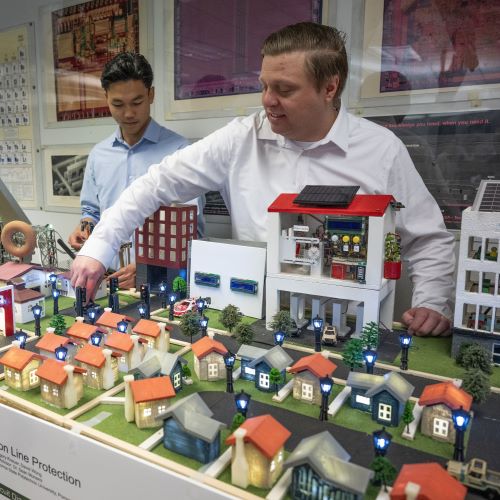
Impact of Inverter-Based Resources (IBR) on Transmission Line Distance Protection
Students: Diego Martinez; Luke X. Piao Advisors: Sean Monemi
Description/Abstract: This project investigates how inverter-based resources (IBRs) affect transmission line distance protection performance. A power system model is developed with integrated IBR penetration, and various fault conditions are simulated across transmission lines. SEL 311L relay response is analyzed to evaluate changes in fault detection and tripping behavior. The results highlight key protection challenges introduced by IBR-dominated grids.
Bidirectional Protection of Solar-Integrated Grid
Students: Tristan Obordo; Jordan A. Gutierrez Advisors: Sean Monemi
Description/Abstract: As power distribution networks continue to modernize by integrated solar, engineers are finding that current protection schemes face issues when protecting against more complex faults. Specifically, many systems still cannot adequately protect faults when the distributed energy resources (DER) begin to send power back into the grid, which arises when power generated is greater than power consumed. Our project aims to prove that the Schweitzer Engineering Laboratories (SEL) 451 relay can both detect what direction power is flowing, and protect against faults no matter the direction. To accomplish this, we designed a reverse power flow scenario in Real-Time Simulation Control and Automation Design (RSCAD) modeling an IEEE 33-bus system, which represents a residential/commercial distribution system with solar integrated. We integrated the SEL 451 relay through the Real Time Digital Simulator (RTDS) hardware in the loop functionality, where it would detect direction and protect against faults in a variety of power flow scenarios.
SMART - Substation Modeling and Reliable Transmission
Students: Art Wesley R. Lachica; Henry O'brien; George Sanchez Advisors: Sean Monemi
Description/Abstract: A miniature multi-stage physical substation that steps down voltage from 120Vac to 48Vac and then from 48Vac to 24Vac. Furthermore, this substation shall have a normally de-energized path with a hot-spare transformer that steps down voltage from 120Vac straight to 24Vac. At the 24Vac stage, there shall be identical 24Vac distribution buses connected to loads (the customers). This model shall incorporate several switching mechanisms to account for N-1 contingencies, particularly for transformer bank failure/outage. The substation shall demonstrate how circuit breakers can be automated by protective relays to redirect power flow. Current and voltage sensors will act as miniature protective relays throughout the substation, will detect abnormal conditions and decide which switching mechanism is necessary given the scenario. This project shall also utilize Gridscale X™ Advanced Protection Assessment (formerly known as PSS®CAPE) to demonstrate the redirection of power flow by tripping and/or closing circuit breakers.
RF Energy – Powered E-Reader
Students: Jasmine Banuelos, Sreya Chamakura, Aiden Ledden, Izel Trejo Advisors: Hyoung Soo Kim
Description/Abstract: The RF Energy–Powered E-Reader is a battery-free digital reading device that harvests ambient radio frequency (RF) energy from Wi-Fi routers to power its operation. Designed with ultra-low-power electronics and an energy-efficient e-ink display, it stores and displays text from book files while consuming minimal energy. By eliminating conventional charging requirements, the device offers continuous and maintenance-free operation in connected environments. Ideal for education, remote deployment, and sustainable technology initiatives, this innovation combines wireless energy harvesting with digital reading to create an environmentally friendly, durable, and highly accessible alternative to traditional e-readers.
Design of a Phase Locked Loop System
Students: Juan Habana Advisors: Hyoung Soo Kim
Description/Abstract: Phase-Locked Loops (PLLs) are fundamental building blocks in modern electronic systems that enable precise frequency synthesis, signal synchronization, and clock generation. The design process incorporates topics from digital, analog, IC design and control systems theory. A basic PLL system is designed with its application being a clock generator. A comprehensive system-level analysis along with performance considerations are provided.
ARIS (Augmented Reality Integrated Systems)
Students: Marc Soss, Arvind Mohanraj, Michael Casicio Advisors: Tim Hong-Chuan Lin
Description/Abstract: This project explores the design and development of a compact optical system for augmented reality (AR) glasses using a birdbath-style optical architecture. The system is intended to project digital imagery from a microdisplay into the user’s field of view while maintaining visibility of the real-world environment. The optical design consists of a micro-OLED display, a collimating lens, a beam splitter, and a concave mirror that redirects and focuses the virtual image toward the user’s eye. Through this architecture, the resulting optical configuration demonstrates a relatively low-cost AR display system capable of producing a clear virtual image while maintaining user comfort. The optical design balances compactness with image quality, showing that effective augmented reality visualization can be achieved using accessible optical components. This approach provides a practical foundation for the continued development of lightweight, wearable AR devices.
Object Detection Rover
Students: Joseph Barajas, Adam Bustamante, Jerry Cruz, Fernando Garcia, Leon Lai, Sean Nguyen, Richard Pablo, Kenneth Tran, Peter Tran, Terence Tong Advisors: Brita Olson
Description/Abstract: This Senior Design Project implements an obstacle detection and avoidance system by integrating ultrasonic sensors, lidar, and modifying an off-the-shelf rover’s drive system. Detection accuracy is improved by utilizing sensor fusion and developing algorithms that will take the vehicle’s detection distance from any given collision entity and correlating time of flight distance formulae from both sensors. The drive system will have a variable potentiometer to determine appropriate speeds for accurate object detection in relation to the rover’s reference speed and location.
Low-Cost Supervisory Control and Data Acquisition and Distributed Control System
Students: Carlos Chavez, Brandon Esebag, Karina Francis, Marlene Pimienta Herrera, Armando Rodriguez, Steven Soto Advisors: Brita Olson
Description/Abstract: This project presents the design and implementation of a low-cost Supervisory Control and Data Acquisition (SCADA) and Distributed Control System (DCS) using consumer-grade hardware. The system realizes core functions of commercial industrial automation platforms by integrating Arduino UNO Rev3-based field devices with a Raspberry Pi Version 4 host responsible for system supervision, data processing, and user interface delivery. The architecture enables real-time monitoring and control over a wireless network. The system’s performance demonstrates that reliable small-scale automation is achievable using widely available components, making the design suitable for educational, prototyping, and non-industrial applications.
High Frequency Trader Prototype - Automated Stock Market
Students: Demajay Francis Advisors: Valerio Formicola
Description/Abstract: This project implements a dual‑path algorithmic trading architecture that cleanly separates high‑latency data handling from ultra‑low‑latency decision making. The slow path runs on a Raspberry Pi, which interfaces with the cloud‑based Alpaca API to retrieve market data. Because Alpaca’s REST endpoints introduce non‑deterministic latency, the Pi focuses on tasks that do not require strict timing guarantees: JSON parsing, data normalization, enrichment, and lightweight stream processing using technologies such as Kafka and Flink. This preprocessing stage reduces noise and bandwidth by forwarding only structured, strategy‑relevant fields to the hardware layer. The fast path executes on an FPGA, which receives the curated data stream over Ethernet and performs the time‑critical logic. Leveraging hardware‑level parallelism, the FPGA parses incoming packets, evaluates trading algorithms deterministically, and emits compact trade signals—BUY/SELL flags, symbol identifiers, and quantities—with nanosecond‑scale consistency. By offloading all nonessential work to the Pi, the FPGA maintains a tightly bounded latency profile suitable for real‑time decision pipelines. A second Raspberry Pi application listens for these FPGA‑generated signals and converts them into Alpaca‑compatible REST order submissions. This design positions the Pi as a flexible software bridge between deterministic hardware logic and a retail broker that supports only HTTP‑based order routing. Running ingestion and order execution as two isolated services on the same device enhances reliability, simplifies debugging, and mirrors the modular separation found in production‑grade trading systems. Together, the architecture combines the determinism and speed of FPGA computation with the adaptability and API integration capabilities of the Raspberry Pi. It provides a scalable, maintainable framework for automated trading that remains compatible with consumer‑grade brokerage APIs while still achieving hardware‑accelerated performance where it matters most.
JARVIS-Bot: An AI-Powered Mobile Assistant Robot with Local LLM
Students: Christopher Vanegas Advisors: Valerio Formicola
Description/Abstract: This project presents JARVIS-Bot, a voice-controlled mobile robot assistant that processes all artificial intelligence locally without cloud dependencies. Built on the NVIDIA Jetson Orin Nano platform using ROS 2 (Robot Operating System), JARVIS demonstrates the feasibility of deploying sophisticated AI capabilities on embedded hardware. The system integrates multiple sensing modalities including an Intel RealSense D435 depth camera for person detection and following, an RPLIDAR A1 for 360-degree obstacle avoidance, and a microphone array for voice command recognition. Natural language understanding is achieved through a hybrid approach combining rule-based pattern matching for real-time responsiveness with an optional local Llama 3.2 LLM for complex queries. Key features include seven distinct personality modes, an animated face display for human-robot interaction, RGB LED mood lighting, and natural text-to-speech output. The modular ROS 2 architecture enables independent development and testing of subsystems while maintaining system-wide integration. JARVIS-Bot demonstrates practical applications of edge AI, computer vision, and human-robot interaction, providing a foundation for assistive robotics, home automation, and educational platforms.
Hybrid Edge–Cloud Computing Framework for Resilient Telemetry: A Case Study from Formula SAE
Students: Justin Sov Advisors: Valerio Formicola
Description/Abstract: This work proposes a hybrid edge–cloud telemetry system designed for Formula SAE applications, enabling reliable and adaptive vehicle monitoring. Combining an edge computing node (RPi5) with a cloud server (Microsoft Azure), the system delivers quick telemetry through WebSocket for low-latency local networks, and MQTT for reliability when network conditions drop. An algorithm monitors network performance and switches between communication protocols to maintain data quality. Telemetry applications provide dashboards (Node-RED based) and a time-series database (InfluxDB) while cybersecurity (mTLS) and network rate limiting are also implemented to ensure secure and stable network access. The system is scalable and modular, making it possible to support more sensors and telemetry nodes. It is suitable for both real-time on-site monitoring and remote telemetry analysis.
End-to-End UAV Engineering: From Hardware Assembly to Real-Time Network Defense
Students: Isaja Castro Vallejo, Emily Morales and Edison Zhou Advisors: Valerio Formicola
Description/Abstract: This project presents the design, development, and security enhancement of an unmanned aerial vehicle (UAV) platform through drone construction, operating system configuration, performance optimization, and the simulation and implementation of an intrusion detection system (IDS). The work begins with the physical assembly and integration of drone hardware components, followed by the configuration of a Linux-based operating system to support flight control, communication protocols, and real-time telemetry. System performance is evaluated in terms of stability, latency, and resource utilization to ensure reliable operation under varying conditions. To address cybersecurity vulnerabilities in UAV networks, a simulation-based intrusion detection system is developed to identify Denial of Service (DoS) and Distributed Denial of Service (DDoS) attacks targeting drone communication channels. Network traffic data is analyzed to extract relevant features, and detection mechanisms are implemented to differentiate between normal telemetry and malicious activity. The IDS is validated through simulated attack scenarios to measure detection accuracy, response time, and overall system resilience.
From Concept to Road: Building an Electric Van with Embedded Telemetry and Diagnostics for System Resilience and Cybersecurity
Students: Benjamin Villa Advisors: Valerio Formicola
Description/Abstract: The increasing complexity of electronics in electric vehicles (EVs) demands improved resilience against failures and cyberattacks. This work presents the ground-up design of an open-source electric van featuring embedded telemetry and diagnostic systems for resilience and cybersecurity. The system is designed to integrate onboard intelligence to detect and analyze anomalous conditions in power, electronics, and communications, enabling early identification of failures or malicious alterations by hackers. By monitoring operational signals in real-time, the approach enhances fault tolerance and anticipates safety-critical conditions. Embodying a security-by-design strategy, our preliminary results include a smart fuse board and an optical control board. Our strategy is unique as intelligence is created on a custom electric van developed from concept to road, hence allowing us to tune and train the best architecture and intelligence with fast iterations.
AI-assisted SQL-to-ROS Motion Framework
Students: Arriana Flores, Czyrone Agbayani, Mariam Nadeem Advisors: Valerio Formicola
Description/Abstract: This project develops a scalable software architecture for complex robotic motion control by bridging high-level data management with low-level hardware execution. Current robotic systems often struggle with the transition from stored "action" sequences to real-time execution without risking system instability. Our solution utilizes a PostgreSQL database to encode multi-movement sequences into single actions, a ROS-based API for physical movement execution, and a middleware wrapper layer to monitor for anomalies. Preliminary testing indicates this architecture significantly reduces manual coding for complex tasks while increasing system reliability through automated error checking. To enhance usability and accessibility, the system integrates voice command input and a Large Language Model (LLM) to interpret natural language instructions into structured database queries. This allows users to issue high-level commands (e.g., “assemble part A” or “pick up the tool”) without manual scripting.
Solar Boat: Power System
Students: Angel Conde, Elijah Tolosa, Justin Laulu, Nawaljit Dhaliwal, Patrick Nguyen Advisors: Dr. Tamer Omar
Description/Abstract: The Solar Boat Power team designed the electrical system for the boat’s power generation, energy storage, and distribution. This system is necessary for powering the controls, data acquisition, and electrical motors. The design utilizes solar panels for power generation, lead-acid batteries for energy storage, and power electronic converters for distribution. With this design, we are conquering the task of optimizing power usage to extend the duration of time spent on the water during an endurance race that lasts 2 hours, while keeping all systems fully functioning. The power generation system consists of four solar panels in a two series, two parallel connection and a charge controller using MPPT tracking to maximize the power output of the solar panels. The energy storage system, which must meet weight limit constraints, uses six lead acid batteries in a three parallel two series connection. The distribution system uses DC-DC converters to supply 12V, 5V, and 3.3V lines for the auxiliary systems and 36V for the high current motors.
Solar Boat - Control Team
Students: Myat Sint, Nathan Nieblas, Gabo Rico, Kaylee Ho Advisors: Dr. Tamer Omar
Description/Abstract: In this senior design project, the control team will work on California Polytechnic University of Pomona’s Solar Boat, which will compete in the Solar Splash competition. This project focuses on developing a microcontroller-based system that includes energy flow, regulates propulsion, monitors real-time performance, and ensures operational safety in a solar-powered boat. This subsystem will use printed circuit board (PCB) design, sensor integration, and STM32 microcontroller programming to optimize performance and efficiency. This team is responsible for designing and implementing the electronic systems that control and monitor the solar boat. The main focus areas include creating a custom PCB that connects the throttle to the Alltrax motor controller, ensuring smooth and reliable motor control. The team will design and program the STM32‑G474RE compute platform and all low‑level firmware, including device drivers, control loops, direct memory access streams, and a safety state machine.
Design & Implementation of a Real-Time Electrical Monitoring System for the Cal Poly Pomona Solar Boat
Students: Isaac Bernal, Timothy Chow, Samuel Neeley, Verenize Sotelo Advisors: Dr. Tamer Omar
Description/Abstract: This proposal presents the design and development of a solar-powered boat that integrates renewable energy harvesting, efficient motor control, and advanced sensing systems for optimal navigation and performance. The project combines solar photovoltaic technology with various sensors to create a sustainable and intelligent marine system. The design aims to demonstrate the potential of renewable-powered transportation and contribute to sustainable engineering innovation through efficient energy management and sensor integration.
Renewable Vehicle Architecture with Remote Telemetry
Students: Sean Wygant, Daniel Mondragon Xicotencatl, Kobe Aquino, Heba Hafez Advisors: Dr. Tamer Omar
Description/Abstract: The Renewable Vehicle Architecture with Remote Telemetry is a modular control and telemetry system designed to power, monitor, and optimize renewable and electric competition vehicles through integrated energy management, embedded control, and real-time data analytics via a remote server. This project consists of 4 subteams, Power, Control, Sensors, and Software contributing to 3 major systems of a solar powered boat. The major systems include Solar Generation and Distribution, Instrumentation and Control, and Data Acquisition. The hull upon which this system operates was designed and fabricated by the Cal Poly Pomona Solar Boat Club Mechanical Team. This system employs custom power distribution units which power safety systems and independent dual motors with differential thrust. The sensing and control apparatus involves the use of an STM32 based microcontroller, using both off the shelf and custom sensors for control and feedback.
Vehicle to Infrastructure On Board Unit (OBU) and Road Side Unit (RSU) data acquisition system.
Students: Bryan Liu, Ryan Lin, Cole Noelte, Minh Ha, and David Fengzheng Advisors: Dr. Tamer Omar
Description/Abstract: The primary goal of this project is to develop a GPS/IMU-based vehicular mesh telemetry network that will detect and relay accident information, reducing emergency medical services (EMS) response time. Our project will use existing framework and improve it by using a mesh network instead of the original star topology network. By using a mesh network, data payloads from OBUs on each car on a highway can be relayed to the root RSU without a direct connection to it. The OBU would have other modules like GPS for accurate coordinates as well as the correct time and IMUs for precise acceleration measurements. With these sensors, accidents can be easily detected and sent straight to EMS systems anywhere on the highway.
Artificial Intelligence-Based Drone Detection Using Software Defined Radio and YOLO Computer Vision
Students: Julio Flores, Juan Rodriguez, Victor Perez Advisors: Dr. Tamer Omar
Description/Abstract: The increasing accessibility of unmanned aerial vehicles (UAVs) has created a growing need for reliable drone detection systems capable of operating in complex and congested radio frequency (RF) environments. This project presents the design and implementation of an artificial intelligence (AI) and machine learning-based drone detection platform that combines RF signal analysis with computer vision techniques to detect and verify the presence of drones in real-world environments. The detection process begins with RF signal acquisition using a USRP N321 software-defined radio (SDR) equipped with antennas to capture communication signals between drones and their controllers.
All poster sessions will be held in 9-247 from 9:00 AM - 11:30 AM
UMBRA Project Lazarus: Sensor Testbed
Students: Aaron Franklyn Barnett Advisors: Farhana Abedin
Description/Abstract: This project is an independent effort conducted as part of UMBRA's Project Lazarus; a multi-team rocketry project that sees the construction of a payload-equipped rocket for an entry into a competition. The current project involves payload- a quadrotor FPV drone. The goal of the project is to design and test a prototype for a payload’s delivery system such as the altitude sensor and its interface with the drone's folding wings. An "ironbird" style copy of the drone body is used to simulate accurate conditions, fitted with the same electronics as in the real system for the competition, the deployment conditions through a series of drop tests will be tested.
Powerline Inspection Drone
Students: Jared Jimenez, Victor Lara, Sado Yun Advisor: Farhana Abedin
Description/Abstract: The goal of our project is to design a drone capable of inspecting power lines to find thermal spikes before they cause fires. Additionally, we are looking to lower the cost of inspecting powerlines in remote areas by reducing the number of personnel required to perform the inspection. To achieve this, we are developing a small quadcopter drone that is built on a custom 3D printed frame. The drone is equipped with an infrared range camera module and a means of storing the video for later review should any abnormal temperatures be detected. This project serves as a proof of concept and an advanced prototype can be developed in future with the addition of computer vision, machine learning, and enhanced thermal camera resolution.
MCAA Student Chapter Competition – Bid for a real world waterpark construction project
Students: Richard Medina, Aura Grego, Antonio Franco Advisor: Farhana Abedin
Description/Abstract: In this project, our team developed a mock mechanical contracting company to complete in the MCAA Student Chapter Competition by submitting a bid for a real-world waterpark construction project. We analyzed detailed schematics to estimate quantities for piping, drainage systems, and materials, while calculating direct and indirect labor, overhead, and total project costs. Our team also created a comprehensive construction schedule and execution plan to demonstrate project feasibility and efficiency. There was a large emphasis on safety planning and compliance throughout all phases of the project. These components were compiled into a 55-page formal proposal designed to simulate a competitive industry bid. Overall, the project provided valuable real-world insight into the processes mechanical contractors use to secure and execute large-scale construction contracts while strengthening our skills in teamwork, cost estimation, and project management. Our goal is to refine our bid proposal by learning from past mistakes and establishing a stronger foundation for next year’s team.
Beowulf HPC Cluster
Students: Billy Strowbridge, Matthew Solorza, Drew Pickett Advisor: Farhana Abedin
Description/Abstract: This project is about building a small but fully functional High Performance Computing (HPC) cluster using surplus hardware that would otherwise be e-wasted due to incompatibility with Windows 11. While making the foundational systems work together initially seems like a simple goal, the process reveals the complexity of distributed computing through debugging and refinement across all system layers. Reliable operation with Slurm across network-booted compute nodes requires careful integration and configuration of all cluster infrastructure. In addition to system development, the project incorporates a computational fluid dynamics (CFD) analysis of a single node to study heat transfer and airflow. Comparative testing is also used to evaluate performance differences between a single system and the entire cluster, as well as to relate simulation results to real-world behavior.
Ecosorter
Students: Joel Medina, Brandon Spiker, Beshoy Habib, William Burns Advisor: Farhana Abedin
Description/Abstract: This year the ASME Student Design Competition challenges students to design and build a small-scale vehicle that can autonomously or remotely perform specific engineering tasks. In this project, teams develop a vehicle capable of navigating a course while identifying and sorting materials such as garbage and recycling. The system typically integrates mechanical design, electronics, and programming, including sensors and actuators for sorting mechanisms. Emphasis is placed on efficiency, accuracy, and reliability under competition constraints. Overall, the competition provides hands-on experience in applying engineering principles to a real-world sustainability problem.
Affordable 6 D.O.F. Robotic Arm
Students: Seth Chairez, Thomas Dinu, Anthony Huynh Advisor: Farbod Khoshnoud
Description/Abstract: Construct a robotic arm with 6 degrees of freedom capable of automated movements through on-board memory with sensor capabilities for controlled movement in an environment that may experience obstructions. The arm will be constructed to serve as a middle ground between the quality of robotic arms used in the manufacturing industry and pricing of robotic arms that one would make as a hobby.
Theder Drone For BillyBOT
Students: Nayeli Hernandez, Dennis Quijano Advisor: Farbod Khoshnoud
Description/Abstract: This project develops a tethered quadrotor drone integrated with an autonomous ground robot, BillyBOT, to provide continuous aerial monitoring and navigation support on a university campus. The drone receives power through a lightweight tether, enabling extended flight time beyond conventional battery limits. A Pixhawk flight controller manages stability, while a Raspberry Pi–based vision system enables autonomous landing using visual markers. The system is designed using 3D-printed components, with PLA for prototyping and ABS for final implementation. By combining mobility, persistent power, and real-time video.
AI Camera Tracking System
Students: Utkrisht Batra, Coree Joseph, Alexander Leon Advisor: Farbod Khoshnoud
Description/Abstract: Our project is an offline AI camera tracking system designed to detect and follow a person in real time without relying on wifi or cloud services. The system uses an NVIDIA Jetson Orin Nano, an Arducam IMX477 camera, and a pan and tilt mechanism to perform onboard tracking and local data storage. It is being developed as a modular prototype that can later be integrated into BillyBOT for person follow demonstrations and future expansion.
Automated Window
Student: Panda Rodriguez Advisor: Farbod Khoshnoud
Description/Abstract: The original premise was to create a 3 stage screw actuator to open the window. However, due to lack of time, I was forced to change to stepper motor with integrated lead screw with limited wireless capabilities. It's intent is to assist individuals who find it difficult or are incapable of opening the window by themselves.
Heavy Duty Vision Based Tracking Gimbal For Mobile Quantum Communications
Students: Thomas Hawkins, Gordon Lau Advisor: Farbod Khoshnoud
Description/Abstract: A solution for remote quantum communications using ground/ariel drones that track targets utilizing direct drive brushless DC motors, a field orientated control algorithm, 20 bit magnetic encoders, and a vision based tracking algorithm
BillyBOT
Students: Christopher Parks, Joseph Ruiz De Paz Advisor: Farbod Khoshnoud
Description/Abstract: BillyBOT is an autonomous robot developed by a student team at Cal Poly Pomona, designed to serve as an AI-powered campus tour guide. It can navigate independently, answer questions about the campus, and guide visitors to buildings using a ChatGPT-based voice assistant, LiDAR-based SLAM navigation, and a solar-powered 48V drivetrain. The system runs ROS 2 on a Raspberry Pi 4 for high-level navigation and AI, while a Raspberry Pi Pico W handles low-level motor control.
The team has implemented the SLAM system, integrated a high-voltage emergency stop circuit, and established the micro-ROS motor control bridge. While core systems are partially functional, ongoing challenges include mechanical stability due to the top-heavy design, motor lag, object detection quirks, and limited battery range. The team continues to work toward full autonomous operation.
Miniature Airship
Students: Angel Medina & Shawn Gangl Advisor: Farbod Khoshnoud
Description/Abstract: Designing a hybrid aerial vehicle that combines a small multirotor drone with a helium balloon to increase endurance and operational range. We want a minimum 90-minute flight time target, 2 km range, and total system weight under 1.5 kg.