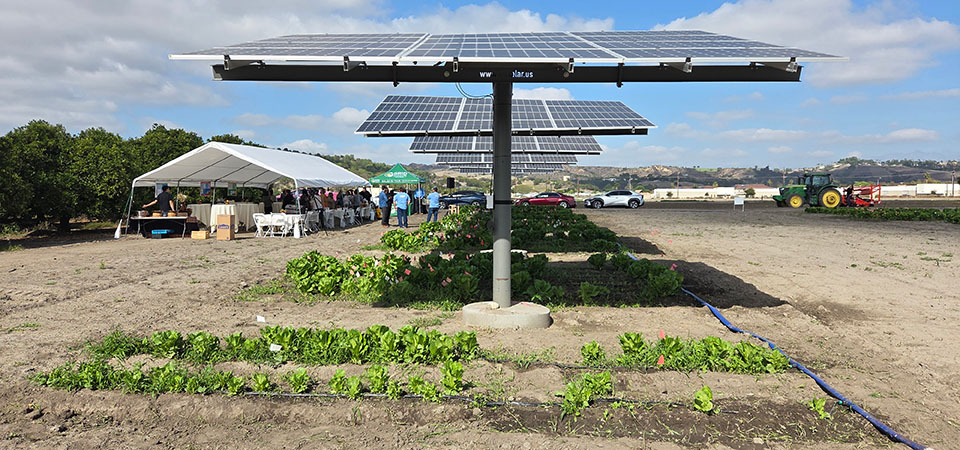
Growing lettuce under photovoltaic panels at the Cal Poly Pomona farm can conserve water and yield produce that weighed as much – if not more – than lettuce grown in open fields, early research results show.
Those findings and more were revealed at the 2026 Southern California Agrivoltaics Conference, which Pitzer College’s Robert Redford Conservancy held at the DoubleTree Hotel in Pomona on Oct. 20.
The Huntley College of Agriculture is collaborating with the conservancy to research the viability of agrivoltaics – growing crops under photovoltaic panels – at the Cal Poly Pomona campus farm.
Over the first five crop cycles since summer 2025, students have grown, measured, and weighed 3,556 heads of romaine lettuce at the campus farm, Plant Science Assistant Professor Eshwar Ravishankar shared at the conference.
This past spring, lettuce leaves growing under the panels lost about half as much water as those in a nearby open field, evidence of water conservation, he added.

The panels reduced crop yields during the cooler seasons of 2025, but by summer 2026, lettuce grown under the panels was as heavy – if not heavier than – heads grown in the open field, Ravishankar said.
In addition to Ravishankar, the conference featured keynote speaker Greg Barron-Gafford, the W.K. Kellogg Chair in Southwest Borderlands Food and Water Security at the University of Arizona’s Southwest Center; speakers from UC Davis and Pitzer College; and a site tour of the campus farm.
The Cal Poly Pomona team working on the photovoltaic project also includes Plant Science Professor Aaron Fox, and students Megan Kelly, Richard Connelly, Jo Campbell, Huy Duong, and Diego Briceño. The conservancy team includes Susan Phillips, Guillermo Douglass-Jaimes, Rose Olivas, and Emily Kuhn.
By growing under the panels, farmers can reduce thermal stress on plants and the amount of water lost to evaporation. It can also provide shade for farm workers in hot climates, improving worker safety.
The project was funded through a $1.8 million grant from the Foundation for Food and Agriculture Research to Pitzer College to study the environmental potential and benefits of agrivoltaics across the state.
In addition, the California Energy Commission has selected Cal Poly Pomona’s solar-photovoltaic located in non-traditional terrain (SPLINT) project – which uses the campus farm for a solar-plus-battery test site – for a $2.1 million research grant.
Formal approval of the grant agreement is expected in February 2027.


