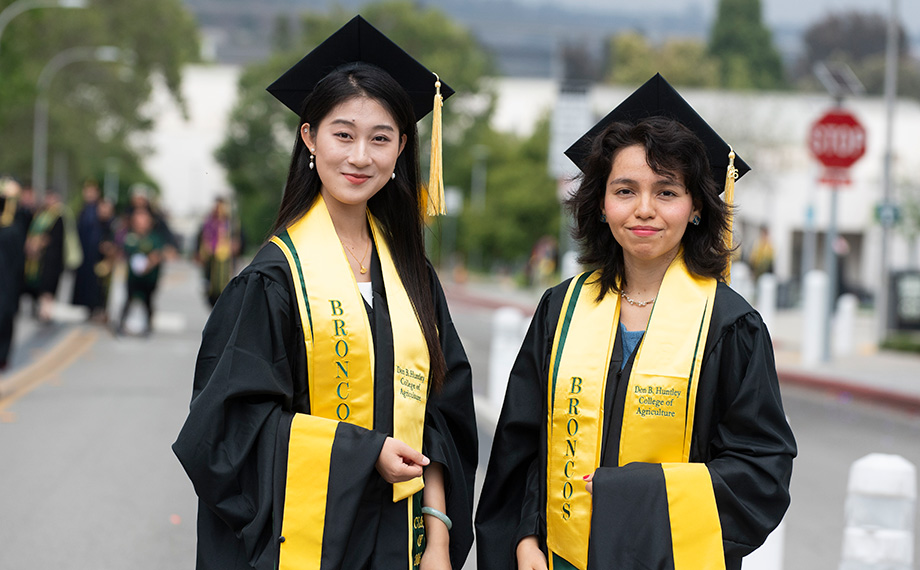
It was like a scene out of “Shark Tank.”
Elizabeth Groenheim and Zhongqin “Sherlly” Shi stood before a panel of judges, industry professionals, and experts at the Fowler Global Social Innovation Challenge in San Diego to pitch a plant-based snack bar that could help improve the health of people worldwide.
The competition challenged the two Cal Poly Pomona nutrition and food science graduate students to apply research, entrepreneurship, and problem-solving skills to create a business solution to a social and environmental problem. They found the presentation both exciting and challenging.
“There is definitely some nervousness, because you are presenting something you have spent years developing,” Groenheim said. "At the same time, it is incredibly rewarding to see people engage with the idea and ask thoughtful questions.
“I did feel nervous before presenting because I wanted to represent our work as perfectly as possible,” Shi said.
Getting to present a product idea in front of a panel was an invaluable, hands-on learning experience for the two to cap off graduate school – they graduated from Cal Poly Pomona in May – and illustrates how university research can address public health challenges and real-world problems.
“I learned more about how to communicate scientific ideas with people from different backgrounds,” Shi said. “They also helped me become more confident in public speaking, practice responding to questions, and stay calm while presenting under pressure.”
“Presenting to judges, entrepreneurs, and industry professionals gave me a better understanding of what it takes to turn a research project into a successful business, and I hope to continue building on those lessons in the years ahead,” Groenheim said.
Getting There
Groenheim and Shi earned the right to appear at the Fowler event in May after winning the $15,000 grand prize for their project at the San Diego State University Social Venture Challenge.
The Social Venture Challenge is a live collegiate pitch competition where student teams present innovative solutions to social and community challenges. This year’s theme was “Achieving Food Security Through Innovation.”
Groenheim and Shi’s project tackled a specific problem: iron deficiency. Millions of people around the world suffer from it, particularly women of reproductive age. Many current solutions rely on supplements that can cause unpleasant side effects.
Groenheim’s graduate research involved fermenting red lentils to reduce compounds called phytates that inhibit iron absorption, while pairing lentils with vitamin-C-rich ingredients to increase the body’s non-heme iron absorption.
She then created a plant-based snack bar with fermented red lentils, dates, and guava, for her master’s thesis with the guidance of her advisor, Assistant Professor Belal Hasan, and her thesis committee.
Presentation Partners
Shi joined Groenheim for the competitions, contributing technical insights and support and jointly presenting the scientific, nutritional, and commercial aspects of the venture to the judging panels.
“Most of the audience and judges were not from the food science fields, so we needed to explain the product features, advantages, and the scientific principles behind our product in a very short time and in a way that is easy for everyone to understand,” Shi said.
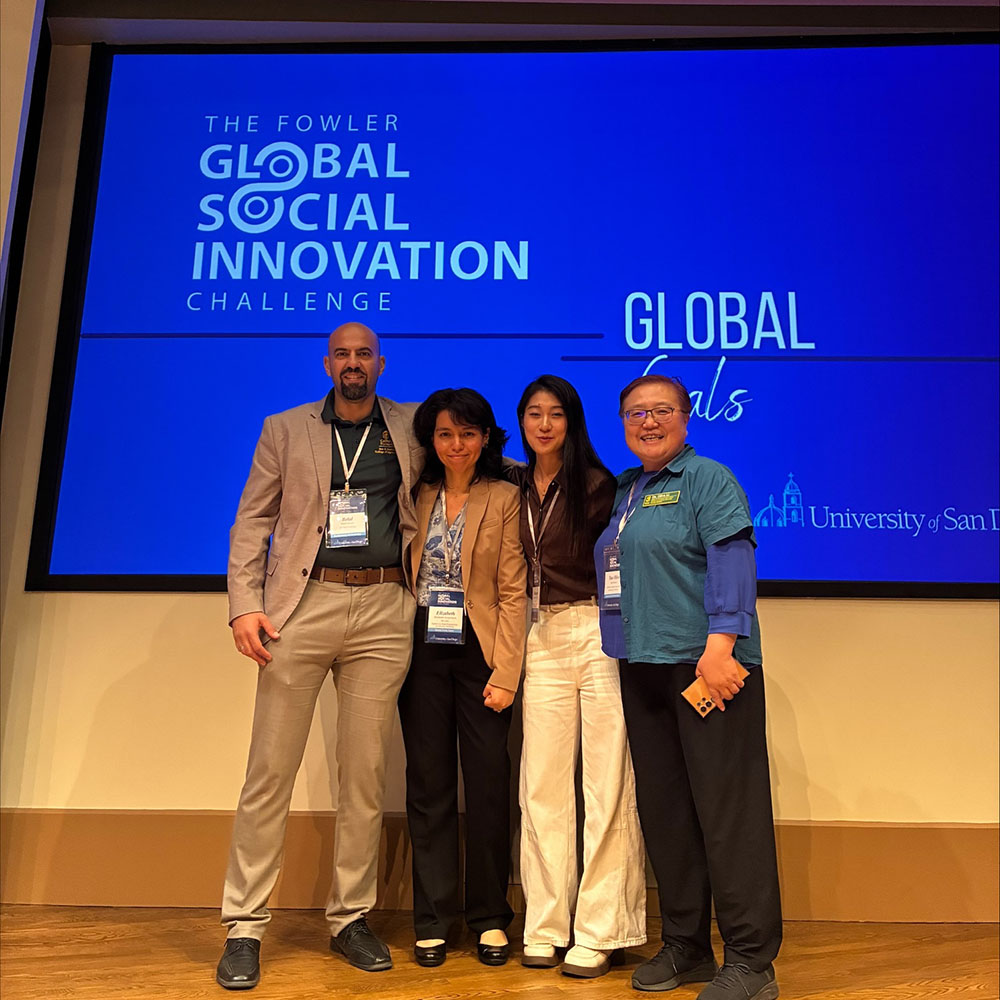
Groenheim and Shi pose with Professor
Olive Li and Assistant Professor Belal Hasan
Groenheim’s primary goal was sharing an idea that combined food science with social impact.
“I wanted to demonstrate how scientific research can be translated into a practical product that addresses a real public health challenge,” she said.
For the Fowler event, the duo adjusted their presentation to make it more relevant to a global audience rather than focusing solely on the United States.
“That was one of the biggest benefits of participating in the event, which encouraged us to think beyond the initial market and consider how this project can potentially be adapted in different communities and regions,” Shi said.
More Than a Competition
Although the duo did not win a prize for their work, participating in the Fowler event was worthwhile.
“Beyond the competition itself, I had the opportunity to meet students and entrepreneurs working on a wide range of projects,” Groenheim said. “Listening to presentations focused on challenges in healthcare, sustainability, education, and other areas gave me a broader perspective on the many ways innovation can be used to improve people’s lives.”
Shi participated in a design thinking workshop where she was teamed with students from Mexico and Nigeria, respectively, to develop a pitch with the theme, “Reimagining Future Food Systems,” in just two hours.
“Our final idea was a sustainable system designed to reduce food waste and make nutritious foods more
accessible to communities,” she said.
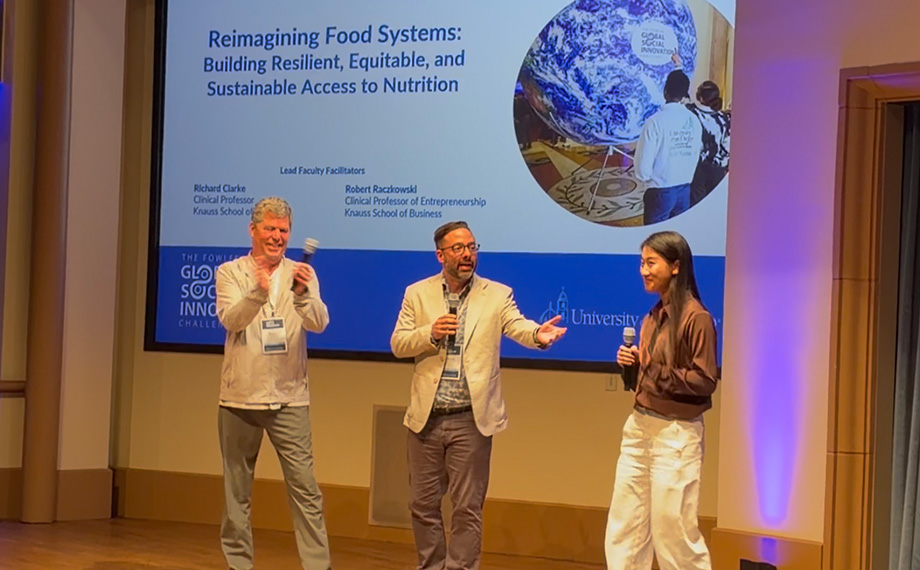
Zhongqin "Sherlly" Shi at
the Fowler Challenge
The team proposed collecting food co-products that still contain valuable nutrients and then dehydrating them using solar power and grinding them into powder for easier storage and transportation. A software platform would allow users to track the processing pathway and the product’s nutritional value.
“We are all from different cultural and educational backgrounds,” Shi said. “It challenged me to communicate efficiently, listen to different perspectives, and connect our ideas into a practical proposal within a very short time.”
The impromptu team took home the grand prize of $6,000.
Shi also represented the Cal Poly Pomona team in a one-minute showcase during the closing ceremony.
The Future
Shi, a native of China who earned her bachelor’s degree in food science and technology from Oregon State University, plans to pursue a career in food product/process development or research and development.
“I was drawn to this field because food connects culture, health, and everyday life,” Shi said. “A product that looks simple to consumers may actually represent years of work by food scientists to improve its nutritional value, texture, flavor, and overall quality.”
For her part, Groenheim wants to commercialize her research. The Ontario native already has filed a patent application related to the snack bar. Her next step is to build a company around her innovation, which means securing partners, investors, and resources to bring the snack bar to market.
Over the long term, Groenheim, who earned her bachelor’s degree in anthropology from UC Riverside, hopes to establish a manufacturing facility to produce the snack bars and other food products that will improve people’s health.
“One of my goals is to develop affordable versions that could be incorporated into school meal programs, helping improve access to nutritious foods for children,” she said. “I am excited to see how far the project can grow over the next several years.”


