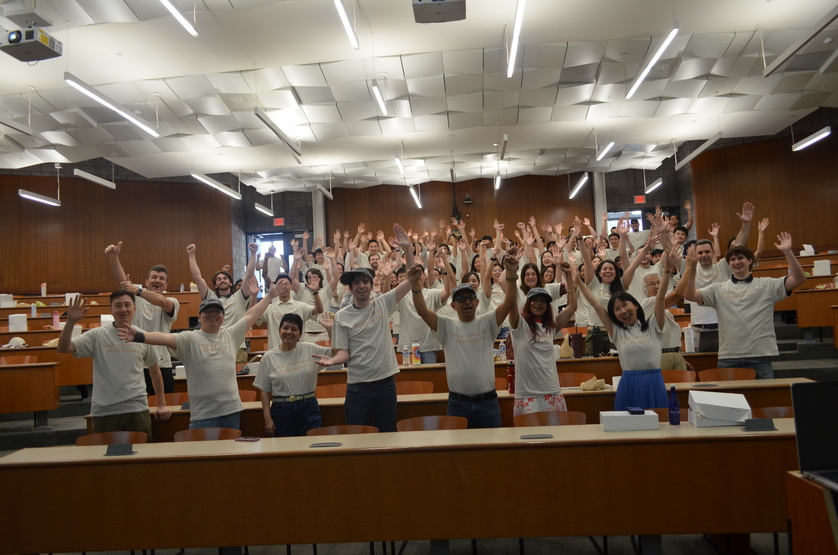
Cal Poly Pomona’s College of Business Administration brought together creativity, technical skill, and applied problem-solving at the 2026 AI Fair & Hackathon, highlighting the university’s commitment to preparing students for a rapidly evolving digital economy.
Held April 16 at the Bronco Student Center, the event marked the culmination of weeks of collaboration, training, and competition. Students from across disciplines presented artificial intelligence-powered solutions addressing challenges in cybersecurity, market research, career development, accessibility, and the future of work. Participation was open to all majors, reinforcing the idea that innovation in AI extends far beyond technical fields.
By the numbers, the event reached new scale this year. More than 320 students registered and competed. More than 60 industry and academic judges evaluated submissions across two rounds — competing for a $10,000 prize pool across five sponsored tracks. A defining technical milestone of 2026 was the adoption of OpenAI Codex as the official "vibe coding" platform — making Cal Poly Pomona among the first universities in the California State University system to deploy Codex at scale for student innovation. The Mitchell C. Hill Center for Digital Innovation gratefully acknowledges OpenAI and the Cal Poly Pomona CTO Office for making this access possible, alongside the corporate sponsors who underwrote the prize pool and challenge design.
AI Fair sponsors included Avanade (Platinum), Splunk (a Cisco company) (Gold), Amazon Web Services (Silver), Cal Poly Pomona College of Business Administration, Singelyn Graduate School of Business (Silver), SHI (Silver), and Northrop Grumman (Green). AI Hackathon Competition sponsors included Avanade, aytm, ISACA Orange County, Neo Smart Living, Insights Association and OpenAI.
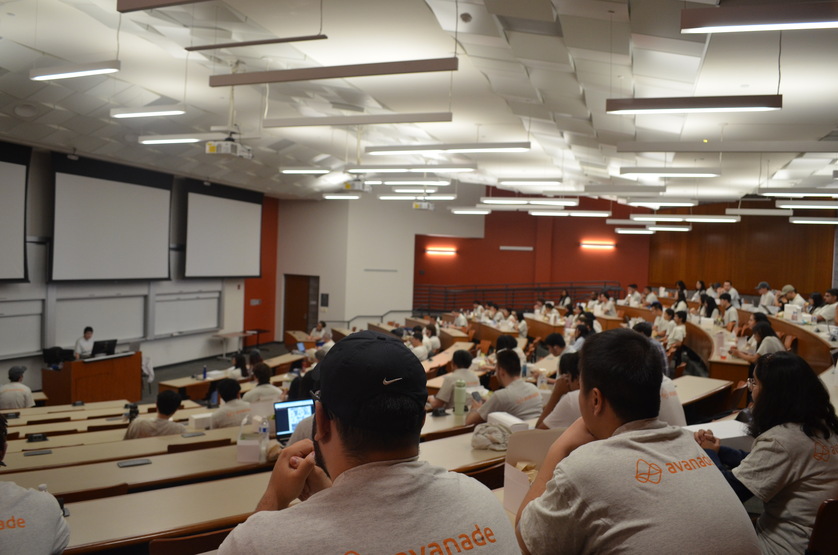
A Platform for Applied Solutions
The hackathon featured five tracks, each co-designed with industry sponsors around real business and societal problems:
- Avanade — AI for Workforce Transformation and Wellbeing
- ISACA Orange County — Personal Cybersecurity Tools for Everyday Users
- Insights Association West — AI-Powered Career Event Smart Matching
- Neo Smart Living × aytm — AI-Driven Simulated Market Research
- Creative Track — Student-Identified Solutions Aligned with the UN Sustainable Development Goals
Teams had six minutes to present their concepts, which were evaluated by industry judges based on innovation and problem framing, impact, technical feasibility, execution potential, and storytelling.
Sponsors served as judges and mentors, offering guidance and framing real industry challenges throughout the competition. The results reflected strong alignment between student ideas and industry needs.
“We had the tough job of selecting first, second, and third place—but honestly, every solution felt market-ready. The level of creativity, usability focus, and understanding of real-world risk was outstanding,” said Jason James, CISA, CDPSE, CCISO, partner, Regents and Park & vCISO, ISACA Orange County chapter.
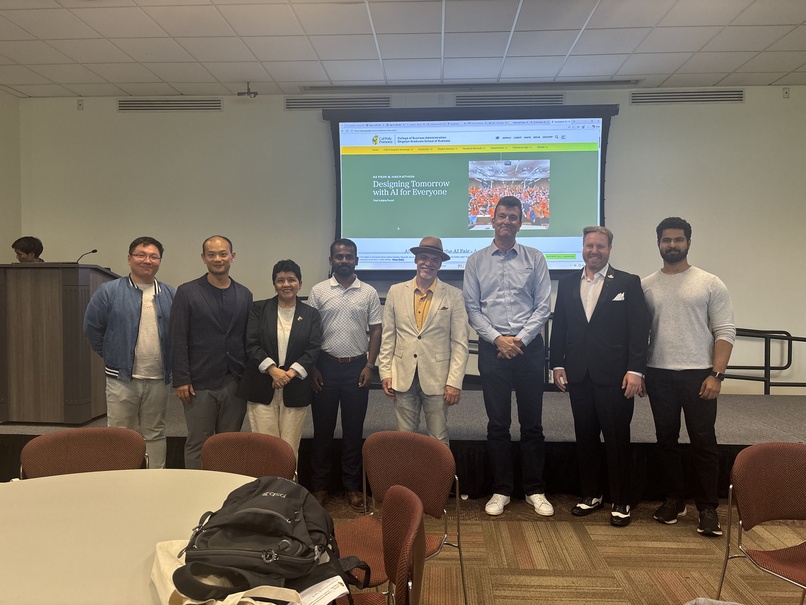
Standout Innovations
Several team projects stood out for their originality and execution:
- In the cybersecurity track, the winning solution, CyberCoach, helps users identify phishing attempts and suspicious content while preserving privacy through local analysis and multi-model AI validation.
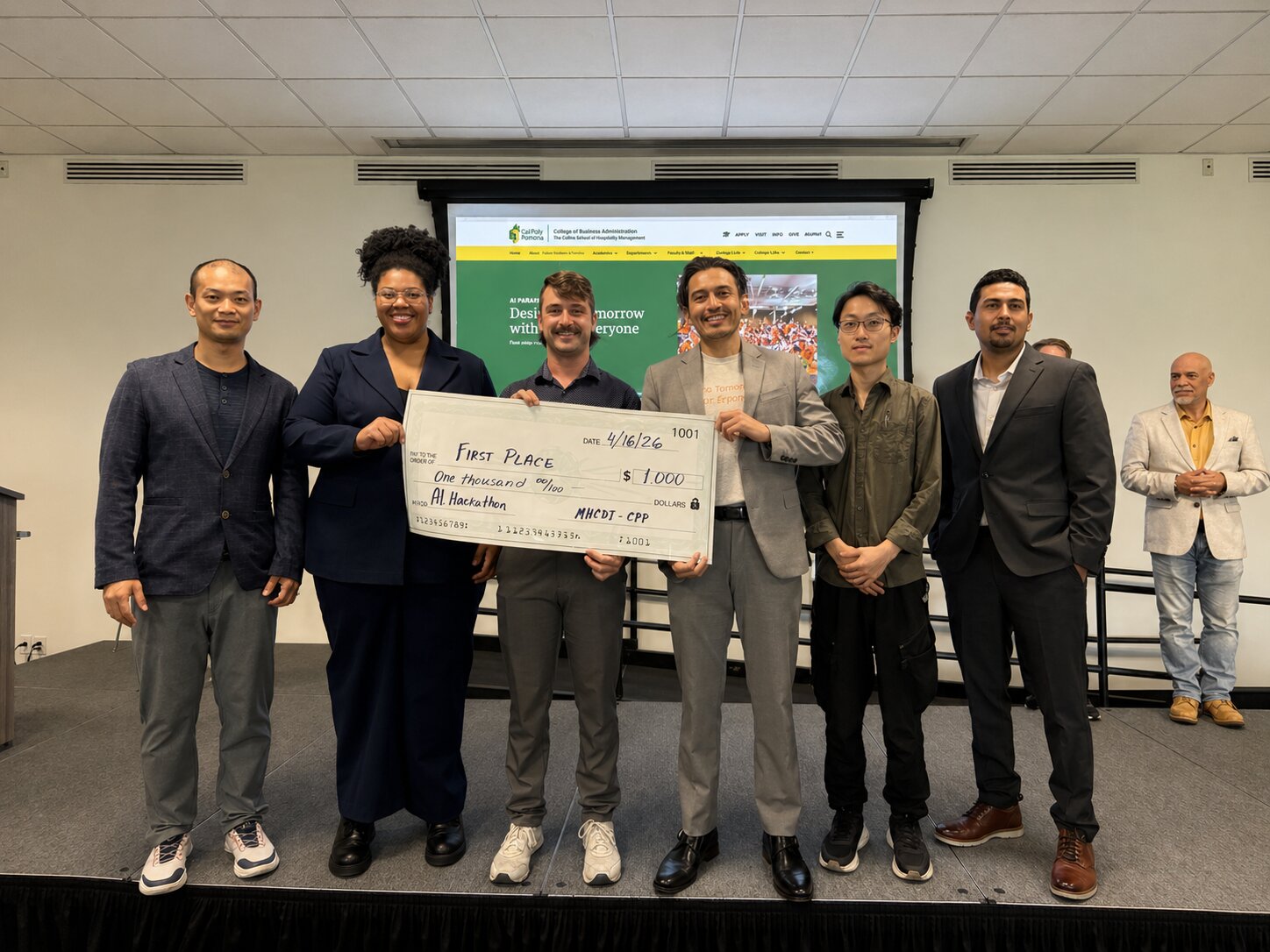
- In the Neo Smart Living and aytm-sponsored track, the first-place team developed a “Synthetic Market Research Pipeline,” an AI-driven system that simulates consumer insights at a fraction of traditional research costs by leveraging multiple large language models.
- In the Creative Track, the first-place project, SignBridge, introduced a real-time communication tool for nonverbal and deaf users, converting gestures, facial expressions, and speech into two-way communication.
- Another notable project, Pocket Buddy, an offline AI-powered learning companion designed for students in low-connectivity environments, earned second place in the Creative Track.
Learning Beyond the Classroom
Distinguished alumna and advisory board member for the California Center for Cyber Risk at Cal Poly Pomona Diane Miller (BSBA ’81) highlighted the university’s “Become By Doing” approach. “One thing Cal Poly does especially well is teach students how to learn,” Miller says. “The school takes a unique approach to addressing opportunities and challenges, and AI is a great example of that. You can see collaboration across all colleges and strong partnerships with industry. This is the right way to approach AI—and really any emerging technology.”
Beyond the competition, the AI Fair created opportunities for learning and networking. Student organizations hosted demonstrations in machine learning, computer vision, and AI ethics, while industry professionals led sessions on responsible AI and high-performance computing.
A keynote presentation by Michael Brent, director of Responsible AI at Boston Consulting Group, explored ethical considerations shaping the future of artificial intelligence. “This moment is as significant as the Industrial Revolution,” cautioned Brent. “We need collaboration across disciplines—technology, social sciences, and humanities—to ensure we build AI responsibly.”
Brent also discussed emerging developments in Artificial General Intelligence (AGI), world models, on-device AI, and agentic AI. “We’re moving extremely fast—faster than regulation can keep up.” The keynote was complemented by a panel discussion examining both opportunities and risks associated with AI adoption in business and society.
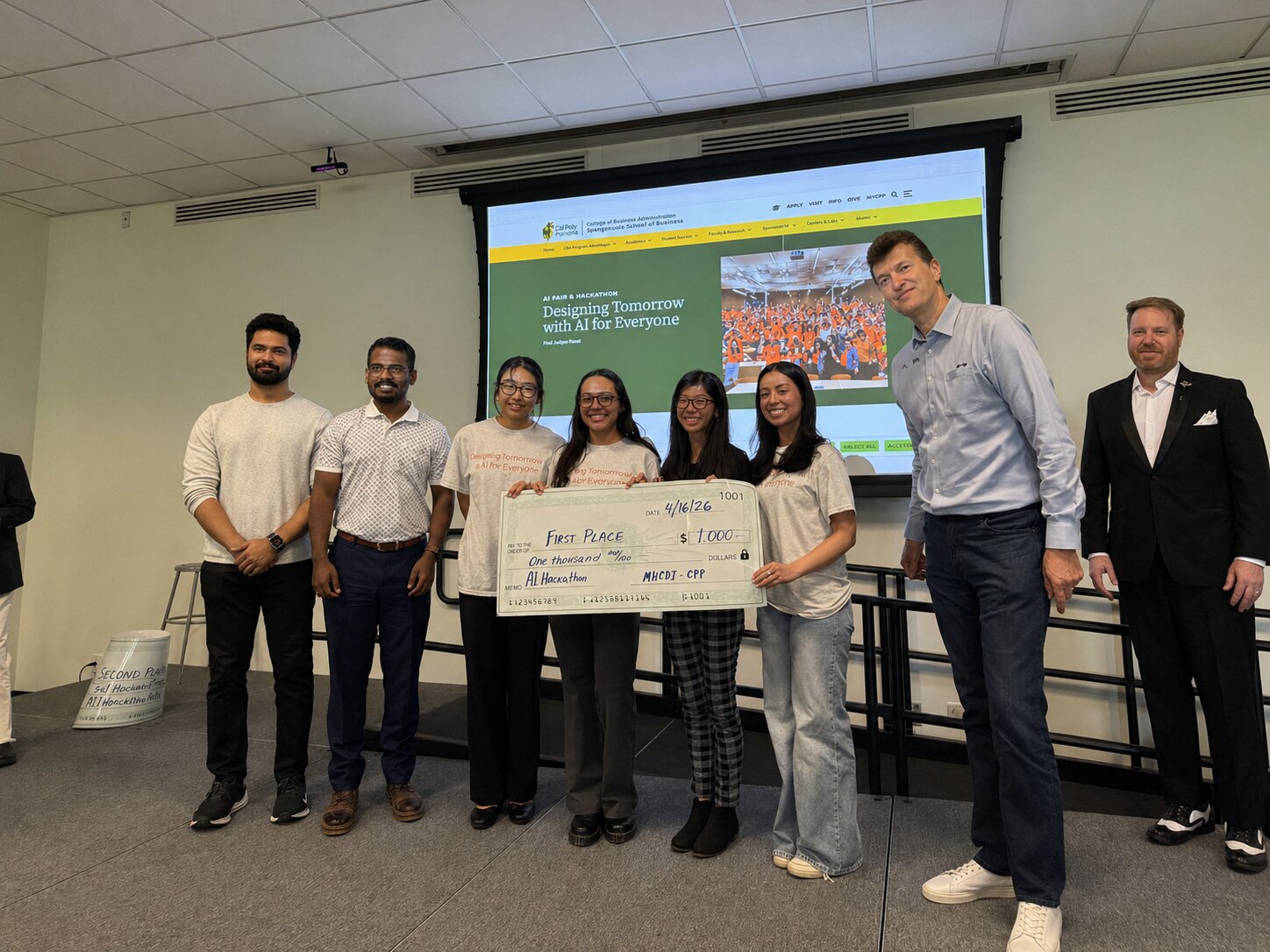
Interdisciplinary Collaboration at the Core
A defining feature of the hackathon was its emphasis on interdisciplinary collaboration. Teams included students from business, engineering, computer science, and design, creating an environment where diverse perspectives shaped solutions. CBA students came from across all departments, with the largest contingents from Computer Information Systems (~34%), Technology & Operations Management (~15%), International Business & Marketing (~10%), and Finance, Real Estate, and Law (~9%), alongside strong cross-college participation from Computer Science (~16%) and Engineering. Roughly four in five participants were undergraduates; among graduate students, the largest cohort came from the Master of Science in Business Analytics (MSBA) — Cal Poly Pomona's signature STEM-designated graduate program, housed in the Singelyn Graduate School of Business. Participants developed not only technical and analytical skills, but also experience in communication, storytelling, and translating complex ideas into actionable outcomes.
Janice Lachan (CS, ’27), an Avanade STEM Scholar and member of the first-place team in the Insights Association West Chapter track, helped develop a smart-matching system connecting students with career events, volunteer opportunities, and professional associations. “The opportunity to present to industry judges and receive direct feedback was both challenging and rewarding,” Lachan explained on LinkedIn. “My team and I got a chance to meet with them, and they gave honest and crucial feedback that left a deep impression on me for how to improve for next time.”
Strong Industry Engagement
The event was made possible through support from corporate and organizational partners, who engaged directly with students while exploring fresh perspectives on challenges in cybersecurity, data analytics, and digital transformation.
Lev Mazin, CEO and co-founder of aytm, emphasized the value of exposing students to business challenges. “Consumer insights have always been about asking the right questions to the right audience,” he said. “What’s changing is the speed, the scale, and the stakes. We want students to grapple with those realities firsthand.”
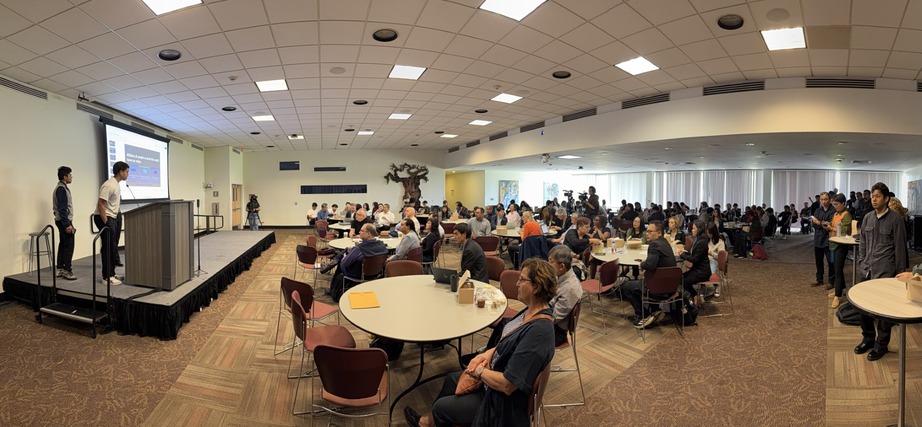
Building the Future of AI Leaders
The AI Fair & Hackathon is organized by the Mitchell C. Hill Center for Digital Innovation, a hub within the College of Business Administration focused on hands-on learning in emerging technologies. Indira Guzman, assistant professor of cybersecurity in computer information systems, serves as the center’s director and the event’s lead organizer.
“At Cal Poly Pomona, we intentionally challenge students with real-world problems and work closely with industry partners, whose support is essential to making these experiences meaningful. It is incredibly rewarding to see our students respond with such creativity and innovation. Through the Mitchell C. Hill Center for Digital Innovation, we are committed to creating these opportunities, and this work would not be possible without the dedication of our faculty, staff, and an outstanding organizing team, including our dean, associate dean Cheryl Wyrick, and Co-Chairs Yufan Lin (research & strategic development lead) and Ken Zheng (training lead).”
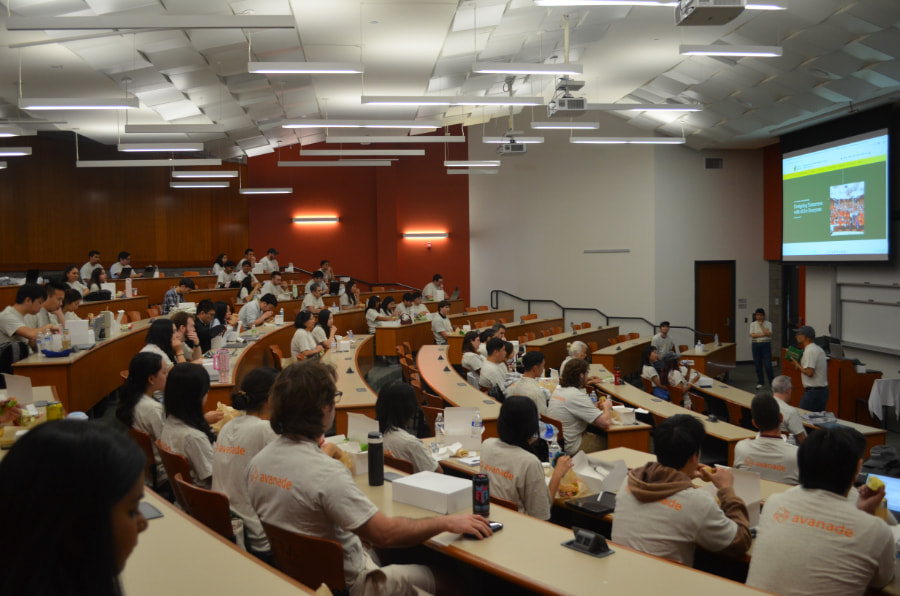
"We designed this hackathon to be both a learning experience and a research instrument," said Yufan Lin, assistant professor of marketing and Co-Chair for Research and Strategic Development. "The OpenAI Codex integration, the sponsor-RFP challenge format, and the matched pre/post AI literacy survey gave us a way to test how quickly students from any major can build with AI when the technical barrier is lowered — and the data we collected this year will inform future curriculum design and grant work."
"Our training goal was simple: no student should feel locked out of the event because of their coding background," said Ken Zhang, assistant professor and Co-Chair for training. "The multi-week vibe-coding workshops in February and March showed that students from every discipline, — business, design, engineering, and computer science — can build production-quality AI prototypes when they have the right scaffolding and mentorship."
A matched pre- and post-event survey of 73 participants showed a statistically significant increase in self-reported AI literacy over the course of the hackathon (p = .006), with the largest gains in students' AI knowledge and their intention to use AI for academic work. Item-level results pointed to growth in understanding fundamental AI principles, explaining AI use to others, and applying AI tools to domain-specific challenges. In open-ended feedback, the aspects students most often praised were team collaboration (37 percent), applying AI to realistic business problems (24 percent), and building a working prototype (23 percent).
By combining experiential learning with industry collaboration, the event challenges students to apply emerging technologies to meaningful societal and business needs.
Looking Ahead
As artificial intelligence continues to reshape industries, events like the AI Fair & Hackathon play a critical role in preparing students for the future.
“In my field, they’re trying to use more AI tools, so I wanted to focus on learning those tools and what they can provide, but also hearing different perspectives on AI, especially around responsibility and safety, I am starting to think more about how AI impacts other people outside of projects,” said student attendee Kelly Cornejo-Garcia (GIS ’26).
The event underscored the growing role of AI across disciplines, offering a glimpse into how the next generation of leaders will shape its application in business and society.
2026 AI in Business Hackathon Winners
Avanade Track — AI for Workforce Transformation and Wellbeing
- 1st place: CAREERCOPLT — Timothy Gaines, Priya Senthil, Joel Madrid, Nicole Hudson
- 2nd place: Hirepath — Mark Jordan, Salvador Figueroa, Dat Nguyen, Phil Elhai, Victor Lin, Nicolas Barzotti
- 3rd place: WELLBY — Candace Tanielian, Mira Bhakta, Michelle Villagomez, Jessica He
ISACA Orange County Track — Personal Cybersecurity Tools for Everyday Users
- 1st place: PHISHBUSTERS — Elizabeth Arellano, Emily Dominguez, Giselle Ng, Akari Narikawa
- 2nd place: NoPhishing — Alvin Wu, Minh Doan
- 2nd place: ScamShield — Frank Sanchez, Isabelle Beline, Sara Leon, Lizeth Rodriguez, Brian Nguyen, Natalie Contreras
Insights Association West Track — AI-Powered Career Event Smart Matching
- 1st place: Techxedo — Janice Lachan, Danny Tran, Justin Li, Chau Nguyen, Gabriel Cerda, Marlenne Salcido
- 2nd place: 4T2J — Peter Bahariance, Cheyenne Valencia, Michelle Lau, Alan Heng, Jonathan Kwong, Graciel Tan
- 3rd place: JShare — Hovig Nourian, Arin Boyadjian, Arakel Hagopian, Jessica Pinto, Ryan Scocca, Selene Liang
Neo Smart Living × aytm Track — AI-Driven Simulated Market Research
- 1st place: Claude Code Crew — Anderson Edmond, Andrew Pasten, Adam Blanco, Kennedy Hawkins, Elena Sorn, Max Chiu
- 2nd place: vibe coders — Kai Chan, Yaza Tun
Creative Track — UN SDG-Aligned Solutions
- 1st place: VOICE&HAND — Aung Myat, Daylan Robinson, Labibah Zaman
- 2nd place: LEBRONCOS — Leo Jiang, Kelsie Chung, Michael Ly, Nicholas Hoang, Brad Kim, Greg Dealba
- 3rd place: CaseBridge — Ryan Simpson, Aspen Knox, Parsa Ghasemi, Changwe Musonda
2026 AI Hackathon Finalist Judges
James Dierks — Senior leader at Avanade, the Microsoft-ecosystem digital and AI consultancy founded by Accenture and Microsoft, representing our Platinum Sponsor for the hackathon. (LinkedIn)
Rob Kaiser, Ph.D. — Chief Methodologist at PSB Insights (WPP), where he leads advanced analytics, AI, and choice modeling across clients including Microsoft, Coca-Cola, and Walmart, and represents the Insights Association as our market research sponsor. (LinkedIn)
Xiaoming (Ming) Cao — Founder/principal at Neo Smart Living, the smart home technology sponsor that brought the Tahoe Mini live-client challenge to our Simulated Market Research track. (LinkedIn)
Jason James, CISA, CDPSE, CCISO — Managing Partner at Regents & Park with 30+ years in IT governance, risk, and compliance across PCI, HIPAA, SOX, and ISO frameworks, and a longtime ISACA Orange County board leader since 2004. (LinkedIn)
Pradeep Simha — President of the ISACA Orange County Chapter and Cybersecurity Solution Architect Leader at Trellix, with deep expertise spanning incident response, digital forensics, SIEM, and cloud security across healthcare, banking, and telecom. (LinkedIn)
Dr. Cervantes (Chih-Chieh) Lee, EdD — Faculty Director of the Center for Entrepreneurship and Innovation at Cal Poly Pomona's College of Business Administration, bringing a multidisciplinary lens that combines a Restaurant EdD, an M.S. in Real Estate Development, and a Finance MBA. (LinkedIn)
Albert Fattal, MBA — AI and Blockchain technologist at the Federal Reserve Board of Governors (Division of Research & Statistics), federally certified across GSA AI tracks, and incoming President of the CPP CBA Alumni Chapter and Dean's Advisory Council member. (LinkedIn)
2026 AI Hackathon Executive Leadership and Organizing Committee
Sandeep Krishnamurthy, Singelyn Family Dean, College of Business Administration
Cheryl Wyrick, Associate Dean, College of Business Administration
Indira Guzman, Director, Mitchell Hill Center for Digital Innovation, Committee Chair
Yufan Lin, Faculty Fellow, Research and Strategic Development Lead
Ken Zhang, Faculty Fellow, Training and Mentorship Lead
Strategic Advisory Board
Margaret Doheny, Avanade
Jacqueline Mendoza Myers, Avanade
Robert Barrios, Alumnus, CIO, Gallo Wines
Luke Blackamore, Alumnus, Serial Entrepreneur
Robert Gamble, Alumnus, Serial Entrepreneur
Jeff Cox, CBA Director of Development
Alex Harwood, CPP Chief Technology Officer
Curtis Carpenter, CPP IT, Director of Advanced Computing
Roman J. Arreguin, Hill Family Fellow
Nicholas I. Rosen, Hill Family Fellow
Daniel Manson, CBA Emeritus Faculty
Heba Ramzy, CBA Board Advisor
Ruth Guthrie, CBA Emeritus Faculty
Kaitlin Yen, MISSA Student Club
Boi Hoanh Lam, Women in Tech Student Club
Abigail Jeffie, Women in Tech Student Club
Alexander Leang, FAST Club
Program Operations and Support Staff
Megan Dison, Administrative Support Coordinator
Saurabh Parate, Student Assistant, Webmaster
Peiching Tsai, Student Assistant, Judging Platform Design
1st Round Judges and Mentors (in alphabetical order)
|
Deepti Agrawal |
Zeynep Aytug |
Beverly Abadines Quon |
|
Luke Blackamore |
Guy Caseneuve |
Yun Chen |
|
Andrew Dibble |
Ashley Demings |
Camryn Friedman |
|
Varun Garde |
Danielle Garland |
Santos Galvez |
|
Scott Hachey |
Daniel Honigman |
Jason James |
|
Maurice Jenkins |
Girish Kannalli |
Niki Khokale |
|
Tony Koo |
Gabrielle Krystopa |
Justin Kurt |
|
Cervantes Lee |
Y. Olive Li |
Bing Liu |
|
Cindy Liu |
Zhongming Ma |
Daniel Macias |
|
Alex Modarresi |
Moheb Mousa |
Pramod Muninarasimhappa |
|
Carlos Navarrete |
Maria Ortiz |
Kerim Palma |
|
Nirav Patel |
Socrates Pena |
Laura A. Pohopien |
|
Heba Ramzy |
MIna Richards |
Eshwar Ravishankar |
|
Faheem Shaikh |
Shar Shahfari-Ibler |
Hui Shi |
|
Pradeep Simha |
Manish Shrivastav |
Shreepani Shukla |
|
Suresh Pairu Subramanyam |
Maya Stovall |
Chang Su |
|
Xuefeng Tian |
Huy Tran |
Jamie Villanueva |
|
Fan Wang |
Yongzhi Wang |
Weiwen Yu |
|
Zining Yang |
Yanlei Zhang |
Chi Zhang |


