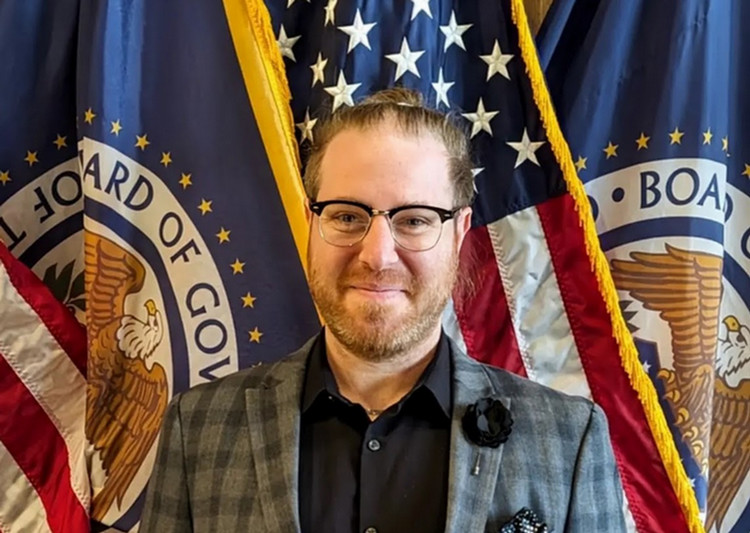
Albert Fattal uses brains, blockchain, and Bronco pride to shape smarter systems for the future of business
Albert Fattal (STS ’19, MBA ’22), is a Bronco whose professional achievements reflect both innovation and a deep commitment to the Cal Poly Pomona College of Business Administration and the Singelyn Graduate School of Business community. A distinguished technologist and strategic leader at the Federal Reserve Board of Governors, Fattal brings real-world insights in artificial intelligence and blockchain to his roles supporting Broncos and business education.
What were some of the biggest lessons you learned during your MBA studies after completing your Science, Technology, and Society undergraduate degree and Computer Information Systems minor?
The CIS program gave me the technical ‘how,’ by giving me the hands-on proficiency to build, code and secure systems, but the MBA gave me the strategic ‘why.’ The biggest lesson I learned is that technology cannot exist in a vacuum; it must drive business value. The MBA bridged the gap between the server room and the boardroom, teaching me to translate complex architectures—like AI and blockchain—into scalable, standardized strategies that solve real economic problems.
What inspired your journey into artificial intelligence and blockchain technologies? What developments in those two areas excite you most?
I am driven by the intersection of science, technology, and society. We are shifting toward Industry 4.0 in an era of ‘trusted intelligence.’ What excites me most is the convergence of these fields, using the generative and agentic power of AI to boost productivity, while leveraging the immutable nature of blockchain to ensure security and trust. Building systems that are both intelligent and cryptographically verifiable is the next industrial revolution, as I view it.
You have valuable insights regarding the role of big data. How does data accessibility impact business, and what is the future of analytics?
Data is the currency of the modern world, but without storytelling, it has no liquidity. My opinion on scale is centered on ‘future-proofing,’ which encompasses building modular, cloud-native architectures that can handle tomorrow’s growth, today. I believe the future of analytics lies in the symbiosis of two technologies that will power the exponential growth in data of tomorrow. AI can serve as the engine to predict trends from massive datasets, while blockchain can serve as the ‘rails’ to ensure that data remains authentic and tamper-proof.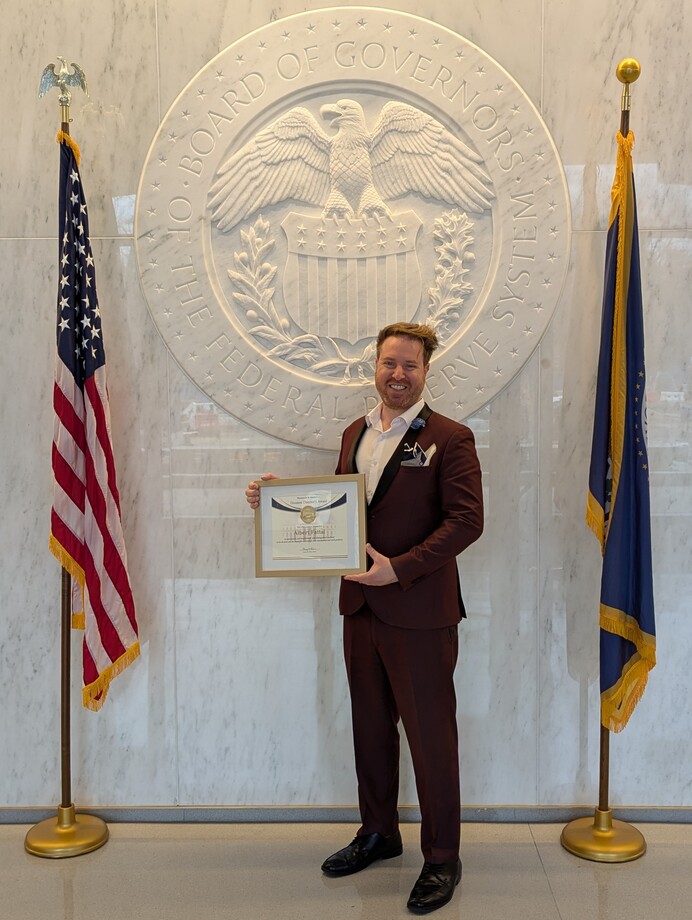
Tell us about your service at the Federal Reserve Board of Governors. How did you become a member of the staff on the Board? What has your experience there taught you?
Serving at the Federal Reserve Board is the pinnacle of my professional career and a deeply humbling responsibility. My journey began as a graduate intern in the Reserve Bank Operations & Payment Systems division. Thanks to the ‘learn by doing’ ethic instilled at CPP, I was able to demonstrate value quickly, eventually transitioning to a data and technology analyst at the Program Direction Office, and as an artificial intelligence application developer in the esteemed board’s AI program. My experience at the Fed has taught me the gravity of ‘public service,’ and that the public sector offers challenges you can’t find anywhere else.
How has joining clubs and organizations, both as a student and a professional, benefited you most?
Academic excellence gets you the interview, but leadership experience gets you the job. My time as student with the Finance Society, the Student Managed Investment Fund and Students With an Interest in the Future of Technology was my laboratory for leadership. These experiences taught me how to foster synergy across diverse teams, how to rally peers toward a common vision, and navigate complex challenges —soft skills that are essential when collaborating on cross-functional projects.
In volunteering as both vice president of the CBA Alumni Chapter and the Dean’s Advisory Council, what inspires you to serve your alma mater?
As a first-generation, nontraditional student, Cal Poly Pomona didn’t just give me a degree; it gave me a future. My service is born out of a deep desire to pay that forward. I am inspired by the university’s unique polytechnic philosophy, which produces graduates who are ‘day one ready.’ Serving as a volunteer on the Dean’s Advisory Council and the Alumni Chapter has given me a behind-the-scenes perspective on how tirelessly the faculty, administration and volunteers work to elevate the student experience. Seeing the caliber of incoming students and the dedication of the faculty reinforces my motivation to ensure the value of a CPP degree continues to appreciate. I want to help ensure the next generation is prepared to lead in the Fourth Industrial Revolution.
What are three pieces of advice 2026 Albert would give to 2019 Albert (your undergrad completion) and 2022 Albert (MBA completion)?
- Embrace resilience: The path to achievement is rarely a straight line. View obstacles not as roadblocks, but as the friction necessary to sharpen your skills.
- Network with purpose: Your net worth is your network. Build genuine, strategic connections with your professors and peers, as they are your future colleagues and partners.
- Stay agile: The technology landscape changes daily. Commit to lifelong learning. Master the fundamentals but always keep your eyes on the horizon of what is coming next.
What is your favorite memory or experience from your time here at Cal Poly Pomona?
Standing on the stage at the Tech Symposium, sharing my research on AI and blockchain, stands out. However, the collective memory that I cherish most is the camaraderie found in the late-night study sessions in the library and the tireless ‘hands-on’ projects with my MBA cohort. There is a specific energy at Cal Poly Pomona, a grit and determination shared by students and faculty alike, that makes you feel like you are part of something larger than yourself. Being able to return now, not just as an alumnus but as a volunteer mentor and volunteering for ‘Professor for a Day,’ brings that experience full circle.
Cal Poly Pomona is a polytechnic university with a “become by doing” philosophy. How has that philosophy specifically helped you?
In my career path thus far, I have learned that, theory isn’t enough, you need practical application. The polytechnic approach meant I had already ‘touched the hardware,’ written the code and articulated the business negotiation before I entered the workforce. That hands-on confidence allowed me to navigate complex systems and AI processes with a level of comfort that purely theoretical study can’t provide.


