Student Safety Training

Student Training
Hazard Classification Tiers
Hazard exposure is quantified by EH&S in two primary tiers which is used to quantify risk and determine when specialized safety training may be applicable. The following is a general overview of the different classification tiers used to determine the applicability of relevant student safety training.
- Tier 1- Activities involving the use of hazardous materials, chemicals, and/or equipment. This category includes all University learning operations both within and outside a classroom or laboratory, including those that generate or accumulate hazardous waste streams.
- Tier 2- Activities that occur only within a classroom environment and does not involve the use of hazardous materials, chemicals, waste and/or equipment that may result in a serious injury as defined by 8 CCR 3202.
Student Training Plans
he following topics should be assigned to any students working in lab environments involving the use of biological materials or medical waste.
Step 1: Students will need to log-in to the SumTotal training portal.
Step 2: Once logged in, students can use the links below to the specific courses identified below.
- Bloodborne Pathogen Awareness (49 mins)
- Biosafety Hazardous Waste Handling and Disposal (34 mins)
- Biosafety Level 1 (60 mins)
- Biosafety Cabinets (NA)
- CSU - Laboratory Safety Fundamentals (150 mins)
Recommended Departments:
- Biochemistry
- Biological Sciences
- Physics
Please visit the Risk Management "Driving on University Business" website for form information.
The following topics should be assigned to any students who will be working at elevations in excess of 4 feet, on ladders, elevated work platforms, scaffolding or man lifts. Please note that driving requirements may be necessary for students operating lift equipment.
Step 1: Students will need to log-in to the CPP Learning portal.
Step 2: Once logged in, students can use the links below to the specific courses identified below.
- Fall Protection - Cal/OSHA (35 minutes)
- Slips, Trips, and Falls - Cal/OSHA (18 minutes)
- Scaffolding and Ladder Safety (41 minutes)
- Scissor Lifts (30 minutes)
Recommended Departments:
Facilities Management
Engineering
Rose Float
The following topics should be assigned to any students working in lab environments involving the use of chemicals and/or hazardous materials.
Step 1: Students will need to log-in to the SumTotal training portal.
Step 2: Once logged in, students can use the links below to the specific courses identified below.
- CSU - Laboratory Safety Fundamentals (150 mins)
- Hazardous Waste Generator (RCRA) (30 mins)
- Compressed Gas Safety (30 mins)
- Safety Data Sheets (60 mins)
Recommended Departments:
- Chemistry
- Biological Sciences
- Geological Sciences
- Physics
- Chemical Materials Engineering
- Civil Engineering (Water Lab)
- Human Food and Nutrition Lab
- Animal Veterinary Sciences
- Animal Health Sciences
- Plant and Soil Sciences
- Art Department
- Landscape Architecture
The following topics should be assigned to any students who will be working with lasers. Please note that radiation safety training may also be applicable depending on the class of laser.
Step 1: Students will need to log-in to the SumTotal training portal.
Step 2: Once logged in, students can use the links below to the specific courses identified below.
Supplemental training unique to radiation generating equipment such as X-ray diffraction, bone density and similar equipment.
The following topics should be assigned to any students working in lab environments involving the use of radiation generating equipment, such as X-ray machines, X-ray diffraction, crystallography devices or soil density gauges.
Step 1: Students will need to log-in to the SumTotal training portal.
Step 2: Once logged in, students can use the links below to the specific courses identified below.
- Radiation Safety (60 mins)
- Non-Ionizing Radiation Safety (NA)
- CSU - Laboratory Safety Fundamentals (150 mins)
Recommended Departments:
- Chemistry
- Biochemistry
- Biological Sciences
- Physics
- Kinesiology
- Engineering
- Landscape Architecture
- Agriculture
- Animal Veterinary Sciences
The following topics should be assigned to any students working in shop environments involving the use of power tools, hand tools, welding or chemicals.
Step 1: Students will need to log-in to the SumTotal training portal.
Step 2: Once logged in, students can use the links below to the specific courses identified below.
- CSU - Shop Safety (15 mins)
- Hazardous Waste Generator (RCRA) (30 mins)
- Machine Guarding (30 mins)
- Compressed Gas Safety (30 mins)
- Welding, Cutting, and Brazing (29 mins)
- Hand and Power Tool Safety (18 mins)
- Safety Data Sheets (60 mins)
- Respiratory Protection – Cal/OSHA (48 mins)
- Student Heat Illness Prevention (26 mins)
Recommended Departments:
- Rose Float
- Engineering
- Architecture
- Physics
- Environmental Design
- Wood/Model Shops
FAQ
Please email ehs@cpp.edu for any additional questions
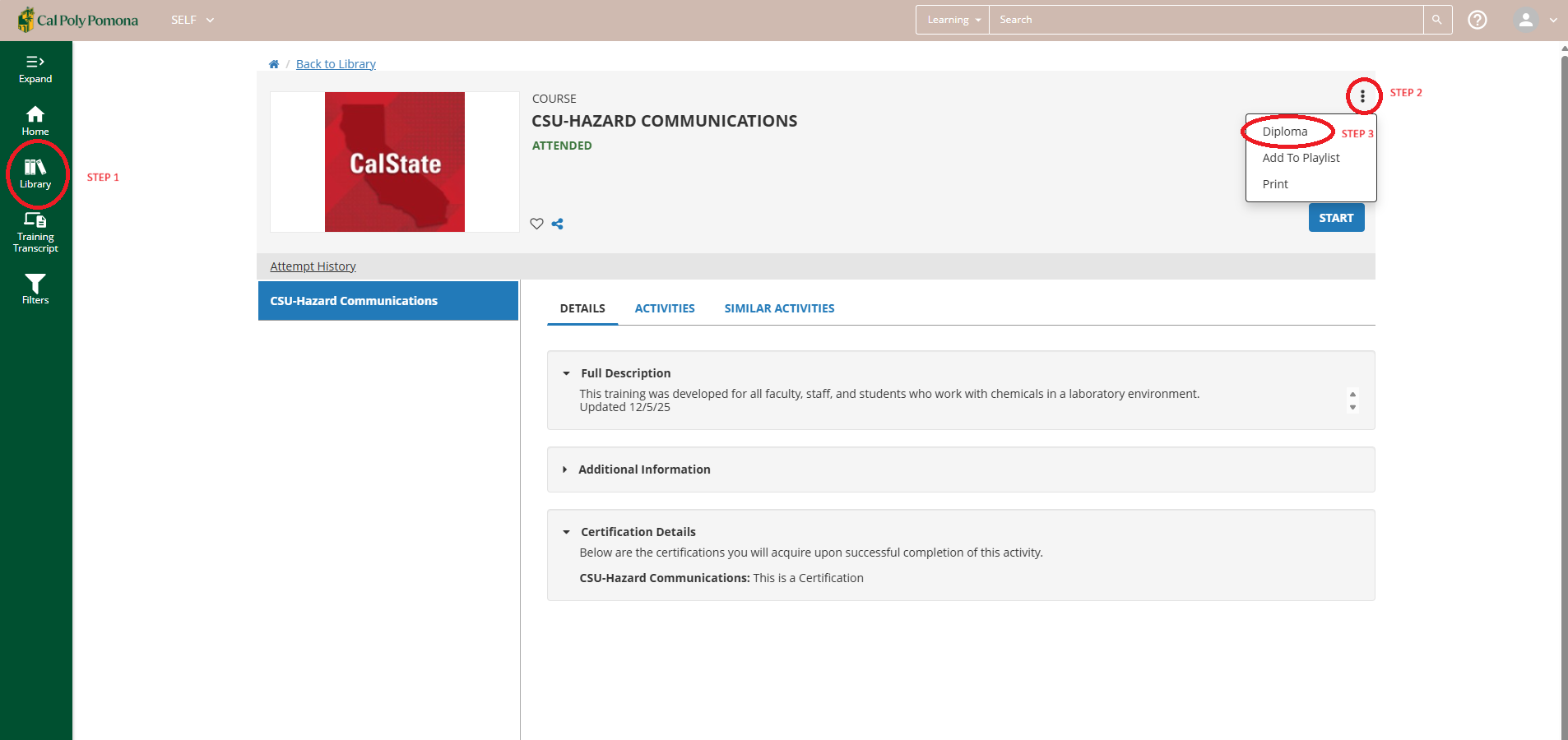
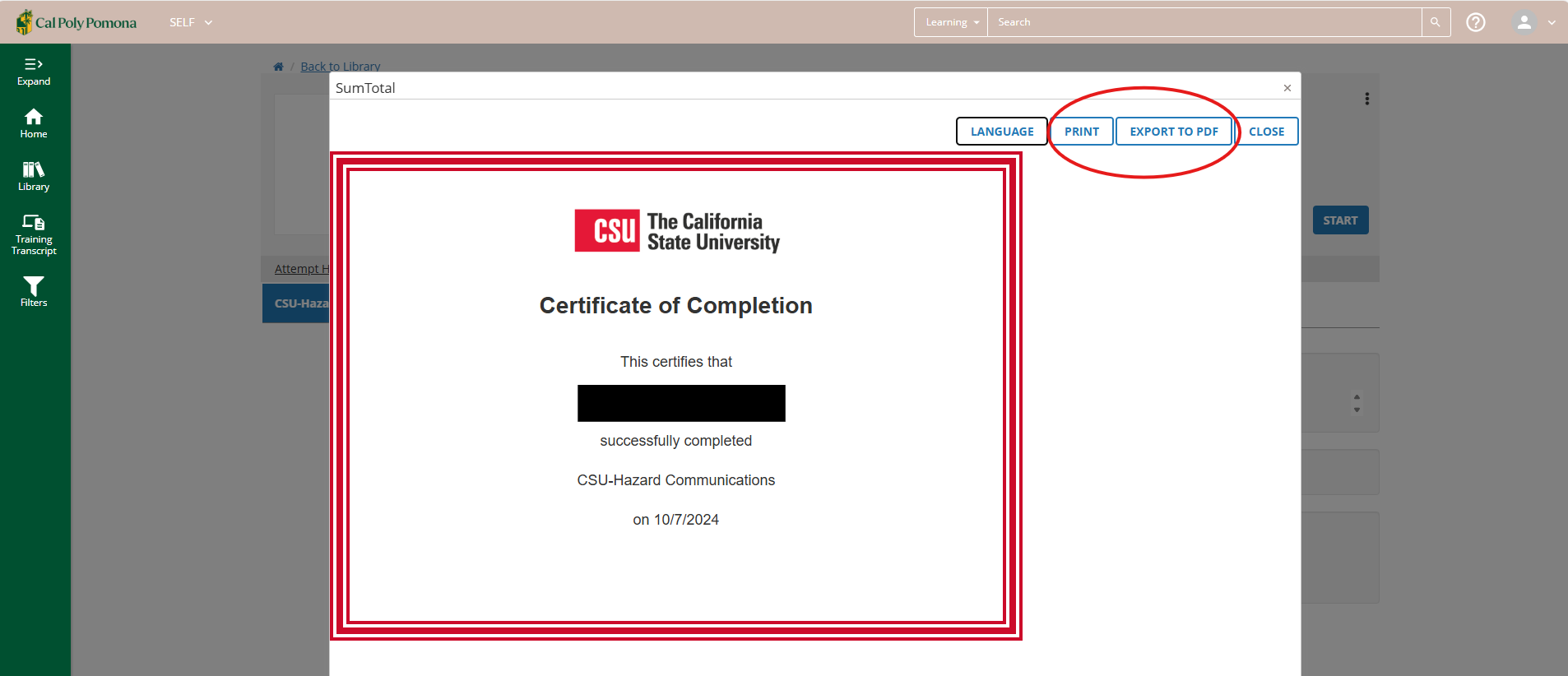
In your training Library click the specific training you've completed >> After opening a screen should pop up saying "ATTENDED" and on the far right, click on the three dots that read "more actions" when hovering over it.>> Click Diploma >> Print