2025 Paul Helmle Fellowship: Teddy Cruz and Fonna Forman
April 17, 2025
Press the tab key to view the content. Use the down arrow key to move to the next tab and up arrow key to move to the previous.
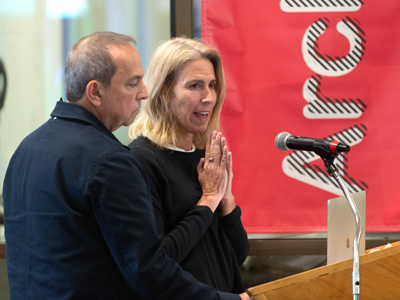 The Cal Poly Pomona Department of Architecture presents the 2026 Paul Helmle Fellows Teddy Cruz and Fonna Forman from Estudio Teddy Cruz + Fonna Forman.
Fonna Forman and Teddy Cruz are internationally renowned and respected researchers in their separate fields of expertise, Political Science and Architecture, respectively. Fonna Forman is a professor of Political Science and the Founding Director of the Center on Global Justice at the University of California, San Diego. Teddy Cruz is a professor of Public Culture and Spatial Practice in the Department of Visual Arts, also at University of California, San Diego.
In their research-based practice, under the Center on Global Justice at the University of California, San Diego, the two bring a multivalent criticality to the issues they explore within the modern urban fabric that touches on immigration and refugee communities, the right to social belonging, and an awareness of ecological responsibility. By pairing local community needs on both sides of the political equator, San Diego and Tijuana, with student involvement, Fonna and Teddy have developed and enacted innumerable projects that catalyze change in those communities.
Their books, Spatializing Justice; Building Blocks and Socializing Architecture; Top-Down Bottom-Up, published in 2022, provide a comprehensive overview of their work, showcasing their unique practice of weaving together architecture, art, public culture, and political theory
The Helmle Fellowship Workshop 2025 opened with a public lecture that introduced key concepts that Teddy and Fonna have distilled from their practice. Following the lecture, the three-day intensive workshop began with a conversation between the Fellows and a group of interdisciplinary students from diverse areas of expertise within the College of Environmental Design. The participants from various disciplines worked collaboratively on research in a way that the resulting analysis was reflected in the exploration of complex design issues. The projects collected here represent the seeds of thinking for future inquiry.
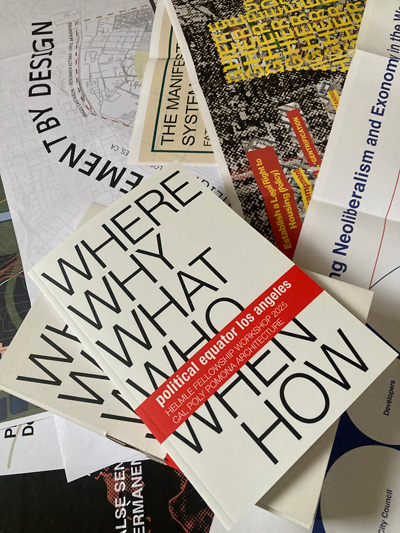
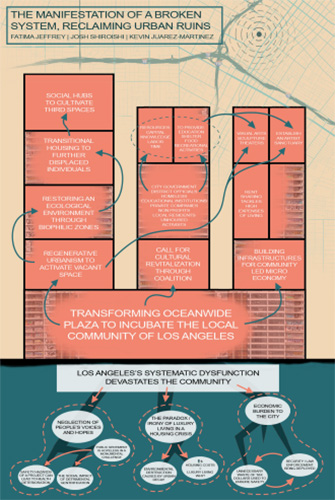
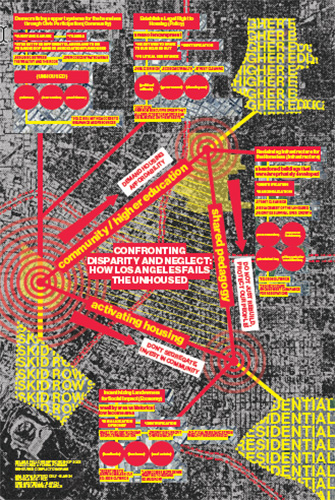
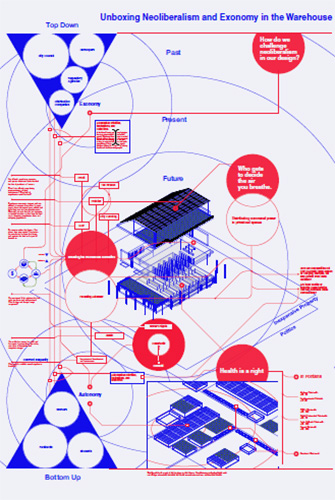
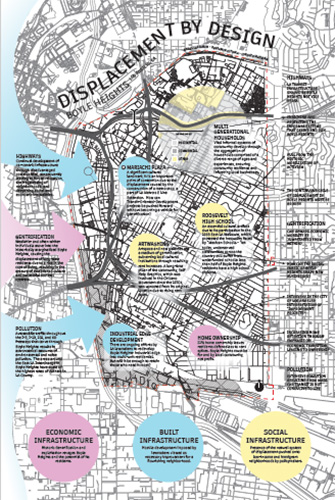
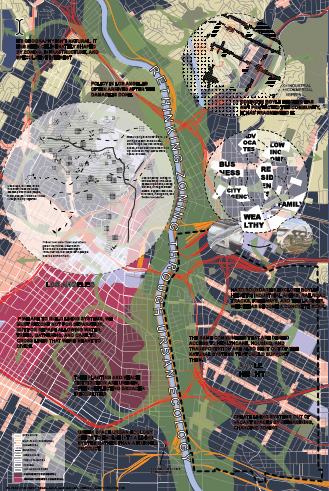
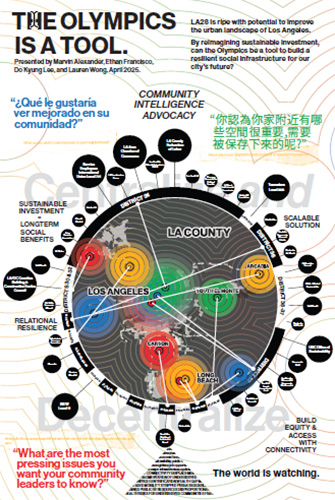
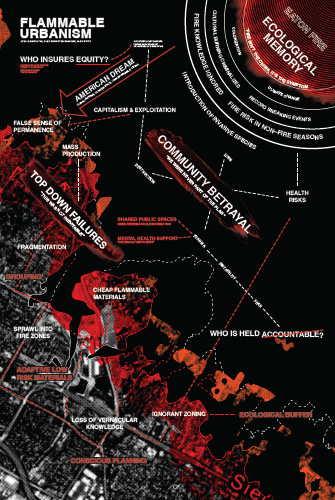
The workshop conducted by Teddy Cruz and Fonna Forman centers their research-based methodology of applying conflict diagrams to current social, political and cultural issues to identify opportunities or new ways of thinking. In this workshop titled “The Political Equator: Los Angeles Workshop” a group of interdisciplinary students from the Department of Environmental Design investigated into the complexity of current issues and created a series of conflict diagrams.
The issues examined during the course of this workshop are profiled as: Flammable Urbanism, Displacement by Design: Boyle Heights, Rethinking Zoning through Urban Ecology, Manifestation of a Broken System; Reclaiming Urban Ruins, Confronting Disparity and Neglect: How Los Angeles Fails the Unhoused, Unboxing Neoliberalism and Exonomy in the Warehouse, The Olympics is a Tool.
(PDF)
(PDF)
(PDF)
(PDF)
(PDF)
(PDF)
(PDF)
Professor Emeritus Paul Helmle (April 27, 1936 - Dec. 3, 2015) taught design studios in the Architecture Department for many years. Hundreds of students had their work looked at, questioned, discussed, encouraged and made better by Paul. He helped them to understand what they were doing, or trying to do, and laid the foundations upon which they would build careers. His constant probing for the best his students had to offer helped them in ways that were not restricted to architecture.
Paul’s own education was firmly founded at the University of Illinois in the 1950s and polished by the graduate school at Princeton. He worked in a small, unsung office in Illinois while he was an undergraduate, and a large, storied one in Connecticut after graduate school. He was hired out of Princeton by Eero Sarrinen, whose office was at the time the most desirable in the country for young, talented graduates. He left the Saarinen, later Roche and Dinkeloo, office to teach at Yale, then started his own practice, and ultimately accepted the offer of a position teaching at Cal Poly Pomona.
Paul’s work as an architect was individual and distinctive, combining the modernist rigor and historical exposure of his education with his own unique aesthetic. His outgoing personality and openness to other people’s viewpoints gave his work and his relationship with his clients deep personal dimensions. These same qualities helped him to sail unscathed through sometimes difficult waters as a member and chair of the architecture faculty. And they inspired generations of students to value his guidance and to enjoy his ebullient and charismatic personality. He was admired and loved by those privileged to work with and to study with him, and it is most fitting that his name should live on in this generous gift from one of his grateful and affectionate students. — Nicholas Pyle