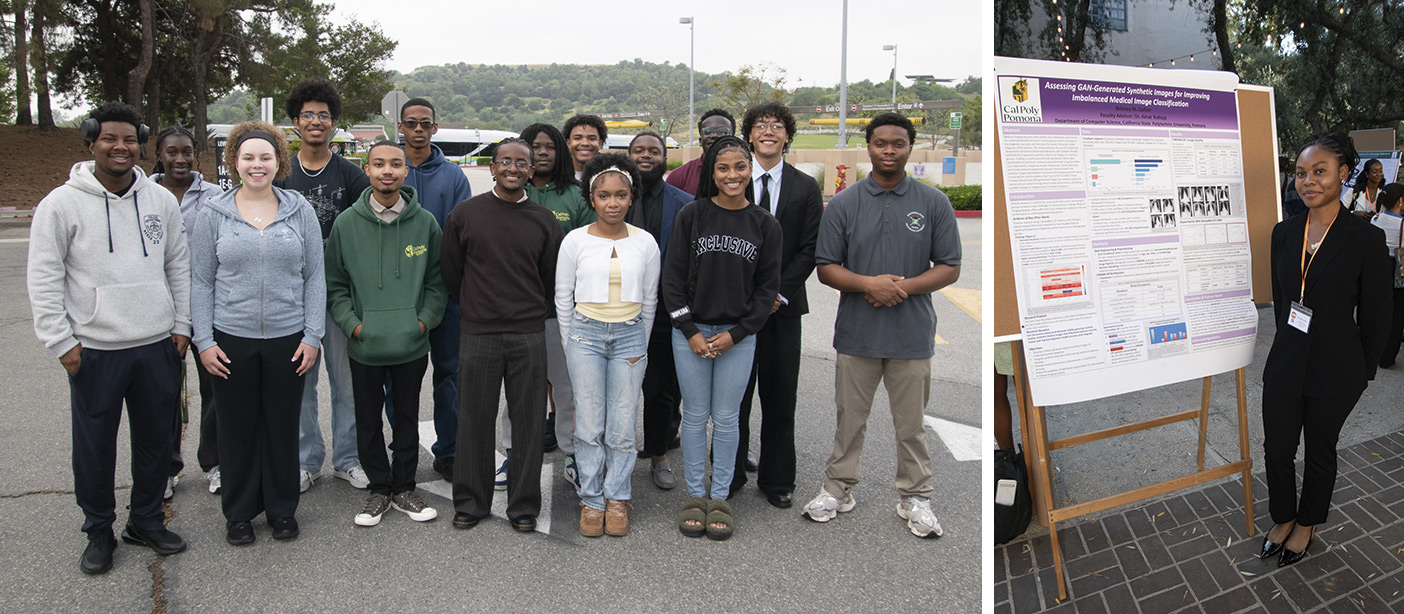
BASES, which began in 2021, is a first-year experience program designed to cultivate a supportive community while providing access to high-impact experiences, mentors, networking opportunities and specially designed classes aimed at supporting student success.
The program has helped increase retention and GPA among BASES scholars and is open to first-time freshman who have been admitted to Cal Poly Pomona. It was started in the College of Science and currently 45% of participants are STEM majors but it’s open to all majors.
One of the benefits of participating in BASES is attending events. In April about 20 BASES students attended the Conference for Emerging Black Academics in STEM (CEBAS) at Caltech. Students had their choice of sessions grouped around themes such as Genes, Development, and Biological Adaptation, Materials, Energy, and the Physical Universe, Computation, Cognition, and Complex Systems, and Physical Systems, Dynamics, and Discovery.
The conference also included a poster session and computer science student Britney M. Collier (pictured above, right) presented her research, Assessing GAN-Generated Synthetic Images for Improving Imbalanced Medical Image Classification.
“My research focuses on addressing class imbalance in medical imaging datasets. In many medical datasets, certain disease categories and racial groups have significantly fewer samples than others, which can negatively affect the performance of machine learning models. To address this challenge, I use Generative Adversarial Networks (GANs) to generate synthetic medical images that augment underrepresented classes. I then evaluate whether these synthetic images improve the performance, robustness, and fairness of classification models compared to training on the original dataset alone,” Collier said.
“Discussing my research with other scientists helped me think more critically about my methodology, evaluation metrics, and potential real-world applications. The experience also strengthened my communication skills and reinforced my interest in pursuing research that leverages AI to improve healthcare outcomes and address challenges in medical data analysis.”
Attending conferences to share their research and learn about other’s research are important experiences for students pursuing careers in STEM. Mechanical engineering student Ethan Garcia-Alogo said, “I most liked the panel that talked about getting into academia. It made me think about the possibilities of becoming a researcher in my field, plus it was followed by a presentation on photovoltaics in space which was a topic close to my major. I’ve always wanted to work on a Mars rover.”
“The panel about NETosis was the most meaningful to me,” Harper Easly said. “I’m an environmental biology major and I enjoyed just how complex the problem is that Hawa Racine Thiam’s Stanford lab is trying to solve. It inspired me and exposed me to the field of biophysics.”
Ka’nya M. Brasley is majoring in mechanical engineering and wants to work in the energy field. “I gained a much deeper understanding of research and I now understand the extensive process behind it. One presentation that stood out was focused on environmental change and solar energy and included the innovative idea of placing solar panels in space to collect clean energy and transmit it back to earth.” Brasley has a long-term goal of creating programs that encourage students to pursue engineering.
In addition to attending events like CEBAS, BASES Scholars enroll in a first-year experience course and are exposed to research experiences. They receive peer mentoring and tutoring support and have opportunities to apply for scholarships.
There are a variety of course offerings as part of the first-year experience. BASES Director, Zakkoyya Lewis-Trammell shared that one of the courses is "Inequities in Science," which is focused on inequities in clinical research where students will explore culturally responsive research design, ethics of human-subject research, and cultural representation is research while also exploring campus undergraduate research opportunities.
The benefits aren’t just about retention and GPA. “BASES scholars are more involved on campus. They are represented in student clubs and make big impacts on student life and campus culture,” Lewis-Trammell said.
The BASES program needs your support to continue its mission. To find out how you can support BASES’ important work in providing these opportunities to STEM majors, contact Bill Burrows: bdburrows@cpp.edu, (909) 869-4160, or click on the link: SUPPORT BASES.


